iHashBand2.0

Search documents
从华为连续入选Gartner 5G RAN领导者象限,看产业未来发展趋势
Sou Hu Cai Jing· 2025-09-27 03:58
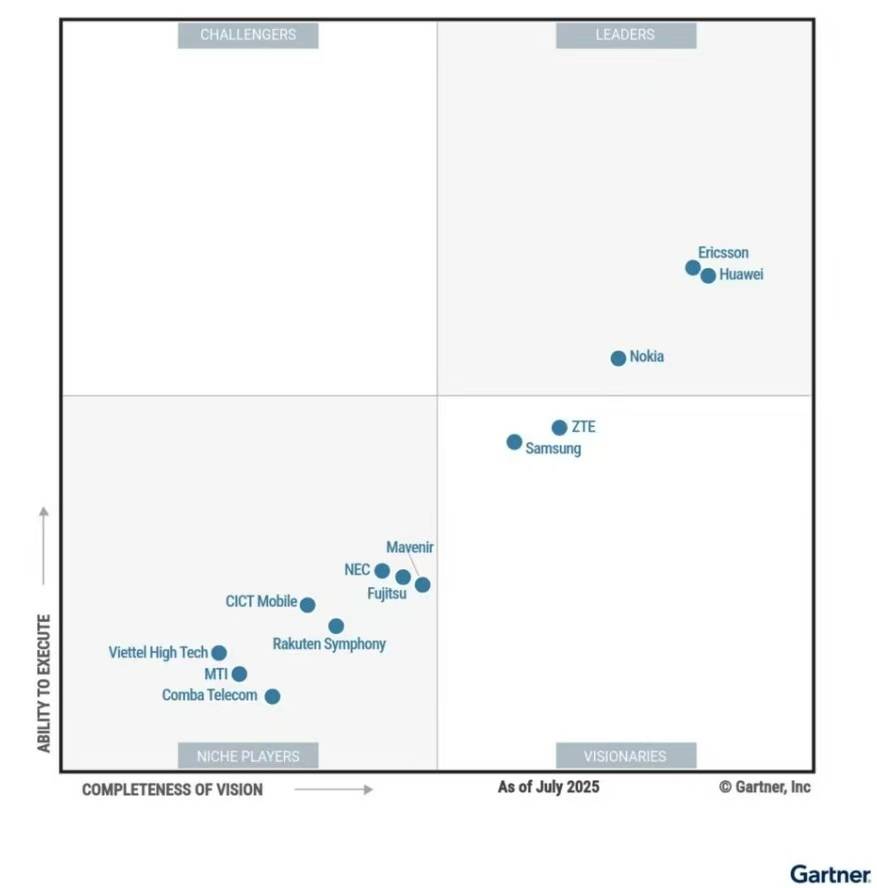
Core Viewpoint - The arrival of the mobile AI era is accelerating the global 5G RAN market's transition from "scale deployment" to "in-depth development" and "value monetization," driven by the continuous evolution of 5G and its deep integration with intelligent technologies [1][4]. Industry Trends - As of early 2025, over 340 5G networks compliant with 3GPP standards are expected to be operational in 127 countries, with 65 mobile operators deploying or launching standalone (SA) 5G networks [5]. - The global RAN market (excluding service business) is projected to maintain steady growth over the next five years, with cumulative revenue expected to reach $160 billion [5]. - The 5G RAN market is showing two major trends: ongoing evolution and high concentration, with operators needing more agile, flexible, and reliable networks to realize the true value of 5G [6]. Market Concentration - The market is increasingly concentrated among a few leading vendors, with the top four suppliers (Ericsson, Huawei, Nokia, and ZTE) expected to hold approximately 91% of the mobile operator network infrastructure market share by 2024 [7]. - The top five suppliers (Huawei, Ericsson, Nokia, ZTE, and Samsung) account for 94% of the RAN market, with Huawei holding a significant 37% share [7]. - Despite the rise of multi-vendor strategies, the market remains dominated by established players, with traditional RAN solutions expected to maintain an 80-85% market share by 2028 [7]. Huawei's Leadership - Huawei has been consistently recognized as a "leader" in the 5G RAN market by Gartner for four consecutive years, demonstrating its strong performance in both technology innovation and market execution [8][9]. - In the latest Gartner report, Huawei is noted for its comprehensive and robust cellular network product portfolio, which includes macro stations, small cells, and professional services, allowing it to respond quickly to customer needs [9]. - Despite geopolitical challenges, Huawei maintains a strong market presence in regions such as China, Asia-Pacific, the Middle East, and Europe, holding a 25% share in the global RAN market excluding China, reflecting its resilience [9]. AI and 5G Integration - Huawei promotes the integration of 5G-A and AI, emphasizing the importance of intelligence in the next phase of 5G development [10]. - The company has introduced the development philosophy of "Networks for AI" and "AI for Networks," embedding AI deeply into network management processes [10][11]. - Huawei's AI-driven 5.5G RAN product offerings include innovative features such as Massive MIMO iBeam algorithms and distributed Massive MIMO software capabilities [10][11]. Conclusion - Huawei's continued recognition as a leader in the Gartner Magic Quadrant reflects its commitment to innovation and its ability to address industry challenges [13]. - As the 5G landscape evolves, operators are seeking partners that can facilitate their digital and intelligent transformation, positioning Huawei to redefine the role of suppliers in the industry [13].