
iOS 27系统

Search documents
放弃面部识别?苹果折叠屏将成iPhone最重大改款机型
新华网财经· 2026-03-30 09:28
Core Viewpoint - The upcoming foldable iPhone is expected to be the most significant redesign since the iPhone X in 2017, featuring a new design and advanced technology aimed at enhancing user experience and functionality [1][2]. Group 1: Product Features and Design - The foldable iPhone will adopt a horizontal book-style design similar to Samsung's Galaxy Z Fold series, with an internal display of approximately 7.7 inches and an external display of about 5.3 inches [1]. - iOS 27 will be optimized for the foldable form factor, supporting multitasking features like split-screen and floating windows [1]. - The device is expected to have a starting price exceeding $1999, making it the most expensive iPhone to date [1]. Group 2: Technology and Specifications - Apple has invested heavily in R&D for this model, integrating teams from Apple Vision Pro and iPhone hardware to address common industry challenges such as crease durability and hinge reliability, aiming for a "visual crease-free" experience and over 300,000 folds lifespan [2]. - The foldable iPhone will replace Face ID with a side-integrated Touch ID fingerprint sensor to save internal space and enhance unlocking stability [4]. - It will feature a 2nm A20 Pro chip from TSMC, a second-generation self-developed C2 modem, and will eliminate the physical SIM card slot in favor of eSIM [4]. - The device will include two rear cameras and a 5500mAh dual-cell battery to support the larger screen's power demands [4]. Group 3: Supply Chain and Production - Foxconn has been selected as the exclusive assembler for the foldable iPhone, while Samsung Display will supply custom LTPO OLED flexible panels [5]. - Initial orders from Apple to the supply chain are between 7 to 8 million units, with projected shipments of 3 to 5 million units in 2026 due to high production complexity [5]. Group 4: Market Impact and Projections - The global foldable smartphone market is expected to grow significantly, with shipments projected to reach approximately 28 million units by 2025 and 34 million units by 2026, with Samsung holding about 68% market share [6]. - Apple's entry into the foldable smartphone market is anticipated to be a pivotal moment, potentially capturing 28% of the global market share by 2026 and challenging Samsung's dominance [6].



新 iPhone 再次确认发布,价格太疯狂了
Xin Lang Cai Jing· 2025-07-31 04:23
Core Viewpoint - The focus is shifting towards Apple's upcoming iPhone 18 series, which will include the company's first foldable device expected to launch in September 2026 at a starting price of $1999 [1][2][5]. Group 1: Product Launch and Pricing - Apple's first foldable iPhone is expected to be released in September 2026, coinciding with the iPhone 18 series launch [2]. - The anticipated starting price for the foldable iPhone is $1999, which is close to previous analyst predictions of around $2000 [5]. Group 2: Market Impact and Sales Projections - The introduction of the foldable iPhone is predicted to stimulate the entire foldable smartphone market, with expected sales of nearly 10 million units in 2027 and approximately 45 million units by 2028 [5]. Group 3: Design and Specifications - The foldable iPhone will feature a "large fold" design similar to Samsung's Galaxy Z Fold series, with a 7.8-inch inner display and a 5.5-inch outer display [6]. - It will include a dual-camera setup (48MP main camera + ultra-wide) and will replace Face ID with a side-mounted Touch ID [7]. - The device aims to eliminate screen creases and enhance system interaction, utilizing OLED panels supplied exclusively by Samsung and a durable hinge mechanism [9]. Group 4: Software and Features - The foldable iPhone will run on iOS 27, expected to support multitasking features similar to iPad capabilities, including floating windows and split-screen operations [11].
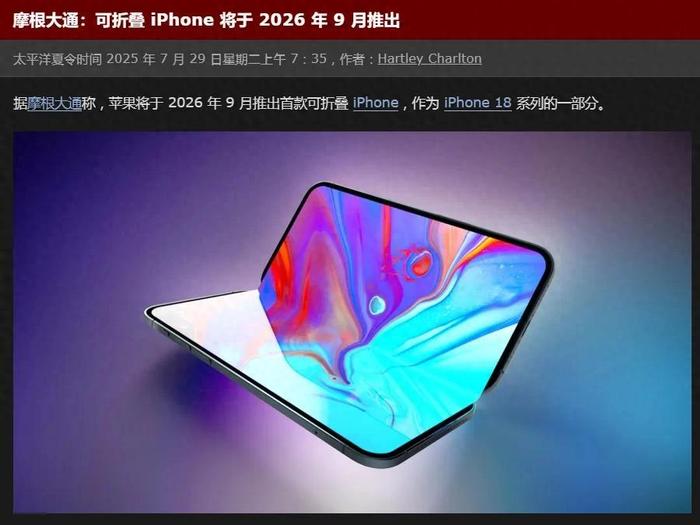
苹果折叠屏iPhone呼之欲出?华为高端市场遭遇劲敌
Xi Niu Cai Jing· 2025-07-28 07:47
Core Insights - Apple's first foldable iPhone is expected to launch in the second half of 2026, featuring a 5.5-inch outer screen and a 7.8-inch inner screen, which may reshape the foldable smartphone market [2] - Global foldable smartphone shipments are projected to reach 19.8 million units in 2025, with Samsung holding a leading market share of 35.4%, while Huawei follows closely with 34.3% [2] - Apple's entry into the foldable market could pose unprecedented challenges for Huawei, particularly in high-end user competition and technology standard setting [2] Group 1 - Apple's foldable iPhone will run on iOS 27, optimized for split-screen interaction and multi-tasking, allowing seamless integration with Mac and iPad devices [2] - The foldable iPhone's production capacity in its first year is expected to reach around 10 million units, with a price range of 14,000 to 20,000 yuan, targeting high-end business users [3] - Huawei's market share in China's 10,000 yuan smartphone segment is currently 72%, but Apple's entry may disrupt this advantage [3] Group 2 - The introduction of Apple's foldable iPhone may lead to a risk of high-end user attrition for Huawei, as Apple's ecosystem could attract users seeking comprehensive integration [3] - Despite Huawei's strengths in distributed capabilities with its HarmonyOS, Apple's iOS has a more mature developer ecosystem, which may result in higher application adaptation efficiency [4] - Huawei's market share in the European foldable smartphone market has increased from 12% in 2024 to 18%, but Apple's global brand influence could limit its expansion [4]
首款折叠iPhone明年见!没有任何创新,这就是苹果的现状
Hua Er Jie Jian Wen· 2025-07-21 00:38
Core Insights - Apple is entering the foldable smartphone market as a "follower" rather than a leader, with its first foldable iPhone expected to launch by the end of 2026, following a market established by Samsung for seven years [1][2] - Unlike its previous groundbreaking products, Apple's entry into this market will not rely on revolutionary technology or design, but rather on a device similar to Samsung's Galaxy Z Fold series, with the OLED foldable screen supplied by Samsung Display [1][2] Group 1: Product Strategy - Apple's approach to the foldable smartphone will not introduce revolutionary interaction interfaces or hardware, but will aim to provide a similar experience to existing products, marking a rare follower position for a company known for leading trends [3] - The engineering team is focused on addressing long-standing weaknesses in foldable devices, such as minimizing screen creases and improving hinge durability and feel [3] - The upcoming iOS 27 will prioritize custom software features for the new device form factor to ensure a smooth user experience [3] Group 2: Market Positioning - Apple's foldable strategy is closely linked to its plans for the Chinese market, where local brands like Xiaomi and Huawei have already launched multiple foldable phones, with a preference for the "book-style" design [4] - The starting price of $2,000 aligns with the purchasing power of high-end Chinese consumers and may be a key factor in boosting sales in China [4] - Despite a lack of hardware innovation, Apple is expected to leverage its brand strength to tap into the market, as millions of iPhone users are reportedly waiting for a foldable product without wanting to switch to Android [4]