
CZBANK(02016)

Search documents
金价大涨,多家银行宣布:上调!
Sou Hu Cai Jing· 2025-11-11 13:18
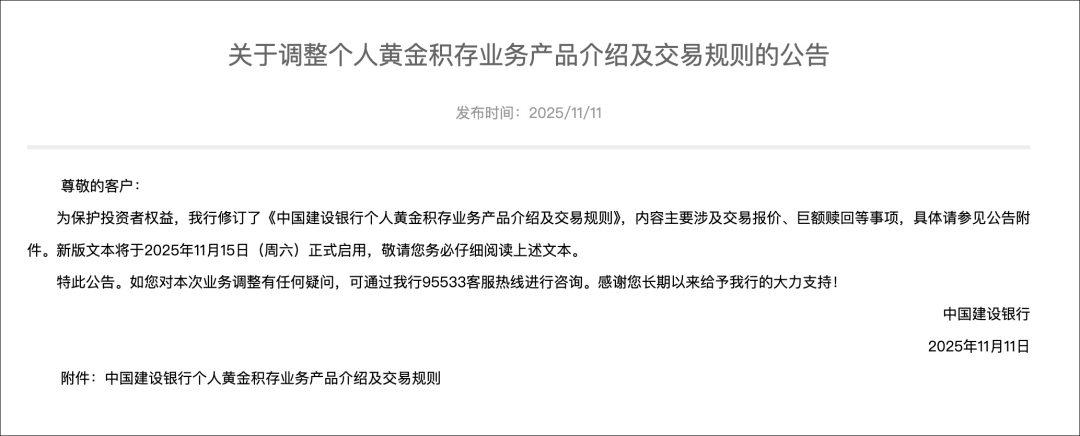
Core Insights - Several banks have adjusted the thresholds for gold accumulation business in response to the recent rise in international gold prices, which have surpassed $4100 per ounce [1][3]. Group 1: Bank Adjustments - China Construction Bank announced an increase in the daily accumulation starting amount from 1000 RMB to 1200 RMB, effective November 15, 2025 [1]. - CITIC Bank has raised the minimum investment amount for its regular gold accumulation plan from 1000 RMB to 1500 RMB, also effective November 15, 2025 [3]. - The last adjustment by CITIC Bank occurred in March 2024, when the minimum investment was raised from 500 RMB to 1000 RMB [5]. Group 2: Market Context - The recent surge in international gold prices has been significant, with London gold prices exceeding $4141 per ounce at the time of reporting [5]. - In addition to the changes in accumulation thresholds, Zheshang Bank has adjusted the daily limit for physical gold redemption through its JD Finance channel to 10,000 RMB, effective November 18, while maintaining an annual limit of 200,000 RMB [5].




真金白银!年内十余家上市银行获股东、高管增持,银行“防御性板块”角色要变?
Xin Lang Cai Jing· 2025-11-10 12:57
Core Viewpoint - The recent surge in share buybacks by various banks, including Qilu Bank and Qingdao Bank, reflects strong confidence in the long-term value of the banking sector, with over 10 listed banks participating in this trend [1][9][10]. Group 1: Share Buybacks - Qilu Bank announced that its directors, supervisors, and senior executives have collectively increased their holdings by 3.15 million yuan, accounting for 90% of the planned buyback amount [1]. - Qingdao Bank's major shareholder, Qingdao Guoxin Financial Holdings, increased its holdings by 957 million yuan, raising its stake to 15.42%, making it the largest shareholder [4]. - Xiamen Bank's executives completed a buyback plan exceeding the minimum target, with total contributions reaching 1.6857 million yuan [5]. Group 2: Market Sentiment - The buyback activities are interpreted as a recognition of the banking sector's valuation, with a current price-to-book ratio of 0.72 and a dividend yield of 3.99%, attracting long-term capital [10][12]. - The banking sector has seen a collective "self-purchase" phenomenon, with various regional banks also engaging in buybacks, indicating a broader trend across the industry [6][8]. Group 3: Performance and Valuation - Despite a slight decline in revenue and net profit for 42 A-share listed banks in the first quarter, 24 banks reported growth in both metrics, particularly city and rural commercial banks [10]. - The net interest margin for listed banks is projected to stabilize, with a simulated net interest margin of 1.32% for Q3 2025, marking a potential turning point after four years of decline [12]. - Long-term capital, particularly from insurance funds, has been increasingly allocated to the banking sector, with a reported increase of 8.36 billion shares held by insurance funds in Q3 2025 [12][13].



险企“长期股权投资”增厚利润惹争议 报表魔术有风险
2 1 Shi Ji Jing Ji Bao Dao· 2025-11-10 08:48
Core Viewpoint - The insurance industry is facing asset-liability matching pressures due to declining interest rates and an "asset shortage," prompting companies to seek long-term equity investments, particularly in undervalued bank stocks, to achieve stable returns and balance sheet improvements [1][3][12]. Group 1: Long-term Equity Investment Strategy - Insurance companies are increasingly turning to long-term equity investments as a strategy to achieve stable returns and match their liabilities [3][12]. - This strategy has sparked controversy, as it is seen as a means to smooth out volatility and achieve stable return on equity (ROE) and dividend returns, but some companies misuse it as a financial engineering tool to mask operational pressures [3][4][15]. - The shift to long-term equity investments is driven by the need for stable, high returns in a low-interest-rate environment, where traditional fixed-income assets are yielding insufficient returns [12][13]. Group 2: Accounting Practices and Implications - The accounting treatment of long-term equity investments allows insurance companies to recognize significant profits through accounting adjustments, particularly when investing in undervalued stocks [5][9]. - By applying the equity method of accounting, companies can report initial investment costs based on the fair value of the net assets of the investee, leading to inflated profits on their financial statements [7][10]. - This practice can create a disconnect between reported profits and actual cash flows, raising concerns about the sustainability of these earnings [11][19]. Group 3: Risks and Challenges - The reliance on long-term equity investments as a financial strategy can lead to systemic distortions in profit, net assets, and risk disclosures, potentially masking underlying financial health issues [4][20]. - Companies face pressures from regulatory requirements and internal assessments of solvency and profitability, which may drive them to prioritize short-term financial reporting over long-term strategic investments [14][15]. - The misuse of long-term equity investments can result in significant risks, including mismatches in capital and liquidity, potential valuation declines, and loss of market trust [20][21]. Group 4: Recommendations for Improvement - To mitigate the risks associated with long-term equity investments, regulatory bodies should establish clearer standards for recognizing significant influence and tighten rules around accounting for goodwill and fair value assessments [21][22]. - Insurance companies should enhance internal controls and focus on sustainable cash flow as a primary measure of investment success, rather than relying on one-time accounting gains [22]. - Expanding investment opportunities into infrastructure REITs, preferred stocks, and other long-term assets can help reduce dependence on equity investments and improve asset-liability matching [22].


从增量扩面到提质控险 银行业普惠金融迈向差异化精准服务
2 1 Shi Ji Jing Ji Bao Dao· 2025-11-10 04:21
Core Insights - The report highlights the significant growth and development of inclusive finance in China, particularly focusing on small and micro enterprises and rural areas, with a notable annual growth rate of over 20% in inclusive micro loans during the 14th Five-Year Plan period [1][2] - As of June 2025, the balance of inclusive micro loans reached 36 trillion yuan, which is 2.3 times that of the end of the 13th Five-Year Plan, with a decrease in interest rates by 2 percentage points [1][2] - The average interest rate for newly issued inclusive micro loans was 3.48% as of June 2025, reflecting a decrease of 66 basis points year-on-year [1][2] Group 1: Digital Empowerment - Digital technology has been a key driver for the development of inclusive finance, with banks utilizing big data and AI to enhance loan approval efficiency and reduce financing costs [2][7] - The market structure among banks is changing, with large commercial banks holding a 45.11% share of inclusive micro loans, while rural financial institutions have seen a decline in their market share [2][3] - The average growth rate of inclusive micro loans has been slowing down, with a decrease from 30.9% in 2020 to 12.3% by mid-2025 [2][3] Group 2: Performance of Listed Banks - Among listed banks, Agricultural Bank of China, Industrial and Commercial Bank of China, and Beijing Bank reported the highest growth rates in inclusive micro loans at 18.50%, 17.30%, and 17.27% respectively [3][4] - In contrast, some banks, including Shanghai Bank and Zhengzhou Bank, experienced negative growth rates of -3.97% and -2.06% [3][4] - The performance of different banks varies significantly, with state-owned banks generally showing stronger growth in inclusive micro loans compared to smaller banks [3][4] Group 3: Interest Rates and Risk Management - The interest rates for newly issued inclusive micro loans have decreased across various banks, with the highest rate at 4.20% and the lowest at 2.94% [7][8] - The gap in interest rates between large and small banks is narrowing, with some large banks' rates aligning closely with those of smaller banks [8][9] - The report emphasizes the importance of risk management in the inclusive finance sector, with several banks focusing on improving asset quality and managing non-performing loans [9][10]


你的支付优惠用了吗?各大银行加入双十一“狂欢”,算的什么账?
Sou Hu Cai Jing· 2025-11-08 00:51
Core Viewpoint - The annual Double Eleven shopping season has officially started, with major commercial banks launching various promotional activities to stimulate consumer spending and boost business before the year-end [1][2]. Group 1: Promotional Activities by Banks - Major banks such as China Construction Bank, Bank of China, Agricultural Bank of China, and others have introduced cashback, discounts, installment benefits, and exclusive offers to attract consumers [1]. - Construction Bank offers a maximum discount of 400 yuan for credit card customers using installment payments on platforms like Alipay and Taobao, while Bank of China provides a random discount of up to 118 yuan for transactions made through Alipay [2]. - Other banks, including China Merchants Bank and Ping An Bank, have also launched various cashback and discount campaigns to engage customers during this shopping season [2]. Group 2: Strategic Insights - Experts suggest that the banks' promotional strategies represent a cost-effective method to acquire and retain customers, activating dormant accounts with low-cost random discounts [5]. - The focus on marketing during peak shopping seasons aims to enhance the usage of bank cards over third-party payment channels, thereby driving growth in credit and debit card transactions [5]. - Recommendations for banks post-Double Eleven include offering temporary credit limit increases and integrating with government consumption voucher programs to enhance customer experience and engagement [5].



上市银行大类资产配置跟踪:信贷投放稳健,债券配置灵活性提升
Ping An Securities· 2025-11-07 08:10
Industry Investment Rating - The investment rating for the banking sector is "Outperform" [1] Core Insights - The proportion of corporate loans has increased, while retail demand recovery is being monitored. As of mid-2025, the proportion of corporate loans among listed banks rose by 1.65 percentage points from the end of 2024 to 60.2%. The manufacturing sector's loans accounted for 18.5% of corporate loans, reflecting a recovery in the operations of manufacturing enterprises [3][12] - The flexibility in bond allocation has increased, with bond trading helping to stabilize market fluctuations. In the first half of 2025, listed banks saw a significant decline in other comprehensive income and fair value changes due to interest rate fluctuations. Some banks, primarily state-owned, increased bond trading to enhance investment returns and stabilize net profit growth [3][6] - Asset quality pressure is manageable, with a focus on risks in the retail sector. The overall asset quality remains stable, with the non-performing loan (NPL) ratio for A-share listed banks holding steady at 1.15% as of Q3 2025. However, the average NPL ratio for retail loans increased by 15 basis points to 1.58% compared to the end of 2024 [3][6] Summary by Sections Corporate Loan Structure - The overall asset structure of listed banks shows an increase in loan allocation, with the loan proportion rising by 0.1 percentage points from the end of 2024. State-owned banks increased interbank asset allocation, while small and medium-sized banks focused more on loan issuance [12][19] - Corporate loans remain the primary focus of credit allocation, with corporate loans accounting for 91.1% of all new loans in the first nine months of 2025. Short-term corporate loans made up 33.7% of new corporate loans [17][18] Bond Investment Preferences - The preference for flexible bond allocation has increased, with banks primarily investing in government bonds and central bank bills. The proportion of OCI accounts has risen, indicating a shift towards more flexible investment strategies [6][3] Asset Quality and Risk Monitoring - The asset quality of the banking sector is stable, with a non-performing loan ratio of 1.15% as of Q3 2025. The retail loan sector has shown slight increases in NPL ratios, necessitating ongoing monitoring of risks in this area [3][6]


5家银行不良率下降,零售AUM增长成亮点
Nan Fang Du Shi Bao· 2025-11-06 23:10
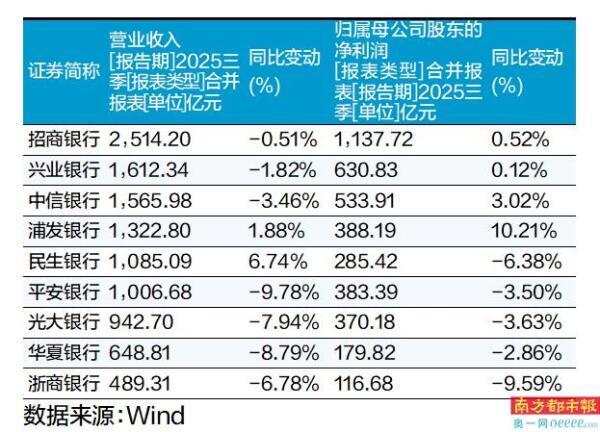
Core Viewpoint - The performance of A-share listed joint-stock banks in the third quarter of 2025 shows a mixed picture, with seven banks experiencing a year-on-year decline in operating income and five banks reporting a drop in net profit. Only Shanghai Pudong Development Bank achieved growth in both metrics [1][2][3]. Group 1: Revenue Performance - Among the nine listed joint-stock banks, only Shanghai Pudong Development Bank and Minsheng Bank reported year-on-year revenue growth, with Minsheng Bank achieving the highest growth rate of 6.74% [2]. - China Merchants Bank led in revenue scale with 2,514.20 billion yuan, followed by Industrial Bank and CITIC Bank with 1,612.34 billion yuan and 1,565.98 billion yuan, respectively [2][3]. - Ping An Bank experienced the most significant revenue decline at -9.78%, while several other banks, including Everbright Bank and Huaxia Bank, also saw declines exceeding 6% [2][3]. Group 2: Net Profit Analysis - China Merchants Bank maintained the highest net profit at 1,137.72 billion yuan, with a slight increase of 0.52% year-on-year. Shanghai Pudong Development Bank saw a notable increase of 10.21% in net profit [3]. - The banks that reported a decline in net profit include Zhejiang Commercial Bank, which had the largest drop at -9.59%, along with Minsheng Bank, Ping An Bank, and others experiencing varying degrees of decline [3]. Group 3: Interest Income and Net Interest Margin - Interest income growth varied significantly, with China Merchants Bank leading at 1,600.42 billion yuan and a 1.74% increase. Shanghai Pudong Development Bank had the highest growth rate in interest income at 3.93% [5]. - The net interest margin faced pressure across the industry, with CITIC Bank experiencing the largest decline of 16 basis points. Only Minsheng Bank reported a slight increase of 2 basis points [5][6]. Group 4: Asset Quality and Provision Coverage - The asset quality of joint-stock banks showed resilience, with a mixed performance in non-performing loan (NPL) ratios. China Merchants Bank had the best NPL ratio at 0.94%, while several banks saw slight increases in their NPL ratios [8]. - Provision coverage ratios decreased for most banks, with China Merchants Bank still leading at 405.93%, despite a decline of 6.05 percentage points [9][10]. Group 5: Loan Structure - The loan structure indicates a shift towards corporate loans, with all five banks reporting growth in corporate loans, while personal loan growth was weak for several banks [11][12]. - China Merchants Bank led in personal loan balance with nearly 3.7 trillion yuan, while corporate loan growth was particularly strong for CITIC Bank, which saw a 10.45% increase [11][12].

浙商银行(02016) - 截至二零二五年十月三十一日止月份之股份发行人的证券变动月报表
2025-11-05 08:30
FF301 致:香港交易及結算所有限公司 公司名稱: 浙商銀行股份有限公司 (「本行」) 呈交日期: 2025年11月5日 I. 法定/註冊股本變動 1. 股份分類 普通股 股份類別 H 於香港聯交所上市 (註1) 是 證券代號 (如上市) 02016 說明 法定/註冊股份數目 面值 法定/註冊股本 上月底結存 5,920,200,000 RMB 1 RMB 5,920,200,000 增加 / 減少 (-) 0 RMB 0 本月底結存 5,920,200,000 RMB 1 RMB 5,920,200,000 | 2. 股份分類 | 普通股 | 股份類別 A | | | 於香港聯交所上市 (註1) | | 否 | | | --- | --- | --- | --- | --- | --- | --- | --- | --- | | 證券代號 (如上市) | 601916 | 說明 | | 於上海證券交易所 (「上交所」)上市之A股 | | | | | | | | 法定/註冊股份數目 | | 面值 | | | 法定/註冊股本 | | | 上月底結存 | | | 21,544,435,963 | RMB | | ...
浙商银行2025年第三季度业绩说明会问答实录
Quan Jing Wang· 2025-11-05 01:04
Core Viewpoint - Zhejiang Merchants Bank reported a decline in revenue and net profit for the first three quarters of 2025, attributed to ongoing challenges in the industry, including low growth and narrowing interest margins [1][2]. Financial Performance - For the first three quarters of 2025, the bank achieved operating income of 48.93 billion yuan, a year-on-year decrease of 6.8%, and a net profit attributable to shareholders of 11.67 billion yuan, down 9.6% year-on-year [1]. - The net interest margin for the first three quarters was 1.67%, a decrease of 13 basis points year-on-year, with net interest income of 34.44 billion yuan, down 3.2% year-on-year [1]. - Non-interest income was 14.49 billion yuan, a decline of 14.3% year-on-year, impacted by external factors affecting bond market yields [1]. Loan and Credit Strategy - The bank has shifted focus towards low-risk, stable-yield lending, with a significant increase in personal consumption loans following the implementation of a government subsidy policy [2][3]. - As of September 2025, the bank's loan and advance balance was 1.9 trillion yuan, with a growth rate of 2.11% year-to-date, primarily driven by corporate loans, which increased by 5.1% [5]. Risk Management - The non-performing loan ratio stood at 1.36%, a slight decrease from the beginning of the year, while the provision coverage ratio dropped to 159.56%, down 19.11 percentage points [3]. - The bank is actively managing risks associated with the real estate sector and small micro-enterprises, emphasizing a cautious approach to new credit approvals [3][4]. Non-Interest Income Outlook - Non-interest income faced pressure, with a 14.3% decline in the first three quarters, but the bank anticipates gradual recovery through enhanced wealth management and service offerings [7]. - The bank plans to implement a "three-year action plan" to improve fee-based income, focusing on wealth distribution, custody, and payment services [7]. Shareholder Engagement - The bank has maintained a cash dividend payout ratio of over 30% for the past three years, totaling over 13.2 billion yuan, and is considering future dividend policies [6]. - The bank has established a market value management plan to enhance investor confidence and protect shareholder interests [6].
浙商银行(601916):营收拖累盈利下行 息差边际企稳
Ge Long Hui· 2025-11-04 21:18
Core Viewpoint - Zhejiang Zheshang Bank reported a decline in both revenue and net profit for the first three quarters of 2025, with revenue down 6.8% year-on-year and net profit down 9.6% year-on-year, indicating pressure on profitability and a need to monitor changes in wealth management demand [1][2]. Financial Performance - The bank achieved operating income of 48.9 billion yuan and a net profit attributable to shareholders of 11.7 billion yuan for the first three quarters of 2025 [1]. - The annualized net interest margin for the first three quarters was 1.67%, with a slight increase in the third quarter compared to the second quarter [2]. - Net interest income decreased by 3.2% year-on-year, while non-interest income fell by 14.3% year-on-year, primarily due to fluctuations in the bond market [1][2]. Asset Quality and Growth - Total assets grew by 3.4% year-on-year, with loans increasing by 3.8% and deposits by 7.6% [1][2]. - The non-performing loan ratio remained stable at 1.36%, indicating steady asset quality [2]. - The bank's provisioning coverage ratio decreased to 160%, but the risk compensation ability remains robust [2]. Investment Outlook - The bank is expected to enter an asset quality improvement cycle, with a new strategy aimed at enhancing profitability [3]. - Earnings per share (EPS) forecasts for 2025-2027 are projected at 0.57, 0.61, and 0.66 yuan, with corresponding profit growth rates of 3.7%, 5.9%, and 8.4% [3]. - The current stock price corresponds to a price-to-book (PB) ratio of 0.46x, 0.43x, and 0.40x for 2025-2027, suggesting a favorable investment opportunity [3].