CMS(06099)

Search documents
黄金股早盘走低,全球央行购金量放缓,机构称金价短期上涨动力减弱
Zhi Tong Cai Jing· 2025-08-11 02:17
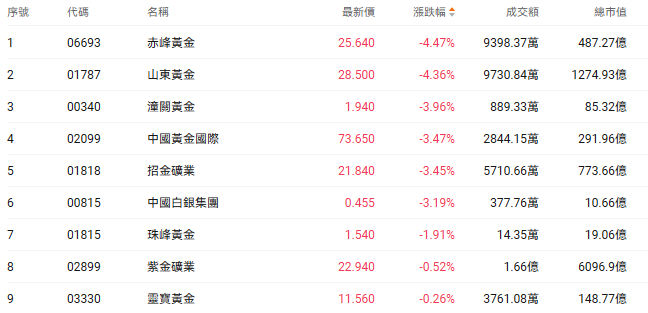
8月11日消息,黄金股早盘走低,截至发稿,、跌超4%,跌超3%,跌近1%。 编辑/melody 消息面上,8月7日,中国人民银行数据显示,7月末黄金储备达7396万盎司,环比增加6万盎司,已连续 9个月增持。世界黄金协会发布的数据显示,2025年6月,全球官方黄金储备净增22吨,已连续第三个月 环比小幅上升。2025年上半年全球央行净购金量达123吨,较2024年同期小幅下降。 招商证券8月初发布研报称,金价短期上涨动力减弱。 虽然黄金具备配置价值,但在短期维度,上涨动 能不足,需警惕局部过热风险。该机构建议投资者,关注结构性机会,而非全面押注黄金上涨。东证期 货指出,市场对未来联储局减息的预期增加,但也基本反映在了金价中。 ...

上银基金管理有限公司关于旗下部分基金新增 国泰海通证券为销售机构的公告
Zhong Guo Zheng Quan Bao - Zhong Zheng Wang· 2025-08-10 23:19
Group 1 - The announcement states that from August 11, 2025, Guotai Haitong Securities will begin selling certain funds managed by the company [1] - The applicable fund range is subject to compliance with the fund contract, prospectus, and related business announcements [1][4] - The announcement includes a list of various sales institutions that will also start selling the company's funds from the same date [5][6][7] Group 2 - Investors can consult details through the websites and customer service numbers provided for each sales institution [4][5][6][7] - The company emphasizes that the specific dates, times, processes, and any fee discount activities for fund sales will be determined by the sales institutions [1][4]




科创债3个月发行超8800亿元 中小机构、民企加速进场
Zheng Quan Shi Bao· 2025-08-10 17:37
Core Viewpoint - The new policy for technology innovation bonds (科创债) has led to a significant increase in issuance, with a total of 883.16 billion yuan in new bonds over the past three months, indicating a strong market response to regulatory support [1][2]. Group 1: Issuance Scale and Participants - The total issuance scale of technology innovation bonds reached 883.16 billion yuan, with financial institutions accounting for nearly 36% of this amount [1][2]. - Among the financial institutions, banks led the issuance with 230.3 billion yuan, followed by 38 securities companies that collectively issued 54.1 billion yuan [2]. - The participation of small and medium-sized institutions and private enterprises has increased, with various smaller banks and private equity firms also issuing technology innovation bonds [2]. Group 2: Characteristics of New Bonds - The average coupon rate for newly issued technology innovation bonds was 1.9282%, which is notably low compared to other credit bonds of similar ratings [3]. - A significant portion of the new bonds has a maturity of over three years, with 76.23% of the total issuance (673.22 billion yuan) falling into this category [3]. - The majority of the issuers are central and local state-owned enterprises, with 203 bonds issued by central state-owned enterprises and 369 by local state-owned enterprises [3].



广东建科: 招商证券股份有限公司关于公司首次公开发行股票并在创业板上市的上市保荐书
Zheng Quan Zhi Xing· 2025-08-10 13:14
Core Viewpoint - Guangdong Provincial Academy of Building Research Group Co., Ltd. (hereinafter referred to as "Guangdong Jian Ke") is preparing for its initial public offering (IPO) on the ChiNext board, with a focus on providing high-tech services in the construction engineering field, particularly in inspection and testing [1][2]. Group 1: Company Overview - The registered capital of Guangdong Jian Ke is 31.39 million yuan, and it was established on December 25, 2013, with its shares incorporated on December 16, 2014 [1]. - The company is recognized as a large-scale construction technology service provider in Guangdong Province and has received multiple national honors, including "National High-tech Enterprise" and "National Model Enterprise for Scientific and Technological Reform" [2][3]. Group 2: Main Business and Services - Guangdong Jian Ke's primary business involves inspection and testing technology services in the construction engineering sector, which is a key area supported by the national government [3][4]. - The company has developed over 4,100 recognized testing standards and holds various qualifications, including comprehensive Class A qualifications for highway engineering and all five categories of Class A qualifications for water conservancy engineering [3][4]. Group 3: Technological Capabilities - The company emphasizes technological research and development, having established multiple provincial and national-level innovation platforms, including the only national green building quality inspection and testing center in South China [5][6]. - Guangdong Jian Ke has participated in over 20 national scientific and technological projects and has received 89 national and provincial-level scientific and technological awards [6][7]. Group 4: Industry Impact and Recognition - The company has provided inspection and testing services for major projects such as the Hong Kong-Zhuhai-Macao Bridge and Guangzhou Baiyun International Airport, contributing to significant economic and social benefits [6][7]. - Guangdong Jian Ke has been awarded titles such as "National AAA Credit Enterprise in the Construction Industry" and "National Green Building Pioneer Award," reflecting its strong reputation in the industry [6][7].

保障信息系统稳定性 14家券商参与起草新标准
Mei Ri Jing Ji Xin Wen· 2025-08-10 12:52
Core Viewpoint - The stability of information systems in the securities industry is essential for ensuring the safe operation of financial markets, prompting the China Securities Association to seek industry feedback on the "Stability Assurance System Standard for the Securities Industry" [1][2]. Group 1: Background and Purpose - The initiative aims to integrate best practices from securities firms to create a practical stability assurance framework, promoting the digital and standardized development of technical capabilities across the industry [1]. - The project for drafting the standard began in November 2023, with participation from 14 securities firms, including major players like GF Securities and CITIC Securities [1]. Group 2: Current Challenges - There are four main challenges identified: 1. Lack of resilience design in system development, leading to high operational risk prevention costs due to insufficient monitoring and automation capabilities [2]. 2. Predominantly reactive risk perception during operations, lacking proactive data-driven risk identification capabilities [2]. 3. Emergency response relies heavily on individual expert experience, lacking data-driven human-machine collaborative capabilities [2]. 4. Insufficient depth of intelligent technology application, resulting in a gap between abnormal response efficiency and real-time business requirements [2]. Group 3: Proposed Framework - The "Stability Assurance System Standard" proposes a "three-in-one" framework for stability assurance, focusing on organizational, institutional, and process guarantees [3]. - Organizational guarantees include defining the structure, personnel competency requirements, and management objectives [3]. - Institutional guarantees encompass regulations, technical support, operational procedures, and timelines to ensure management requirements are actionable and traceable [3]. - Process guarantees focus on ten core processes related to stability management, including monitoring, alerting, and fault management, with mechanisms for evaluation and key activities [3]. - The standard emphasizes a shift towards proactive operations management to meet non-functional requirements like resilience and maintainability, utilizing digital methods to enhance defense capabilities [3].



技术择时信号:市场震荡看多,结构上维持看好小盘
CMS· 2025-08-09 14:14
Quantitative Models and Construction Methods DTW Timing Model - **Model Name**: DTW Timing Model - **Model Construction Idea**: The model is based on the principle of similarity and the DTW algorithm, focusing on price and volume timing[1][5][14] - **Model Construction Process**: - The model examines the similarity between current index trends and historical trends, selecting several historical segments with high similarity as references[25] - It calculates the weighted average future price change and weighted standard deviation of the selected historical segments (weights are the inverse of the distance)[25] - Based on the average future price change and standard deviation, trading signals are generated[25] - The model uses the DTW distance algorithm instead of the Euclidean distance for similarity measurement, as DTW distance can better handle time series mismatches[27] - Improved DTW algorithms such as Sakoe-Chiba and Itakura Parallelogram are introduced to overcome the "over-bending" issue in traditional DTW algorithms[29][30][35] - **Model Evaluation**: The model has shown stable excess returns in general market conditions, although it faced some drawdowns during periods of sudden macroeconomic policy changes[16] Foreign Capital Timing Model - **Model Name**: Foreign Capital Timing Model - **Model Construction Idea**: The model is based on the divergence between foreign and domestic related assets[1][14] - **Model Construction Process**: - The model uses two foreign-listed assets related to A-shares: FTSE China A50 Index Futures (Singapore market) and Southern A50 ETF (Hong Kong market)[34] - It constructs two indicators from FTSE China A50 Index Futures: premium and price divergence, forming the FTSE China A50 Index Futures timing signal[34] - It constructs a price divergence indicator from Southern A50 ETF, forming the Southern A50 ETF timing signal[34] - The timing signals from both assets are combined to form the foreign capital timing signal[34] - **Model Evaluation**: The model has shown good performance with high annualized returns and low maximum drawdowns[20][23] Model Backtest Results DTW Timing Model - **Absolute Return**: 25.79% since November 2022[5][16] - **Excess Return**: 16.83% relative to CSI 300[5][16] - **Maximum Drawdown**: 21.32%[5][16] - **Absolute Return (2024)**: 23.98% on CSI 300[18] - **Excess Return (2024)**: 2.76%[18] - **Maximum Drawdown (2024)**: 21.36%[18] - **Win Rate (2024)**: 53.85%[18] - **Profit-Loss Ratio (2024)**: 2.93[18] Foreign Capital Timing Model - **Absolute Return (2024)**: 29.11% for long strategy[5][23] - **Maximum Drawdown (2024)**: 8.32% for long strategy[5][23] - **Annualized Return (2014-2024)**: 18.96% for long-short strategy, 14.19% for long strategy[20] - **Maximum Drawdown (2014-2024)**: 25.69% for long-short strategy, 17.27% for long strategy[20] - **Daily Win Rate (2014-2024)**: Nearly 55%[20] - **Profit-Loss Ratio (2014-2024)**: Both exceed 2.5[20]
知名量化私募陷“内斗风波”,招商证券被卷入其中
Di Yi Cai Jing Zi Xun· 2025-08-08 15:57
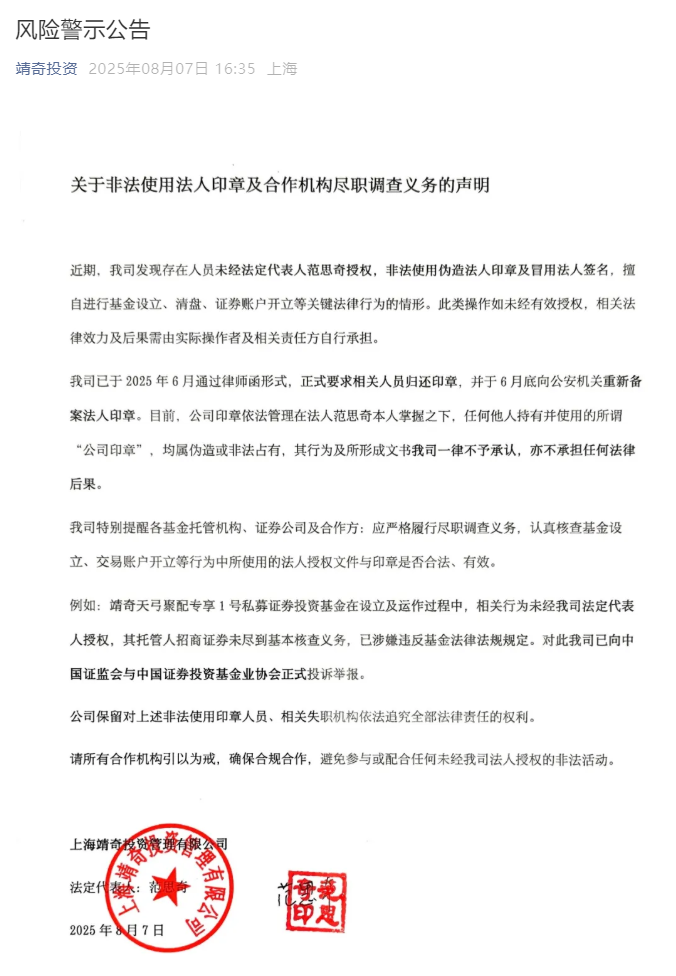
Core Viewpoint - The recent internal conflict at Jingqi Investment has escalated, involving allegations of financial misconduct and mismanagement, with the company’s founder and fund manager Fan Siqi at the center of the controversy [2][3][4]. Group 1: Company Operations and Allegations - Jingqi Investment's basic account experienced a significant abnormal fund transfer on July 2, which has severely impacted the company's financial operations [3]. - The company claims that there have been illegal uses of forged corporate seals and unauthorized actions regarding fund establishment and liquidation, implicating its custodian, China Merchants Securities, for failing to fulfill its due diligence obligations [4]. - Jingqi Investment has filed formal complaints with the China Securities Regulatory Commission and the Asset Management Association of China regarding these allegations [4]. Group 2: Management Disputes - The company is currently undergoing a change in its legal representative, with Fan Siqi allegedly using his authority to alter the management of the company's WeChat account during this transition [6]. - There are conflicting narratives between the founders, with Fan Siqi asserting that he was unfairly removed from his positions and that his actions were in defense of the company [5][6]. - The other founder, Tang Jingren, claims that Fan Siqi has not been involved in the company's daily operations for nearly three years and has been living in Japan, which has contributed to the management issues [7][8]. Group 3: Financial Management and Structure - Jingqi Investment was established on March 9, 2015, and currently manages between 1 billion to 2 billion yuan, with 56 funds under management [5]. - The company has faced scrutiny over its operational practices, particularly regarding the management of its funds and the legitimacy of its financial transactions [4][5].

知名量化私募靖奇投资陷内斗风波,招商证券被卷入内斗风波
Di Yi Cai Jing· 2025-08-08 13:57
Core Viewpoint - The recent internal conflict at the well-known quantitative private equity firm Jingqi Investment has escalated, leading to risk warning announcements and account irregularities, with招商证券 being implicated in the turmoil [1] Group 1: Internal Conflict - Jingqi Investment's founder and fund manager Fan Siqi has issued statements regarding significant abnormal transfers from the company's main account and allegations of illegal activities such as forgery of corporate seals and unauthorized fund establishment and liquidation [1] - Another founder, Tang Jingren, stated that the company is currently undergoing a change in legal representative, and Fan Siqi has misused his authority to alter the management of the company's WeChat account [1] - Fan Siqi's actions are reportedly aimed at pressuring other shareholders due to differing management philosophies, including maliciously liquidating company fund products and misplacing company seals [1] Group 2: Involvement of 招商证券 - 招商证券 has been identified as the custodian for three of Jingqi Investment's products, which are not involved in trading at the firm, and all product establishment and operation matters have been confirmed as compliant with legal regulations [1] - A representative from 招商证券 clarified that there are no violations of fund laws and regulations concerning their custodial responsibilities [1]
知名量化私募靖奇投资陷“内斗风波”,招商证券被卷入其中
Di Yi Cai Jing· 2025-08-08 13:29
Core Viewpoint - The internal conflict within the well-known quantitative private equity firm Jingqi Investment has escalated, involving allegations of financial misconduct and mismanagement by its founders, particularly concerning the handling of company accounts and legal authority [1][2][4]. Group 1: Internal Conflict and Allegations - Jingqi Investment has issued multiple risk warning announcements regarding significant abnormal fund transfers from its main account, which have severely impacted its financial operations [2][3]. - Founder Fan Siqi has been accused of unauthorized actions, including the illegal use of the company seal and signatures to establish and liquidate funds without proper authorization [1][2][3]. - The company is currently undergoing a change in its legal representative, which has led to disputes over control and management rights between the founders [6][7]. Group 2: Company Operations and Management - Jingqi Investment was established on March 9, 2015, with a management scale between 1 billion and 2 billion yuan, overseeing 56 funds [4]. - The firm has faced scrutiny regarding its compliance with fund regulations, particularly concerning the Jingqi Tiangong Jupei Exclusive No. 1 Private Securities Investment Fund, which allegedly operated without proper authorization [3][4]. - The company has reported that its main account operations have been frozen online, but offline transactions can still be conducted under strict conditions [2][3]. Group 3: Stakeholder Responses - The other founder, Tang Jingren, has publicly stated that Fan Siqi's actions are intended to pressure other shareholders and disrupt the company's operations [6][7]. - Tang Jingren and another shareholder have issued a statement to investors regarding the removal of Fan Siqi from his positions, indicating ongoing legal processes to formalize this change [6][7]. - Fan Siqi has claimed that he has been sidelined from company operations and has not agreed to the current business direction, which he believes lacks transparency [6][7].
靖奇投资内斗升级举报招商证券
Zhong Guo Jing Ji Wang· 2025-08-08 12:36
Core Viewpoint - Recent announcements from Jiangqi Investment highlight serious internal issues, including unauthorized use of corporate seals and significant fund transfers, indicating potential governance failures and internal conflicts within the company [1][2][10]. Group 1: Unauthorized Actions - Jiangqi Investment reported that individuals acted without the authorization of the legal representative, Fan Siqi, using forged corporate seals and signatures for critical legal actions such as fund establishment and account opening [1][2]. - The company has formally requested the return of the seals and has reported the matter to law enforcement, asserting that any documents created under these unauthorized actions will not be recognized [2][3]. Group 2: Fund Transfer Incident - On July 2, a significant abnormal fund transfer occurred, with 5 million yuan being moved from the company's main account within hours, leaving only 2,600 yuan remaining [6][10]. - The transfers included payments for unauthorized bonuses and services, raising concerns about financial management and oversight within the company [10]. Group 3: Internal Conflict - The fund transfer incident is seen as an extension of internal power struggles, with the founder, Fan Siqi, previously losing access to critical company functions and later announcing his resignation due to pressure [10]. - Allegations have surfaced regarding a shareholder misappropriating funds for personal use, further complicating the company's internal dynamics [10]. Group 4: Compliance and Due Diligence - Jiangqi Investment has urged all partners and financial institutions to strictly adhere to due diligence requirements, ensuring that any actions taken regarding fund management are properly authorized [2][4]. - The company has emphasized the importance of compliance to prevent involvement in unauthorized activities that could lead to financial losses [4][9].