
Haixin Foods (002702)

Search documents
36氪精选:罗永浩大战贾国龙,预制菜闷声发大财
日经中文网· 2025-09-20 00:33
Core Viewpoint - The recent surge in stock prices of pre-prepared food companies in A-shares is attributed to the upcoming national food safety standards for pre-prepared dishes, which will provide a unified identity and safety baseline for the industry [12][13]. Industry Overview - The pre-prepared food industry in China has a history dating back to the 1990s, with significant developments occurring between 2000 and 2005 when many current leading companies were established [13]. - Regulatory frameworks for pre-prepared foods have only begun to take shape in recent years, with standards being introduced by various governmental bodies [13][14]. Market Dynamics - The stock prices of companies such as Deli Foods, Longda Food, and Huifa Foods have seen increases of over 5%, with Deli Foods hitting a 10.10% rise [7][11]. - The rise in stock prices is linked to the public's renewed interest in the pre-prepared food debate, sparked by recent comments from industry figures [12]. Consumer Perception - There is a disconnect between the regulatory definition of pre-prepared foods and consumer understanding, leading to concerns about food safety and transparency [14]. - Consumers express frustration over the lack of knowledge regarding the preparation of their meals, reflecting a deeper societal issue of time constraints and the desire for authentic dining experiences [14][17]. Operational Trends - The adoption of pre-prepared foods is becoming widespread among restaurants, as they are more cost-effective than hiring chefs and allow for a diverse menu without extensive culinary skills [16]. - The rise of central kitchens and cold chain logistics post-2008 has facilitated the expansion of pre-prepared foods, standardizing offerings across various dining establishments [16].



海欣食品2025年上半年营收下滑、亏损扩大 深陷经营困局、主营业务全面承压
Xin Lang Zheng Quan· 2025-09-19 10:28
Core Viewpoint - Hai Xin Food, once a market favorite, is facing unprecedented operational challenges, including expanding losses, deteriorating cash flow, and high inventory levels [1][2]. Business Decline: Core Product Line Downturn - The core business segments of Hai Xin Food are experiencing significant declines, with traditional frozen fish and meat products seeing a notable drop in revenue, leading to a continuous decrease in their share of total income [3]. - The frozen dish product line, which was expected to be a new growth area, has also performed poorly, with revenue significantly declining year-on-year [3]. - The frozen rice and noodle products are stagnating, showing minimal growth, while the ambient snack food segment has seen substantial growth, but its low proportion does not materially impact overall revenue [3]. - The aging product structure is increasingly problematic, revealing deep-seated issues in product and market strategy in response to changing consumer trends [3]. Financial Deterioration: Cash Flow and Inventory Pressures - Hai Xin Food's cash flow situation has sharply worsened, with net cash flow from operating activities turning negative, indicating serious issues with cash recovery in operations [4]. - This cash flow deterioration is primarily due to reduced cash receipts from sales and adjustments in distributor contract cycles [4]. - The company is also facing significant concerns regarding high inventory levels, with end-period inventory substantially increasing compared to the beginning of the period, occupying an excessive proportion of current assets [4]. - The inventory turnover rate is continuously declining, with inventory growth outpacing the growth of operating costs and revenue, indicating poor inventory management efficiency [4]. - The accounts receivable turnover rate is also declining, weakening the ability to recover receivables, further exacerbating cash flow pressures [5]. Strategic Challenges - Despite attempts to reverse the situation through increased market promotion and brand investment, the results have been unsatisfactory, with the subsidiary Fujian Changheng Food Co., Ltd. not fully utilizing its production capacity, leading to increased costs without meeting sales expectations [5]. - New product sales have not yet reached a significant scale, posing substantial challenges to the company's strategic transformation [5]. - The management must confront the pressing issue of finding sustainable growth paths in an increasingly competitive market environment [6].

海欣食品(002702.SZ):与永辉超市、胖东来、海底捞等多家大型客户保持了长期的合作关系
Ge Long Hui· 2025-09-18 07:14
Core Viewpoint - The company is actively preparing for the sales peak during the upcoming Mid-Autumn Festival and National Day by focusing on product innovation and marketing strategies [1] Group 1: Company Strategy - The company has established long-term partnerships with major clients such as Yonghui Supermarket, Pang Donglai, and Haidilao [1] - The company emphasizes its commitment to product innovation and market marketing in anticipation of increased sales [1] Group 2: Market Context - The upcoming dual festivals (Mid-Autumn Festival and National Day) are expected to drive sales, prompting the company to enhance its preparations [1]

海欣食品:公司与永辉超市、胖东来、海底捞等多家大型客户保持长期的合作关系
Mei Ri Jing Ji Xin Wen· 2025-09-18 04:32
Core Viewpoint - The company is actively preparing for the upcoming sales peak during the Mid-Autumn Festival and National Day by focusing on product innovation and marketing strategies [1] Group 1: Sales Strategy - The company is enhancing its product innovation and market marketing efforts in anticipation of the sales peak during the festive season [1] - The company has established long-term partnerships with major clients such as Yonghui Supermarket, Pang Donglai, and Haidilao [1]

预制菜概念股ESG相关报告披露率为45% 专家认为提高透明度是关键
Mei Ri Jing Ji Xin Wen· 2025-09-16 11:46
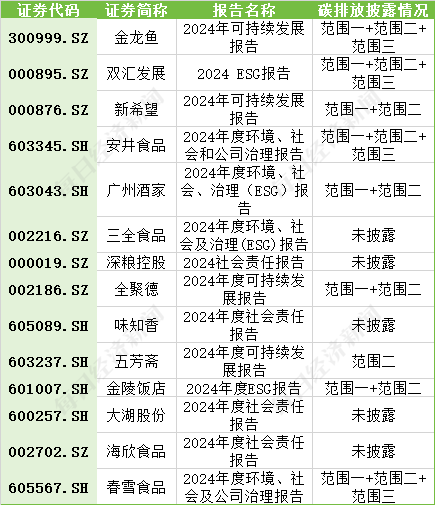
Core Viewpoint - The recent controversy surrounding pre-prepared meals has drawn significant attention to the industry, particularly following comments made by a prominent figure regarding the quality and pricing of dishes at a specific restaurant chain [1] Group 1: Industry Overview - The A-share market has 31 companies involved in the pre-prepared meal concept, with 14 of them disclosing ESG (Environmental, Social, and Governance) reports, resulting in a disclosure rate of 45% [1] - The focus of the industry includes key issues such as product safety and quality, supply chain management, and climate change response [3] Group 2: ESG Reporting - Among the 31 companies, 9 are rated A (including A+, A, A-), 9 are rated B, 8 are rated C, and 5 are rated D, indicating a relatively even distribution of ESG ratings [3] - The majority of companies emphasize the importance of transparency in their ESG reports, with a notable number focusing on sustainable development and social responsibility [2][3] Group 3: Environmental Initiatives - Companies like Jinlongyu and New Hope are implementing green logistics and sustainable packaging practices to reduce environmental impact [4] - Out of the 14 companies that disclosed ESG reports, 8 reported on Scope 1 (direct emissions) and Scope 2 (indirect emissions), while only 4 reported on Scope 3 (value chain emissions), highlighting a gap in comprehensive carbon footprint reporting [4] Group 4: Food Safety and Quality - The industry is shifting towards enhanced food safety and nutritional health management, driven by national strategies aimed at prioritizing public health [5] - New regulations on food additives are set to be implemented, requiring pre-prepared meal producers to adjust their product formulations to comply with stricter safety standards [5] Group 5: Supply Chain Management - Effective supply chain management is crucial for ensuring food safety, with companies like Jinlongyu and New Hope adopting rigorous supplier management practices [7] - The emphasis on transparency and responsible sourcing is seen as essential for maintaining consumer trust and ensuring product quality [8]


罗永浩大战贾国龙,预制菜闷声发大财
3 6 Ke· 2025-09-15 13:25
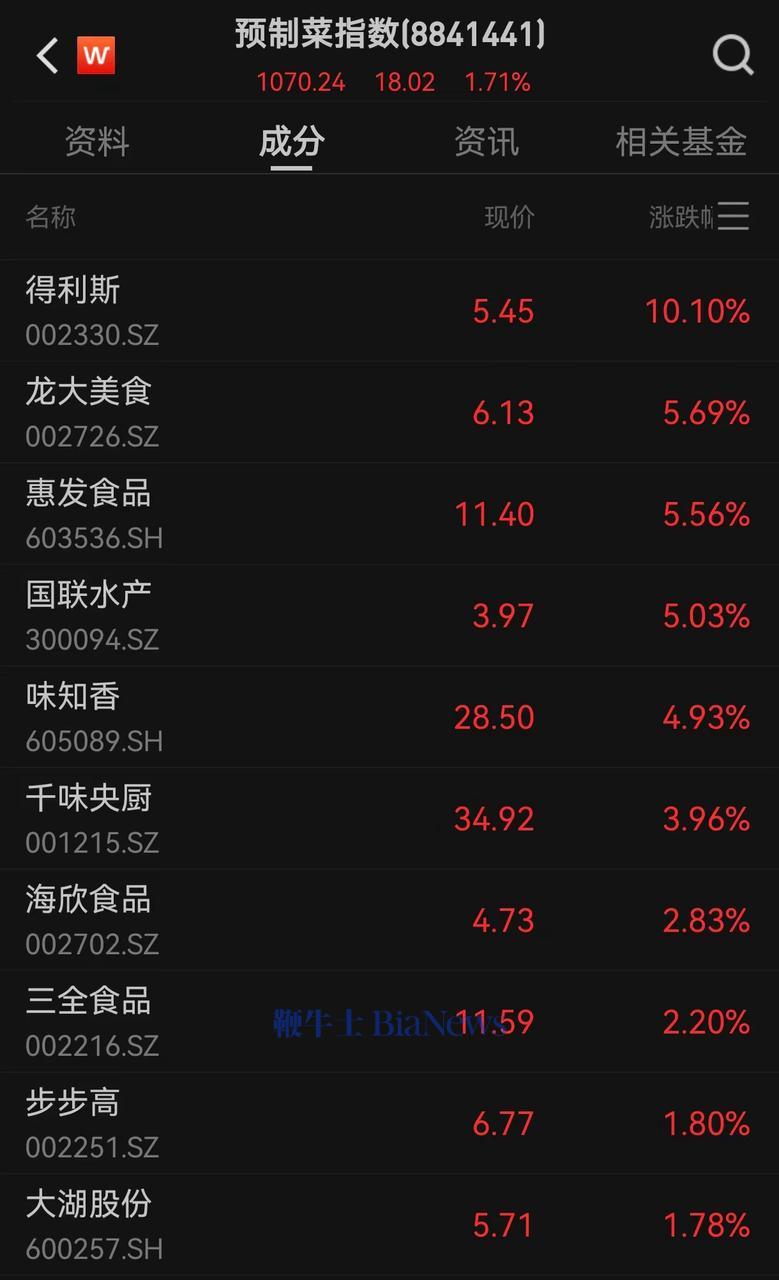
Core Viewpoint - The recent surge in the stock prices of pre-prepared food companies in A-shares is attributed to the public's renewed interest in the pre-prepared food industry, sparked by the apology from Jia Guolong and the upcoming national food safety standards for pre-prepared foods [1][5]. Group 1: Stock Performance - As of September 15, several companies, including Huifa Food, Guolian Aquatic, and Tiankang Biological, saw stock price increases of over 5%, with Delisi reaching a daily limit increase [2]. - Among the rising stocks, suppliers of pre-prepared food, such as Qianwei Yangchun and Longda Meishi, are also noted [3]. Group 2: Regulatory Developments - The significant stock price increase is linked to the approval of the draft national food safety standards for pre-prepared foods by the National Health Commission on September 13, which will provide a unified "identity certification" and safety baseline for the industry [5]. - The pre-prepared food industry has seen regulatory developments only in the past three years, with standards being gradually established [8]. Group 3: Industry History and Trends - The pre-prepared food industry in China dates back to the 1990s, with significant developments occurring between 2000 and 2005, when many of the currently rising companies were registered [6]. - The rise of pre-prepared foods has been facilitated by the emergence of central kitchens and cold chain logistics since 2008, allowing for standardization and wider adoption across various restaurant types [12]. Group 4: Consumer Perception and Market Dynamics - Consumers express concerns about the safety of pre-prepared foods, reflecting a deeper frustration over the loss of transparency regarding food preparation [10]. - The convenience and cost-effectiveness of pre-prepared foods make them appealing to both large and small restaurants, leveling the playing field in the food service industry [12].
风波中的预制菜行业:门槛低竞争加剧,上市公司利润普遍下滑
Sou Hu Cai Jing· 2025-09-15 11:21
Core Viewpoint - The recent events involving Luo Yonghao and Xibei have sparked renewed consumer interest in the "pre-prepared dishes" industry, leading to significant stock price increases for related listed companies on September 15, 2025 [1][10]. Industry Overview - The pre-prepared dishes industry is gradually entering a path of standardized development, with regulations and standards being established in recent years. However, challenges such as low entry barriers and varying consumer perceptions complicate market entry for new players [3][4]. - In March 2024, a joint notification from several government departments outlined clear definitions and standards for pre-prepared dishes, marking the beginning of a standardized development path for the industry [4]. Market Growth - According to iMedia Consulting, the market size of China's pre-prepared dishes reached 485 billion yuan in 2024, reflecting a year-on-year growth of 33.8%. The market is expected to grow to 749 billion yuan by 2026 due to technological advancements and supportive policies [5]. Competitive Landscape - Despite rapid market growth, the industry faces intense competition, characterized by low entry barriers, product homogeneity, and a crisis of consumer trust, leading to declining profits across many companies [6][9]. - Financial reports from various pre-prepared dish companies for the first half of 2025 indicate a general decline in net profits, with several companies reporting losses. For instance, Guolian Aquatic Products reported a loss of 550 million yuan [7][9]. Company Performance - Key financial metrics from several pre-prepared dish companies for the first half of 2025 include: - Longda Meishi: Revenue of 782 million yuan (-19.5% YoY), gross margin of 12.43% (+1.24% YoY) - Guolian Aquatic Products: Revenue of 1.65 billion yuan (-18.36% YoY), net loss of 550 million yuan - Huifa Food: Revenue of 734 million yuan (-17.75% YoY), net loss of 31 million yuan - Aixin Food: Revenue of 7.604 billion yuan (+0.8% YoY), gross margin of 20.52% (-3.39% YoY) [7][9]. Consumer Insights - Consumers express a desire for transparency and choice regarding pre-prepared dishes, indicating that they are not opposed to the concept but seek better information about the products [10].


食品加工板块9月15日涨0.49%,得利斯领涨,主力资金净流入2.58亿元
Zheng Xing Xing Ye Ri Bao· 2025-09-15 08:42
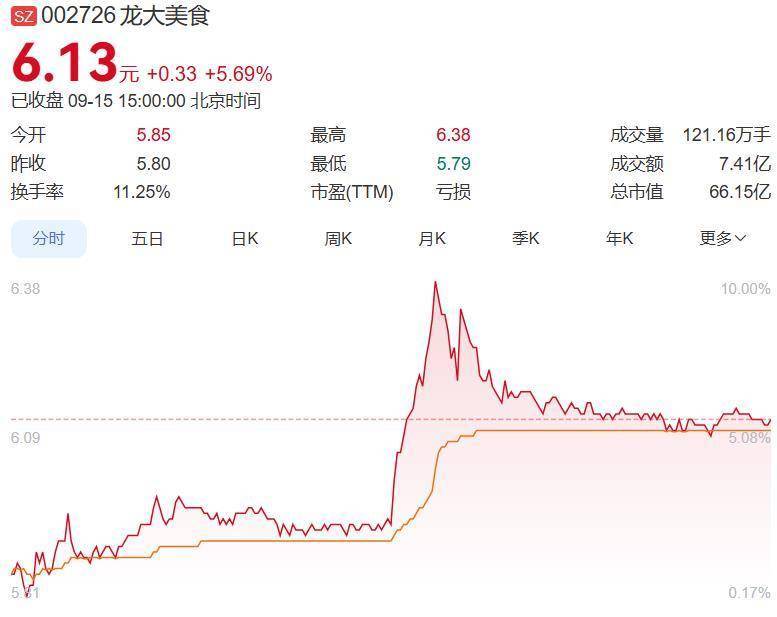
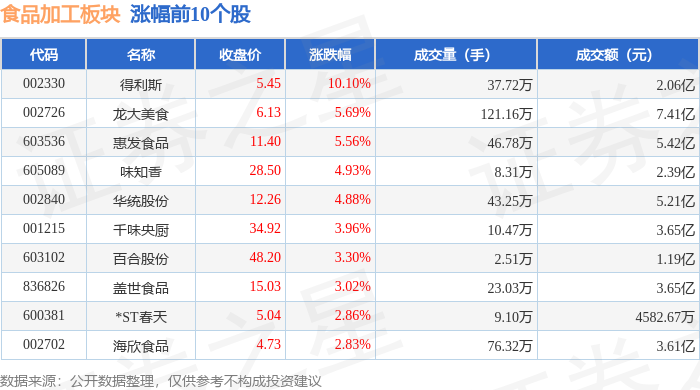
Core Insights - The food processing sector experienced a 0.49% increase on September 15, with Delisi leading the gains [1] - The Shanghai Composite Index closed at 3860.5, down 0.26%, while the Shenzhen Component Index closed at 13005.77, up 0.63% [1] Food Processing Sector Performance - Delisi (002330) saw a closing price of 5.45, with a significant increase of 10.10% and a trading volume of 377,200 shares, amounting to a transaction value of 206 million yuan [1] - Longda Meishi (002726) closed at 6.13, up 5.69%, with a trading volume of 1,211,600 shares and a transaction value of 741 million yuan [1] - Huifa Food (603536) closed at 11.40, up 5.56%, with a trading volume of 467,800 shares and a transaction value of 542 million yuan [1] - Other notable performers include Weizhi Xiang (605089) with a 4.93% increase, and Huatong Co. (002840) with a 4.88% increase [1] Capital Flow Analysis - The food processing sector saw a net inflow of 258 million yuan from institutional investors, while retail investors experienced a net outflow of 216 million yuan [2] - The main capital inflow was observed in Huifa Food, with a net inflow of 93.15 million yuan, representing 17.17% of the total [3] - Delisi had a net inflow of 45.21 million yuan, accounting for 21.99% of its trading volume, despite a net outflow from retail investors [3]
预制菜板块震荡走强
Di Yi Cai Jing· 2025-09-15 03:14
Core Viewpoint - The food industry is experiencing significant stock price increases, with multiple companies reaching their daily limit up, indicating strong market interest and potential investor confidence in the sector [1] Group 1: Company Performance - Huihua Food and Delisi both hit the daily limit up, showcasing robust market performance [1] - Geshih Food saw a rise of over 15%, reflecting positive investor sentiment [1] - Guolian Aquatic Products increased by over 10%, indicating strong demand in the market [1] Group 2: Market Trends - The overall trend in the food industry is upward, with several companies like Haixin Food, Qianwei Yangchu, Weizhi Xiang, and Yike Food also showing notable gains [1]

预制菜板块震荡走强,惠发食品、得利斯双双涨停
Mei Ri Jing Ji Xin Wen· 2025-09-15 02:09
Group 1 - The prepared food sector is experiencing a strong rebound, with companies like Huifa Food and Delisi both hitting the daily limit up [1] - Gaisi Food has seen an increase of over 15%, while Guolian Aquatic has risen by more than 10% [1] - Other companies such as Haixin Food, Qianwei Central Kitchen, Weizhi Xiang, and Yike Food are also among the top gainers in this sector [1]