Haixin Foods (002702)

Search documents
海欣食品(002702) - 关于召开2025年第一次临时股东会的通知
2025-10-29 08:53
证券代码:002702 证券简称:海欣食品 公告编号:2025-042 海欣食品股份有限公司 关于召开 2025 年第一次临时股东会的通知 本公司及董事会全体成员保证信息披露内容的真实、准确和完整,没有虚假 记载、误导性陈述或重大遗漏。 一、召开会议的基本情况 1、股东会届次:2025 年第一次临时股东会 2、股东会的召集人:董事会 3、本次会议的召集、召开符合《中华人民共和国公司法》《深圳证券交易所股票上市 规则》《深圳证券交易所上市公司自律监管指引第 1 号——主板上市公司规范运作》等法律、 行政法规、部门规章、规范性文件及《公司章程》的有关规定。 4、会议时间: (1)现场会议时间:2025 年 11 月 17 日 14:30 (2)网络投票时间:通过深圳证券交易所系统进行网络投票的具体时间为 2025 年 11 月 17 日 9:15-9:25,9:30-11:30,13:00-15:00;通过深圳证券交易所互联网投票系统投 票的具体时间为 2025 年 11 月 17 日 9:15 至 15:00 的任意时间。 5、会议的召开方式:现场表决与网络投票相结合。 6、会议的股权登记日:2025 年 11 ...

海欣食品(002702) - 第七届监事会第十次会议决议公告
2025-10-29 08:52
证券代码:002702 证券简称:海欣食品 公告编号:2025-040 海欣食品股份有限公司 第七届监事会第十次会议决议公告 本公司及监事会全体成员保证信息披露内容的真实、准确和完整,没有虚假 记载、误导性陈述或重大遗漏。 经审核,监事会认为:公司调整募集资金投资规模及内部投资结构,是公司 根据发展规划作出的审慎决策,有利于提高募集资金使用效率,不存在损害公司 及股东利益的情形。 具体内容详见公司同日披露于《中国证券报》《上海证券报》《证券时报》 及巨潮资讯网(http://www.cninfo.com.cn)的《关于调整募集资金投资规模及 一、监事会会议召开情况 本次会议由公司监事会主席王磊召集并主持,公司高级管理人员列席了会议。 会议召开符合有关法律法规、规章和《公司章程》的规定。出席会议的监事对各 项议案进行了认真审议并作出了如下决议: 二、监事会会议审议情况 (一)审议通过《关于〈2025 年第三季度报告〉的议案》。 经审核,监事会认为:《2025年第三季度报告》的编制程序符合法律、行政 法规的规定,报告内容真实、准确、完整地反映了公司的实际情况,不存在任何 虚假记载、误导性陈述或者重大遗漏。 具体内 ...
海欣食品(002702) - 第七届董事会第十二次会议决议公告
2025-10-29 08:51
证券代码:002702 证券简称:海欣食品 公告编号:2025-039 海欣食品股份有限公司 第七届董事会第十二次会议决议公告 本公司及董事会全体成员保证信息披露内容的真实、准确和完整,没有虚假 记载、误导性陈述或重大遗漏。 一、董事会会议召开情况 海欣食品股份有限公司(以下简称"公司")第七届董事会第十二次会议 于 2025 年 10 月 28 日(星期二)以通讯方式召开。会议通知已于 2025 年 10 月 23 日通过短信与邮件的方式送达全体董事。本次会议应出席董事 7 人,实际出 席董事 7 人。 本次会议由公司董事长滕用庄先生召集并主持,公司监事及高级管理人员列 席了本次会议。会议召开符合有关法律法规、规章和《公司章程》的规定。经各 位董事认真审议,会议形成了如下决议: 二、董事会会议审议情况 (一)审议通过《关于〈2025 年第三季度报告〉的议案》 经审核,董事会认为《2025年第三季度报告》的编制程序符合法律、行政法 规的规定,报告内容真实、准确、完整地反映了公司的实际情况,不存在任何虚 假记载、误导性陈述或者重大遗漏。 本议案已经公司第七届董事会审计委员会审议通过。 具体内容详见公司同日披露于 ...
海欣食品(002702) - 国金证券股份有限公司关于海欣食品股份有限公司关于调整部分募投项目总投资额规模及使用募集资金投资部分的内部投资结构的核查意见
2025-10-29 08:50
国金证券股份有限公司 关于海欣食品股份有限公司关于调整部分募投项目 总投资额规模及使用募集资金投资部分的内部投资 结构的核查意见 国金证券股份有限公司(以下简称"保荐机构") 作为海欣食品股份有限 公司(以下简称"海欣食品"或"公司")向特定对象发行股票的保荐机构和 持续督导机构,根据《公司法》《证券发行上市保荐业务管理办法》《深圳证 券交易所股票上市规则》等有关规定,对海欣食品关于调整部分募投项目总投 资额规模及使用募集资金投资部分的内部投资结构的事项进行核查,具体情况 如下: 一、募集资金基本情况 根据中国证券监督管理委员会(以下简称"中国证监会")《关于同意海欣 食品股份有限公司向特定对象发行股票注册的批复》(证监许可[2023]1345 号),公司向特定对象发行人民币普通股(A 股)75,000,000 股,发行价格为 5.01 元/股,募集资金总额人民币 375,750,000.00 元,扣除不含税的发行费用人 民币 10,704,192.45 元,实际募集资金净额为人民币 365,045,807.55 元。该募集 资金已于 2023 年 8 月 8 日全部到位,大华会计师事务所(特殊普通合伙)对资 ...
海欣食品(002702) - 2025 Q3 - 季度财报
2025-10-29 08:30
Revenue and Profitability - Q3 2025 revenue decreased by 14.82% year-on-year to CNY 363,450,550.15, and year-to-date revenue decreased by 15.05% to CNY 969,603,179.11[5] - The net profit attributable to shareholders was a loss of CNY 7,881,683.98, representing a 29.21% increase in loss compared to the same period last year[5] - Basic and diluted earnings per share were both CNY -0.0142, a decrease of 29.70% year-on-year[5] - Net profit for the current period is -¥29,399,141.25, compared to -¥23,473,633.16 in the previous period, indicating a worsening of approximately 25.3%[18] - The total comprehensive income for the current period is -¥29,398,881.19, compared to -¥23,484,459.61 in the previous period, indicating a decline of approximately 25.4%[19] Assets and Liabilities - Total assets decreased by 6.35% from the end of the previous year to CNY 1,970,205,320.75[5] - Total current assets decreased from 1,026,307,161.66 CNY to 886,598,489.06 CNY, a decline of approximately 13.6%[14] - Total liabilities decreased to ¥893,486,567.01 from ¥997,369,548.85, a reduction of about 10.43%[16] - Total equity decreased to ¥1,076,718,753.74 from ¥1,106,420,858.53, reflecting a decline of approximately 2.68%[16] Cash Flow - Cash flow from operating activities showed a net outflow of CNY -84,447,101.36, a significant decline of 320.32% compared to the same period last year[9] - Net cash flow from operating activities was -84,447,101.36, a decrease from 38,329,318.08 in the previous period, indicating a decline in operational performance[22] - The total cash and cash equivalents at the end of the period was 70,000,834.20, down from 160,409,855.97, highlighting a decrease in liquidity[22] - Net cash flow from financing activities increased by 118.79% to CNY 10,052,544.78, driven by increased financing and reduced dividend payments[9] - Cash inflow from operating activities totaled 1,226,282,796.63, a decrease from 1,396,707,134.25, indicating a decline in operational cash generation[22] Shareholder Information - Total number of common shareholders at the end of the reporting period is 42,553[11] - The largest shareholder, Teng Yongxiong, holds 14.60% of shares, totaling 81,120,000 shares[11] - The top four shareholders are acting in concert, indicating a potential influence on company decisions[12] Financial Expenses and Income - Financial expenses increased by 64.69% to CNY 10,822,842.58 due to increased interest expenses[8] - Financial expenses increased to ¥10,822,842.58 from ¥6,571,763.61, an increase of approximately 64.5%[18] - Investment income improved by 182.73% to CNY 840,404.79, attributed to reduced losses from an associate company[8] Inventory and Receivables - Accounts receivable decreased from 211,535,389.62 CNY to 138,327,854.68 CNY, a reduction of approximately 34.5%[15] - Inventory increased from 460,498,949.10 CNY to 583,328,689.79 CNY, an increase of about 26.6%[15] Audit and Compliance - The company did not undergo an audit for the third quarter financial report, which may affect stakeholder confidence[23]
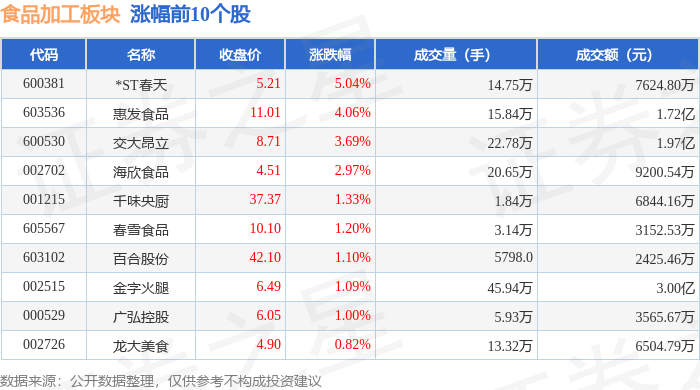
食品加工板块10月20日涨0.14%,*ST春天领涨,主力资金净流出5382.64万元
Zheng Xing Xing Ye Ri Bao· 2025-10-20 08:30
Market Overview - On October 20, the food processing sector rose by 0.14% compared to the previous trading day, with *ST Chuntian leading the gains [1] - The Shanghai Composite Index closed at 3863.89, up 0.63%, while the Shenzhen Component Index closed at 12813.21, up 0.98% [1] Stock Performance - The top performers in the food processing sector included: - *ST Chuntian (600381) with a closing price of 5.21, up 5.04% with a trading volume of 147,500 shares and a turnover of 76.248 million yuan [1] - Huifa Food (603536) closed at 11.01, up 4.06% with a trading volume of 158,400 shares and a turnover of 172 million yuan [1] - Jiaoda Anli (600530) closed at 8.71, up 3.69% with a trading volume of 227,800 shares and a turnover of 197 million yuan [1] Capital Flow - The food processing sector experienced a net outflow of 53.8264 million yuan from institutional investors, while retail investors saw a net inflow of 46.0448 million yuan [2] - The capital flow for individual stocks showed: - Jiaoda Anli (600530) had a net inflow of 18.9711 million yuan from institutional investors [3] - *ST Chuntian (600381) had a net inflow of 13.8693 million yuan from institutional investors [3] - Double Happiness Development (000895) had a net inflow of 18.8154 million yuan from institutional investors [3]


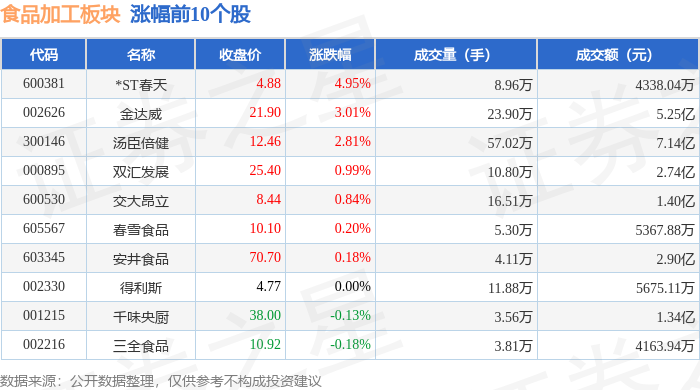
食品加工板块10月16日涨0.49%,*ST春天领涨,主力资金净流出1.06亿元
Zheng Xing Xing Ye Ri Bao· 2025-10-16 08:20
Market Overview - The food processing sector increased by 0.49% on October 16, with *ST Chuntian leading the gains [1] - The Shanghai Composite Index closed at 3916.23, up 0.1%, while the Shenzhen Component Index closed at 13086.41, down 0.25% [1] Stock Performance - *ST Chuntian (600381) closed at 4.88, up 4.95% with a trading volume of 89,600 shares and a turnover of 43.38 million yuan [1] - Quandawei (002626) closed at 21.90, up 3.01% with a trading volume of 239,000 shares and a turnover of 52.5 million yuan [1] - Tangchen Beijian (300146) closed at 12.46, up 2.81% with a trading volume of 570,200 shares and a turnover of 714 million yuan [1] - Shuanghui Development (000895) closed at 25.40, up 0.99% with a trading volume of 108,000 shares and a turnover of 274 million yuan [1] - Other notable stocks include Jiaoda Anli (600530) and Chunxue Food (605567), with minor increases of 0.84% and 0.20% respectively [1] Capital Flow - The food processing sector experienced a net outflow of 106 million yuan from institutional investors, while retail investors saw a net inflow of 69.89 million yuan [2] - The overall capital flow indicates a mixed sentiment, with institutional investors withdrawing funds while retail investors are actively buying [2] Individual Stock Capital Flow - Anjiu Food (603345) had a net inflow of 18.59 million yuan from institutional investors, while retail investors had a net outflow of 34.42 million yuan [3] - Jiaoda Anli (600530) saw a net inflow of 16.91 million yuan from institutional investors, but retail investors had a net outflow of 9.50 million yuan [3] - *ST Chuntian (600381) had a net inflow of 11.76 million yuan from institutional investors, with retail investors also experiencing a net outflow [3]


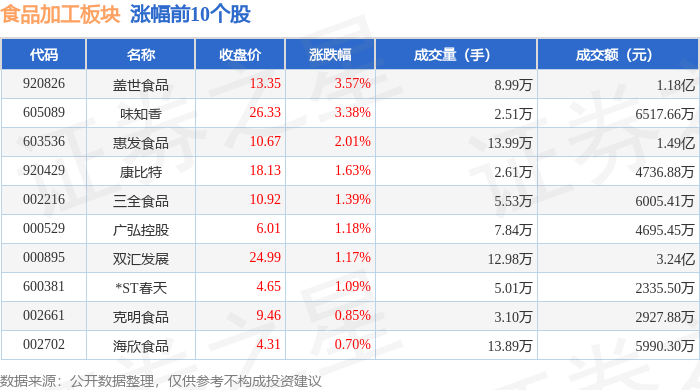
食品加工板块10月14日涨0.04%,盖世食品领涨,主力资金净流出1.25亿元
Zheng Xing Xing Ye Ri Bao· 2025-10-14 08:39
Market Overview - On October 14, the food processing sector rose by 0.04% compared to the previous trading day, with Gai Shi Food leading the gains [1] - The Shanghai Composite Index closed at 3865.23, down 0.62%, while the Shenzhen Component Index closed at 12895.11, down 2.54% [1] Stock Performance - Gai Shi Food (code: 920826) closed at 13.35, up 3.57% with a trading volume of 89,900 shares and a turnover of 118 million yuan [1] - Wei Zhi Xiang (code: 605089) closed at 26.33, up 3.38% with a trading volume of 25,100 shares and a turnover of 65.18 million yuan [1] - Hui Fa Food (code: 603536) closed at 10.67, up 2.01% with a trading volume of 139,900 shares and a turnover of 149 million yuan [1] - Other notable performers include Kang Bi Te (code: 920429) up 1.63% and Shuanghui Development (code: 000895) up 1.17% [1] Capital Flow - The food processing sector experienced a net outflow of 125 million yuan from institutional investors, while retail investors saw a net inflow of 140 million yuan [2] - The overall capital flow indicates a mixed sentiment, with institutional investors pulling back while retail investors are more active [2] Individual Stock Capital Flow - ST Chuntian (code: 600381) had a net inflow of 3.86 million yuan from institutional investors, while it faced a net outflow of 3.76 million yuan from speculative funds [3] - Hui Fa Food (code: 603536) saw a net inflow of 2.40 million yuan from institutional investors, but a net outflow of 2.55 million yuan from retail investors [3] - Shuanghui Development (code: 000895) had a net inflow of 1.87 million yuan from institutional investors, with a significant outflow of 38.42 million yuan from speculative funds [3]


食品加工板块10月10日涨0.81%,光明肉业领涨,主力资金净流出426.1万元
Zheng Xing Xing Ye Ri Bao· 2025-10-10 08:46
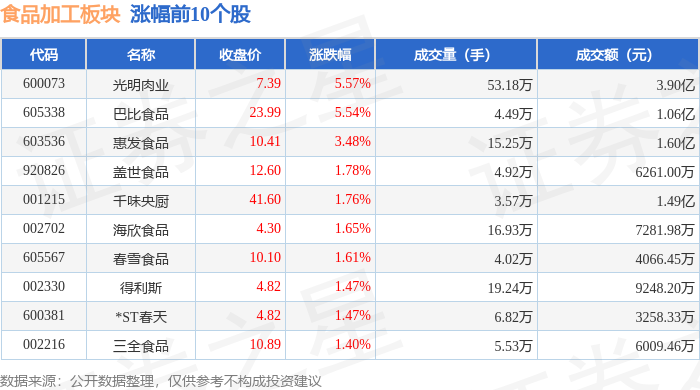
Core Insights - The food processing sector experienced a rise of 0.81% on October 10, with Bright Meat Industry leading the gains [1] - The Shanghai Composite Index closed at 3897.03, down 0.94%, while the Shenzhen Component Index closed at 13355.42, down 2.7% [1] Food Processing Sector Performance - Bright Meat Industry (600073) closed at 7.39, up 5.57% with a trading volume of 531,800 shares and a transaction value of 390 million [1] - Other notable performers included: - Baba Food (605338) at 23.99, up 5.54% [1] - Huifa Food (603536) at 10.41, up 3.48% [1] - Gai Shi Food (920826) at 12.60, up 1.78% [1] - Qianwei Central Kitchen (001215) at 41.60, up 1.76% [1] Capital Flow Analysis - The food processing sector saw a net outflow of 4.261 million from institutional investors, while retail investors had a net inflow of 11.6 million [2] - Key stocks with significant capital flow included: - Bright Meat Industry with a net inflow of 43.4 million from institutional investors [3] - Anji Food (603345) with a net inflow of 12.8 million from institutional investors [3] - Tang Chen Bei Jian (300146) with a net inflow of 12.3 million from institutional investors [3]


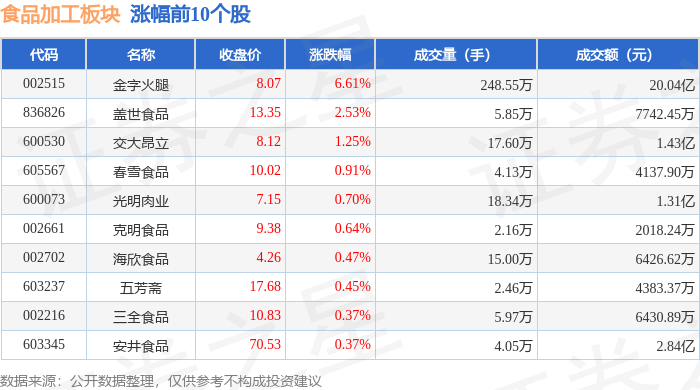
食品加工板块9月26日跌0.04%,味知香领跌,主力资金净流出1835.41万元
Zheng Xing Xing Ye Ri Bao· 2025-09-26 08:42
Market Overview - On September 26, the food processing sector experienced a slight decline of 0.04% compared to the previous trading day, with Wei Zhi Xiang leading the drop [1] - The Shanghai Composite Index closed at 3828.11, down 0.65%, while the Shenzhen Component Index closed at 13209.0, down 1.76% [1] Stock Performance - Jinzi Ham (002515) saw a significant increase of 6.61%, closing at 8.07 with a trading volume of 2.4855 million shares and a transaction value of 2.004 billion [1] - Wei Zhi Xiang (605089) led the declines with a drop of 4.53%, closing at 27.61 with a trading volume of 41,000 shares and a transaction value of 115 million [2] - Other notable performers included Gai Shi Food (836826) with a 2.53% increase and Longda Meishi (002726) with a 2.42% decrease [2] Capital Flow Analysis - The food processing sector experienced a net outflow of 18.3541 million from institutional investors, while retail investors saw a net inflow of 65.5132 million [2] - The capital flow data indicates that Jinzi Ham had a net inflow of 94.3197 million from institutional investors, while it faced a net outflow of 56.9452 million from speculative funds [3] - The overall trend shows that while institutional and speculative funds are withdrawing, retail investors are actively buying into the sector [2][3]