
AGRICULTURAL BANK OF CHINA(ACGBY)

Search documents
2024年一季报点评:业绩微降,关注中期分红安排
Guoxin Securities· 2024-05-01 06:04
Investment Rating - The investment rating for the company is "Buy (Maintain)" [4] Core Views - The company reported a slight decline in revenue and net profit in Q1 2024, but remains in a relatively strong position among large banks [12] - The company has a unique advantage in county-level financial services, with a focus on manufacturing, green finance, and inclusive finance [12] - The board has decided on a mid-term dividend arrangement for 2024, indicating a commitment to returning value to shareholders [12] Financial Forecasts and Key Metrics - Revenue (in million yuan) is projected to be 730,460 in 2024, with a growth rate of 5.1% [3] - Net profit attributable to shareholders is expected to reach 295,190 million yuan in 2024, reflecting a year-on-year increase of 9.6% [3] - The diluted earnings per share (EPS) is forecasted to be 0.84 yuan in 2024, increasing to 0.93 yuan by 2026 [3] - The return on equity (ROE) is projected to be 11.8% in 2024, slightly improving in subsequent years [3] - The dividend payout ratio for the mid-term dividend is expected to be no more than 30% of the net profit attributable to shareholders for the first half of 2024 [12] Financial Performance Indicators - The company reported total assets of 42.2 trillion yuan at the end of Q1 2024, with a loan balance of 23.9 trillion yuan [12] - The non-performing loan ratio stands at 1.32%, indicating stable asset quality [12] - The capital adequacy ratio is deemed reasonable, with a core Tier 1 capital ratio of 11.37% [12]
基本面稳健,县域和重点领域表现亮眼
Xinda Securities· 2024-04-30 09:00
Investment Rating - The investment rating for Agricultural Bank of China is "Accumulate" [1]. Core Views - The report highlights that while revenue and profit growth have declined, the performance remains better than comparable peers. In Q1 2024, the bank's net profit attributable to shareholders decreased by 1.63% year-on-year, and operating income fell by 1.76% year-on-year, compared to a 3.91% and 0.03% increase in 2023 respectively [1][3]. - The decline in profit is primarily attributed to the pressure on net interest margin, while the expansion in scale has positively contributed to performance. The net interest margin for Q1 2024 was 1.44%, down 26 basis points year-on-year, but the decline has narrowed compared to previous periods [1][3]. - The bank has increased its focus on county-level financial services, with significant growth in loans and advances in rural areas, which rose by 16.78% year-on-year, surpassing the overall loan growth rate of 12.92% [1][3]. - Asset quality indicators are improving, with a non-performing loan ratio of 1.32% at the end of Q1 2024, down 5 basis points year-on-year, and a provision coverage ratio of 303.22%, indicating strong risk resilience [1][3]. Summary by Sections Financial Performance - In Q1 2024, the bank's net interest income was 5,718 million, with a year-on-year growth rate of -1.76%. The net profit attributable to shareholders was 2,694 million, reflecting a growth rate of 3.94% [1][6]. - The report forecasts a slight recovery in profit growth, with expected net profit growth rates of 1.88%, 4.12%, and 5.26% for the years 2024E, 2025E, and 2026E respectively [1][6]. Capital Adequacy - As of Q1 2024, the core Tier 1 capital adequacy ratio was 11.37%, indicating a reasonable level of capital adequacy. The bank is actively working on enhancing its capital base through the issuance of subordinated bonds and perpetual bonds [1][3]. Loan and Deposit Growth - Total loans and deposits have shown robust growth, with total loans increasing by 12.92% year-on-year and total deposits by 12.25% year-on-year as of Q1 2024 [1][3]. Strategic Focus - The bank is strategically focusing on expanding its services in rural finance and key sectors, aiming to become a leading bank in supporting rural revitalization and serving the real economy [1][3].
农业银行(601288) - 2024 Q1 - 季度财报
2024-04-29 11:06
Financial Performance - Total operating income for Q1 2024 was RMB 186,021 million, a decrease of 1.76% compared to the same period last year[18]. - Net profit attributable to shareholders of the parent company was RMB 70,386 million, down 1.63% year-on-year[18]. - Basic earnings per share were RMB 0.19, representing a decrease of 5.00% year-on-year[18]. - The group reported a net profit of 70.839 billion RMB for the period, a decrease of 1.77% year-on-year[46]. - Net interest income was 144.535 billion RMB, down 0.74% year-on-year, with a net interest margin of 1.44%[29]. - Net fee and commission income decreased by 10.79% year-on-year to 29.037 billion RMB[29]. - The group's investment income for the first quarter of 2024 was RMB 3,664 million, compared to RMB 4,607 million in the same period of 2023, indicating a decline of approximately 20.4%[71]. - The group's fee and commission income was RMB 32,505 million for the first quarter of 2024, down from RMB 35,930 million in the same period last year, reflecting a decrease of about 9.5%[71]. - The group reported a total comprehensive income of RMB 66,038 million for the first quarter of 2024, compared to RMB 60,103 million for the same period in 2023, representing an increase of about 9.8%[73]. Cash Flow and Liquidity - Net cash flow from operating activities was RMB 783,563 million, reflecting a decline of 13.50% compared to the previous year[18]. - The group's cash inflow from operating activities for the three months ended March 31, 2024, was RMB 2,619,025 million, a decrease of 16.9% compared to RMB 3,151,941 million for the same period in 2023[75]. - The net cash outflow from investing activities was RMB 1,187,549 million for the three months ended March 31, 2024, compared to RMB 222,880 million for the same period in 2023, indicating a significant increase in investment expenditures[79]. - Cash inflow from financing activities amounted to RMB 869,401 million for the three months ended March 31, 2024, up from RMB 623,968 million in the same period of 2023, reflecting increased debt issuance[79]. - The net cash flow from financing activities was RMB 63,340 million for the three months ended March 31, 2024, compared to a net outflow of RMB 16,034 million for the same period in 2023, showing a positive shift in financing[79]. - The group received RMB 739,677 million from the recovery of investments during the three months ended March 31, 2024, an increase from RMB 512,320 million in the same period of 2023[79]. - The cash received from investment income was RMB 85,267 million for the three months ended March 31, 2024, compared to RMB 70,318 million for the same period in 2023, reflecting growth in investment returns[79]. Assets and Liabilities - Total assets at the end of the reporting period reached RMB 42,157,279 million, an increase of 5.73% from the end of the previous year[18]. - Total liabilities reached RMB 39,158.06 billion, an increase of RMB 21,819.34 billion or 5.90% compared to the end of the previous year[49]. - The total assets of the group as of March 31, 2024, reached RMB 42,157,279 million, an increase from RMB 39,872,989 million as of December 31, 2023, representing a growth of approximately 5.7%[69]. - The total liabilities of the group as of March 31, 2024, were RMB 39,872,989 million, an increase from RMB 37,000,000 million as of December 31, 2023, reflecting a growth of approximately 7.8%[69]. - The total amount of loans and advances was 23,863.600 billion RMB, up 5.52% from the end of the previous year[29]. - The balance of manufacturing loans was RMB 33,256 billion, reflecting a growth of RMB 3,737 billion or 12.66%[52]. - The balance of green credit business reached RMB 48,154 billion, an increase of RMB 7,667 billion or 18.94%[52]. Shareholder Information - The company reported a decrease in the number of ordinary shareholders, with the top ten shareholders holding significant stakes[9][10]. - Cash dividends of RMB 4.84 per share were distributed to shareholders, totaling RMB 19.36 billion[54]. - The group's earnings per share for the first quarter of 2024 were RMB 0.25, compared to RMB 0.26 for the same period in 2023, indicating a decrease of approximately 3.8%[73]. Capital and Ratios - The capital adequacy ratio, tier 1 capital adequacy ratio, and core tier 1 capital adequacy ratio were 18.40%, 13.77%, and 11.37% respectively as of March 31, 2024[52]. - The average liquidity coverage ratio for the first quarter of 2024 was 131.17%[52]. - The weighted average return on net assets (annualized) was 11.39%, a decrease of 1.21 percentage points[18]. - The annualized average return on total assets was 0.69%, down 0.13 percentage points year-on-year[46]. - The annualized weighted average return on equity was 11.39%, a decrease of 1.21 percentage points year-on-year[47].
农业银行(01288) - 2024 Q1 - 季度业绩
2024-04-29 08:30
Financial Performance - The operating income for the first quarter of 2024 was RMB 186,147 million, representing a decrease of 1.70% compared to the same period last year[5]. - The net profit attributable to shareholders of the parent company was RMB 70,386 million, down by 1.63% year-on-year[5]. - For the three months ended March 31, 2024, the group achieved a net profit of RMB 70.839 billion, a decrease of 1.77% year-on-year[13]. - The net profit for the three months ended March 31, 2024, was RMB 70,839 million, compared to RMB 72,115 million for the same period in 2023[23]. - The bank's net profit before tax for the first quarter of 2024 was RMB 79,439 million, down from RMB 83,027 million in the same period of 2023, indicating a decrease of about 4.8%[27]. Earnings and Returns - The basic earnings per share were RMB 0.19, a decrease of 5.00% from the same period last year[5]. - The annualized weighted average return on net assets was 11.39%, a decrease of 1.21 percentage points year-on-year[5]. - The annualized average return on total assets was 0.69%, a decrease of 0.13 percentage points year-on-year[13]. Assets and Liabilities - The total assets at the end of the reporting period were RMB 42,157,279 million, an increase of 5.73% from the end of the previous year[5]. - Total assets as of March 31, 2024, amounted to RMB 42,157.279 billion, an increase of RMB 228.429 billion or 5.73% compared to the end of the previous year[14]. - Total liabilities reached RMB 39,158.056 billion, an increase of RMB 218.193 billion or 5.90% compared to the end of the previous year[14]. - Total liabilities amounted to RMB 39,158,056 million, up from RMB 36,976,122 million, indicating an increase of approximately 5.3%[26]. Cash Flow - The net cash flow from operating activities was RMB 783,563 million, reflecting a decline of 13.50% compared to the previous year[5]. - The bank's net cash flow from operating activities for the first quarter of 2024 was RMB 783,563 million, compared to RMB 905,857 million in the same period of 2023, showing a decrease of about 13.5%[27]. - The bank's investment activities resulted in a net cash outflow of RMB 1,187,549 million for the first quarter of 2024, compared to RMB 222,880 million in the same period of 2023[28]. Shareholder Information - The total number of ordinary shareholders at the end of the reporting period was 418,187, with 397,782 being A-share shareholders and 20,405 being H-share shareholders[6]. - Central Huijin Investment Ltd. held 40.14% of the shares, while the Ministry of Finance held 35.29%[6]. - Central Huijin Investment Ltd. plans to continue increasing its stake in the company over the next six months[8]. - A cash dividend of RMB 4.84 per share was distributed to shareholders, totaling RMB 1,936 million (including tax) on March 11, 2024[20]. Customer Loans and Deposits - Customer loans and advances totaled RMB 23,863.600 billion, increasing by RMB 124.897 billion or 5.52% from the end of the previous year[14]. - Customer loans and advances increased to RMB 22,921,347 million from RMB 21,731,766 million, reflecting a growth of about 5.5%[25]. - Customer deposits amounted to RMB 31,060.509 billion, up RMB 216.204 billion or 7.48% from the end of the previous year[14]. - The bank's total deposits increased to RMB 31,060,509 million from RMB 28,898,468 million, reflecting a growth of approximately 7.5%[25]. Non-Performing Loans - The non-performing loan balance was RMB 315.325 billion, with a non-performing loan ratio of 1.32%, a decrease of 0.01 percentage points from the end of the previous year[15]. - The provision coverage ratio stood at 303.22%, a decrease of 0.65 percentage points from the end of the previous year[15]. Capital and Liquidity - The capital adequacy ratio, Tier 1 capital adequacy ratio, and core Tier 1 capital adequacy ratio were 18.40%, 13.77%, and 11.37%, respectively, as of March 31, 2024[18]. - The average liquidity coverage ratio for the first quarter of 2024 was 131.17%[18]. - The bank issued RMB 40 billion of non-fixed-term capital bonds in the interbank bond market in March 2024[19]. Sector-Specific Loans - The balance of loans in the manufacturing sector was RMB 3,325.60 billion, up by RMB 373.70 billion, or 12.66% year-on-year[17]. - The balance of green credit business reached RMB 4,815.40 billion, an increase of RMB 766.70 billion, or 18.94% compared to the previous year[17]. - The balance of inclusive finance loans was RMB 4,392.50 billion, increasing by RMB 809.80 billion, or 22.60% year-on-year[17]. Equity - The equity attributable to shareholders of the parent company was RMB 2,991,892 million, up by 3.55% compared to the end of the previous year[5]. - The bank's equity totalled RMB 2,999,223 million as of March 31, 2024, an increase from RMB 2,896,867 million at the end of 2023, representing a growth of approximately 3.5%[26]. - The bank issued other equity instruments, raising RMB 40,000 million during the first quarter of 2024[28].
农业银行(01288) - 2023 - 年度财报
2024-04-26 09:00
Financial Performance - The bank achieved a net profit of RMB 269.82 billion for the year 2023, reflecting its strong financial performance[2]. - The company achieved an operating income of RMB 695.5 billion in 2023, maintaining positive growth, and a net profit of RMB 269.8 billion, an increase of 4.2% year-on-year[13]. - Net profit attributable to shareholders was RMB 269,356 million in 2022, compared to RMB 259,140 million in 2021, reflecting a growth of 4.7%[9]. - The net profit for 2023 reached RMB 269.82 billion, an increase of RMB 10.95 billion or 4.2% from the previous year[25]. - The pre-tax profit increased by 16.2% to RMB 152,549 million in 2023, up from RMB 131,317 million in 2022[145]. Asset and Liability Management - As of the end of 2023, Agricultural Bank of China's total assets reached RMB 39,872.99 billion, with customer loans and advances totaling RMB 22,614.62 billion and deposits amounting to RMB 28,898.47 billion[2]. - Total assets reached RMB 39,872,989 million as of December 31, 2023, up from RMB 33,927,533 million in 2022, representing a growth of 17.5%[8]. - Total liabilities amounted to RMB 36,976,122 million, an increase of 18.5% from RMB 31,253,082 million in 2022[8]. - Total liabilities reached RMB 36,976.12 billion as of December 31, 2023, an increase of RMB 57,243.94 billion or 18.3% year-over-year[63]. Credit Quality - The bank's non-performing loan ratio was reported at 1.5% as of December 31, 2023, consistent with the previous year[8]. - The non-performing loan ratio improved to 1.33%, a decrease of 0.04 percentage points from the previous year, with a provision coverage ratio of 303.87%[11]. - The total non-performing loans (NPLs) reached RMB 300,760 million as of December 31, 2023, with a non-performing loan ratio of 1.33%[166]. - The company continues to maintain a strong asset quality in its credit card business, positioning itself among the industry leaders[155]. Capital Adequacy - The capital adequacy ratio stood at 17.14%, indicating a solid capital position[2]. - The bank's capital adequacy ratio stood at 14.5%, indicating a strong capital position to support future growth[8]. - The bank's capital adequacy ratio and leverage ratio details can be found in the 2023 Capital Adequacy Report published on the Shanghai and Hong Kong Stock Exchanges[199]. Digital Transformation and Innovation - The bank's digital transformation framework has been established, enhancing data-driven business operations and marketing effectiveness[16]. - The digital loan product "Agricultural Bank e-loan" surpassed 4 trillion yuan by the end of 2023, reflecting the company's commitment to digital transformation[22]. - The company has completed the migration of over 800 million personal customers and 1.8 billion personal accounts to a distributed architecture, marking the largest system migration in the industry[121]. Customer Base and Market Position - The total number of personal customers reached 867 million, maintaining the first position in the industry[15]. - The total number of personal customers reached 867 million, maintaining the industry lead, with financial assets amounting to 20.29 trillion yuan[82]. - The domestic personal deposit balance was 17.11 trillion yuan, an increase of 2.13 trillion yuan compared to the end of the previous year, continuing to lead the industry[83]. Strategic Focus and Initiatives - The bank emphasizes its role as a leading bank in serving rural revitalization and the real economy, focusing on inclusive finance, green finance, and digital operations[2]. - The bank plans to expand its market presence through strategic partnerships and technological advancements in the coming year[8]. - The company plans to enhance its focus on technology finance, green finance, and digital finance as part of its strategic initiatives for 2024[21]. Risk Management - The company is enhancing its comprehensive risk management system to better identify and control risks in key economic sectors[147]. - The company is focusing on optimizing credit risk management, particularly in the real estate sector, to mitigate potential risks[153]. - The liquidity risk management framework includes a decision-making system, execution system, and supervision system to ensure timely fulfillment of liquidity needs[182]. ESG and Sustainability - The bank aims to integrate sustainable development concepts into its management, focusing on ESG (Environmental, Social, and Governance) management systems[200]. - In 2023, the bank was recognized as one of the top ten "China ESG Model" enterprises and received multiple awards for its ESG practices[200]. - The bank's MSCI ESG rating has improved to "AA" in 2023[200].
农业银行:农业银行关于2024年二级资本债券(第二期)发行完毕的公告
2024-04-25 09:38
经相关监管机构批准,中国农业银行股份有限公司(以 下简称"本行")在全国银行间债券市场公开发行"中国农业银 行股份有限公司 2024 年二级资本债券(第二期)"(以下简 称"本期债券"),于 2024 年 4 月 25 日发行完毕。 证券代码:601288 证券简称:农业银行 公告编号:临 2024-016 号 中国农业银行股份有限公司 关于 2024 年二级资本债券(第二期) 发行完毕的公告 中国农业银行股份有限公司董事会及全体董事保证本公告内容不存在任何 虚假记载、误导性陈述或者重大遗漏,并对其内容的真实性、准确性和完整性 承担法律责任。 二〇二四年四月二十五日 1 本期债券发行总规模为人民币 600 亿元,分为两个品种, 其中品种一为 10 年期固定利率债券,发行规模为 300 亿元, 票面利率为 2.32%,在第 5 年末附有前提条件的发行人赎回 权;品种二为 15 年期固定利率债券,发行规模为 300 亿元, 票面利率为 2.49%,在第 10 年末附有前提条件的发行人赎回 权。 本期债券募集的资金将依据适用法律和监管部门的批准, 补充本行的二级资本。 特此公告。 中国农业银行股份有限公司董事会 ...
商业银行年内发行“二永债”规模已达4070亿元 较去年同期增长55.8%
Cai Jing Wang· 2024-04-19 02:39
Core Insights - Several commercial banks, including Agricultural Bank of China, Bohai Bank, and Industrial Bank, have successfully issued varying scales of secondary capital bonds or perpetual bonds in the interbank bond market [1] - The issuance of secondary capital bonds and perpetual bonds helps improve the capital adequacy ratio of commercial banks [1] Group 1: Issuance Trends - As of April 18, 2023, nine commercial banks have issued a total of 407 billion yuan in "two perpetual bonds" (secondary capital bonds and perpetual bonds combined), representing a year-on-year increase of 55.8% [1] - Among the total issuance, secondary capital bonds accounted for 314 billion yuan (77.1%), while perpetual bonds made up 93 billion yuan (22.9%) [1] - State-owned banks have been particularly active in bond issuance, with China Bank, Agricultural Bank, and Construction Bank issuing a total of 280 billion yuan in secondary capital bonds this year [1] Group 2: Capital Supplementation Needs - The increase in issuance volume compared to the same period last year is attributed to stronger capital supplementation needs, regulatory guidance encouraging market-based capital replenishment, and a favorable interest rate environment [1] - The overall capital adequacy ratio of commercial banks is facing downward pressure, with capital adequacy ratios reported at 15.06%, 12.12%, and 10.54% for total, tier 1, and core tier 1 capital respectively, all showing declines from the end of 2022 [1] - The decline in core tier 1 capital adequacy ratio is primarily due to increased risk-weighted assets from declining asset quality, reduced net profit growth affecting internal capital replenishment, and the need for more capital due to increased credit issuance [1] Group 3: TLAC Requirements - Despite currently high capital adequacy ratios, major state-owned banks need to enhance their TLAC (Total Loss-Absorbing Capacity) to meet regulatory requirements, which will require a TLAC ratio of 16% by early 2025 [2] - Different types of banks are expected to adopt various strategies for capital supplementation, including internal capital retention, issuance of secondary capital bonds, preferred shares, and perpetual bonds, as well as asset restructuring and strategic investor introduction [2] - Large banks are likely to prefer issuing long-term capital instruments in the capital market, while smaller banks may rely more on restructuring, mergers and acquisitions, and profit retention for capital supplementation [2]


高股息助推估值修复,国有大行股价创近年新高
3 6 Ke· 2024-04-19 00:51
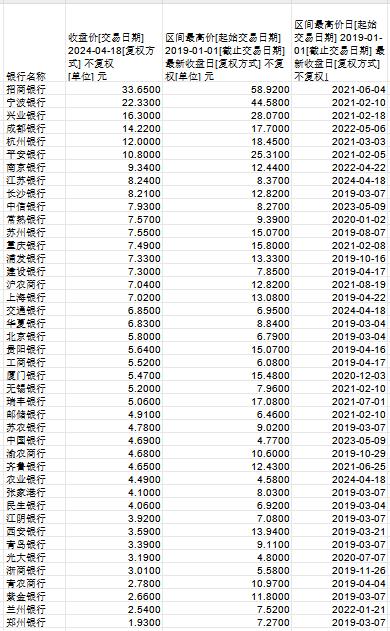
Group 1: Bank Stock Performance - Bank stocks have shown significant gains in April 2024, with major state-owned banks reaching multi-year highs, such as Agricultural Bank at 4.58 CNY and Bank of Communications at 6.95 CNY [1][2] - Central Huijin's support through share buybacks has contributed to the rise in bank stock prices, with over 1 billion shares accumulated across major banks [2] - The overall banking sector is recovering, driven by high dividend yields, with bank dividends maintaining above 5% since mid-2022, outperforming the broader market [1][2] Group 2: Financial Performance and Valuation - The net profit of major banks like CITIC Bank increased by 7.91% in 2023, with a non-performing loan ratio of 1.18%, indicating improved financial health [2][3] - Despite the positive performance of some banks, there is a notable divergence, with certain joint-stock banks experiencing profit declines of over 40% compared to their historical highs [3] - The average price-to-book (PB) ratio for listed banks remains below 1, indicating low valuation levels, with some banks like Minsheng Bank at 0.34 and Pudong Development Bank at 0.35 [5][6] Group 3: Market and Economic Context - The banking sector's recovery is supported by government policies aimed at stabilizing the financial market and addressing risks associated with real estate and local government financing [7][8] - Recent economic data shows a GDP growth of 5.3% in Q1 2024, which is expected to bolster the banking sector's performance and valuation recovery [8] - The shift in market sentiment towards high-dividend strategies reflects a broader trend in investor behavior, favoring stability in uncertain economic conditions [1][2]
价格高涨库存紧张 银条打首饰火了
Zhong Guo Jing Ji Wang· 2024-04-18 23:19
Core Viewpoint - The demand for raw investment silver bars is surging due to high silver prices, with many consumers purchasing them for investment purposes or to create jewelry, leading to tight inventory levels in various sales channels [1][2]. Group 1: Market Demand and Pricing - Raw investment silver bars are sold out or in tight supply across various platforms, while certain bank-sold silver bars remain available at higher prices due to their collectible value [1]. - As of April 18, the price of silver was reported at 7.046 yuan per gram, with a 500-gram raw investment silver bar priced at 4,050 yuan, compared to 7,545 yuan for a similar bank-sold product [1]. - Consumers are increasingly turning to online platforms for purchasing silver bars, although there are concerns about counterfeit products [1][2]. Group 2: Processing Costs and Regional Variations - Consumers find it more cost-effective to buy silver bars and have them processed into jewelry rather than purchasing finished silver items directly [2]. - Processing fees for silver jewelry vary significantly by region, with costs for a popular bracelet style ranging from 4 yuan to 10 yuan per gram depending on the location [2]. - Different processing shops have varying policies on handling material loss during the processing of silver, affecting overall costs for consumers [2]. Group 3: Silver Price Trends and Market Analysis - As of April 17, COMEX silver futures closed at $28.295 per ounce, reflecting a more than 23% increase since March [3]. - Analysts suggest that the rising price of silver is supported by its dual role as both a financial and industrial commodity, with increasing demand in sectors like photovoltaics and AI [3]. - Supply constraints are anticipated due to the nature of silver mining, which is often a byproduct of other metal mining, potentially leading to a supply-demand gap that could further elevate silver prices [3].
农业银行:农业银行H股公告
2024-04-17 09:24
董事會 香港交易及結算所有限公司及香港聯合交易所有限公司對本公告的內容概不負責,對其準確性或完整性亦不發表 任何聲明,並明確表示,概不對因本公告全部或任何部份內容而產生或因倚賴該等內容而引致的任何損失承擔任 何責任。 董事會會議召開日期 中國農業銀行股份有限公司(「本行」)董事會(「董事會」)謹此宣佈,本行將於2024年4月 29日(星期一)召開董事會會議,以考慮及批准(其中包括)本行截至2024年3月31日的第 一季度業績。 中國農業銀行股份有限公司 中國農業銀行股份有限公司 AGRICULTURAL BANK OF CHINA LIMITED (於中華人民共和國註冊成立之股份有限公司) (股份代號:1288) 中國北京 2024年4月17日 於本公告日期,本行的執行董事為谷澍先生、張旭光先生和林立先生;本行的非執行董事為周濟女士、李蔚先生、 劉曉鵬先生、肖翔先生和張奇先生;本行的獨立非執行董事為黃振中先生、梁高美懿女士、劉守英先生、 吳聯生先生和汪昌雲先生。 ...