Mastercard(MA)

Search documents
Mastercard said to weigh Zerohash investment after ending takeover talks worth billions
Yahoo Finance· 2026-01-20 16:50
Core Viewpoint - Mastercard is exploring a strategic investment in blockchain infrastructure firm Zerohash after acquisition discussions ended, as Zerohash chose to remain independent [1][2]. Group 1: Acquisition Talks - Mastercard was in late-stage talks to acquire Zerohash for up to $2 billion, but these discussions have concluded [2]. - Zerohash has stated it is not considering an acquisition by Mastercard and aims to maintain its independence to foster innovation [3]. Group 2: Investment and Market Activity - Despite the end of acquisition talks, investment discussions between Mastercard and Zerohash are ongoing [2]. - The crypto merger and acquisition landscape is becoming more active, with a shift towards proven infrastructure projects rather than speculative protocols [4]. Group 3: Company Background and Financials - Zerohash raised $104 million in a Series D-2 funding round in October last year, achieving a valuation of $1 billion [5]. - The funding round included participation from notable investors such as Morgan Stanley and Apollo-managed funds [6]. - Founded in 2017, Zerohash provides APIs and developer tools for financial institutions to integrate crypto services, reaching over 5 million users across 190 countries [7].

Consumers push back on swipe fees: survey
Yahoo Finance· 2026-01-20 10:23
This story was originally published on Payments Dive. To receive daily news and insights, subscribe to our free daily Payments Dive newsletter. Nearly a third of small businesses that assess credit card surcharges say that customers cancel purchases when they see the extra fee at checkout, according to J.D. Power survey released last week. The data and analytics firm queried roughly 4,400 U.S. small businesses and found 35% include surcharges for customers who use credit cards, up slightly from 34% in th ...

Merchant lawyers laud surcharge option
Yahoo Finance· 2026-01-20 09:17
This story was originally published on Payments Dive. To receive daily news and insights, subscribe to our free daily Payments Dive newsletter. Merchants should support a swipe-fee settlement with Visa and Mastercard because it gives them more flexibility to impose surcharges, according to plaintiffs in a 21-year-old lawsuit targeting Visa and Mastercard fees. A proposed settlement with the two largest card networks over interchange fees and card-acceptance rules presents an opportunity to educate consume ...
What Do Analysts Think About Mastercard Incorporated (MA)?
Yahoo Finance· 2026-01-18 17:29
Group 1 - Mastercard Incorporated (NYSE:MA) is considered one of the best stocks to buy in 2026 for beginners, with multiple analysts providing positive rating updates [1] - Citi reiterated a Buy rating on Mastercard and set a price target of $735, indicating strong confidence in the stock's performance [1] - Compass Point upgraded Mastercard from Neutral to Buy, raising the price target from $620 to $735, and expressed a favorable outlook for the payment networks sector [2] - TD Cowen increased the price target for Mastercard from $654 to $668 while maintaining a Buy rating, citing steady fundamentals and resilience in consumer spending [3] Group 2 - Mastercard operates as a technology company providing payment solutions, including debit, credit, prepaid, and commercial payment programs, under brands like Mastercard, Cirrus, and Maestro [3] - The company also offers intelligence and cyber solutions, enhancing its service portfolio [3]
Should You Buy, Sell, or Hold Mastercard Stock for January 2026?
Yahoo Finance· 2026-01-18 16:00
In addition to handling payments, it delivers fraud protection, data analytics, and modern digital solutions that help make buying and selling easier and more accessible for everyone. With a towering market capitalization of about $484.86 billion, payment powerhouse Mastercard delivered a decent performance in 2025, with its shares climbing roughly 8%, edging out rival Visa (V), which gained about 6.8% over the same period.Founded in 1966, New York-based Mastercard is a global payments technology company th ...
With Financial Stocks Suddenly Tanking, Is Now the Time to Buy?
Yahoo Finance· 2026-01-17 12:05
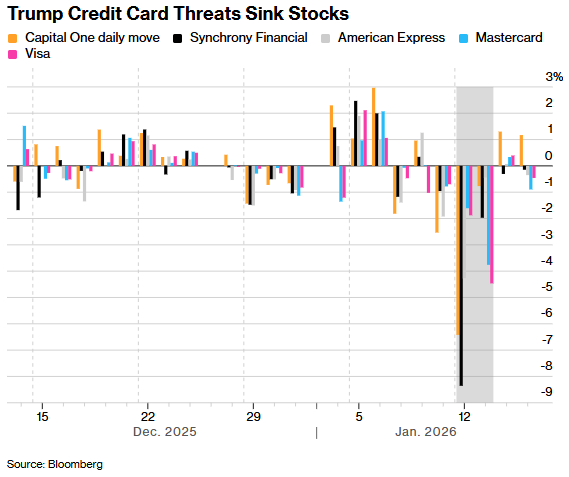
Core Viewpoint - The financial sector, particularly credit card issuers, is currently experiencing stock price declines despite potential long-term profitability due to proposed regulatory changes on interest rates [2][8]. Group 1: Impact of Proposed Interest Rate Cap - President Trump proposed a one-year, 10% cap on credit card interest rates, effective January 20, which has led to significant declines in stock prices of major credit card issuers [2][3]. - Major credit card issuers such as Bank of America, JPMorgan Chase, American Express, Capital One Financial, and Citigroup saw stock declines ranging from 4.5% to 9.9% following the announcement [9]. - Payment networks Visa and Mastercard also experienced stock drops of 8% and 6.9%, respectively, indicating a broader impact on the financial sector [4]. Group 2: Historical Context and Legislative Challenges - Previous attempts to cap credit card interest rates have failed, with a similar proposal by Senator Bernie Sanders stalling in Congress last year [5][6]. - The financial industry is expected to strongly oppose the current proposal, suggesting that it is unlikely to be enacted [6][7]. - Analysts predict that the banking industry will effectively counter this proposal before it gains traction [7].



Why Mastercard's API-First Strategy Is Becoming a Growth Multiplier
ZACKS· 2026-01-16 19:01
Core Insights - Mastercard's API-first strategy is transforming its role from a traditional card network to a key player in the payments infrastructure, integrating services into fintechs, banks, merchants, and platforms through APIs [1][4] Group 1: API-First Strategy - The API-first approach allows partners to integrate services like tokenization, authentication, and fraud detection without overhauling their core systems, leading to quicker product launches and stronger client relationships [2][8] - This strategy diversifies revenue streams by creating recurring, higher-margin services that are less affected by consumer spending volatility, positioning Mastercard to capture value from complex payment flows as digital commerce evolves [3][4] Group 2: Competitive Landscape - Competitors like Visa and American Express are also adopting API-driven strategies to enhance their roles in digital commerce, with Visa embedding security and data services into client platforms and American Express connecting payments and risk management tools [5][6] Group 3: Financial Performance and Estimates - Over the past year, Mastercard's shares have increased by 3.4%, contrasting with a 12.5% decline in the industry [7] - The forward price-to-earnings ratio for Mastercard is 28.31, above the industry average of 19.95, with a Zacks Consensus Estimate indicating a 12.5% growth in earnings for 2025 [10][11] - Current earnings estimates for Mastercard show a year-over-year growth of 10.21% for the current quarter and 12.53% for the current year [12]


Jim Cramer Discusses Trump Interest Rate Cap & Mastercard (MA)
Yahoo Finance· 2026-01-16 18:20
Group 1 - Mastercard Incorporated (NYSE:MA) shares have decreased by 2.8% year-to-date, similar to peers Visa and American Express, following President Trump's suggestion to cap credit card interest rates at 10% [2] - TD Cowen raised Mastercard's price target to $668 from $654 while maintaining a Buy rating, citing consumer spending data and asserting that macroeconomic factors have not impacted the company [2] - Mizuho indicated that while financial technology companies might benefit from the interest rate cap, payment processors like Mastercard could face pressure as banks increase scrutiny of borrowers [2] Group 2 - Jim Cramer expressed agreement with TD Cowen, stating that Mastercard and Visa, as processing companies, would not be affected by the interest rate cap since they do not engage in lending [2] - The article suggests that while Mastercard is a viable investment, there are AI stocks that may offer higher returns with limited downside risk [3]
特朗普利率突袭冲击金融股,华尔街高管财报季遭质询
智通财经网· 2026-01-16 12:48
Core Viewpoint - President Trump's unexpected request for credit card companies to set a cap on interest rates at 10% could significantly impact the profitability of the financial sector, leading to a decline in financial stocks and raising concerns among bank executives during earnings calls [1][4]. Financial Sector Impact - The proposed interest rate cap is half of the current average rate on outstanding balances, potentially erasing billions in profits for credit card issuers [1]. - Major banks such as Capital One (COF.US), JPMorgan Chase (JPM.US), and American Express (AXP.US) experienced significant stock declines following the announcement [1]. - Analysts from KBW indicated that if the policy is implemented, it would severely weaken the profitability of credit card issuers and could trigger economic repercussions [4]. Legislative Developments - Trump has called for Congressional support for the Credit Card Competition Act, which targets the nearly $200 billion in swipe fees charged by banks and payment companies, negatively affecting stocks of Visa (V.US) and Mastercard (MA.US) [4]. - Some analysts doubt the feasibility of the interest rate cap, suggesting that the probability of it being enacted is less than 20% due to the lack of legislative support [4]. Broader Economic Effects - Bank executives have warned that the interest rate cap could lead to a significant economic slowdown and push consumers towards unregulated lending sources [5]. - The proposed changes are expected to have ripple effects beyond the financial sector, impacting industries such as airlines and retail, which rely on partnerships with credit card companies for substantial revenue [7]. - Airlines like Delta (DAL.US) and United Airlines (UAL.US) saw stock declines, as did retailers like Macy's (M.US) and Kohl's (KSS.US), due to concerns over the potential impact of the proposed legislation [7].



Trump’s Market Mayhem: A Daily Dose of Volatility, Served Fresh
Stock Market News· 2026-01-16 06:00
Financial Sector - The financial sector experienced a significant downturn following President Trump's announcement of a one-year cap of 10% on credit card interest rates, effective January 20, 2026, aimed at protecting consumers from high rates averaging around 20% [2][3] - Major financial institutions like JPMorgan Chase, Bank of America, Citigroup, and Wells Fargo saw their stock prices drop significantly, with JPMorgan's shares falling 4.2% to $310.90 despite better-than-expected earnings [3][4] - Consumer finance firms specializing in credit cards faced even steeper declines, with drops between 8% and 11% for companies like Synchrony Financial and Capital One, while Visa and Mastercard also saw declines of over 2% [4] Semiconductor Industry - A trade deal between the U.S. and Taiwan resulted in a reduction of tariffs on Taiwanese goods from 20% to 15%, in exchange for Taiwan's commitment to invest $250 billion in U.S. semiconductor and AI sectors [6][7] - Taiwan Semiconductor Manufacturing Co. reported a 35% year-over-year increase in fourth-quarter profit, leading to a 4.5% surge in its U.S.-listed shares, with trading volume increasing by 159% [7] - Despite a new 25% tariff on specific high-end AI chips, Nvidia's stock rebounded by around 3% due to positive earnings from TSMC and exemptions for companies investing in America [8][9] Healthcare Sector - President Trump introduced "The Great Healthcare Plan" aimed at lowering prescription drug prices and insurance premiums, but the lack of details and the need for Congressional approval left the market skeptical [10] - Some healthcare stocks like UnitedHealth Group and Cigna saw modest gains, but the overall market impact was minimal due to concerns over rising premium costs for millions of Americans [10] Geopolitical Developments - President Trump's announcement of a "Board of Peace" in Gaza and withdrawal from 66 global organizations had little immediate market impact, overshadowed by economic news [11] - Oil prices dropped approximately 5% following Trump's de-escalation of military threats against Iran, indicating a positive market reaction to reduced geopolitical tensions [11] Market Volatility - The week illustrated the unpredictable nature of the market under Trump's administration, characterized by sudden policy announcements and immediate market reactions, creating a challenging environment for investors [12]