Pfizer(PFE)

Search documents
Pfizer's 6.9% Yield & Bullish Signal: A Prime Buying Opportunity?
ZACKS· 2025-09-04 20:11
Core Insights - Pfizer Inc. is experiencing challenges in share price momentum post-COVID-19, but recent strong quarterly results and a favorable technical chart indicate a potential turnaround, making it a consideration for investment due to its attractive dividend yield of approximately 6.9% [1][7] Dividend and Financial Performance - Pfizer's current payout ratio stands at 51% of earnings, reflecting a commitment to returning profits to shareholders while also reinvesting in growth [2][3] - The company has increased its dividend five times over the past five years, with an annualized dividend growth of 2.56% [3][2] - In the first half of the year, Pfizer reported cash inflows of $571 million against dividend payments of $4.9 billion, but the CFO has assured improvements in cash flows for the second half [3][4] Revenue and Growth Prospects - Pfizer's Q2 revenues reached $14.7 billion, marking a 10% year-over-year increase, with EPS rising 30% to $0.78 [7][9] - The company is launching new drugs, such as Elrexfio and Sigvotatug vedotin, to offset revenue losses from the loss of exclusivity of some best-selling drugs [4][5] - The acquisition of Seagen is expected to enhance cash flow, providing financial flexibility for sustaining and increasing dividends [5][8] Market Position and Competitive Landscape - Pfizer's sales for its COVID-19 products, Paxlovid and Comirnaty, have shown year-over-year growth, alongside strong performance from cancer drugs like Xtandi and Padcev [9] - Despite positive indicators, challenges remain, including competition in the immuno-oncology space and patent expirations for key products like Eliquis and Xtandi [12] Technical Indicators - A golden cross pattern has emerged, indicating a potential uptrend in Pfizer's share price, as the 50-day moving average has crossed above the 200-day moving average [10]


Pfizer defends Covid-19 vaccine effectiveness after Trump remarks
CNBC Television· 2025-09-03 14:58
Company Response to Public Pressure - Pfizer responds to President Trump's call for more transparency regarding COVID-19 vaccines [2] - Pfizer praises Operation Warp Speed for restoring consumer confidence and saving over $1 trillion in healthcare costs [2] - Pfizer shares a link to its website containing studies and updates on safety, immunogenicity, and efficacy data [3] - Pfizer will share more data on its latest booster in the coming days [3] Vaccine Transparency and Data Sharing - The company desires transparency regarding its COVID-19 vaccines [2] - The company is addressing controversy around the success and role of its vaccines [3]
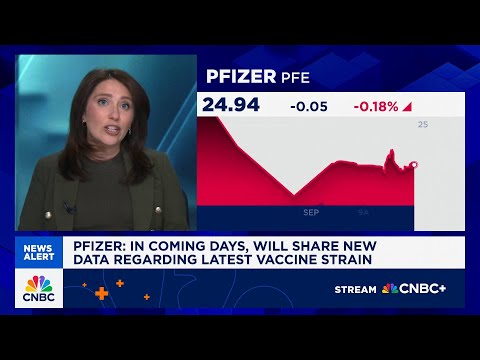
X @Bloomberg
Bloomberg· 2025-09-03 14:25
Company Response - Pfizer defended the evidence supporting its Covid vaccine [1] - Pfizer responded to President Donald Trump's questioning of drug companies' transparency around the shots [1]
Valneva Reports Further Positive Phase 2 Safety and Immunogenicity Results for Lyme Disease Vaccine Candidate
Globenewswire· 2025-09-03 05:00
Core Insights - Valneva SE announced positive immunogenicity and safety data from the Phase 2 study of its Lyme disease vaccine candidate, VLA15, showing strong immune response and favorable safety profile after a third booster dose [1][3][4] Company Overview - Valneva SE is a specialty vaccine company focused on developing, manufacturing, and commercializing prophylactic vaccines for infectious diseases, addressing unmet medical needs [12] - The company has advanced multiple vaccines from early R&D to approvals and currently markets three proprietary travel vaccines [13] Vaccine Development - VLA15 is the only Lyme disease vaccine candidate in advanced clinical development, with two Phase 3 trials nearing completion [2][6] - The vaccine targets the outer surface protein A (OspA) of Borrelia burgdorferi, the bacteria causing Lyme disease, and aims to inhibit the bacterium's ability to infect humans [6][8] Clinical Study Results - The Phase 2 study (VLA15-221) involved 560 healthy participants aged 5 to 65, demonstrating a 100% seroconversion rate across all age groups after the third booster dose [3][9] - The safety profile after the third booster was consistent with previous doses, with no safety concerns reported by the independent Data Monitoring Committee [4][7] Market Need - There are currently no approved human vaccines for Lyme disease, with approximately 476,000 cases diagnosed annually in the U.S. and 132,000 in Europe, highlighting a significant unmet medical need [2][11] - The geographic expansion of Lyme disease increases the urgency for vaccination solutions [3][11] Collaboration - Valneva has a collaboration agreement with Pfizer for the development and commercialization of VLA15, initiated in April 2020 [4]


Pfizer: Pipeline Monetization Shows Great Promise - Rich Yields Pending Re-Rating
Seeking Alpha· 2025-09-02 14:10
Core Insights - The article emphasizes the importance of conducting personal in-depth research and due diligence before making investment decisions, highlighting the inherent risks involved in trading [3]. Group 1 - The analysis is intended solely for informational purposes and should not be interpreted as professional investment advice [3]. - There is a clear disclaimer regarding the lack of any stock, option, or similar derivative positions in the companies mentioned, indicating a neutral stance [2]. - The article expresses that past performance does not guarantee future results, reinforcing the need for careful consideration by investors [4].
Olema Oncology Announces New Clinical Trial Agreement with Pfizer to Combine Palazestrant with Atirmociclib in ER+/HER2- Metastatic Breast Cancer
Globenewswire· 2025-09-02 11:00
Core Viewpoint - Olema Pharmaceuticals has announced a new clinical trial collaboration with Pfizer to evaluate the combination of palazestrant and atirmociclib in treating metastatic breast cancer, aiming to establish palazestrant as a potential backbone endocrine therapy [1][2] Group 1: Clinical Trial Collaboration - The collaboration involves a Phase 1b/2 study to assess the safety and combinability of palazestrant and atirmociclib in patients with ER+/HER2- metastatic breast cancer [1][2] - Pfizer will supply atirmociclib for the study, while Olema will lead the trial [2] - This marks Olema's second clinical trial agreement with Pfizer, following a previous agreement in November 2020 [3] Group 2: Product and Pipeline Information - Olema's lead product candidate, palazestrant (OP-1250), is an orally available complete estrogen receptor antagonist and selective ER degrader, currently in a Phase 3 trial called OPERA-01 [4][5] - Palazestrant has received FDA Fast Track designation for treating ER+/HER2- metastatic breast cancer that has progressed after endocrine therapy [5] - The company is also developing OP-3136, a KAT6 inhibitor, which is in a Phase 1 clinical study [4] Group 3: Future Plans and Expectations - The new study is expected to involve approximately 35 patients, with initiation anticipated in the second half of 2025 [6] - Successful results from this study could inform a pivotal Phase 3 trial for the combination therapy in the frontline metastatic breast cancer setting [6]


3 High-Yield Dividend Stocks You Can Buy in September and Hold Forever
The Motley Fool· 2025-09-02 07:21
Core Insights - The article highlights the challenge of finding high-yield dividend stocks in a buoyant stock market, emphasizing the potential of Realty Income, Healthpeak Properties, and Pfizer as attractive options for passive income generation. Group 1: Realty Income - Realty Income has seen its shares fall approximately 22% from their peak in 2022, yet it continues to raise its dividend payout, currently offering a 5.5% yield with a history of steady payout growth [4][5]. - The company makes monthly dividend payments and has raised its payout every quarter except one since going public over 30 years ago, despite facing challenges from rising interest rates [5]. - Realty Income's portfolio consists of 15,606 properties, and it only accounts for about 4% of the U.S. net lease REIT market, indicating significant growth potential, especially in Europe where it has a minimal market share [6]. Group 2: Healthpeak Properties - Healthpeak Properties, a net lease REIT, focuses on renting laboratory space to pharmaceutical and biotech companies and recently merged with Physicians Realty to enhance its portfolio [7][8]. - Following the merger, Healthpeak's stock price has declined, allowing it to offer a 6.8% dividend yield, despite a decrease in demand for laboratory space [8]. - The company expects funds from operations to be between $1.78 and $1.84 per share this year, which is sufficient to support its current annualized payout of $1.22 per share [9]. Group 3: Pfizer - Pfizer's shares have decreased about 60% from their all-time high during the COVID-19 pandemic, primarily due to declining sales of COVID-19 products and upcoming patent cliffs [10]. - Despite the stock price drop, Pfizer raised its dividend for the 16th consecutive year, currently offering a 6.9% yield [10]. - The company anticipates losing patent protection for key products, which could reduce annual sales by $17 billion to $18 billion between 2026 and 2028, but it has invested in new products expected to generate $20 billion in annual sales by 2030 [11][12].



Pfizer's Golden Cross Signals Strength: How to Play the Stock
ZACKS· 2025-09-01 17:01
Core Insights - Pfizer's stock has been trading above its 50-day and 200-day simple moving averages since mid-August, indicating a potential upward trend with a "golden cross" formation [1][2][9] Group 1: Financial Performance - Pfizer's oncology revenues grew by 9% in the first half of 2025, driven by key drugs such as Xtandi, Lorbrena, Braftovi-Mektovi combination, and Padcev [5] - The company expects a revenue CAGR of approximately 6% from 2025 to 2030, with the acquisition of Seagen projected to contribute over $10 billion in risk-adjusted revenues by 2030 [11] - Pfizer's recently launched and acquired products generated $4.7 billion in revenues in the first half of 2025, reflecting a 15% operational increase compared to the previous year [10] Group 2: Product Pipeline and Strategy - Pfizer is advancing its oncology clinical pipeline with several candidates in late-stage development, including sasanlimab, vepdegestrant, and sigvotatug vedotin [6] - The company is also expanding the labels of its approved products across oncology and non-oncology categories [7] Group 3: Challenges and Risks - Sales of COVID-related products, Comirnaty and Paxlovid, are expected to decline significantly from $56.7 billion in 2022 to around $11 billion in 2024, with ongoing uncertainty regarding future sales [12] - Pfizer anticipates a moderate negative impact on revenues due to loss of exclusivity (LOE) for several key products between 2026 and 2030 [13] - The company expects an unfavorable impact of approximately $1 billion from the Medicare Part D redesign under the IRA, affecting higher-priced drugs [14] Group 4: Valuation and Market Position - Pfizer's stock is trading at a forward price/earnings ratio of 7.98, significantly lower than the industry average of 14.78 and its own 5-year mean of 10.75 [18] - The Zacks Consensus Estimate for earnings has increased for both 2025 and 2026, indicating positive sentiment around the company's financial outlook [21] Group 5: Future Outlook - Pfizer is implementing cost cuts and internal restructuring aimed at delivering savings of $7.7 billion by the end of 2027, which should drive profit growth [25] - The company maintains a high dividend yield of around 7%, making it attractive for long-term investors despite current stock price declines [26]
7 Big Yields From The Beat-Up Healthcare Sector
Forbes· 2025-09-01 14:52
Core Insights - Healthcare stocks have remained stagnant since April, contrasting with a 27% rise in the S&P 500, which raises interest for contrarian investors [2] - Seven healthcare stocks offer yields up to 7.1%, indicating potential investment opportunities due to their underperformance relative to the broader market [2] Group 1: High Yield Healthcare Stocks - Omega Healthcare Investors (OHI) has a yield of 6.4% and operates skilled nursing and assisted living facilities, with a portfolio of 93,961 beds across over 1,000 properties [3] - OHI has shown progress by beating estimates for adjusted funds from operations (AFFO) and raising its full-year AFFO guidance, while also acquiring 57 properties [4] - LTC Properties (LTC) offers a 6.3% yield and is transitioning some contracts to RIDEA-structured contracts, which could enhance growth potential [7][8] - Healthpeak Properties (DOC) has a yield of 7.0% and a diversified portfolio, but may face growth challenges due to headwinds in its life sciences segment [10] - Sila Realty Trust (SILA) has a yield of 6.4% and has shown a nearly 20% total return since its IPO, with a strong financial position [11][12] - Siga Technologies (SIGA) offers a high yield of 7.1% but is concentrated on a single product, TPOXX, which limits diversification [13][21] - Bristol-Myers Squibb (BMY) has a yield of 5.3% and a market cap of nearly $100 billion, but has underperformed significantly over the past five years [14][15] - Pfizer (PFE) has a yield of 6.9% and is facing challenges with declining COVID drug sales and upcoming patent expirations, leading to a high yield not seen since the Great Recession [18][19] Group 2: Market Context and Challenges - The healthcare sector is facing uncertainties including potential cuts to Medicaid, health research funding, and initiatives aimed at lowering drug costs [6] - The overall healthcare market has underperformed compared to the S&P 500, with BMY experiencing a 25% decline in price over the past five years [15] - Pfizer is targeting over $7 billion in cost savings by the end of 2027, but its long-term prospects depend on the success of its product pipeline [19][20]




Trump tells drugmakers to 'justify the success' of Covid meds after FDA limits vaccine approval
CNBC· 2025-09-01 14:31
Group 1 - President Trump called on pharmaceutical companies to justify the success of their Covid drugs, emphasizing the need for transparency in their results [2][5] - The FDA approved new Covid vaccines, but limited their availability to individuals at higher risk of severe illness [2][4] - The leadership changes at the CDC, including the firing of Director Susan Monarez, reflect ongoing tensions regarding U.S. immunization policies and the management of federal health agencies [3][4] Group 2 - Trump expressed frustration over the lack of public disclosure of extraordinary results from companies like Pfizer, questioning why these results are not shared [4] - The recent upheaval at the CDC includes mass firings and significant changes to vaccine policy, indicating a shift in the federal approach to public health [4]