SIGNATURE BANK(SBNY)

Search documents
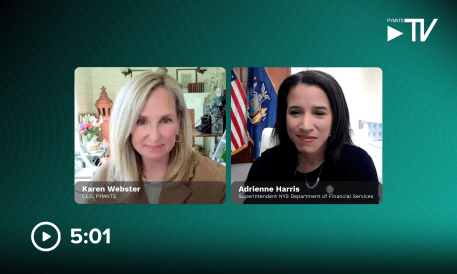
Adrienne Harris Reflects on 4 Years of Redefining Financial Regs
PYMNTS.com· 2025-10-20 08:00
Core Insights - The New York Department of Financial Services (DFS) is drafting rules for Buy Now, Pay Later (BNPL) that focus on disclosure, credit reporting, and harmonization with other regulators while ensuring appropriate guardrails [1][10] - Adrienne Harris, the outgoing superintendent, emphasizes that regulators can protect consumers and markets while being supportive of business [3][4] - The DFS has established itself as a national model for financial regulation, promoting innovation within defined boundaries [4][8] Regulatory Developments - The DFS's virtual currency team has expanded from a few members to 60, making it one of the largest regulatory groups for virtual currencies globally [9] - The agency's early adoption of the BitLicense framework has positioned New York as a leader in digital asset oversight, influencing the recent federal GENIUS Act [8][9] - Proposed BNPL rules will address fees, disclosures, and credit reporting, ensuring that regulations keep pace with evolving financial models [10] Leadership Transition - Kaitlyn Asrow will assume the role of acting superintendent, ensuring continuity in the DFS's leadership in digital finance [6] - Harris's tenure included significant challenges, such as the crypto winter and the collapses of several banks, leading to internal reforms within the DFS [11] Achievements and Legacy - Under Harris's leadership, the DFS has secured over $725 million in restitution for consumers, highlighting a commitment to consumer protection [11] - Harris's legacy includes redefining how regulation can support innovation sustainably and durably for all stakeholders [11]


Black Bear Value Partners Q3 2025 Letter
Seeking Alpha· 2025-10-09 06:00
Core Insights - The Black Bear Value Fund has underperformed compared to broader indices, returning -12.7% year-to-date against the S&P 500's +14.8% [11] - The fund's strategy focuses on long-term investments in underappreciated businesses, particularly in sectors currently facing challenges but with potential for recovery [4][28] Performance Overview - The Black Bear Value Fund returned -7.1% in September, -1.0% for the quarter, and -12.7% year-to-date [11] - In contrast, the S&P 500 returned +3.6% in September, +8.1% for the quarter, and +14.8% year-to-date [11] Investment Strategy - The fund emphasizes a private investing mindset, looking beyond short-term market noise to identify long-term value [4] - The portfolio is heavily weighted in sectors like homebuilding, chemical production, and metallurgical coal, which are currently underperforming but have long-term growth potential [4][28] Key Holdings Builders FirstSource (BLDR) - BLDR is experiencing a structural housing shortage in the USA, with management reducing their 2025 cash flow outlook from $800 million-$1.2 billion to $800 million-$1 billion [6][8] - The company has shifted focus to value-added products, which now account for over 40% of revenue, and has been actively buying back stock [7][9] Flagstar Financial (FLG) - FLG has undergone a significant turnaround, raising over $1 billion in capital and stabilizing its balance sheet [12][13] - The bank is trading at approximately 65% of a conservatively marked balance sheet, with potential for a 50-150% increase in value over the next 1-3 years [15] Lanxess (LXS.DE) - LXS has shifted its focus from cyclical, capital-intensive businesses to more stable, lower-capital businesses, increasing its US sales from 15% to nearly 30% [17] - The company is expected to generate €200-250 million in free cash flow in a normalized environment, with a potential cash inflow of €500 million from a joint venture [19][20] Tidewater (TDW) - TDW operates one of the largest fleets of offshore support vessels, with a strong long-term outlook despite near-term uncertainties [21] - The company is currently generating over $300 million in free cash flow, with expectations to increase this to $500 million-$1 billion in a normalized environment [23] Warrior Met Coal (HCC) - HCC is investing heavily in the Blue Creek mine, which is expected to significantly boost free cash flow once the investment period concludes [24][25] - The company anticipates generating $200 million-$850 million in annual free cash flow post-investment, translating to a 6-25% unlevered annual free cash flow yield [26][27]




Bullish Partners with Deutsche Bank for Fiat Services in Hong Kong and Germany
FinanceFeeds· 2025-10-08 19:57
Core Insights - Bullish, a crypto exchange, has partnered with Deutsche Bank to manage fiat deposits and withdrawals, indicating a growing integration between traditional finance and digital assets [1][3] - The partnership aims to expand Bullish's regulatory presence globally, including in the U.S., following its listing on the New York Stock Exchange [2][6] - Deutsche Bank is increasing its involvement in the crypto sector, preparing to launch digital asset custody services by 2026 and collaborating with various crypto infrastructure providers [4][5] Company Developments - Bullish, founded in 2021 and led by former NYSE President Tom Farley, has processed over $1.5 trillion in cumulative trading volume, targeting institutional clients [6] - The exchange's stock was trading near $65.17, reflecting stability in its market performance [7] - Bullish's partnership with Deutsche Bank strengthens its position in Europe and Asia, regions that are actively developing regulatory frameworks for digital assets [8] Industry Trends - The collaboration between Bullish and Deutsche Bank signifies a thaw in relations between crypto firms and mainstream finance, especially after setbacks faced by other digital asset exchanges [8][9] - Deutsche Bank's cautious approach to direct crypto exposure suggests a strategy to integrate digital asset capabilities within its banking services rather than compete directly with crypto firms [9][10] - The overall trend among global lenders is to re-engage with the crypto sector, driven by renewed regulatory clarity and political support, including endorsements from influential figures [5]

Nigerian exports boss targets intra-African trade boost
African Business· 2025-10-01 03:00
Core Insights - The Nigerian pavilion at the Intra-African Trade Fair (IATF) 2025 in Algiers has seen significant attendance and engagement, marking it as the most-visited pavilion at the event [2][3] - The Nigeria Export Promotion Council (NEPC) is actively facilitating collaboration among various agencies to enhance Nigeria's export capabilities [3][6] - Non-oil exports from Nigeria reached $3.225 billion in the first half of 2025, reflecting a growth from $2.696 billion in the same period of 2024, with export volume increasing to 4.04 million metric tonnes [5][14] Industry Developments - The NEPC is focusing on value addition to products, encouraging exporters to process raw materials to achieve premium prices in the global market [6][7] - Initiatives are in place to support women in business, with the NEPC being a pilot beneficiary of the Women Exporters in the Digital Economy (WEIDE) fund, which aims to empower female-led businesses through grants and training [12][13] - The African Continental Free Trade Area (AfCFTA) is viewed as a significant opportunity for Nigeria to expand its market access and enhance intra-African trade [12][14] Capacity Building and Training - The NEPC has organized 252 training programs in the first half of 2025, reaching over 27,000 participants, focusing on export documentation, quality standards, and good agricultural practices [10][11] - Emphasis is placed on the importance of packaging and certification to meet international standards, which is crucial for successful exports [11] Future Outlook - The NEPC anticipates continued growth in the non-oil export sector, projecting a positive outlook with over 20% year-on-year growth since the current leadership began [14] - Nigeria's hosting of the IATF in 2027 is expected to provide a significant platform for showcasing Nigerian products and enhancing economic visibility [14]

Bailouts: The Emergency Button That Keeps Getting Reinstalled
PYMNTS.com· 2025-09-27 08:00
Group 1: Historical Financial Rescues - J.P. Morgan's intervention in 1907 led to the creation of the Federal Reserve in 1913 after he gathered New York trust company presidents for a rescue package [3] - The U.S. profited approximately $580 million from the bailout of Mexico during the 1995 Tequila Crisis due to early repayment and interest premia [3] - President Gerald Ford initially rejected New York City's plea for help in 1975 but later authorized $2.3 billion in federal loans [4] Group 2: Notable Bailouts and Their Outcomes - The Federal Reserve facilitated a $3.6 billion bailout for hedge fund LTCM in 1998 without using taxpayer dollars, involving 14 banks [4] - The Troubled Asset Relief Program (TARP) authorized $700 billion in 2008, but the actual lifetime cost was around $31 billion, with many bank investments generating profits [5] - Greece received a total of 288.7 billion euros (approximately $337.8 billion) across three bailout programs from 2010 to 2015, including the largest sovereign debt restructuring [5] Group 3: Modern Bailout Strategies - Cyprus implemented a "bail-in" in 2013, converting 47.5% of uninsured deposits into equity to recapitalize Bank of Cyprus [6] - In 2023, U.S. regulators ensured all depositors were made whole after the failures of Silicon Valley Bank and Signature Bank, while shareholders were not compensated [7] - UBS acquired Credit Suisse in 2023 with significant liquidity support from Switzerland, resulting in the wiping out of AT1 bondholders while shareholders received UBS stock [7]

Senate report: KPMG ignored red flags before 2023 bank failures
American Banker· 2025-09-17 17:29
Core Insights - KPMG, the accounting firm, audited three midsize regional banks that failed in 2023, leading to public belief in their financial soundness shortly before their collapses [1][3] - The Senate Permanent Subcommittee on Investigations report alleges KPMG ignored significant risks at these banks, including liquidity issues at Silicon Valley Bank (SVB) and fraud allegations at Signature Bank [2][3] KPMG's Audit Findings - KPMG provided clean audit opinions for SVB, Signature Bank, and First Republic Bank shortly before their failures, with SVB receiving its opinion just 14 days prior [3][9] - The report indicates KPMG was aware of internal weaknesses at SVB as early as 2022 but failed to disclose these risks in audits [7][8] Specific Bank Issues - SVB's rapid growth concealed risks, including a heavily concentrated customer base and 94% of deposits being uninsured, leading to its collapse and a $23 billion cost to the FDIC [5][6] - Signature Bank faced mortgage fraud allegations that KPMG did not adequately investigate, relying instead on an oral summary from the bank's law firm [10][12] - First Republic Bank's "going concern" analysis raised internal doubts about its survival, but KPMG did not communicate these concerns to the board just days before the bank's failure [14][15] Conflicts of Interest - The report highlights potential conflicts of interest, noting KPMG's long-standing relationships with the banks, which may have compromised auditor independence [16][18] - KPMG earned nearly $20 million in combined fees from the three banks in 2022, raising questions about the influence of financial ties on audit quality [9][16] Recommendations for the Auditing Industry - The report calls for reforms in the auditing industry, including mandatory auditor competition and expanded disclosure requirements from the Public Company Accounting Oversight Board (PCAOB) [17][19] - It suggests establishing a PCAOB whistleblower office to enhance accountability and transparency in the auditing sector [20]

Bank CEOs Press Lawmakers for Deposit Insurance Reform
PYMNTS.com· 2025-09-10 22:25
Core Insights - The need for deposit insurance reform has been emphasized by bank CEOs and lawmakers following the collapse of Silicon Valley Bank in 2023, highlighting the urgency for modernization of the current system [2][3][4] Group 1: Current System and Proposed Reforms - The 2023 banking turmoil revealed shortcomings in the existing deposit insurance framework, prompting discussions on potential reforms [3][4] - Three options for deposit insurance reform were outlined: limited coverage with a potential higher limit, unlimited coverage for all depositors, and targeted coverage for business payment accounts [6] - There is a call for targeted expansion of FDIC deposit insurance for business operating accounts, with a recommendation to raise the insurance cap from $250,000 to at least $20 million per account [7][10] Group 2: Implications for Smaller Banks - The rapid digital-age deposit flight in March 2023 led to deposits moving from smaller banks to larger ones, creating a disparity in the safety net for these institutions [7] - Smaller banks face challenges in retaining uninsured funds due to the perceived safety of larger banks, which have a backstop [7][10] Group 3: National Security Concerns - Implicit guarantees for larger banks pose risks for smaller institutions and raise national security concerns, particularly for small defense suppliers affected by the banking crisis [10] - The freezing of client funds at SVB impacted small businesses and their employees, highlighting the need for targeted coverage for business payment accounts [10] Group 4: Data-Driven Approach - The American Bankers Association advocates for deposit insurance coverage limits to be empirically based and indexed to inflation, emphasizing the need for expanded data collection [9][12] - Currently, only about 57% of business operating accounts are covered by existing limits, indicating a gap that needs to be addressed [12]