Sanofi

Search documents
This Beaten-Down Biotech Is Showing Signs of Life. Is It a Buy?
Yahoo Finance· 2026-01-29 13:50
Core Viewpoint - Novavax has experienced a significant decline in market value over the past five years, losing more than 90% despite successfully launching a coronavirus vaccine later than expected, which has affected its competitiveness in the market [1] Group 1: Recent Developments - Novavax's shares have increased by 28% in 2026 following a licensing deal with Pfizer for its Matrix-M adjuvant technology [2] - The licensing agreement with Pfizer includes an upfront payment of $30 million, potential milestone payments of up to $500 million, and royalties on future approved products utilizing the adjuvant technology [3] - This is not the first licensing deal for Novavax's Matrix-M platform, as Sanofi also entered a similar agreement two years prior [4] Group 2: Revenue and Market Challenges - Novavax's revenue has been inconsistent, and changes in U.S. regulatory recommendations regarding coronavirus vaccine eligibility may hinder future sales [5] - Sanofi will lead commercialization efforts for Novavax's vaccine in the U.S. and other markets, with Novavax receiving royalties on sales, but the revenue outlook remains uncertain [6] - The market for coronavirus vaccines is unpredictable, and Novavax's financial success may depend on the performance of pipeline products from Pfizer or Sanofi that utilize its adjuvant technology [7] Group 3: Internal Developments - Novavax is also working on developing several vaccines internally, including a flu vaccine and a combination coronavirus/flu vaccine [8] - Phase 3 studies for these candidates were placed on clinical hold in October 2024 due to suspected adverse reactions, which has delayed progress despite the hold being lifted [8]

Sanofi(SNY) - 2025 Q4 - Earnings Call Presentation
2026-01-29 13:30
Business Finance Pipeline Appendices Business Finance Pipeline Appendices Results Q4/FY 2025 January 29, 2026 Forward-looking statements This document contains forward-looking statements as defined in the Private Securities Litigation Reform Act of 1995, as amended. Forward-looking statements are statements that are not historical facts. These statements include projections and estimates and their underlying assumptions, statements regarding plans, objectives, intentions, and expectations with respect to fu ...

Drugmakers Roche and Sanofi talk up their pipelines, as earnings fail to excite
CNBC· 2026-01-29 11:31
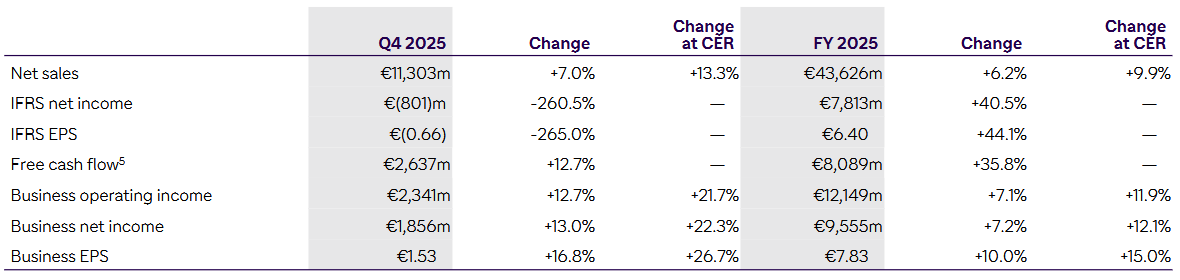
Core Viewpoint - Roche and Sanofi's latest earnings met expectations, with both companies emphasizing the importance of developing new drugs to counteract the impending "patent cliff" facing the pharmaceutical industry [1][2]. Roche - Roche's sales grew by 8% in the fourth quarter, driven by blockbuster drugs like Ocrevus and Tecentriq [5]. - The company forecasts profit growth to outpace sales growth by 2026, with adjusted earnings per share expected to grow by high single digits at constant currencies [5]. - Roche plans to launch up to 19 new medicines by the end of the decade, focusing on late-stage development [3]. - The company is entering the obesity market with its weight-loss candidate CT-388, which showed a 22.5% weight reduction in Phase 2 trials, comparable to competitors [10]. - Roche has partnered with Zealand Pharma to co-develop the drug petrelintide, aiming to invest in next-generation obesity treatments [11]. Sanofi - Sanofi reported a 13% sales growth in the fourth quarter at constant currencies, with earnings per share of 1.53 euros ($1.20), exceeding forecasts [6]. - The company anticipates sales growth in the high single digits for 2026, with profit growth expected to be slightly higher than revenue [8]. - Sanofi's growth was supported by new medicines and its drug Dupixent, which reached a new quarterly high [8]. - The company announced a 1 billion euro share buyback, but investor focus remains on its research and development efforts [8]. - The need to expand the pipeline will be a key topic in Sanofi's earnings call, highlighting long-term R&D spending and potential M&A activities [9].


赛诺菲:2025年总收入约507.81亿美元,度普利尤单抗收入182亿美元
Cai Jing Wang· 2026-01-29 10:10
1月29日,赛诺菲发布2025年财报,公司全年总收入达436.26亿欧元(约507.81亿美元),同比增长 9.9%(按固定汇率计算)。研发投入为78.42亿欧元(约91.28亿美元),同比增长8.8%,占净销售额的 18.0%。 (赛诺菲财报) (编辑:杨燕 林辰) 财报提到,赛诺菲免疫领域明星产品Dupixent2025年销售额达157.14亿欧元(约182.91亿美元),同比 增长25.2%。赛诺菲还在计划将Dupixent扩展至第9个适应症,并在全球范围内加速推广新获批的适应症 (如慢阻肺、结节性痒疹)。 ...
明星药物Dupixent销售额再创新高!赛诺菲(SNY.US)Q4盈利超预期
智通财经网· 2026-01-29 08:49
Core Viewpoint - Sanofi's strong sales performance of Dupixent has driven better-than-expected earnings for Q4 2025, with continued revenue and profit growth anticipated in 2026 [1] Financial Performance - Q4 2025 net sales reached €11.303 billion, a year-on-year increase of 7.0% (13.3% at constant exchange rates) [2] - Business operating income for Q4 was €2.341 billion, up 12.7% year-on-year [2] - Business net income for Q4 was €1.856 billion, reflecting a 13.0% increase year-on-year [2] - Business earnings per share (EPS) for Q4 was €1.53, a 16.8% increase compared to the previous year [2] - Free cash flow for Q4 was €2.637 billion, up 12.7% year-on-year [2] Product Performance - Dupixent sales grew by 32.2% year-on-year to a record €4.246 billion in Q4, solidifying its position as a key growth driver for Sanofi [2] - The pharmaceutical segment's sales increased by 49.4% to €1.121 billion, primarily driven by Ayvakit and ALTUVIIIO [2] Future Outlook - Sanofi expects sales growth in 2026 to be in the high single-digit percentage range (at constant exchange rates), with business EPS growth slightly exceeding sales growth [3] - The company plans to execute a €1 billion share buyback program in 2026 [3] Challenges and Strategic Focus - Sanofi's vaccine business faced a 2.5% decline in Q4 sales to €2.039 billion, with expectations of a slight decrease in vaccine sales for 2026 [3] - CEO Paul Hudson expressed optimism about sustained profit growth for at least five years, but emphasized the need for a robust pipeline to reduce reliance on Dupixent [4] - Recent disappointing trial results for new drugs have raised concerns about Sanofi's ability to generate sufficient revenue from upcoming products [4] - The company has written down €2.24 billion, primarily related to the failed multiple sclerosis drug tolebrutinib [4] Strategic Initiatives - Following the divestiture of its consumer health business, Sanofi is focused on demonstrating the success of its "pure innovation" strategy [5] - The company has engaged in significant partnerships, including a $1.04 billion collaboration with ADEL for an early-stage Alzheimer's antibody and a potential $1.7 billion deal with Dren Bio to enhance its autoimmune platform [5]
Sanofi to Launch $1.20 Billion Share Buyback
WSJ· 2026-01-29 06:58
Core Insights - The French drugmaker announced a share buyback program following an increase in sales and earnings for the fourth quarter [1] Group 1 - The company's sales and earnings for the fourth quarter showed a positive trend, indicating strong financial performance [1]

Sanofi targets high single digit sales growth in 2026, plans share buyback
Reuters· 2026-01-29 06:33
Core Viewpoint - French drugmaker Sanofi expects sales to grow by a high-single-digit percentage in 2026, driven by strong demand for its asthma drug Dupixent and newer medicines [1] Sales Growth Expectations - Sanofi anticipates a high-single-digit percentage increase in sales for the year 2026 [1] Key Products Driving Growth - The growth is primarily attributed to the strong demand for Dupixent, a blockbuster asthma drug, along with contributions from some newer medicines [1]
Ipsen nominates Peter Guenter to its Board of Directors
Globenewswire· 2026-01-29 06:00
Core Viewpoint - Ipsen has appointed Peter Guenter as a new Director on its Board, effective January 28, 2026, filling the vacancy left by Henri Beaufour [1][9]. Group 1: Appointment Details - Peter Guenter brings nearly 40 years of experience in the global pharmaceutical industry, having most recently served as CEO of Merck Healthcare from 2021 to 2025 [2]. - His previous roles include CEO at Almirall, where he focused on medical dermatology, and over 20 years at Sanofi, where he joined the Executive Committee in 2013 [2][3]. - Following this appointment, Ipsen's Board will consist of 14 directors, equally divided between men and women, including five independent directors and two employee representatives [3]. Group 2: Shareholder Meeting - A request for ratification of Peter Guenter's appointment will be presented at the next Shareholders' meeting, which will remain effective until the 2027 Shareholders' meeting [4]. Group 3: Company Overview - Ipsen is a global biopharmaceutical company focused on transformative medicines in oncology, rare diseases, and neuroscience, with nearly 100 years of development experience [5]. - The company operates in over 40 countries and partners globally to deliver medicines to more than 100 countries [5].

FOLD vs. RIGL: Which Rare Disease Biotech Stock Has Better Upside?
ZACKS· 2026-01-28 17:27
Core Viewpoint - Amicus Therapeutics (FOLD) and Rigel Pharmaceuticals (RIGL) are appealing to growth-focused investors due to their focus on rare diseases, which can support strong revenue growth despite small patient populations [2] Company Overview - Amicus is a mid-cap stock, while Rigel is classified as a small biotech [2] - Both companies are developing treatments for rare medical conditions with limited existing therapies [2] Product Highlights - Amicus' lead product, Galafold, is the first oral precision medicine for Fabry disease, generating significant revenue [3][6] - Rigel's lead drug, Tavalisse, is an oral spleen tyrosine kinase inhibitor for chronic immune thrombocytopenia (ITP), also showing strong sales growth [3][9] Acquisition Potential - Amicus is set to be acquired by BioMarin Pharmaceutical for $14.50 per share, totaling $4.8 billion, expected to close in Q2 2026 [5][10] - This acquisition could enhance Amicus' value realization beyond organic sales growth [4] Financial Performance - Galafold generated $371.5 million in sales in the first nine months of 2025, a 12% year-over-year increase, contributing over 80% of Amicus' net product sales [6] - Pombiliti + Opfolda, a new therapy for late-onset Pompe disease, generated $77.5 million in sales, up 61% year-over-year [7] - Rigel's Tavalisse sales reached $113.3 million in the first nine months of 2025, a 54% increase year-over-year [9] Future Outlook - Rigel expects total revenues of $294.3 million for 2025, with net product sales of $232 million [12] - The company anticipates fourth-quarter revenues of $69.8 million, a 21.2% increase year-over-year [13] Competitive Landscape - Rigel faces increasing competition in the ITP market, particularly from Sanofi's Wayrilz, which poses a threat to Tavalisse [15][16] - Amicus' reliance on Galafold makes it vulnerable to regulatory setbacks, while Rigel's dependence on Tavalisse highlights its exposure to competitive risks [8][26] Valuation and Performance - In the past six months, FOLD shares have increased by 133.1%, while RIGL shares have risen by 87.2%, compared to the industry return of 21.7% [21] - Amicus has a higher price-to-sales (P/S) ratio of 7.41 compared to Rigel's 2.53, indicating a more expensive valuation [23] Investment Recommendation - Amicus is viewed as a better investment opportunity due to its acquisition by BioMarin and strong sales performance, while Rigel's strategy is seen as riskier due to its dependence on Tavalisse [24][27]


Sensorion Announces €60 Million Financing With a €20M Strategic Investment from Sanofi and Support from Global Healthcare Specialists To Advance Genetic Medicine Pipeline
Businesswire· 2026-01-28 06:43
Core Viewpoint - Sensorion, a clinical-stage biotechnology company focused on hearing loss therapies, announced a €60 million Reserved Offering to specific investors, including Sanofi and existing shareholders, to advance its gene therapy programs [1][2][4]. Funding and Investment - The Reserved Offering involves the issuance of 214,285,714 new ordinary shares at a price of €0.28 per share, with Sanofi investing €20 million and other investors contributing €40 million [1][5]. - The net proceeds from the offering, approximately €56 million, will primarily fund R&D activities for the gene therapy programs SENS-501 and SENS-601 (GJB2-GT) [5][8]. Gene Therapy Programs - SENS-601 (GJB2-GT) is the second gene therapy program entering clinical trials, targeting GJB2 mutations responsible for about 50% of autosomal recessive non-syndromic congenital hearing loss [3][23]. - SENS-501, which targets deafness caused by otoferlin mutations, is already in clinical development [3][23]. Clinical Milestones - Key upcoming clinical milestones include the submission of the Clinical Trial Application for SENS-601 in Q1 2026 and the follow-up data for SENS-501 [6][8]. Shareholder Impact - The issuance of new shares will result in a capital increase of approximately €59.99 million, representing about 71% of the company's share capital before the offering [8][10]. - Existing shareholders who do not participate in the offering will see their ownership diluted; for example, a shareholder with 1% before the offering will hold approximately 0.58% afterward [12][16]. Lock-up Agreements - The company has entered into a lock-up agreement restricting the issuance of additional shares for 90 days following the subscription agreement with investors [17]. Trading and Admission - The new shares will be admitted to trading on Euronext Growth in Paris, expected to occur on January 30, 2026, and will be fungible with existing shares [10][18].