HDFC Bank

Search documents
Sensex surges on firm global trends, fresh foreign fund
Rediff· 2025-11-20 11:15
Market Performance - The BSE Sensex increased by 446.21 points or 0.52% to close at 85,632.68, reaching a 52-week high of 85,801.70 during the day [3][4] - The NSE Nifty also achieved a 52-week high of 26,246.65 before closing at 26,192.15, reflecting a gain of 139.50 points or 0.54% [3][4] Influencing Factors - The rally in global markets contributed to the rise in Indian indices, with optimism surrounding India's trade talks and progress on phase-1 agreements enhancing market sentiment [4] - Strong performance in sectors such as Auto, Financials, and IT, along with fresh foreign institutional investor (FII) inflows, supported the positive trend [5] Institutional Activity - Foreign institutional investors purchased equities worth ₹1,580.72 crore in the previous trading session [6] - Domestic institutional investors also bought stocks valued at ₹1,360.27 crore [7] Sector Performance - Major gainers among Sensex firms included Bajaj Finance, Bajaj Finserv, Reliance Industries, HDFC Bank, Tech Mahindra, and Axis Bank [4] - Conversely, Asian Paints, HCL Tech, Titan, and Hindustan Unilever were among the laggards [4] Commodity Prices - Brent crude oil prices rose by 0.83% to $64.03 per barrel [7]


NHAI launches Raajmarg Infra Investment Managers for highway monetization
The Economic Times· 2025-11-20 11:11
Core Viewpoint - The National Highways Authority of India (NHAI) is establishing the Raajmarg Infra Investment Trust (RIIT) as a Public InvIT to monetize National Highway assets, targeting retail and domestic investors [7]. Group 1: Investment Structure - Public InvITs allow retail investors to invest in operational infrastructure projects, with units traded on stock exchanges like NSE and BSE [1][7]. - Raajmarg Infra Investment Managers Pvt Ltd (RIIMPL) has been incorporated as the Investment Manager for the proposed InvIT, with equity participation from major banks and financial institutions [2][7]. Group 2: Financial Performance - NHAI has successfully monetized assets worth Rs 48,995 crore through the Toll-Operate-Transfer (TOT) model and raised approximately Rs 43,638 crore across four rounds of Private InvITs [5][7]. - The introduction of around 1,500 km of completed and operational National Highways into the Public InvIT is expected over the next 3-5 years, creating significant investment opportunities [6][7]. Group 3: Governance and Compliance - RIIMPL will focus on establishing strong governance standards aligned with SEBI's InvIT regulations, ensuring transparency and investor protection [6][7]. - The first issuance of InvIT units for retail and public investors is anticipated to launch in February 2026 [7].

2025 年亚太峰会 - 峰会前瞻:中国重回焦点-Asia Pacific Summit 2025-Summit Preview China back in focus
2025-11-19 01:50
Summary of the Asia Pacific Summit 2025 Conference Call Industry and Company Focus - **Industry**: Global Economics and Investment Strategies - **Company**: Morgan Stanley Key Points and Arguments Economic Outlook - Morgan Stanley's 2026 outlook anticipates moderate global growth and continued disinflation as the base case, with the US being a critical swing factor due to resilient consumption and AI-driven productivity [1][8] - Asia's real GDP growth is projected to accelerate from 4.3% in Q4 2025 to 4.7% in Q4 2026, driven by non-tech exports, improved capital expenditure, labor market conditions, and consumption [1][8] China’s Economic Policy - China's reflation is expected to be gradual, with modestly expansionary and supply-centric policies, including anticipated rate and RRR cuts [1][8] - Spending will focus on tech localization and infrastructure, with slow progress on rebalancing and social welfare support [1][8] Investment Recommendations - Strong performance is expected in risk assets, particularly US and Japanese equities, due to favorable policy and AI-driven fundamentals [1][8] - In Asia, a preference for Japan over emerging markets is recommended for 2026, with Chinese equities likely stabilizing after strong returns in 2025 [1][8] Corporate Themes and Trends - The conference will address four major global themes: Tech Diffusion, Multipolar World, Future of Energy, and Longevity [2] - Ongoing trends in Asia include China's Emerging Frontier, The New India, Singapore at 60, and Korea Renaissance [2] Keynote Speakers - Notable speakers include Chee Hong Tat (Minister for National Development, Singapore), Teo Chee Hean (Chairman, Temasek Holdings), and Sebastian Thrun (Founder of Google X and Waymo) [3] Market Positioning - Morgan Stanley recommends tight market-risk positions versus benchmarks, indicating a cautious approach to market volatility [1][8] - The firm highlights a preference for Japan within its coverage universe, suggesting a strategic focus on Japanese equities [1][12] Earnings Forecasts - The forecast for TOPIX EPS for fiscal years 2025, 2026, and 2027 is ¥185 (+9%), ¥198 (+7%), and ¥225 (+14%) respectively, indicating a positive outlook for Japanese equities [13] Asset Allocation - Morgan Stanley's asset allocation recommendations include a focus on equities, particularly in the US, Europe, Japan, and emerging markets, while maintaining a cautious stance on government bonds and credit [9] Other Important Content - The conference will feature various panel discussions and presentations from Morgan Stanley analysts across different regions, providing insights into global economic trends and investment strategies [3][14][15] - The agenda includes discussions on navigating post-tariff growth divergence, the role of AI in various sectors, and the implications of geopolitical dynamics on investment strategies [14][15][17][18]
Cost of funds puts a squeeze on banks' H1 profit growth
The Economic Times· 2025-11-18 00:26
Core Insights - The aggregate net profit of state-owned, private, and small-finance banks increased by 2.5% to ₹1.92 lakh crore in the six months ending September, compared to ₹1.87 lakh crore in the same period last year [1][11] - Net Interest Income (NII) rose by approximately 2% to ₹4.36 lakh crore, while other income, including treasury gains and fee income, surged by 19% to ₹2.06 lakh crore [1][11] - The State Bank of India (SBI) reported a potential increase in Net Interest Margins (NIMs) from the current level of 3.09% if there are no rate cuts in December [1][11] Bank Performance - Private banks outperformed Public Sector Undertaking (PSU) banks, with aggregate net profits of ₹97,790 crore for private banks compared to ₹93,674 crore for PSU banks [4][11] - Small finance banks reported a net profit of ₹684 crore [5][11] Market Dynamics - Higher advances typically boost interest income; however, margins were compressed in the first half due to immediate drops in lending rates following policy easing, while deposit repricing lagged [7][11] - The Reserve Bank of India's (RBI) repo rate was reduced by 100 basis points since February, leading to a significant decline in lending rates [7][11] Loan and Deposit Trends - Gross advances increased by 11.3% to ₹197 lakh crore, driven by strong retail growth, while deposits rose by 10% to ₹236 lakh crore [9][11] - Stressed loans for all listed banks decreased, with gross non-performing loans down 10.3% to ₹4.11 lakh crore and net NPA reduced by 8% to ₹92,302 crore as of September 30 [8][11]
From Ola to BSE and Tata stocks: Retail investors bet Rs 18,000 crore on these 10 stocks
The Economic Times· 2025-11-17 03:37
Core Insights - Retail investors in India demonstrated strong buying activity in the September 2025 quarter, investing over ₹18,000 crore across ten companies, indicating resilience amid market volatility [11] - The trend shows a shift in retail investor behavior, often acting contrarian to institutional investors, particularly in large-cap stocks [4][11] - Despite a decline in average stock prices of retail-heavy counters by 6.55%, the number of companies with rising retail participation exceeded 1,000, reflecting sustained interest [5][11] Retail Investment Trends - BSE Ltd attracted the highest retail inflow of ₹6,089 crore, followed by Tata Consultancy Services (TCS) with ₹4,531 crore and Trent Ltd with ₹1,752 crore [11] - Retail investors were significant sellers in financial heavyweights, with HDFC Bank experiencing the largest outflow of ₹9,361 crore, followed by Adani Power and State Bank of India [11] - Retail ownership across NSE-listed companies stands at 7.43% by value and 16.38% by volume as of September 2025, highlighting their growing influence [3][11] Market Dynamics - The rise of domestic participation has reduced the share of foreign institutional investors (FIIs) to 16.7% of NSE companies by value, the lowest in 13 years [7][11] - Retail investors are particularly active in mid and small-cap segments, with retail ownership in these categories significantly higher than in Nifty-50 stocks [6][11] - The Q2FY26 earnings season revealed subdued trends in mass consumption but an uptick in select discretionary segments, with better-than-expected performance from metals, mining, and oil marketing companies [9][11] Analyst Perspectives - Analysts suggest a constructive market environment for long-term growth and quality investing, with a focus on domestic-oriented sectors such as consumption, domestic financials, healthcare, and telecom [10][11] - Caution is advised regarding IT, deep cyclicals, energy, and utilities sectors, reflecting a selective investment approach [10][11]
RBI may approve 1-3% provisioning floor for stage-2 loans under ECL framework: Sources
BusinessLine· 2025-11-16 16:30
Core Viewpoint - The Reserve Bank of India (RBI) may consider reducing the provisioning requirement for stage-2 loans from 5% to a range of 1-3% as per bankers' requests under the draft expected credit loss (ECL) guidelines [1][2]. Group 1: Provisioning Requirements - Bankers have requested the RBI to reconsider the proposed 5% provision for stage-2 assets, as they currently maintain only 0.4% provision for most standard and stressed assets [2]. - Stage-2 advances are defined as loans that are overdue for 61-90 days, and in segments like home or vehicle loans, there is a 50% average recovery rate from overdue and non-performing assets (NPAs) [2]. Group 2: Impact on Capital Ratios - Higher provisions for stage-2 loans could adversely affect the capital ratios of some lenders and hinder growth, as banks cannot recognize NPAs as standard assets even after six months of full payment by the borrower [5]. - The shift to the ECL model from the incurred loss model could have a sub-150 basis points impact on banks' capital ratios, particularly affecting those reliant on riskier segments like unsecured credit cards and micro loans [5]. Group 3: Profitability Concerns - There will be a profitability impact from the implementation of ECL guidelines, despite the provided glide path for implementation [7]. - It is suggested that the RBI should revisit the proposed flooring percentages, especially if systemic risks arise in certain asset categories [7]. Group 4: Current Actions by Banks - Bank of Baroda has made ₹400 crore of floating provisions in Q2FY26 in anticipation of the shift to the ECL model, while larger banks like State Bank of India and HDFC Bank are awaiting final guidelines to create ECL-specific provisions [8].

Mcap of eight of top-10 valued firms jumps Rs 2.05 lakh crore; Bharti Airtel, RIL major winners
The Economic Times· 2025-11-16 06:48
Market Performance - The BSE Sensex increased by 1,346.5 points, or 1.62 percent, while the NSE Nifty rose by 417.75 points, or 1.64 percent, indicating a strong market rebound after a recent phase of weakness [1][5]. Company Market Capitalization - Reliance Industries Ltd's market capitalization surged by Rs 54,941.84 crore, reaching Rs 20,55,379.61 crore, maintaining its position as the most valued company [2][5]. - Bharti Airtel's market capitalization increased by Rs 55,652.54 crore to Rs 11,96,700.84 crore, making it one of the biggest gainers [5]. - Tata Consultancy Services saw its market cap rise by Rs 40,757.75 crore to Rs 11,23,416.17 crore [5]. - ICICI Bank's market valuation climbed by Rs 20,834.35 crore to Rs 9,80,374.43 crore [5]. - State Bank of India's market capitalization rallied by Rs 10,522.9 crore to Rs 8,92,923.79 crore [5]. - Infosys advanced by Rs 10,448.32 crore to Rs 6,24,198.80 crore [5]. - HDFC Bank's market cap increased by Rs 9,149.13 crore to Rs 15,20,524.34 crore [5]. - Hindustan Unilever's market valuation rose by Rs 2,878.25 crore to Rs 5,70,187.06 crore [5]. - Conversely, Bajaj Finance's market cap declined by Rs 30,147.94 crore to Rs 6,33,573.38 crore, and Life Insurance Corporation of India's valuation fell by Rs 9,266.12 crore to Rs 5,75,100.42 crore [5]. Top Valued Companies - The combined market valuation of the top 10 most valued companies surged by Rs 2,05,185.08 crore last week, with Reliance Industries and Bharti Airtel being the largest contributors [5].
Mcap: 8 of top-10 valued firms jump ₹2.05 lakh crore; Bharti Airtel, RIL major winners
BusinessLine· 2025-11-16 05:46
Market Valuation Overview - The combined market valuation of eight of the top 10 most valued companies increased by ₹2,05,185.08 crore last week, with Bharti Airtel and Reliance Industries being the largest gainers [1] - Reliance Industries retained its position as the most valued company, followed by HDFC Bank, Bharti Airtel, Tata Consultancy Services, ICICI Bank, State Bank of India, Bajaj Finance, Infosys, Life Insurance Corporation of India, and Hindustan Unilever [1] Individual Company Performance - Bharti Airtel's market capitalisation surged by ₹55,652.54 crore to ₹11,96,700.84 crore [2] - Reliance Industries Ltd's market valuation increased by ₹54,941.84 crore to ₹20,55,379.61 crore [2] - Tata Consultancy Services saw its market capitalisation rise by ₹40,757.75 crore to ₹11,23,416.17 crore [2] - ICICI Bank's market valuation climbed by ₹20,834.35 crore to ₹9,80,374.43 crore [2] - State Bank of India's market valuation rallied by ₹10,522.9 crore to ₹8,92,923.79 crore [2] - Infosys advanced by ₹10,448.32 crore to ₹6,24,198.80 crore [2] Declines in Market Valuation - Bajaj Finance experienced a decline in market capitalisation by ₹30,147.94 crore to ₹6,33,573.38 crore [4] - Life Insurance Corporation of India's market valuation decreased by ₹9,266.12 crore to ₹5,75,100.42 crore [4] Market Index Performance - The BSE Sensex appreciated by 1,346.5 points, or 1.62 percent, while the NSE Nifty rose by 417.75 points, or 1.64 percent [4] - The markets showed a strong rebound during the week, ending positively after a recent phase of weakness [4]
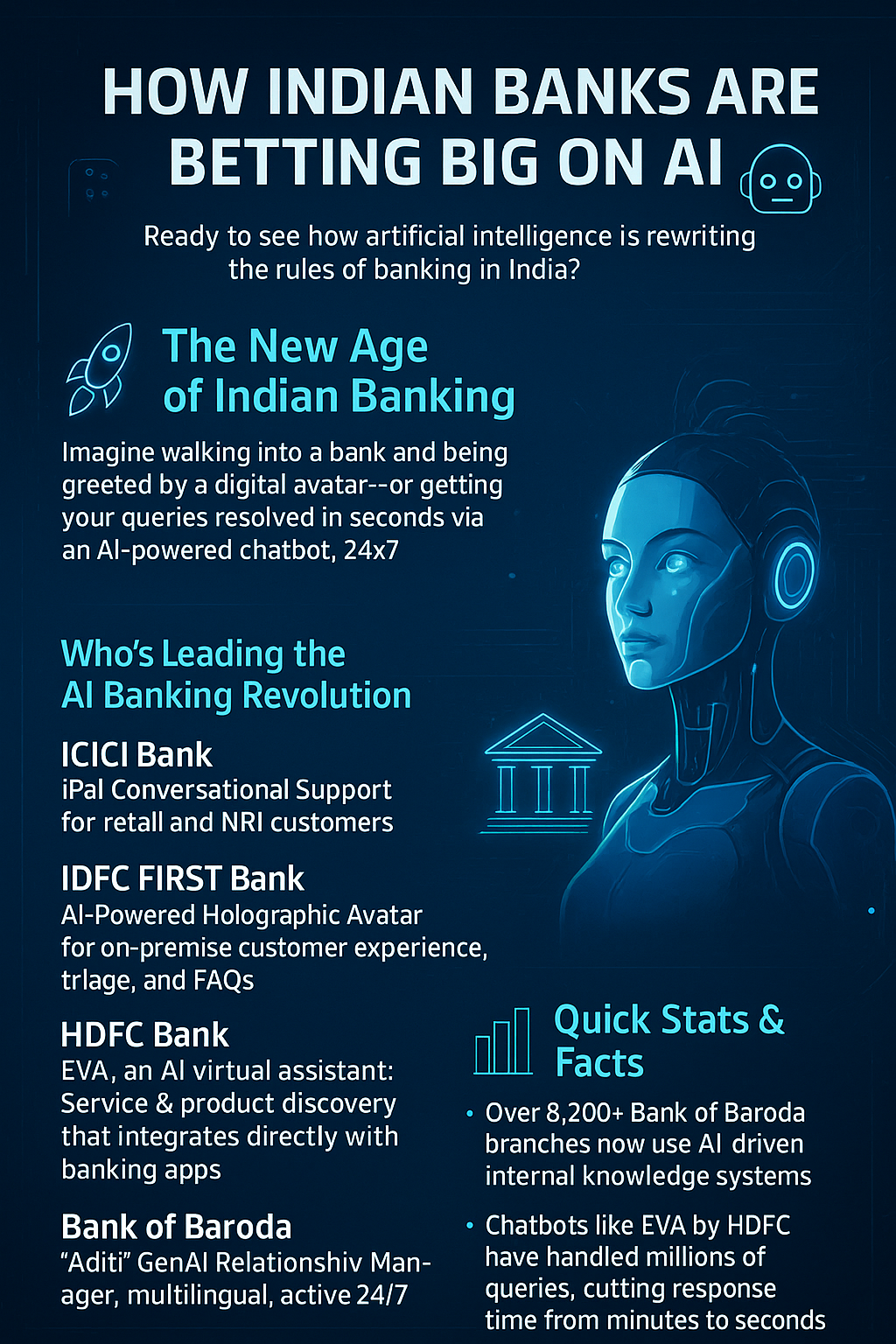
How Indian Banks Are Betting Big on AI 🤖🏦
Medium· 2025-11-16 04:32
Core Insights - Indian banks are leveraging artificial intelligence (AI) to enhance customer experience, operational efficiency, and service scalability in the financial sector [1][3]. AI Implementation by Leading Banks - ICICI Bank utilizes iPal for conversational support aimed at retail and NRI customers [4]. - IDFC FIRST Bank has introduced an AI-powered holographic avatar to improve on-premise customer interactions [5]. - HDFC Bank employs EVA, an AI virtual assistant, for service and product discovery integrated with banking applications [6]. - Bank of Baroda features "Aditi," a GenAI relationship manager, providing multilingual support and operating 24/7 [7]. - SBI (State Bank of India) has revamped its YONO platform to incorporate a broader AI strategy and features [8]. - Axis Bank and IndusInd Bank offer IndusAssist, providing seamless AI service across various channels [9]. Market Context - India's banking sector serves over 1.4 billion people, managing crores of accounts and billions in daily transactions [11]. - AI technologies are essential for addressing the scale of operations, personalizing services, and ensuring 24/7 availability [11]. Performance Metrics - Over 8,200 branches of Bank of Baroda utilize AI-driven internal knowledge systems [12]. - HDFC's chatbot EVA has managed millions of queries, significantly reducing response times from minutes to seconds [12]. - The introduction of holographic avatars and multilingual support is enhancing accessibility and personalization in banking services [12].
Post Office schemes beating FD returns: These small savings schemes offer 7% and higher interest rates on deposits
The Economic Times· 2025-11-15 07:20
SBI to discontinue mCASH service after November 30, 2025: Here’s how customers can send money to third-party beneficiaries after thatWhich Post Office small savings schemes offer higher interest rates than FDs of many leading banks?Post Office small savings schemes are offering better returns than many leading banks’ fixed deposit schemes. Post office scheme interest rates are revised every quarter by the government. At present, below-mentioned post office schemes are offering 7% and above interest rates.In ...