
GeneDx

Search documents
GeneDx (WGS) - 2025 Q2 - Earnings Call Transcript
2025-07-29 13:32
Financial Data and Key Metrics Changes - The company reported revenues of $102.7 million for Q2 2025, a 49% increase year-over-year [20] - Exome and Genome revenue reached a record high of $85.9 million, up 69% from the same quarter last year [20] - The average reimbursement rate for Exome and Genome tests was over $3,700, an increase from approximately $3,400 in the previous quarter [20] - Adjusted gross margin expanded to a record high of 71%, driven by favorable mix shift, improved reimbursement, and lower COGS [24] - Adjusted net income for Q2 was $15 million, marking the fourth consecutive quarter of profitability [26] Business Line Data and Key Metrics Changes - The majority of Q2 volume growth came from existing clinicians, with 23,102 Exome and Genome tests reported, a 28% increase compared to the same quarter last year [22] - New indications like cerebral palsy and pediatric immunologists contributed to early signs of increased adoption [12][43] - The NICU market represents a significant opportunity, with fewer than 5% of babies currently receiving genetic tests [13] Market Data and Key Metrics Changes - The company has captured nearly a third of its target clinicians in the pediatric neurology segment [11] - Pediatric neurologists accounted for most of the volume growth in Q2, with 25% coming from new clinicians [43] - The general pediatrician market remains largely untapped, with 60,000 pediatricians in the U.S., of which about 25,000 diagnose children with developmental or intellectual delays [15] Company Strategy and Development Direction - The company aims to shift healthcare from reactive to proactive, focusing on early genetic diagnosis to improve health outcomes [6][8] - Plans to engage pediatricians through educational initiatives and presence at the AAP meeting to promote the use of exome and genome sequencing [16][38] - The integration of Fabric Genomics is expected to enhance the company's capabilities and competitive edge in genomic testing [10][76] Management's Comments on Operating Environment and Future Outlook - Management expressed confidence in achieving at least 30% year-over-year volume growth for the full year 2025 [22][27] - The company anticipates that the NICU and general pediatric markets will drive growth in the second half of the year [12][44] - Management highlighted the importance of reducing denial rates and improving collection processes as key drivers of financial performance [21][72] Other Important Information - The company raised its full-year revenue guidance to between $400 million and $415 million for 2025 [27] - The acquisition of Fabric Genomics included a payment of $33.2 million at closing [26] Q&A Session Summary Question: ASPs trounced estimates, what were the drivers? - Management noted improvements in revenue cycle processes and increased Medicaid coverage across states as key drivers for higher ASPs [33][34] Question: How to balance investment in the pediatric market? - The company will focus on pediatric neurology while gradually building the general pediatrician market, emphasizing education and marketing efforts [37][38] Question: What is the impact of NICU and new indications on volume growth? - Management expects significant contributions from NICU testing and new indications in Q3 and Q4, with a focus on activating new accounts [44][46] Question: What is the current denial rate? - The paid rate has improved to the mid-50s, with ongoing efforts to reduce denials further [72] Question: How is the integration of Fabric Genomics progressing? - The integration is on track, with positive collaboration between teams and plans to expand into international markets [76][78]

GeneDx (WGS) - 2025 Q2 - Earnings Call Transcript
2025-07-29 13:30
Financial Data and Key Metrics Changes - The company reported revenues of $102.7 million for Q2 2025, a 49% increase year over year [19] - Exome and Genome revenue reached a record high of $85.9 million, up 69% from the same quarter last year [19] - The average reimbursement rate for Exome and Genome tests was over $3,700, an increase from approximately $3,400 in the previous quarter [19] - Adjusted gross margin expanded to a record high of 71%, driven by favorable mix shift, improved reimbursement, and lower COGS [22] - Adjusted net income for Q2 was $15 million, marking the fourth consecutive quarter of profitability [25] - Cash, cash equivalents, and marketable securities totaled $135.5 million as of June 30, 2025 [25] Business Line Data and Key Metrics Changes - The company conducted 23,102 Exome and Genome tests in Q2 2025, a 28% increase compared to the same quarter last year [21] - Most volume growth came from existing doctors, with 25% of volume growth attributed to new clinicians [44] - The introduction of new indications like cerebral palsy is expected to drive increased same-store sales [21][44] Market Data and Key Metrics Changes - Pediatric neurologists constituted a majority of new exome and genome ordering providers, capturing nearly a third of the target clinicians in this segment [10] - The NICU market represents a billion-dollar opportunity, with fewer than 5% of babies currently receiving genetic tests [12] - The company has established a presence in 42 out of the 50 top NICUs, with expectations for significant scaling in NICU testing [12] Company Strategy and Development Direction - The company aims to shift healthcare from reactive to proactive, focusing on early genetic diagnosis to improve health outcomes [6][7] - Plans to engage pediatricians and expand into the general pediatrics market, targeting 60,000 pediatricians in the U.S. [14][15] - The acquisition of Fabric Genomics is expected to enhance the company's capabilities and competitive edge in genomic testing [9][78] Management's Comments on Operating Environment and Future Outlook - Management expressed confidence in achieving at least 30% year-over-year volume growth for the full year 2025 [21][26] - The company anticipates that the broader adoption of genomic testing will take 18 to 24 months following new guidelines from the American Academy of Pediatrics [16][96] - Management highlighted the importance of simplifying the ordering process for pediatricians to facilitate adoption [92] Other Important Information - The company is focused on building partnerships with pharmaceutical companies to leverage genomic data for drug development [17] - The integration of AI into the proprietary interpretation platform is expected to enhance accuracy and scalability [9] Q&A Session Summary Question: ASPs trounced estimates; what drove this? - Management attributed the increase to major overhauls in the revenue cycle and improved adherence to documentation requirements [32][34] Question: How to balance investment in pediatric market with current business? - The company will continue to focus on pediatric neurology while gradually building the general pediatric market [37][38] Question: How is the NICU market progressing? - The company has three health systems live with Epic and expects to onboard at least 12 more in the second half of the year [46] Question: What is the current denial rate? - The paid rate is now in the mid-50s, reflecting improvements in the revenue cycle [72] Question: How is the Fabric Genomics integration progressing? - The integration is on track, with a focus on leveraging AI and expanding into international markets [78] Question: What is the timeline for commercial payers to adopt new guidelines? - The company expects an 18 to 24-month timeline for operationalizing new guidelines with payers [96]
GeneDx: Strong Testing Volume And An Invaluable Genomic Database
Seeking Alpha· 2025-07-15 06:52
Core Insights - The article emphasizes a holistic investment approach in healthcare equities, integrating both top-down and bottom-up valuation techniques [1] - It highlights the importance of detailed company analysis, particularly focusing on capital structure and debt covenants, which significantly influence equity valuation [1] Summary by Categories Investment Approach - The investment strategy involves a comprehensive evaluation that combines macroeconomic factors with specific company metrics [1] Company Analysis - Detailed examination of companies is crucial, with particular attention to their capital structure and debt obligations, as these factors can greatly affect their market valuation [1]


GeneDx (WGS) FY Conference Transcript
2025-06-09 21:00
Summary of GeneDx Conference Call Company Overview - GeneDx was established 25 years ago at the National Institutes of Health, focusing on diagnosing difficult cases, particularly in rare diseases [4][5] - The company has built the largest rare disease data asset in the U.S., with over 800,000 exomes and genomes and more than 6,100,000 phenotypic data points [5][6] Strategic Initiatives - GeneDx aims to reduce the diagnostic odyssey, which currently takes about five years, to weeks or even hours [5][6] - The company is focusing on increasing utilization in pediatric outpatient settings and NICUs [6] Differentiation and Market Position - GeneDx's tests are differentiated by their extensive data assets, which include a highly representative database and a robust phenotypic data set [7][8] - Approximately 60% of the time, both parents are tested, enhancing the accuracy of diagnoses [7] - The company claims an 80% market share among expert geneticists, with significant growth potential in pediatric neurology and NICU settings [14][16] Market Penetration - In pediatric neurology, GeneDx has only penetrated about 14% of the patient population, indicating substantial growth opportunities [16] - In NICUs, fewer than 5% of babies currently receive genetic testing, despite studies showing that 60% would benefit from it [19][22] - GeneDx aims to increase its NICU testing to approximately 225,000 tests annually, targeting a quarter million children by 2026-2027 [24] Product Development and Testing - GeneDx has launched a two-day ultra-rapid turnaround time for genome testing, which is expected to enhance market uptake [25][26] - The company is expanding its testing indications to include conditions like cerebral palsy and hearing loss, focusing on the best clinical outcomes [29][30] Financial Performance and Cost Management - GeneDx has achieved profitability and aims for continued profitable growth, focusing on areas with sufficient reimbursement [17][18] - The company has reduced denial rates from 65% to less than 50% for pediatric neurologists, improving reimbursement rates and gross margins [48][49] - Current gross margins for exome and genome testing are around 80%, with ongoing efforts to reduce costs further through automation and technology [54][56] Future Growth and Market Strategy - GeneDx plans to expand into adult genetic testing as reimbursement pathways develop, aiming for early diagnosis across all age groups [62][63] - The company is also exploring monetization of its extensive data set for biopharma, aiming to contribute to drug discovery and clinical trial development [64][66] Conclusion - GeneDx is positioned as a leader in genetic testing for rare diseases, with a strong focus on data-driven diagnostics and expanding market opportunities in pediatric and adult settings. The company is committed to improving patient outcomes through faster and more accurate testing while maintaining a focus on profitability and cost management.
GeneDx (WGS) 2025 Conference Transcript
2025-06-04 14:55
Summary of GeneDx Conference Call Company Overview - **Company**: GeneDx - **Industry**: Genetic testing and diagnostics, focusing on rare diseases Key Points and Arguments 1. **Rare Disease Awareness**: One in ten Americans has a rare disease, with half being children. GeneDx is launching a campaign to raise awareness about the challenges in diagnosing these conditions [3][4][5] 2. **Mission Statement**: GeneDx aims to revolutionize the diagnosis of rare diseases by providing faster, more comprehensive, and precise genetic testing, ultimately empowering families and clinicians [6][7] 3. **Market Opportunity**: The company is focused on increasing the utilization of genetic testing, particularly in outpatient settings and NICUs, where fewer than 5% of babies currently receive genetic tests [12][14][30] 4. **Cost Implications**: The lack of diagnosis for rare diseases costs the US healthcare system approximately $1 trillion annually, highlighting the financial burden of underutilization of testing [12] 5. **Growth Strategy**: GeneDx is expanding its focus to include additional indications such as cerebral palsy and immune deficiency disorders, aiming for a 30% volume growth in testing [13][28] 6. **Path to Profitability**: The company reported a positive adjusted EBITDA of $7.7 million in Q1 2024, with a focus on improving reimbursement rates and reducing denial rates [16][18] 7. **Denial Rates**: Currently, nearly 50% of tests are denied, primarily due to administrative issues. The company aims to reduce this to 20% over the next 18-24 months [43][44] 8. **Competition**: GeneDx welcomes competition as it raises awareness and pressure on payers, while emphasizing its advantages in data assets and testing capabilities [45][49] 9. **M&A Strategy**: The acquisition of Fabric aims to enhance GeneDx's interpretation capabilities and expand into international markets, while also improving cost efficiencies through automation [53][54][56] Additional Important Content 1. **NICU Focus**: GeneDx is targeting level three and four NICUs, where they believe 225,000 tests could be run annually, significantly increasing the number of genetic tests performed [30][31] 2. **Technological Advancements**: The company is investing in AI and automation to improve the efficiency of its testing processes, which could lead to lower costs per test in the future [19][56] 3. **State Medicaid Coverage**: GeneDx has seen an increase in state Medicaid programs adopting coverage for exome and genome testing, now reaching 33 states [18][41] 4. **Patient-Centric Approach**: The company emphasizes the importance of providing the best clinical tests based on guidelines, ensuring that patient needs are prioritized in their testing menu [50][51] This summary encapsulates the key insights and strategic directions discussed during the GeneDx conference call, highlighting the company's commitment to improving the diagnosis of rare diseases and its plans for growth and profitability.
GeneDx: Strong Fundamentals Intact As Market Misreads Test Volume Dip
Seeking Alpha· 2025-05-20 09:21
Core Insights - The article discusses the investment potential in certain stocks, particularly in the biotech and healthcare sectors, emphasizing the importance of due diligence for investors [2][3]. Group 1 - The stocks mentioned may already be part of various model portfolios, indicating a strategic selection process for investment opportunities [2]. - Small-cap and biotech stocks are highlighted as carrying a higher risk of losses compared to the broader market, suggesting a need for careful evaluation [2]. - The article notes that opinions on stocks can change over time with new data, which may affect their future favorability in the market [2]. Group 2 - The article does not provide specific recommendations or advice on investment suitability, reinforcing the need for individual assessment by investors [3]. - It clarifies that past performance of stocks is not indicative of future results, which is a critical consideration for potential investors [3].

GeneDx (WGS) - 2025 Q1 - Earnings Call Transcript
2025-04-30 12:30
Financial Data and Key Metrics Changes - The company reported revenues of $87.1 million for Q1 2025, marking a 62% year-over-year growth in Exome and Genome revenues, which contributed $71.4 million this quarter [17][21] - Adjusted gross profit from continuing operations was $59.7 million, up 56% year-over-year, resulting in an adjusted gross margin of 69%, an increase from 61% a year ago [21][24] - Adjusted net income for Q1 2025 was $7.7 million, representing the third consecutive quarter of profitability [22][24] Business Line Data and Key Metrics Changes - Exome and Genome tests accounted for 40% of all tests in Q1, with volumes from these products up 24% year-over-year [17][21] - The company launched an ultra-rapid genome sequencing product in April, which delivers results in as soon as 48 hours, enhancing its service offerings [10][19] Market Data and Key Metrics Changes - The company expanded its market penetration among pediatric neurologists to 14% [10] - The average reimbursement rate for Exome and Genome tests increased to approximately $3,400, up from $2,600 in the same quarter last year [20] Company Strategy and Development Direction - The company is focused on integrating exome and genome testing as a standard of care, aiming to shift from reactive to proactive healthcare [8][12] - Plans to acquire Fabric Genomics, which will enhance AI-powered genomic interpretation and create a recurring software-based revenue stream [13][21] - The company is also targeting new clinical indications, including immune deficiency disorders and cerebral palsy, to drive growth [19][63] Management's Comments on Operating Environment and Future Outlook - Management expressed optimism about the strategic fit of the Fabric acquisition and its potential to unlock scalable platform economics [13][21] - The company anticipates a NICU volume ramp in the second half of the year, supported by foundational infrastructure laid in previous quarters [11][19] - Management reaffirmed guidance for 2025, expecting total revenues between $360 million and $375 million, with at least 30% growth in Exome and Genome volumes [24][25] Other Important Information - The company highlighted the importance of newborn screening and its potential contribution to revenue streams, likely in the 2027 timeframe [45][46] - The company is integrating AI across its business to enhance efficiency and accuracy in genomic interpretation [13][21] Q&A Session Summary Question: What are the reasons for the sequential decline in volumes in Q1? - Management acknowledged a historical pattern of volume decline from Q4 to Q1, exacerbated by weather disruptions and fewer sales days in Q1 [30][31] Question: What caused the increase in G&A expenses? - A significant portion of the increase was attributed to costs related to the Epic integration and general support costs, with expectations to drive down operating expenses as a percentage of revenue over time [33][34] Question: What visibility supports the expected acceleration in NICU volumes in the second half of the year? - Management indicated strong initial integration with Epic and a backlog of clients ready to come online, supporting the anticipated volume growth [37][38] Question: How is pricing expected to play out in Q2 and beyond? - Management noted that the average reimbursement rate is expected to remain stable, with ongoing efforts to reduce denials and improve the revenue cycle [39][42] Question: What is the expected impact of the weather disruptions on Q2 volumes? - Management expects to recoup some of the missed appointments in Q2, although the scarcity of specialists may delay recovery [88][90] Question: What are the expectations for new indications this year? - Management confirmed that new indications are expected to contribute to growth, with ongoing efforts to change standard care practices among physicians [63][66]
GeneDx (WGS) - 2025 Q1 - Earnings Call Transcript
2025-04-30 12:30
Financial Data and Key Metrics Changes - The company reported revenues of $87.1 million for Q1 2025, marking a 62% year-over-year growth in Exome and Genome revenues, which contributed $71.4 million this quarter [16][22] - Adjusted gross profit from continuing operations was $59.7 million, up 56% year-over-year, resulting in an adjusted gross margin of 69%, an increase from 61% a year ago [21][22] - Adjusted net income for Q1 2025 was $7.7 million, representing the third consecutive quarter of profitability [22] Business Line Data and Key Metrics Changes - Exome and Genome tests accounted for 40% of all tests in Q1, with volumes from these flagship products up 24% year-over-year [16] - The company launched its ultra-rapid genome sequencing product, which delivers results in as soon as 48 hours, enhancing its service offerings [10][19] Market Data and Key Metrics Changes - The company grew its market penetration of pediatric neurologists to 14% [9] - Average reimbursement rate for Exome and Genome tests increased to approximately $3,400, up from $2,600 in the same quarter last year [20] Company Strategy and Development Direction - The company is focused on integrating exome and genome testing as a standard of care, aiming to shift from reactive to proactive healthcare [7][8] - Plans to acquire Fabric Genomics, which will enhance AI-powered genomic interpretation and create a recurring software-based revenue stream [12][13] - The company is expanding into new clinical indications and markets, including NICU and adult testing, to capture growth opportunities [10][19] Management's Comments on Operating Environment and Future Outlook - Management expressed optimism about the strategic fit of the Fabric acquisition and its potential to unlock scalable platform economics [13] - The company anticipates continued growth in its core exome and genome testing business, with a guidance increase for total revenues to between $360 million and $375 million for the full year 2025 [23][25] Other Important Information - The company highlighted the importance of newborn screening and its potential revenue contribution, expected to materialize around 2027 [46] - Management noted that only 5% of rare diseases currently have approved therapies, emphasizing the critical role of genomic data in drug discovery [14] Q&A Session Summary Question: What are the reasons for the sequential decline in volumes in Q1? - Management acknowledged a historical pattern of volume decline from Q4 to Q1, exacerbated by weather disruptions and fewer sales days in Q1 [30][31] Question: What contributed to the increase in G&A expenses? - A significant portion of the increase was attributed to costs related to the Epic integration and general support costs, with expectations of driving down OpEx as a percentage of revenue over time [34][35] Question: What visibility supports the expected acceleration in NICU volumes in the second half of the year? - Management indicated that initial integration with Epic is on track and that there is a solid pipeline of clients ready to come online [38] Question: How is pricing expected to play out in Q2 and beyond? - Management noted that the average reimbursement rate is expected to remain stable, with ongoing efforts to reduce denials and improve the revenue cycle [40][43] Question: What is the expected impact of the weather disruptions on Q2 volumes? - Management expects to recoup some of the missed appointments in Q2, although long wait times for specialist appointments may affect recovery [90] Question: What are the expectations for new indications this year? - Management confirmed that new indications, including immune deficiencies and cerebral palsy, are expected to contribute to growth, although it is too early to quantify their impact [63][65]
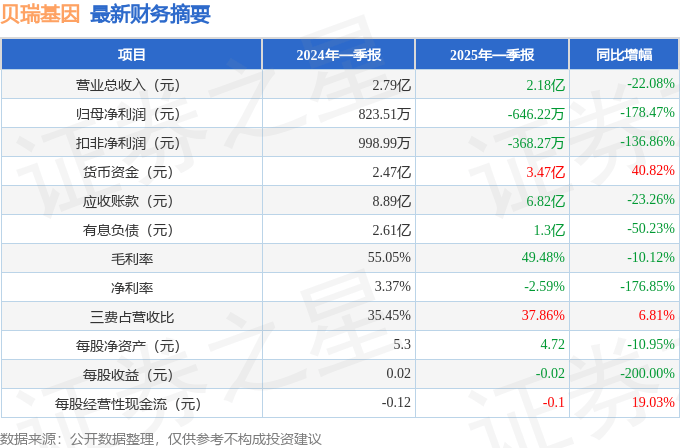
贝瑞基因(000710)2025年一季报简析:净利润减178.47%,公司应收账款体量较大
Sou Hu Cai Jing· 2025-04-28 22:10
Financial Performance - Berry Genomics reported a total revenue of 218 million yuan for Q1 2025, a decrease of 22.08% year-on-year [1] - The net profit attributable to shareholders was -6.46 million yuan, representing a decline of 178.47% compared to the previous year [1] - The gross margin was 49.48%, down 10.12% year-on-year, while the net margin was -2.59%, a decrease of 176.85% [1] - Total expenses (selling, administrative, and financial) amounted to 82.44 million yuan, accounting for 37.86% of revenue, an increase of 6.81% year-on-year [1] Accounts Receivable and Cash Flow - Accounts receivable represented 63.24% of the latest annual revenue, indicating a significant amount of outstanding payments [1] - The company reported a cash flow from operations of -0.1 yuan per share, an increase of 19.03% year-on-year [1] Comparison with Competitors - Berry Genomics' business model focuses on genetic testing for newborns and children, similar to GeneDx, which has performed well in the US market [3] - The differences between Berry Genomics and GeneDx include market conditions, payment methods, and the maturity of their respective technologies [3][4] - The average price for pediatric genetic testing in the US ranges from 3,000 to 5,000 USD, while in China it is between 1,000 and 5,000 yuan [4] Market Potential - The Chinese market for pediatric genetic testing is larger than that of the US, with opportunities for improvement in the continuity of maternal and pediatric medical services [4] - Berry Genomics aims to provide a full-chain service from testing consultation to subsequent treatment, facilitating the widespread implementation of its projects in China [4]

贝瑞基因(000710) - 000710贝瑞基因投资者关系管理信息20250416
2025-04-16 11:10
Group 1: Collaboration Overview - The collaboration with Beijing Children's Hospital aims to establish a three-tiered neonatal screening, diagnosis, and treatment system [2] - The project focuses on early screening and diagnosis of functional birth defects in newborns, leveraging genetic testing [2][3] - The partnership seeks to create a comprehensive health management system for children, extending services from newborns to preschoolers [2] Group 2: Market Potential - Approximately 9 million newborns are born in China each year, with a projected screening coverage of 30% to 50%, potentially generating an annual revenue of 4 billion to 6 billion RMB [7] - The genetic testing for newborns and children is positioned as a crucial preventive measure against birth defects, with a current birth defect rate of about 5.4% in China [7] Group 3: Business Model - The genetic testing services will charge between 1,000 to 5,000 RMB based on the type of test, with initial operations planned in Henan province [5] - The integration of AI technology aims to enhance the efficiency and accuracy of genetic testing processes, providing personalized health management solutions [10][9] Group 4: Company Advantages - The company has significant advantages in second and third-generation sequencing technologies, enabling large-scale clinical testing [8] - Established partnerships with top hospitals enhance service capabilities and market reach [8] Group 5: Future Plans - The company plans to evaluate and transform intellectual property from the collaboration into marketable products, with expected revenue generation starting in Q4 2025 [4] - The collaboration is seen as a strategic entry into the neonatal health management sector, expanding the company's market presence [10] Group 6: Competitive Landscape - Compared to GeneDx, the company offers a more mature third-generation sequencing technology and aims to provide a comprehensive service chain from testing to treatment [12] - The domestic market for genetic testing is expected to grow significantly, with a focus on improving continuity of care in maternal and child health services [12]