
Freddie Mac

Search documents
Mortgage rates end 2025 at fresh low, giving buyers an 'encouraging sign' into new year
Yahoo Finance· 2025-12-31 17:07
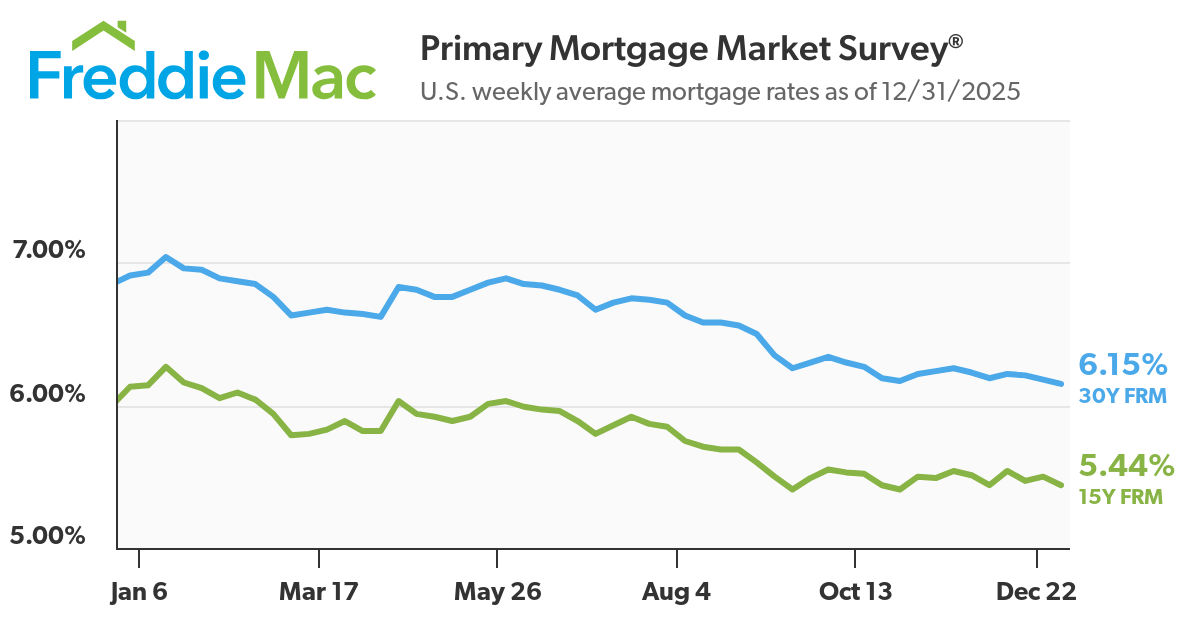
Core Insights - Mortgage rates have reached a new low for 2025, with the average 30-year mortgage rate at 6.15% and the 15-year rate at 5.44%, providing potential homebuyers with renewed momentum as they approach 2026 [1][2]. Group 1: Mortgage Rate Trends - The average 30-year fixed-rate mortgage started the year near 7% but has now dropped to its lowest level in 2025, indicating a positive shift for homebuyers [3]. - Mortgage rates have shown a significant decline in the second half of the year, stabilizing around 6.2% since mid-September, which has encouraged more buyers and sellers to enter the market [2][4]. Group 2: Market Activity and Predictions - Housing contract activity saw an unexpected increase of over 3% in November, suggesting that lower mortgage rates are beginning to improve market conditions [3]. - Economists predict that mortgage rates will average around current levels in the coming year, with modest home price growth, potentially aiding the recovery of the housing market [4]. - If the current momentum continues into the peak buying season of 2026, stronger sales figures are anticipated compared to much of 2025 [5].
Average US long-term mortgage rate falls to the lowest level of the year at 6.15%
Yahoo Finance· 2025-12-31 17:05
Mortgage Rates Overview - The average rate on a 30-year U.S. mortgage fell to 6.15%, down from 6.18% last week, and significantly lower than the 6.91% average a year ago [1] - The average rate on 15-year fixed-rate mortgages decreased to 5.44% from 5.50%, compared to 6.13% a year ago [1] Influencing Factors - Mortgage rates are influenced by the Federal Reserve's interest rate policy, bond market expectations for the economy and inflation, and generally follow the 10-year Treasury yield [2] - The 10-year Treasury yield was at 4.14%, slightly down from 4.15% the previous week [2] Recent Trends - The average rate on a 30-year mortgage has been stable since dropping to 6.17% on October 30, the lowest level in over a year [3] - Mortgage rates began to ease in July in anticipation of Federal Reserve rate cuts, which started in September and continued into October [3] Federal Reserve's Role - The Federal Reserve does not set mortgage rates directly, but its short-term rate cuts can signal lower inflation or slower economic growth, influencing long-term Treasury yields and mortgage rates [4] - However, Fed rate cuts do not always lead to lower mortgage rates [4] Market Conditions - Home shoppers with cash or financing at current mortgage rates are in a better position than a year ago, with a significant increase in home listings and many sellers lowering their asking prices [5] - Affordability remains a challenge for first-time buyers, particularly due to economic uncertainty and job market conditions [6] Sales Performance - Sales of previously occupied U.S. homes rose in November compared to the previous month but slowed year-over-year for the first time since May, despite low average long-term mortgage rates [7] - Home sales are down 0.5% for the first 11 months of the year compared to the same period last year, with economists forecasting the average 30-year mortgage rate to remain slightly above 6% next year [7]
Mortgage Rates Drop to Lowest Level in 2025
Globenewswire· 2025-12-31 17:00
Core Insights - Freddie Mac reported that the average 30-year fixed-rate mortgage (FRM) is 6.15%, marking a decrease from 6.18% the previous week and down from 6.91% a year ago, indicating a positive trend for potential homebuyers [1][4] - The 15-year FRM averaged 5.44%, down from 5.50% last week and lower than 6.13% a year ago, reflecting a similar downward trend in mortgage rates [4] Industry Overview - The Primary Mortgage Market Survey® (PMMS®) focuses on conventional, conforming, fully amortizing home purchase loans for borrowers with excellent credit who put 20% down [2] - Freddie Mac's mission is to enhance liquidity, stability, and affordability in the housing market, having assisted millions of families in buying, renting, or maintaining their homes since 1970 [3]


Mortgage Rates Drop to Lowest Level in 2025
Globenewswire· 2025-12-31 17:00
Core Insights - Freddie Mac reported that the average 30-year fixed-rate mortgage (FRM) is now at 6.15%, marking a decrease from 6.18% the previous week and down from 6.91% a year ago, indicating a positive trend for potential homebuyers as the new year approaches [1][6]. Group 1: Mortgage Rate Trends - The 30-year FRM averaged 6.15% as of December 31, 2025, down from 6.18% the previous week [6]. - The 15-year FRM averaged 5.44%, a decrease from 5.50% the prior week [6]. - Year-over-year, the 30-year FRM has decreased from 6.91% and the 15-year FRM from 6.13% [6]. Group 2: Freddie Mac's Mission - Freddie Mac's mission is to enhance liquidity, stability, and affordability in the housing market, supporting families in buying, renting, or maintaining their homes since 1970 [3].
Mortgage and refinance interest rates today, December 31: Down to a new 2025 low
Yahoo Finance· 2025-12-31 11:00
Core Insights - Mortgage rates are currently stable, with the average 30-year fixed rate at 5.97% and the 15-year fixed rate at 5.42% [1][15] - Economists do not anticipate significant drops in mortgage rates before the end of 2026, despite recent cuts to the federal funds rate [17] - Mortgage rates have generally decreased over the past couple of months, remaining about half a point lower than a year ago [18] Current Mortgage Rates - The national average rates for various mortgage types are as follows: - 30-year fixed: 5.97% - 20-year fixed: 5.95% - 15-year fixed: 5.42% - 5/1 ARM: 5.83% - 7/1 ARM: 5.97% - 30-year VA: 5.42% - 15-year VA: 4.99% - 5/1 VA: 5.12% [4] Mortgage Refinance Rates - Current mortgage refinance rates are typically higher than purchase rates, although this is not always the case [3] - The national averages for refinance rates are also rounded to the nearest hundredth, similar to purchase rates [3] Mortgage Types and Their Characteristics - A 30-year fixed mortgage offers lower and predictable monthly payments, but comes with higher interest costs over the loan's life [7][9] - A 15-year fixed mortgage has higher monthly payments but lower interest rates, allowing homeowners to pay off their mortgage sooner and save on interest [10][11] - Adjustable-rate mortgages (ARMs) offer lower initial rates but can lead to unpredictable payments after the introductory period [12][13] FAQs on Mortgage Rates - The current national average for a 30-year mortgage is 5.97%, but rates can vary based on location [15] - To secure the lowest refinance rate, improving credit scores and lowering debt-to-income ratios are recommended strategies [19]
US lawmakers launch probe into insurance rating firm in Florida
Digital Insurance· 2025-12-30 19:34
Core Viewpoint - An inquiry has been initiated by three US senators into Demotech, an insurance ratings firm, regarding its ratings and the potential risks they pose to Fannie Mae, Freddie Mac, and taxpayers due to climate-related insurer failures [1][2]. Group 1: Inquiry Details - The senators questioned the rationale behind Fannie Mae and Freddie Mac's acceptance of Demotech ratings as proof of insurer financial strength, especially given the high failure rates of insurers with these ratings [2][3]. - They have requested detailed disclosures from both Fannie Mae and Freddie Mac about their reliance on Demotech-rated insurers, including the number of mortgages involved and the geographic concentration of these loans [10]. Group 2: Demotech's Role and Market Impact - Demotech has a significant presence in the Florida insurance market, where it was established to rate smaller insurance companies that struggle to meet the standards of larger rating agencies [6]. - A study indicated that over 60% of Florida insurers are rated by Demotech, but nearly 20% of these rated insurers became insolvent while holding an A rating from 2009 to 2022 [8]. Group 3: Climate Change Concerns - The inquiry is set against the backdrop of increasing climate change impacts, which are intensifying natural disasters and straining the property insurance market across the US [4]. - The senators warned that reliance on Demotech could lead to systemic risks in the mortgage market, reminiscent of the 2008 financial crisis, if a collapse occurs in the homeowners' insurance market [9][11].

Privatizing Fannie Mae and Freddie Mac the wrong way risks a second Great Recession
Fortune· 2025-12-30 14:05
Core Viewpoint - The Trump Administration's focus on privatizing Fannie Mae and Freddie Mac may undermine housing market stability and primarily benefit wealthy investors rather than the public [4][5][12]. Group 1: Current Challenges in the Housing Market - Homebuyers are facing challenges due to insufficient home construction, rising construction costs, and increasing insurance costs linked to climate risks [1]. - Fannie Mae and Freddie Mac play a crucial role in the housing market by purchasing mortgages, bundling them into securities, and selling them to investors, which helps maintain credit flow and lower rates for homebuyers [2]. Group 2: Historical Context and Risks - Excessive risk-taking by Fannie Mae and Freddie Mac contributed to the 2008 financial crisis, leading to their federal conservatorship to ensure market stability [3]. - The Trump Administration's push for privatization raises concerns about eroding safeguards that have maintained housing market stability and increasing systemic risks [4][5]. Group 3: Implications of Privatization - Privatization without strong safeguards could lead to higher borrowing costs for consumers, with estimates suggesting an increase of $500 to $2,000 annually for typical borrowers [9]. - A lack of government backing during financial crises could exacerbate housing credit crunches, deepening economic downturns [10]. - Privatization efforts may recreate conditions that led to the Great Recession, as for-profit entities could engage in excessive risk-taking without adequate oversight [11][12]. Group 4: Proposed Safeguards - Essential components for a successful privatization include a government backstop during downturns and strong operational guardrails during stable periods, referred to as the "twin pillars" [6][14]. - These pillars ensure liquidity and stability, allowing Fannie Mae and Freddie Mac to maintain affordable housing goals while managing risks effectively [14][15].

Mortgage rate forecast: March 2026
Yahoo Finance· 2026-02-27 21:19
Core Insights - The Federal Reserve may consider further interest rate cuts in January, but mortgage rates have shown minimal change following the recent quarter-point reduction [1][2] - Mortgage rates are influenced by broader economic expectations rather than directly following Fed rate cuts, with current rates reflecting concerns about inflation and employment [1][2] - The average 30-year mortgage rate as of December 17 was reported at 6.30%, indicating a stable but high borrowing environment [2] - The Fed's communication suggests a pause in rate cuts, contributing to the stagnation of mortgage rates despite the recent reduction in the federal funds rate [2][3] Mortgage Rate Trends - The possibility of mortgage rates dropping below 6% has increased, with Fannie Mae forecasting an end-of-2026 rate of 5.9% [3] - Higher mortgage rates have led to a "lock-in effect," where homeowners are reluctant to refinance due to lower existing rates [4] - The median national home price reached a record high of $409,200 in November, reflecting ongoing challenges in the housing market [4] Rate Reporting Differences - Bankrate's mortgage rate averages are slightly higher than those reported by Freddie Mac due to the inclusion of origination points and other costs [5] - Despite differences in reporting, both Bankrate and Freddie Mac show similar trends in mortgage rates, indicating a consistent market direction [5]
The 11 big trades of 2025: Bubbles, cockroaches and a 367% jump
BusinessLine· 2025-12-29 04:24
Market Overview - The year was characterized by high-conviction bets and rapid reversals across various markets, including bonds, currencies, and stocks [1] - Investors engaged in significant bets on political shifts, inflated balance sheets, and speculative narratives, leading to both substantial gains and losses [2][3] Cryptocurrency Trends - The Trump brand initially drove momentum in the cryptocurrency market, with various tokens launched by Trump family members experiencing significant but short-lived rallies [4][5] - By December 23, Trump's memecoin had dropped over 80% from its January high, while Melania Trump's token fell nearly 99% [6] - The volatility in crypto assets highlighted the speculative nature of the market, where political momentum could not shield investments from core market patterns [7] Defence Stocks Surge - A geopolitical shift led to a significant rise in European defence stocks, with companies like Rheinmetall AG and Leonardo SpA seeing year-to-date gains of approximately 150% and over 90%, respectively [10] - Asset managers, previously hesitant to invest in defence due to ESG concerns, began to redefine their mandates and invest heavily in the sector [11][12] - A Bloomberg basket of European defence stocks rose over 70% for the year, indicating a major shift in capital allocation towards defence as a public good [12] Debasement Trade Narrative - Heavy debt loads in major economies prompted investors to seek refuge in gold and alternative assets, leading to the emergence of the "debasement trade" narrative [13] - In October, both gold and Bitcoin reached record highs amid concerns over the US fiscal outlook and a prolonged government shutdown [14] - Despite the initial rise, Bitcoin later slumped, and the dollar stabilized, illustrating the complexities of the debasement trade [15][16] South Korean Stock Market - South Korea's benchmark equity index surged over 70% in 2025, driven by President Lee Jae Myung's efforts to enhance capital markets [18] - Foreign investment increased significantly, while local retail investors remained net sellers, indicating a disconnect between domestic sentiment and foreign capital inflows [20] Japanese Bonds - The "widowmaker" trade against Japanese bonds turned profitable in 2025 as yields surged, driven by interest rate hikes and increased government spending [26][27] - The benchmark 10-year JGB yields surpassed 2%, marking levels not seen in decades, while the overall bond market faced significant declines [28][29] Credit Market Dynamics - The credit market in 2025 experienced a series of smaller collapses, exposing poor lending practices and leading to significant losses for investors [40][41] - Companies like Saks Global and New Fortress Energy faced severe financial difficulties, prompting a reevaluation of credit risk and lending standards [41][42] Fannie Mae and Freddie Mac - Following Donald Trump's re-election, shares of Fannie Mae and Freddie Mac surged by 367% from the start of the year to their September high, driven by optimism regarding potential privatization [34][35] - The possibility of an IPO valuing the companies at around $500 billion further fueled investor interest, despite ongoing skepticism about the timeline for such a move [35][36] Turkish Carry Trade Collapse - The Turkish carry trade, initially favored by investors, collapsed following political unrest, leading to significant outflows from Turkish lira-denominated assets [37][39] - By December 23, the lira had weakened by 17% against the dollar, highlighting the risks associated with high-yield investments in politically unstable environments [39]


Reporting rent can boost your credit, but 1 tiny mistake could cost you all the benefits
Yahoo Finance· 2025-12-27 13:00
Core Insights - An increasing number of Americans are having their rent payments reported to credit bureaus, with 13% of renters experiencing this in 2025, up from 11% in 2024 [1] - Experts are divided on the implications of this trend, with some viewing it as a potential benefit for those with limited credit history, while others warn of negative consequences for struggling tenants [2][4] Group 1: Benefits of Rent Reporting - Reporting rent payments can help individuals build credit, potentially enabling them to secure mortgages in the future [1][3] - A 2021 TransUnion analysis indicated that including rent payments in credit reporting could increase credit scores by an average of 60 points [4] Group 2: Concerns and Challenges - Not all renters are self-reporting; some property managers report on behalf of tenants, which can lead to negative impacts if late payments are recorded [2] - The percentage of property managers reporting rent payments has decreased, suggesting that more renters are self-reporting through third-party agencies [3]
