Federal Reserve

Search documents
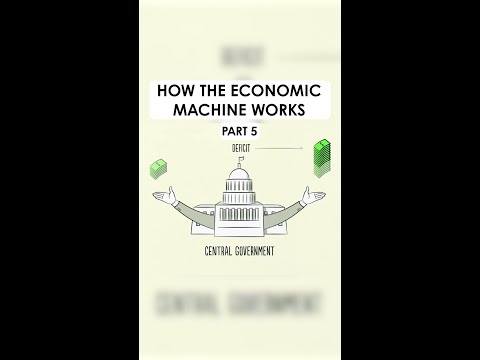
How the Economic Machine Works Part 5
Principles by Ray Dalio· 2025-10-31 13:01
Economic Impact of Deleveraging - Lower incomes and increased unemployment reduce government tax revenue while simultaneously increasing the need for government spending on unemployment benefits [1] - Governments often implement stimulus plans and increase spending, leading to budget deficits as they spend more than they earn in taxes [2] - Governments may raise taxes on the wealthy to redistribute wealth, potentially causing resentment between different socioeconomic groups [3] - Continued economic depression can lead to social disorder and political instability, both within and between countries [4] Monetary Policy Response - Central banks, having lowered interest rates to near zero, may resort to printing money to stimulate the economy [5] - Central banks print money to buy financial assets and government bonds, as the Federal Reserve printed over $2 trillion during the 2008 crisis [6] - This action increases asset prices, benefiting those who own financial assets, but the central bank can only buy financial assets [7] - Central banks cooperate with the central government, which can buy goods and services, by buying government bonds, effectively lending money to fund stimulus programs [8] Risks and Policy Considerations - Policymakers must balance deflationary and inflationary measures to manage debt burdens and maintain stability during deleveraging [9]

X @Bloomberg
Bloomberg· 2025-10-31 02:02
Market Trends - Hedge funds are speculating that the Yen will depreciate to 160 per dollar by year-end [1] - The speculation is fueled by diverging interest rate policies between the Federal Reserve and the Bank of Japan [1]
Federal Reserve to Cut Staff and Management Layers at Supervision Division
PYMNTS.com· 2025-10-31 00:02
Core Viewpoint - The Federal Reserve plans to reduce its supervision and regulation division staff by 30%, from 500 to 350 employees, as part of a broader effort to streamline operations and reduce complexity in the regulatory framework [1][2]. Group 1: Staff Reduction Details - The staff cuts were announced by Fed Vice Chair for Supervision Michelle Bowman during a meeting, with the intention to achieve these reductions through attrition, retirements, and voluntary separation incentives [2][3]. - The Federal Reserve aims to operate with fewer management layers and has plans to rename its operations unit to "business enablement group" while creating a new position focused on industry engagement [3]. Group 2: Regulatory Framework and Criticism - Bowman stated that the bank regulatory system has become overly complicated and has imposed unnecessary costs on banks and customers, indicating a need for balance between economic growth and regulatory safety [4][5]. - Senator Elizabeth Warren criticized the cuts, suggesting that the Federal Reserve is reverting to pre-2008 financial crisis practices by reducing its regulatory staff while accommodating the deregulation desires of large banks [4]. Group 3: Broader Workforce Reduction Plans - In a previous memo, Federal Reserve Chair Jerome Powell indicated plans to cut the overall workforce by about 10% over the next couple of years, which could amount to nearly 2,500 workers, bringing staffing levels close to a decade ago [5][6]. - Powell directed leadership to find ways to consolidate functions, modernize business practices, and ensure the organization is appropriately sized to meet its statutory mission [6].

Should you refinance your mortgage right now? The answer might surprise you
The Economic Times· 2025-10-30 17:55
Core Insights - The Federal Reserve has implemented its second interest rate cut of the year, prompting homeowners to consider refinancing options [1][12] - Mortgage rates are influenced more by the 10-year Treasury yield than by the federal funds rate, which has recently decreased [3][13] Federal Reserve Actions - The Fed began cutting interest rates in late 2024 after a period of increases aimed at controlling inflation, with two cuts made this year and another anticipated in December [2][12] - The 10-year Treasury yield has approached 4%, leading to a decrease in mortgage rates toward 6% [3] Mortgage Rate Projections - Analysts expect mortgage rates to remain slightly above 6% until the end of the year, with Fannie Mae forecasting rates of 6.3% by the end of 2025 and 5.9% by the end of 2026 [4] - Historical data indicates that the long-term average for mortgage rates is above 7.5%, with rates in the 7% range recorded since 1971 [6] Refinancing Considerations - Traditional guidelines for refinancing suggest a rate drop of 2% was once ideal, which has since shifted to 1%, and some lenders now consider smaller drops of 0.5% or 0.25% as potentially worthwhile [7][15] - Homeowners should evaluate their current interest rate, monthly payment, and credit score, and consider the time to break even on refinancing compared to their planned duration in the home [9][14] Home Equity Options - Approximately 82% of homeowners currently have mortgage rates at 6% or lower, making refinancing less appealing for many [10][15] - Homeowners may opt for a home equity line of credit (HELOC) to leverage their home’s value while maintaining their existing low mortgage rate [11][15]

Bitcoin Tumbles 4% on News of the Federal Reserve's Latest Rate Cut. Should Investors Be Concerned?
Yahoo Finance· 2025-10-30 16:05
Core Viewpoint - The Federal Reserve's recent 25-basis-point interest rate cut has not positively impacted the cryptocurrency market, with Bitcoin experiencing a significant decline in value following the announcement [1][3]. Group 1: Market Reaction - Bitcoin has fallen approximately 4% in the 24 hours following the Fed's announcement [2]. - The decline in Bitcoin and other cryptocurrencies may be attributed to a "buy the rumor, sell the news" phenomenon, as the market had anticipated the rate cut [3]. Group 2: Federal Reserve Commentary - Federal Reserve Chair Jerome Powell indicated that another rate cut in the next meeting is not guaranteed, especially given the current government shutdown affecting data availability [4]. - The Fed's shift to a rate-cutting policy comes in response to rising inflation and recent weaknesses in U.S. employment trends [5]. Group 3: Future Outlook - The FOMC's vote to cut rates was 10 to 2, suggesting potential support for further cuts in December, contingent on upcoming economic data [6]. - Despite the rate cut being generally favorable for the crypto market, investor confidence regarding future cuts appears to be waning, leading to volatility in cryptocurrency valuations [7].
Fed decision could lower stagnant mortgage rates
Yahoo Finance· 2025-10-30 15:07
Core Insights - Mortgage rates are currently at their lowest in a year at 6.19%, but have remained above 6% for the past three years, causing frustration among potential homebuyers [1] - The Federal Reserve's actions, particularly regarding its balance sheet, significantly influence mortgage rates, even though it does not set them directly [1][5] Group 1: Federal Reserve Actions - The Federal Reserve's new target for the benchmark Federal Funds Rate is set between 3.75% and 4.00% effective October 29 [2] - The Fed has implemented its second quarter-point interest rate cut of 2025 to balance its dual mandate of price stability and maximum employment [3] - The Fed's total assets are approximately $6.59 trillion, representing about 22% of U.S. nominal GDP as of October 22 [4] Group 2: Quantitative Tightening and Easing - During Quantitative Tightening (QT), the Fed reduces its balance sheet by selling or allowing bonds to mature, which removes money from the system [7] - Conversely, during Quantitative Easing (QE), the Fed buys bonds and mortgage-backed securities to inject money into the economy, typically lowering long-term rates [7] - The Fed has been a net seller of Treasuries since 2022, which has pressured rates higher and elevated borrowing costs, including mortgages [8]
Yen weakens after BOJ holds rates steady, Fed boosts dollar
Yahoo Finance· 2025-10-30 14:40
Group 1 - The Japanese yen declined against the U.S. dollar after the Bank of Japan maintained interest rates and signaled a potential rate hike depending on wage outlook [1][2] - The Federal Reserve Chair Jerome Powell indicated that a rate cut in December is not guaranteed, contributing to the dollar's strength [1][3] - Fed funds futures traders adjusted their expectations, now pricing in 71% odds of a rate cut in December, down from 85% prior to Powell's comments [5] Group 2 - The Bank of Japan's decision to keep rates steady disappointed yen bulls, as there was little indication of a timeline for future rate hikes [2] - The dollar index increased by 0.35% to 99.49, reaching its highest level since August 1, while the dollar strengthened 0.98% against the yen to 154.21, the highest since February 13 [5] - The European Central Bank also kept interest rates unchanged at 2% for the third consecutive meeting, with no hints about future moves, leading to a decline in the euro [6]
X @Arthur Hayes
Arthur Hayes· 2025-10-30 09:41
BOJ quote of the day:"Due to rising uncertainty in domestic political circumstances, as well global economic weakness as indicated by the Fed's continuing rate cuts, we feel it is best to maintain policy as is with the intention to further propel inflation (unspecified measure therof) to our 2% target"Translation: $BTC to JPY200m ...
Key to watch small business sector, that's what moves the economy: Richard Fisher
Youtube· 2025-10-29 20:00
Group 1 - The Federal Reserve's dual mandate includes managing inflation and ensuring employment, which creates tension between job growth and price stability [2][10] - The Kansas City Fed has a historical tendency to adopt a hawkish stance, indicating a cautious approach towards rate cuts despite pressures from political figures [4][5] - Small and medium-sized businesses are crucial for job creation in the U.S., accounting for 80% of jobs and holding about 50% of employment, suggesting that their performance is more indicative of economic health than larger companies [8][9] Group 2 - Current economic indicators show a mixed picture, with some data suggesting a slowdown while others indicate stability, highlighting the complexity of the economic landscape [7][8] - The 10-year Treasury yield remains steady, which is critical for businesses, as they rely more on long-term rates than on the Federal Funds rate [7] - There is skepticism regarding the likelihood of further rate cuts unless there is a significant economic downturn, with the Fed expected to maintain its principles against political pressures [6][10]