Fannie Mae

Search documents
Former Treasury Secretary issues stark warning about the national deficit — could it lead to a mortgage rate spike?
Yahoo Finance· 2025-11-08 15:00
Core Viewpoint - The possibility of continued high mortgage rates is a significant concern for homeowners and potential buyers, as indicated by former Treasury Secretary Larry Summers, who suggests that long-term rates are more likely to rise due to fiscal pressures on the economy [1] Mortgage Rate Trends - As of mid-October, the average 30-year fixed mortgage rate was 6.19%, a decrease from 6.44% at the same time last year [3] - Mortgage rates have remained elevated since 2022, with the average 30-year fixed-rate mortgage increasing from 3.45% in January 2022 to 6.42% by December 2022, and rates have not dipped below 6% since then [3] Economic Impact - High mortgage rates have contributed to an affordability crisis in the housing market, leading to slow new home sales in 2025, with Fannie Mae projecting total home sales in 2025 to be lower than in 2024 [5] - The Federal Reserve's interest rate hikes in response to inflation in 2022 have influenced mortgage rates, which are indirectly affected by the interest rates set by the Fed [4] Future Projections - Predictions for mortgage rates in 2025 and 2026 are more optimistic than Summers' outlook, with Fannie Mae forecasting a decline to 5.9% by the end of 2026, although Freddie Mac anticipates a potential increase to 6.4% by December 2025 [6]
Here Come the HELOCs: Mortgages, Housing-Debt-to-Income-Ratio, Serious Delinquencies, and Foreclosures in Q3 2025
Wolfstreet· 2025-11-08 01:45
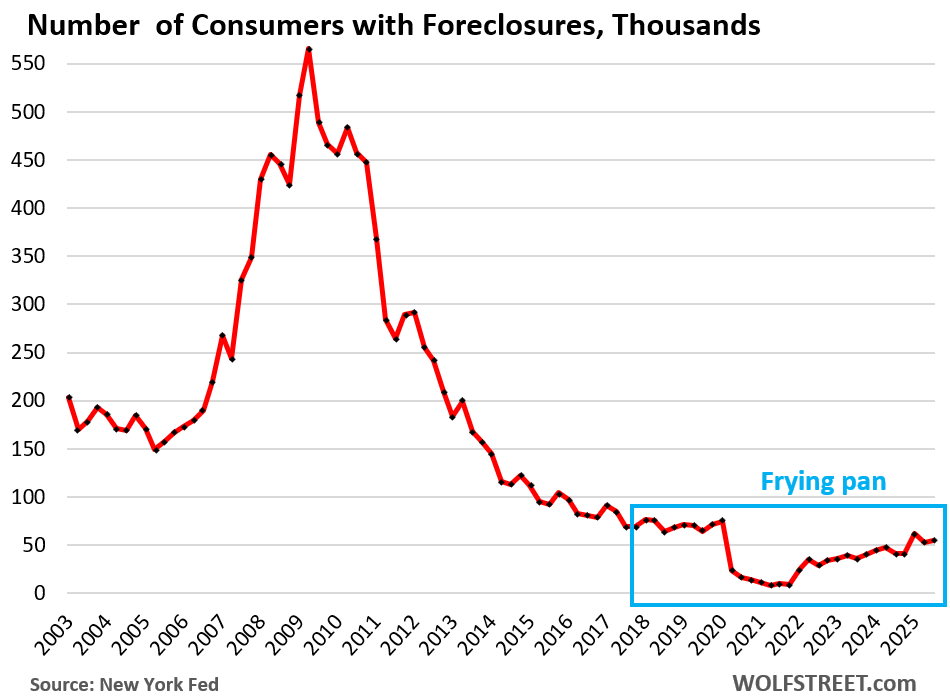
Core Insights - The article discusses the shifting of mortgage risks from banks to taxpayers and investors, highlighting the current state of mortgage balances and the implications for the housing market [1][16]. Mortgage Balances - Mortgage balances increased by $137 billion (+1.1%) in Q3 from Q2 and by $482 billion (+3.8%) year-over-year, reaching a total of $13.1 trillion [1]. - The growth in mortgage balances is influenced by several factors, including the financing of newly constructed homes and the cash-out portion of refinanced mortgages [2]. Home Equity Lines of Credit (HELOCs) - HELOC balances rose by 2.7% quarter-to-quarter and by 9.0% year-over-year, totaling $422 billion, with a 33% increase since the low point in Q1 2021 [5][6]. - Despite the increase, HELOC balances remain relatively low, with many lines of credit unused [6]. - Risks associated with HELOCs include the potential for foreclosure if homeowners default on the second lien while keeping the first-lien mortgage current [8][9]. Housing Debt Metrics - The housing-debt-to-disposable income ratio in Q3 increased to 58.6%, slightly above the record low in Q2 [14]. - The burden of housing debt is evaluated using the debt-to-income ratio, which includes both mortgage and HELOC debt [11][12]. Risk Distribution - Banks and credit unions are responsible for $2.7 trillion in mortgages, accounting for only 19.7% of the total mortgage and HELOC debt [16]. - The government is liable for $9.1 trillion of single-family mortgages that are securitized into mortgage-backed securities (MBS) [17]. - Investors hold $1.7 trillion of residential mortgages that are not government-backed, carrying the credit risk for these loans [18]. Delinquency and Foreclosure Rates - Serious delinquency rates for mortgages and HELOCs remain low at 0.8% [19]. - Foreclosures in Q3 rose to 54,760, significantly below the pre-crisis levels [23].

More Homes Equal Lower Prices. Bill Pulte Wants Builders to Step on the Gas.
Barrons· 2025-11-07 20:51
Core Viewpoint - Federal Housing Finance Agency (FHFA) Director Bill Pulte emphasizes the need for home builders to increase construction to lower new home prices, highlighting the role of Fannie Mae and Freddie Mac in providing liquidity to builders [3][5][6]. Summary by Relevant Sections Home Builders and Construction - Pulte urges builders to ramp up construction to address high home prices, stating that those not building will be scrutinized for artificially constricting supply [6][7]. - He mentions that Fannie Mae provides over $8 billion in liquidity to Lennar and over $5 billion to D.R. Horton, indicating significant financial support for large builders [5][6]. Fannie Mae and Freddie Mac - Pulte indicates that Fannie Mae and Freddie Mac are likely to remain under conservatorship, with a decision on a potential IPO expected soon [5][9]. - He notes that the companies may consider taking equity stakes in technology firms, which could diversify their investment portfolio [11]. Market Context and Future Outlook - The housing market is facing a supply deficit of approximately 3 to 4 million homes, impacting affordability [7]. - Pulte expresses confidence that the conservatorship will not disrupt operations and may even enhance stability in the mortgage market [9].


X @Bloomberg
Bloomberg· 2025-11-07 18:18
Bill Pulte, the director of the Federal Housing Finance Agency, said that Fannie Mae and Freddie Mac are looking at ways to take equity stakes in technology companies. https://t.co/tEYzVSwSjB ...
Mortgage and refinance interest rates today, November 7, 2025: Annual rate down by a half-point
Yahoo Finance· 2025-11-07 11:00
Core Insights - Mortgage rates have decreased compared to one year ago, with the national average 30-year fixed mortgage rate at 6.22%, which is 57 basis points lower than last year [1][15] - The 15-year fixed mortgage rate has also seen a decline, now at 5.50%, which is a half-point lower than the same time last year [1][15] - Freddie Mac's chief economist noted that the current rates could allow homebuyers to save thousands annually, indicating a gradual improvement in affordability [2] Current Mortgage Rates - The current national average rates for various mortgage types include: - 30-year fixed: 6.22% - 15-year fixed: 5.50% [1][15] - Refinance rates are generally higher than purchase rates, but specific current refinance rates were not detailed in the provided documents [3] Future Rate Predictions - Industry forecasts suggest that mortgage rates will remain around current levels, with the 30-year rate expected to stay at 6% or higher for most of 2026, although a slight decrease to 5.9% is projected for Q4 2026 [14][16] - The Mortgage Bankers Association (MBA) anticipates the 30-year mortgage rate to be 6.4% by the end of 2025 and to remain stable through 2026 [16] Rate Types and Their Implications - Fixed-rate mortgages provide stability in payments over the loan term, while adjustable-rate mortgages (ARMs) may start lower but can fluctuate after an initial fixed period [8][9] - A 30-year fixed-rate mortgage is suitable for those seeking lower monthly payments, while a 15-year fixed-rate mortgage is advantageous for those wanting to pay off their loan faster and save on interest [11][12]
Mortgage and refinance interest rates today, November 7, 2025: A half-point lower than last year
Yahoo Finance· 2025-11-07 11:00
Core Insights - Mortgage rates have decreased compared to one year ago, with the national average 30-year fixed mortgage rate at 6.22%, which is 57 basis points lower than last year [1][15] - The 15-year fixed mortgage rate has also seen a decline, now at 5.50%, which is half a point lower than the same time last year [1][15] - Freddie Mac's chief economist noted that the current rates could allow homebuyers to save thousands annually, indicating a gradual improvement in affordability [2] Current Mortgage Rates - The current national average rates for various mortgage types include: - 30-year fixed: 6.22% - 15-year fixed: 5.50% - 5/1 ARM: 6.47% - 7/1 ARM: 6.36% [1][5][6] - Refinance rates are generally higher than purchase rates, although this is not always the case [3] Future Projections - Industry forecasts suggest that mortgage interest rates will remain around current levels, with predictions indicating the 30-year rate could stay at 6% or higher for most of 2026 [14][16][17] - Fannie Mae projects a slight decrease to 5.9% in Q4 2026, while the Mortgage Bankers Association expects the 30-year rate to be 6.4% by the end of 2025 [14][16]
Fannie Mae and Freddie Mac could go public by end of the year, housing chief says — what it could mean for your mortgage
Yahoo Finance· 2025-11-02 11:45
Core Viewpoint - President Trump is considering taking Fannie Mae and Freddie Mac public, potentially by the end of 2025, as part of a strategy to run them more like businesses and reduce costs [2][3]. Group 1: Privatization Potential - The speculation around privatizing Fannie Mae and Freddie Mac has intensified following Trump's re-election, with discussions about ending their government conservatorship [2][3]. - Privatization could generate significant revenue, potentially billions of dollars, for both investors and the government [3]. - Since Trump's election, shares of Fannie Mae and Freddie Mac have increased over 700%, leading to a combined market value of approximately $20 billion as of October 20 [3]. Group 2: Market Impact - Fannie Mae and Freddie Mac back 70% of the mortgage market, and their privatization could reshape the housing landscape in the U.S. [3]. - Experts suggest that privatization would likely lead to increased mortgage rates, which could exacerbate the current housing affordability crisis [4].
Deposit Insurance For Billionaires?
ZeroHedge· 2025-10-31 23:15
Core Viewpoint - The article critiques the proposal to raise the federal deposit insurance limit from $250,000 to $10 million, arguing it primarily benefits the ultra-wealthy and poses risks to the financial system [7][8][9]. Group 1: Historical Context - The U.S. economy faced a severe crisis less than 20 years ago due to risky lending practices and government guarantees, leading to a significant financial meltdown [3][4]. - The government’s role in insuring high-risk loans contributed to moral hazard, as banks engaged in riskier lending without fear of repercussions [5][6]. Group 2: Current Proposal Analysis - The proposed increase in deposit insurance is labeled the "Billionaire Insurance Act," as it would primarily benefit the wealthiest Americans, with fewer than 1 percent of accounts exceeding the current limit [8]. - Supporters argue that this change would help smaller community banks compete with larger institutions, but the article questions the oversight of banks under such a policy [8][9]. Group 3: Implications for Investment Behavior - Raising the deposit insurance limit may discourage risk-taking among wealthy investors, who are essential for funding innovative ventures [10][11]. - The article emphasizes that risk-taking is crucial for economic growth and should be undertaken with personal capital rather than taxpayer-backed funds [11].

Third Avenue Real Estate Value Fund cuts position in Fannie Mae, Freddie Mac, Weyerhaeuser in Q3
Seeking Alpha· 2025-10-31 18:37
Core Insights - Third Avenue Real Estate Value Fund achieved a return of 13.54% in the first nine months of 2025, outperforming its benchmark, the FTSE EPRA/NAREIT Developed Index, which returned 11.26% [3] Group 1 - The fund focuses on investments in real estate [3] - The performance comparison highlights the fund's effective management and investment strategy [3]
Seeking Alpha's Quant Ratings Strikes Again
Seeking Alpha· 2025-10-31 11:30
Core Insights - Amazon (AMZN) reported strong earnings driven by AWS, while Apple (AAPL) saw a rise due to a positive forecast despite lower iPhone and China sales [2] - Retail candy prices are up 10.8% year-over-year as retailers discount ahead of Halloween [3] - Fiserv (FI) shares plummeted 44% after disappointing earnings and guidance, leading to a significant reassessment by analysts [4][5] Company Performance - Fiserv's third-quarter results missed expectations, prompting a drastic cut in guidance and raising concerns about management stability [5] - The departure of former CEO Frank Bisignano and the challenges faced by current CEO Mike Lyons have contributed to investor fears [5][6] - Fiserv's total long-term debt stands at $25.6 billion, comparable to its current market cap, raising red flags about its financial health [7] Market Reactions - Analysts have reacted swiftly to Fiserv's performance, with many downgrading their ratings following the earnings report [4][8] - Seeking Alpha's Quant ratings had previously indicated a Sell signal for Fiserv, which proved prescient as the stock price fell from around $140 to $65 [8]