Motorola

Search documents
What Is a Just in Time Inventory System?
Small Business Trends· 2025-10-03 18:51
Core Concept - Just-in-Time (JIT) inventory management is a strategy that focuses on producing goods only as needed, minimizing excess stock and reducing carrying costs, thereby enhancing operational efficiency [6][8][10]. Principles of JIT - JIT emphasizes producing goods strictly as needed, aligning production closely with actual customer demand while minimizing excess stock [14]. - Continuous improvement is vital in JIT, requiring regular assessments and enhancements of processes to eliminate waste and boost efficiency [14][15]. - Strong supplier relationships are crucial for ensuring timely delivery of materials, preventing production delays [14][25]. Benefits of JIT - Cost reduction is achieved through lower storage costs and improved cash flow [18][19]. - Product quality improves as production focuses on what is necessary, reducing defects [18][19]. - Operational efficiency increases by minimizing waiting times and enhancing inventory turnover ratios [18][19]. Ordering Based on Demand - JIT systems order materials based on actual customer demand rather than forecasts, maintaining optimal inventory levels [21][22]. - The Kanban system is utilized to manage inventory levels visually and trigger reorders based on real-time usage [23][24]. Supplier Coordination - Effective supplier coordination is essential in JIT to ensure materials arrive just in time for production, minimizing holding costs and stockout risks [25][26]. - Technologies like Electronic Data Interchange (EDI) facilitate real-time information exchange, improving order accuracy and reducing lead times [26]. Pros and Cons of JIT - Advantages include reduced inventory costs, improved cash flow, and enhanced product quality [31]. - Disadvantages involve vulnerability to supply chain disruptions, reliance on precise demand forecasting, and coordination challenges among suppliers and manufacturers [32][51]. Real-World Applications - Companies like Toyota exemplify JIT by aligning production with customer demand, significantly reducing inventory costs [39]. - Retail giants such as Walmart implement JIT through advanced supply chain logistics, ensuring timely replenishment based on actual customer demand [40][56]. Future of JIT - The future of JIT is expected to incorporate advanced technologies like artificial intelligence and machine learning for improved demand forecasting and supply chain optimization [63]. - Sustainability and real-time inventory tracking will become increasingly important as businesses aim to reduce waste and enhance operational efficiency [64][65].



Galaxy S25 FE Review: Samsung’s Software Lifts Up This Entry-Level Galaxy
CNET· 2025-09-25 12:00
Over the last two weeks, I've been using Samsung's $650 Galaxy S25 FE. And while it's not without its flaws, this cheaper edition of the Galaxy S25 came in handy in ways I did not expect. This is all things mobile.The Galaxy S25 FE largely continues the formula that Samsung has followed for the last 2 years with the S23 and S24 FE. In this case, the S25 FE takes the phone design of the $1,000 S25 Plus and fills it with internals that match up to last year's Galaxy S24. This gives the phone the look of a bra ...

Why Samsung, Google And Possibly Apple Are Investing In Folding Smartphones
CNBC· 2025-09-06 15:00
Market Trends & Dynamics - Foldable smartphones are gaining traction, with Samsung's Galaxy Z Fold and Flip series breaking preorder records, indicating growing consumer interest in the foldable form factor [2] - The foldable phone market, while still niche, is evolving, with more brands entering the space, including Google, Motorola, Huawei, and Xiaomi, and Apple reportedly planning to join in 2026 [3][4][5] - Foldable smartphones currently account for less than 2% of global smartphone shipments in 2024, highlighting their limited market share compared to traditional smartphones [12] Technological Advancements & Challenges - Early foldable phones faced durability issues, particularly with screen creases and hinge design, but recent models have made significant improvements in these areas [9][10][11] - Samsung's latest foldable phones have reduced thickness and improved battery life, addressing previous concerns and bringing them closer to flagship phone standards [11][12] - Apple's potential entry into the foldable market is contingent on solving durability and usability challenges, aiming for a user experience-focused approach [15][16] Pricing & Accessibility - The high price of foldable phones, ranging from $1500 to $2000, remains a barrier to mass adoption, positioning them as a niche product in the premium smartphone market [12][13] - Samsung is starting to lower prices, with models like the Flip seven launching under $1000, suggesting a trend towards more accessible pricing as the technology matures [24][25] - Industry anticipates that for foldable phones to become mainstream, the price premium needs to be in the 10-20% range relative to a normal phone [23] AI & User Experience - Samsung and Google are positioning foldables as AI-first devices, leveraging the larger screen for enhanced multitasking, immersive tools, and content creation [19][20] - The larger screen of foldable phones facilitates AI-driven use cases, enhancing productivity and creativity by reducing friction in phone usage [20][21]

Unboxing Motorola’s $1,000 Brilliant Collection: Motorola Razr & Moto Buds Loop
CNET· 2025-09-02 02:56
Both the Motorola Razr and the Moto Buds Loop got a new Pantone Ice Melt color that feature Swarovski crystals. Let’s unbox The $1,000 Brilliant Collection 💎📲🎧 #unboxing #motorola #foldable #swarovski #motorolarazr #openearbuds ...

Pixelworks(PXLW) - 2025 Q2 - Earnings Call Transcript
2025-08-12 22:00
Financial Data and Key Metrics Changes - Revenue for Q2 2025 was $8.3 million, compared to $7.1 million in Q1 2025 and $8.5 million in Q2 2024, indicating a sequential increase driven by product shipments in the home and enterprise market [26] - Non-GAAP gross profit margin for Q2 2025 was 46%, down from 49.9% in Q1 2025 and 51% in Q2 2024, reflecting a unique product mix [26] - Non-GAAP operating expenses decreased to $9.7 million in Q2 2025 from $10.4 million in Q1 2025 and $12.8 million in Q2 2024, showing effective cost reduction measures [27] - The net loss for Q2 2025 was $5.3 million, or a loss of $1 per share, compared to a net loss of $6.5 million in Q1 2025 and $7.7 million in Q2 2024 [28] - Cash and cash equivalents at the end of Q2 2025 were $14.3 million, down from $18.5 million at the end of Q1 2025 [28] Business Line Data and Key Metrics Changes - Home and enterprise revenue was approximately $7.1 million in Q2 2025, while mobile revenue was approximately $1.2 million [26] - The mobile business saw a similar revenue profile to the prior quarter, with shipments supporting residual demand from previously launched smartphone models [14] - Revenue from the home and enterprise market increased over 20% sequentially, driven by a combination of seasonal demand recovery and ramping shipments of new SOCs [18] Market Data and Key Metrics Changes - The TrueCut Motion platform has been credited with three new theatrical releases, indicating growing acceptance and demand in the market [10] - Titles utilizing TrueCut Motion have achieved over $4 billion at the box office, demonstrating the format's value to studio partners [12] - The mobile market is expected to remain flat, with Chinese OEMs focusing on differentiation to expand globally [33] Company Strategy and Development Direction - The company is focusing on two defined approaches in the mobile segment: expanding the target market with a low-cost mobile graphics accelerator and pursuing premium gaming experiences [15] - The strategic review process for the Pixelworks Shanghai subsidiary is nearing closure, with potential new ownership structures being evaluated [23] - The company aims to reach profitability for its Shanghai subsidiary by Q4 2025, despite delays in mobile revenue recovery [22] Management's Comments on Operating Environment and Future Outlook - Management expressed confidence in the growth of the TrueCut Motion format, anticipating it to become a standard for premium large format cinemas [12] - The company is better positioned to drive bottom-line results from a small uplift in revenue due to previous cost structure reductions [22] - Management noted that the overall market for projectors is expected to remain similar to 2024, with no significant impacts from global trade dynamics observed so far [18] Other Important Information - The company received approximately $1.6 million in cash subsidies as part of China's Little Giant program, aiding in R&D expenses [27] - The company completed all scheduled end-of-life shipments of transcoding products in Q4 2024, with potential one-time orders from prior customers being evaluated [19] Q&A Session Summary Question: Why are mobile customers in China emphasizing custom ASIC? - Management indicated that differentiation is key for Chinese OEMs in a flat market, as they seek to expand globally and compete against established brands [33][38] Question: Will the transcoding one-time customer revenue hit in Q3 or Q4? - Management confirmed that the revenue from the transcoding order would be recognized in Q4 [42] Question: How will Pixelworks be different post-transaction regarding the Shanghai division? - Management stated it is too early to provide details on the strategic direction post-transaction [44] Question: How broad is the ASIC design and IP application? - Management clarified that the IP is not limited to smartphones and can be applied in tablets, AR/VR markets, and other display technologies [48] Question: What is driving the strength in the home and enterprise market? - Management noted that the strength is partly due to a higher ASP of new SOCs and stocking needs from customers [52]

Counterpoint Research:2025年Q2印度智能手机出货量同比增长8%
智通财经网· 2025-08-07 02:54
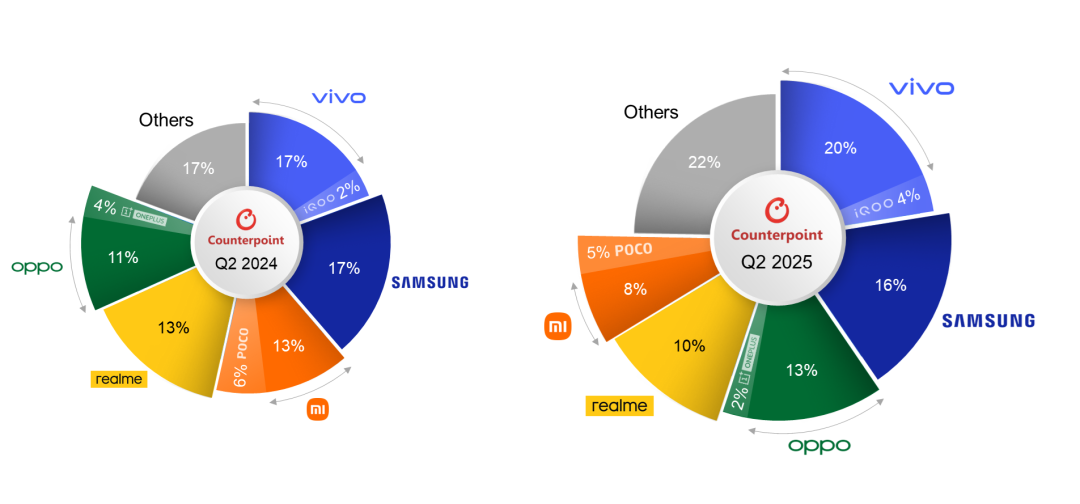
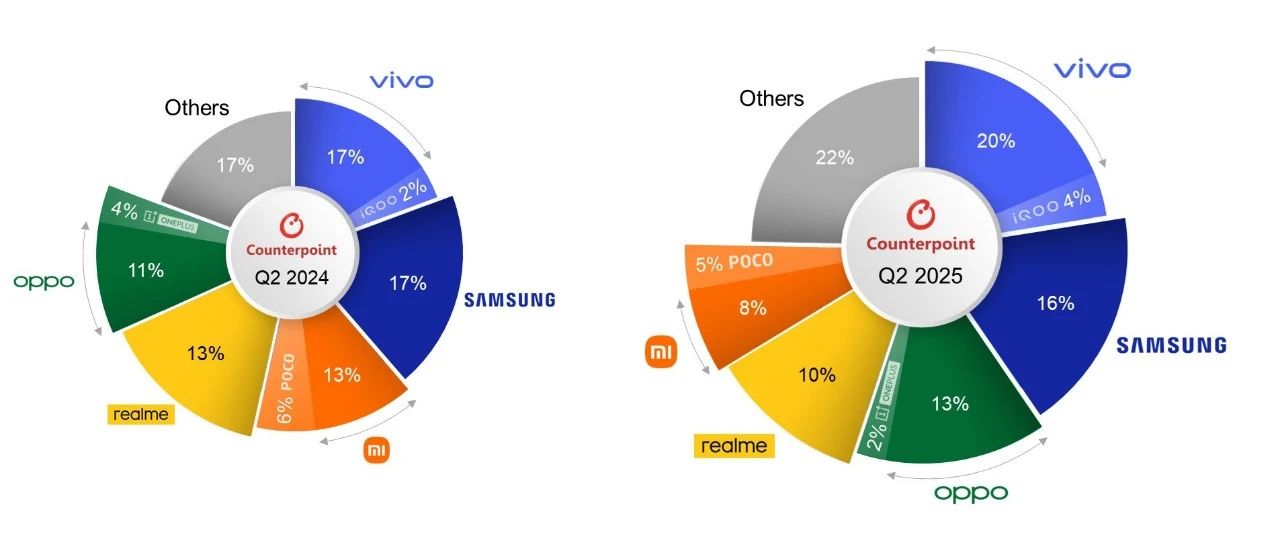
Core Insights - The Indian smartphone market experienced a robust rebound in Q2 2025, with shipments and wholesale value increasing by 8% and 18% year-on-year, respectively, driven by a 33% increase in new product launches and effective marketing strategies during the summer promotional period [1][2] - The improvement in the macroeconomic environment, including a decrease in retail inflation to a six-year low and a reduction in the central bank's repo rate, has boosted consumer confidence and spending, creating favorable conditions for non-essential purchases [1] Market Performance - The ultra-premium segment (priced above 45,000 INR, approximately 510 USD) saw a remarkable year-on-year growth of 37%, making it the fastest-growing price segment, contributing to the highest average selling price (ASP) and value for the Indian smartphone market in Q2 [2] - Apple and Samsung capitalized on this trend through trade-in programs, zero-interest EMI options, and limited-time summer discounts, making flagship devices more accessible to consumers [2] Brand Performance - Vivo achieved a 23% year-on-year growth in Q2 2025, driven by strong demand for its Y and T series in the 10,000-15,000 INR (approximately 110-170 USD) price range, with the T series performing well in offline channels [5] - Samsung maintained its growth momentum in the mid-to-high-end segment, supported by aggressive summer promotions for its A and S series, as well as attention on its N-1 flagship model [5] - OPPO secured the third position in the market, benefiting from strong performance of its updated A5 and K series, product portfolio optimization, and enhanced retailer collaboration [5] Other Key Insights - Nothing achieved a remarkable 146% year-on-year growth in shipments, becoming the fastest-growing brand for six consecutive quarters, primarily due to the launch of the CMF Phone 2 Pro and expansion of its retail network [8] - Motorola's shipments grew by 86% year-on-year, driven by strong demand for its G and Edge series, while Lava became the fastest-growing brand in the sub-10,000 INR segment with a 156% year-on-year increase [8] - MediaTek led the Indian smartphone chip market with a 47% share, followed by Qualcomm at 31%, with both companies experiencing a year-on-year shipment growth of 28% [8] - The iPhone 16 emerged as the highest-selling model in Q2 2025, contributing to Apple's record second-quarter shipments in India [8] - OnePlus recorded a 75% year-on-year growth in the ultra-premium market, driven by the performance of its 13 and 13R series, along with positive reception for the newly launched 13s series [9]
2025年Q2印度智能手机出货量同比增长8%,iPhone 16成出货量最高机型
Counterpoint Research· 2025-08-07 01:03
Core Insights - The Indian smartphone market experienced a robust rebound in Q2 2025, with shipments and wholesale value increasing by 8% and 18% year-on-year, respectively, driven by a 33% increase in new product launches and effective marketing strategies during the summer promotional period [4][5][8]. Market Dynamics - The recovery of the Indian smartphone market in Q2 2025 was further supported by an improved macroeconomic environment, which boosted consumer confidence and spending. Retail inflation fell to a six-year low, easing household budget pressures, while a reduction in the central bank's repo rate made financing more accessible. Additionally, tax relief policies introduced earlier in the year increased disposable income and savings, creating favorable conditions for non-essential purchases [5][8]. - The ultra-premium segment (priced above 45,000 INR, approximately 510 USD) saw a remarkable year-on-year growth of 37%, making it the fastest-growing price segment. This growth was fueled by promotional strategies from brands like Apple and Samsung, which included trade-in offers and zero-interest installment plans [5][8]. Competitive Landscape - In Q2 2025, OEMs and channel partners conducted numerous online and offline promotional activities, helping some OEMs clear existing inventory and launch new products. Vivo achieved a 23% year-on-year growth in the 10,000-15,000 INR (approximately 110-170 USD) price range, driven by strong demand for its Y and T series [8][9]. - Samsung maintained its position as the second-largest brand, benefiting from summer promotions for its A and S series, as well as attention garnered from its N-1 flagship model upgrades. OPPO also performed well, securing the third position through product optimization and enhanced retail partnerships [9][14]. Key Brands and Performance - iPhone 16 emerged as the best-selling model in Q2 2025, highlighting strong consumer demand. Apple achieved its highest-ever second-quarter shipments in India, supported by ongoing promotional offers and flexible financing options [8][14]. - Nothing brand recorded a remarkable 146% year-on-year growth, becoming the fastest-growing brand for six consecutive quarters, primarily due to the launch of CMF Phone 2 Pro and expansion of its retail network [14]. - Motorola's G and Edge series saw an 86% year-on-year increase in shipments, aided by expanded distribution channels in smaller cities [14]. - Lava became the fastest-growing brand in the sub-10,000 INR (approximately 110 USD) segment, achieving a 156% year-on-year growth driven by competitive new products and improved after-sales service [14]. Market Projections - The Indian smartphone market is expected to surpass 50 billion USD in 2025, while global smartphone manufacturing is projected to see a slight decline, with Indian manufacturing anticipated to grow against this trend [15].
Ahead of Motorola (MSI) Q2 Earnings: Get Ready With Wall Street Estimates for Key Metrics
ZACKS· 2025-08-04 14:20
Core Insights - Motorola (MSI) is expected to report quarterly earnings of $3.36 per share, reflecting a 3.7% increase year over year, with revenues forecasted at $2.74 billion, a 4.2% increase compared to the previous year [1] Earnings Projections - Changes in earnings projections are crucial for predicting investor reactions, with empirical studies showing a strong correlation between earnings estimate trends and short-term stock price movements [2] - Analysts have collectively revised their consensus EPS estimate upward by 0.2% over the past 30 days, indicating a reassessment of initial projections [1] Key Metrics Forecast - The consensus estimate for 'Net Sales- Products and Systems Integration' is $1.69 billion, indicating a 2% year-over-year change [4] - 'Net Sales- Software and Services' is expected to reach $1.05 billion, reflecting an 8% increase from the prior-year quarter [4] - 'Net sales from products' are projected at $1.61 billion, showing a 3.1% increase from the year-ago quarter [4] - 'Net sales from services' are anticipated to be $1.12 billion, indicating a 5.4% increase from the previous year [5] Operating Earnings Estimates - 'Non-GAAP Operating Earnings- Software and Services' is expected to be $255.67 million, down from $313.00 million reported in the same quarter last year [5] - 'Non-GAAP Operating Earnings- Products and Systems Integration' is forecasted at $530.80 million, compared to $445.00 million in the previous year [6] Stock Performance - Motorola shares have increased by 2.8% over the past month, outperforming the Zacks S&P 500 composite, which saw a 0.6% increase [6]


X @𝘁𝗮𝗿𝗲𝘀𝗸𝘆
𝘁𝗮𝗿𝗲𝘀𝗸𝘆· 2025-07-13 15:55
User Preference Shift - A user with over a decade of iPhone experience switched to Android, specifically the OPPO Find X8s [1] - The user found the transition to Android easier than expected and is now using it as their primary phone [1] - The user's previous Android phone was a moto defy, indicating a return to the Android platform after 14 years [1] Device Choice - The user selected the OPPO Find X8s as their Android device of choice [1] - The OPPO Find N5 is mentioned as the Android phone that brought the user back to the Android platform [1]
Galaxy Unpacked Event: What to Expect From Samsung | All Things Mobile
CNET· 2025-07-07 12:00
Product Expectations - Samsung is expected to announce new foldable phones, including the Galaxy Z Fold 7, Galaxy Z Fold Ultra, Galaxy Z Flip 7, and Galaxy Z Flip 7 FE [1] - The company is also anticipated to launch new smartwatches, such as the Galaxy Watch 8, Galaxy Watch Ultra 2, and Galaxy Watch 8 Classic [1] - A thinner version of the Fold, potentially named Fold Slim, might be introduced [5] Competitive Landscape - Competitors like Motorola, Google, Honor, Oppo, and Xiai have been improving on the shortcomings of Samsung's foldable phones, such as price, size, battery life, and camera quality [3] - Motorola has introduced multiple versions of its Razr, including one starting at $700, offering a more affordable option [9] Pricing and Affordability - Last year, Samsung raised the price of the Galaxy Fold 6 to $1,900 [8] - Samsung might introduce a more affordable Z Flip FE, potentially priced similarly to Motorola's baseline Razr at $700 [9][13] Features and Technology - The Galaxy Z Fold 7 is rumored to move away from the under-display camera [7] - The Galaxy Z Flip 7 might be powered by Samsung's Exynos 2500 processor [12] - New wellness and health features are expected in the upcoming Galaxy Watches [17]