Rivian Automotive

Search documents
Will Rivian's Charging Update Help It Catch Up With Rivals?
ZACKS· 2025-06-04 16:05
Core Insights - Rivian Automotive, Inc. is implementing a new over-the-air software update that introduces manual preconditioning for high-voltage batteries for DC fast charging on R1S and R1T models, enhancing user control over battery management [1][9] - The software version 2025.18 features a redesigned Energy App with an Energy Monitor for detailed energy consumption insights and a Charging Tab that provides smart reminders for unplugging during long trips [2][9] - Charging speeds for certain R1S and R1T models have been improved, with Gen 2 vehicles now capable of reaching a peak charging rate of 215 kW, resulting in shorter charging times for 10-80% top-ups [3][9] Competitive Landscape - Rivian's updates, while not groundbreaking compared to Tesla's existing features, demonstrate the company's commitment to enhancing the electric vehicle user experience [4] - Tesla has expanded its Supercharger network significantly, adding over 10,000 new stalls and growing its global network by 19% year-over-year, delivering more than 5.2 terawatt-hours of energy [5] - Volkswagen Group is rapidly expanding its electric vehicle charging infrastructure through subsidiaries and partnerships, including a collaboration with XPeng to build super-fast charging networks in China [6] Financial Performance - Rivian has outperformed the Zacks Automotive-Domestic industry year-to-date, with RIVN shares gaining 8% compared to the industry's decline of 14.8% [7] - Rivian appears undervalued with a forward price/sales ratio of 2.58, lower than the industry's 2.75 [11] - The Zacks Consensus Estimate for Rivian's EPS has increased by 42 cents for 2025 and 15 cents for 2026 over the past 30 days [12]


Rivian Automotive, Inc. (RIVN) CEO RJ Scaringe presents at UBS Auto & Auto Tech Conference (Transcript)
Seeking Alpha· 2025-06-04 15:59
Core Insights - Rivian Automotive is navigating significant volatility and uncertainty in the automotive industry, particularly influenced by macroeconomic factors and policy changes [1] - The company has learned valuable lessons from past challenges, particularly during the launch of its R1 product amidst the COVID-19 pandemic and subsequent supply chain crises [2] Company Overview - Rivian's CEO, RJ Scaringe, highlighted the difficulties faced during the launch of the R1 product, which included establishing a supply chain and manufacturing plant under unprecedented conditions [2] - The company is preparing to launch its next product, R2, following the updates made to the R1 product, referred to as Gen 2 [2]

Rivian Automotive (RIVN) 2025 Conference Transcript
2025-06-04 13:50
Summary of Rivian's Conference Call Company Overview - **Company**: Rivian - **Event**: Second annual UBS Auto and Auto Tech Conference - **Key Speaker**: RJ Skirinj, Founder and CEO Industry Context - **Industry**: Automotive, specifically Electric Vehicles (EVs) - **Current Trends**: Increased focus on domestic manufacturing and technology in the U.S. aligns with Rivian's strategy [10][11] Key Points and Arguments 1. Managing Volatility and Supply Chain Challenges - Rivian has faced significant challenges during product launches, including the pandemic and supply chain crises [3][4] - The company has developed robust supply chain processes and agile decision-making practices to adapt to rapid changes [5][6][7] 2. Government Policy and Its Impact - Rivian is actively engaging with the U.S. administration to address challenges related to EV policies and trade [9][15] - The administration's focus on domestic manufacturing aligns with Rivian's operational strategy, as the company employs over 15,000 people in the U.S. [10][11] 3. Product Launches and Market Position - Rivian's R1 series (R1S and R1T) has a significant market share, with the R1S being the best-selling electric SUV over $70,000, capturing approximately 35% of that market [30][31] - The upcoming R2 product line, starting at $45,000, targets a broader market segment, which is crucial for scaling the business [31][32] 4. Consumer Demand and Market Dynamics - Current consumer behavior shows volatility influenced by economic factors, including potential changes in EV credits and interest rates [28][29] - Despite a shift towards lower-priced vehicles, overall auto industry volume remains stable [32] 5. Regulatory Credits and Financial Guidance - Rivian anticipates approximately $300 million in regulatory credits for the year, factoring in expected changes in California's regulatory environment [33][34] - The company expects federal credits to become more valuable due to a pullback from other OEMs in electrification efforts [37][38] 6. Cost Management and Efficiency - Rivian has successfully reduced material costs by over 20% through strategic sourcing and supplier negotiations [58][59] - The R2 is expected to have significantly lower material costs compared to the R1, with ongoing optimization in design and manufacturing processes [65][66] 7. Advancements in Autonomy and AI - Rivian is transitioning to a more advanced AI-driven approach for vehicle autonomy, moving away from traditional rules-based systems [69][70] - The company is investing heavily in data architecture and AI capabilities, which will enhance vehicle features and performance over time [78][79] 8. Market Competition and Consumer Choice - The U.S. EV market is currently dominated by a few models, primarily from Tesla, limiting consumer choice [41][42] - Rivian aims to provide compelling alternatives to internal combustion engine (ICE) vehicles, targeting consumers who may not have considered EVs previously [45][46] Additional Important Insights - Rivian's strategic partnerships, including a significant joint venture with Volkswagen, enhance its market position and supplier leverage [15][61] - The company is focused on educating policymakers about the complexities of automotive supply chains and the potential negative impacts of rapid regulatory changes [21][24] This summary encapsulates the key insights and strategic directions discussed during the conference call, highlighting Rivian's position in the evolving automotive landscape.
Rivian Automotive, Inc. (RIVN) TD Cowen 9th Annual Future of the Consumer Conference (Transcript)
Seeking Alpha· 2025-06-03 22:56
Group 1 - Rivian Automotive has successfully navigated a challenging electric vehicle (EV) market where many startups have struggled, primarily due to its strong brand positioning and product-market fit [3][4] - The company emphasizes the complexity of the automotive product, which requires a multitude of decisions and components to come together effectively [3] - Rivian has focused on creating a compelling brand that inspires consumers and aligns with their lifestyle, which has been a significant factor in its success [4][5]

Rivian Automotive (RIVN) FY Conference Transcript
2025-06-03 20:30
Summary of Rivian's Conference Call Company Overview - **Company**: Rivian - **Industry**: Electric Vehicles (EV) Key Points Success Factors in a Challenging Industry - Rivian's success is attributed to a complex product that combines attributes, positioning, design, and price point to connect with the market effectively [1] - The brand positioning focuses on inspiring customers to engage in activities worth documenting, which supports both flagship and upcoming lower-priced products (R2 and R3) [1] Customer Demographics - A significant majority of Rivian's customers are first-time EV buyers, coming from diverse backgrounds [2] - Rivian has been recognized as the number one rated brand in the automotive sector by Consumer Reports for two consecutive years, indicating strong brand strength and customer satisfaction [3][4] Market Share and Pricing Strategy - Rivian holds a commanding market share of approximately 35% in the electric SUV segment priced over $70,000, with an average selling price (ASP) of around $90,000 [4] - The upcoming R2 model, starting at $45,000, aims to penetrate a broader market segment [4] Brand Awareness and Growth - Brand awareness in the U.S. has been increasing, with more Rivian vehicles on the road contributing to this growth [5][6][7] - The EV market is geographically uneven, with higher sales concentrated on the coasts compared to central regions [8][9] Product Offerings and Trim Combinations - Rivian is simplifying its product offerings for R2 by reducing the number of trim combinations to streamline production and logistics [10][11] - Initial R2 configurations will be higher-priced fully loaded vehicles, with lower-priced options introduced shortly after launch [14][15] Current Demand Environment - The demand for Rivian's R1 products remains strong, but the premium segment is facing compression as consumers opt for more affordable vehicles [16][17] - Record demo drives indicate potential pent-up demand, despite a volatile macroeconomic environment affecting consumer behavior [18][19] Supply Chain and Tariff Concerns - The company faces challenges related to rare earth metals, crucial for electric motors, particularly due to trade tensions with China [20][21] - Efforts are underway to find alternative sources and reduce dependency on these materials [22] Autonomy Platform Development - Rivian is transitioning from a rules-based approach to an AI-centric model for its autonomy platform, which is expected to enhance vehicle safety and performance [23][24][25] - The company emphasizes the importance of controlling the perception stack and data platforms to develop a robust autonomous driving system [26][27][28] Future of Vehicle Safety and Insurance - Rivian's current highway feature is reported to be significantly safer than human drivers, with potential for reduced insurance rates for users [40][41] - The company aims for a substantial reduction in automotive fatalities as autonomous technology matures [42][43][44] Licensing Opportunities - Rivian has established partnerships, including a significant software licensing deal with Volkswagen, indicating potential for future revenue streams through technology licensing [48][49] Additional Insights - The company is focused on creating a data flywheel to enhance the capabilities of its autonomous systems, which is seen as a critical area for future growth [30][31][32] - Rivian's approach to autonomy is designed to scale effectively, with plans to expand features and capabilities over time [36][37][38]
Tesla's planned robotaxi launch in tech-friendly Austin has Musk playing catch-up in his hometown
CNBC· 2025-06-03 16:34
Core Insights - Tesla is set to launch its robotaxi service in Austin, Texas, with initial deployment of 10 vehicles, aiming for expansion to thousands based on the success of the launch [2][3] - Austin has become a competitive hub for self-driving technology, attracting multiple companies due to its favorable regulatory environment and access to talent [3][13] Company Developments - Tesla has been testing Model Y vehicles without safety drivers in Austin, indicating progress in its autonomous vehicle capabilities [1] - Other companies like Waymo, Zoox, and Volkswagen are also testing and deploying autonomous vehicles in Austin, highlighting the competitive landscape [4][5] - Waymo has successfully offered robotaxi rides in Austin since March, with plans for further expansion [6][30] Regulatory Environment - Texas has a more lenient regulatory framework for autonomous vehicles compared to California, allowing for easier testing and deployment [13][15] - A 2017 Texas law prohibits municipalities from regulating autonomous vehicles, centralizing authority at the state level [14][15] - The Texas Department of Transportation collaborates with AV companies to ensure infrastructure readiness for autonomous vehicle operations [16] Industry Trends - The AV industry is pushing for federal standards to reduce regulatory uncertainty, with companies looking to Texas as a model for self-driving regulations [21][23] - Companies are focusing on safety protocols and engaging with local first responders to build trust and ensure public safety [28][29] - Despite some incidents involving autonomous vehicles, experts believe that the technology can lead to a reduction in fatal accidents compared to human drivers [34]

全球汽车业-被 “关税先生” 重击 -描绘美国汽车关税对全球的影响
2025-06-02 15:44
Summary of Key Points from the Conference Call Industry Overview - **Industry**: U.S. Automotive and Auto Parts - **Context**: The U.S. automotive sector is facing significant challenges due to new tariffs imposed by the U.S. administration, particularly affecting global OEMs differently based on their geographic and operational strategies [2][15]. Core Insights and Arguments - **Impact of Tariffs**: - Japanese OEMs are projected to experience the most severe impact, with estimated operating profit declines of approximately 42% due to tariffs [2][3]. - U.S. and European automakers have managed to mitigate some impacts through exemptions and strategic adjustments, but they still face increased costs [2][4]. - The U.S. automotive tariffs include a 25% tariff on imported vehicles and parts, with specific provisions for USMCA-compliant production [15][18]. - **Regional Variations**: - **Japanese OEMs**: Companies like Toyota and Honda are expected to see profit declines of around 29% and 34%, respectively, while others like Nissan and Subaru face even greater risks [3][8]. - **U.S. OEMs**: Domestic manufacturers such as Stellantis, Ford, and General Motors face gross tariff exposures of $1.8 billion, $2.4 billion, and $7.3 billion, respectively, before mitigation strategies [4][9]. - **European OEMs**: BMW and Mercedes are better positioned due to their substantial U.S. production, while companies like VW and Porsche face significant EBIT impacts ranging from €500 million to €900 million [5][20]. - **Future Outlook**: - The U.S. administration's unpredictable trade policy continues to create uncertainty, with potential for further tariff increases or changes in trade agreements [6][15]. - The automotive sector is expected to see a material increase in input costs, which may lead to higher consumer prices and affect demand [4][9]. Additional Important Insights - **Investment Implications**: - Analysts remain positive on select companies like BMW, Ferrari, and Renault, which have shown resilience or minimal exposure to tariffs [7][21]. - Conversely, companies like Ford, General Motors, Rivian, and Polestar are rated as Underperform due to their higher exposure to tariff impacts [9][21]. - **Indian Auto Sector**: - Indian OEMs are less affected by U.S. tariffs due to low vehicle export volumes, but auto component exporters may face challenges as the U.S. is their largest market [10]. - **Tariff Landscape Stability**: - Recent weeks have seen some stabilization in the tariff landscape, but ongoing trade negotiations and potential changes in U.S. content definitions pose risks for manufacturers [15][18]. - **Long-term Strategies**: - Companies are urged to localize supply chains and achieve compliance with USMCA standards to mitigate future tariff impacts [18]. This summary encapsulates the critical points discussed in the conference call regarding the current state and future outlook of the U.S. automotive industry amidst evolving tariff policies.



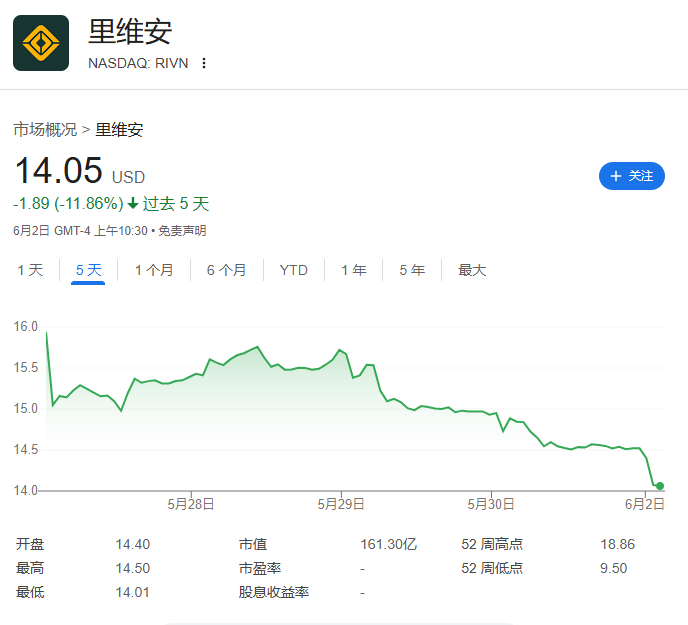
“特斯拉劲敌”Rivian(RIVN)跌3.3%,最近五天迄今累计下跌11.8%。该公司计划发行12.5亿美元绿色债券,从而在电动汽车需求下滑期间为债务再融资。
news flash· 2025-06-02 14:35
Group 1 - Rivian (RIVN) has experienced a decline of 3.3% recently, with a cumulative drop of 11.8% over the past five days [1] - The company plans to issue $1.25 billion in green bonds to refinance its debt amid a decline in electric vehicle demand [1]
Should You Buy ChargePoint While It's Trading Below $1?
The Motley Fool· 2025-06-01 09:10
Industry Overview - The electric vehicle (EV) industry is currently facing significant challenges, including tariffs, rising EV prices, and a negative political environment, which are impacting automakers and the broader EV ecosystem [1] - EV sales in the U.S. accounted for 8.1% of total vehicle sales last year, a slight increase from 7.8% in 2023, indicating slow adoption rates due to high prices [4] ChargePoint Company Analysis - ChargePoint's share price has decreased by 60% over the past year, now trading below $1, raising concerns among investors about the stock's potential [2] - The average transaction cost for a new electric vehicle was $59,200 in April, a nearly 4% increase from the previous year, making EVs less accessible to many buyers [4] - ChargePoint's sales fell by 18% in fiscal 2025 to $417 million, with projections for first-quarter 2026 sales at $100 million, reflecting a nearly 7% decline from the same quarter last year [9] - The company reported a non-GAAP net loss of approximately $159 million last year, although this was an improvement from a loss of about $297 million in 2024 [10] - ChargePoint's largest revenue segment, networked charging system sales, decreased by 35%, while subscription sales increased by 20% [10] External Challenges - Tariffs on automotive imports are negatively affecting U.S.-based EV manufacturers, leading to increased production costs [6] - Political uncertainty surrounding tariffs has caused major automakers like Ford, Stellantis, and General Motors to withdraw their 2025 guidance [7] - A recent bill passed by Republicans in the House aims to roll back tax credit incentives for EV purchases, which could further hinder EV adoption [8] Investment Outlook - Despite ChargePoint's low price-to-sales multiple of 0.75, the current market conditions and company-specific challenges suggest that it may not be a good investment opportunity [11] - The company and the broader EV industry are expected to continue facing serious headwinds that could further slow growth, making it difficult for ChargePoint to achieve market-beating returns in the near future [12]


Prediction: Rivian Stock Is a Buy Before Aug. 5
The Motley Fool· 2025-05-31 08:05
Core Viewpoint - Rivian Automotive's stock has surged by approximately 40% recently, and there are strong reasons for investors to consider buying shares before the upcoming earnings call, expected around August 5 [1] Group 1: Growth Potential - Rivian has faced sluggish sales growth in recent years, primarily due to market saturation with its two existing models, the R1T and R1S, which have high price points nearing $100,000 [2] - The company is set to launch three new models (R2, R3, and R3X) next year, all priced under $50,000, which is expected to significantly expand its addressable market and unlock millions of potential buyers [3] - Analysts project a modest 5% sales growth in 2025, increasing to 41% in 2026, with potential for explosive revenue growth starting in 2027 as production scales [3] Group 2: Profitability Improvement - Rivian achieved a positive gross margin by the end of last year, with further improvements noted in the most recent quarter, aligning its profitability levels with those of Tesla [4] - Achieving scale is crucial for profitability in the electric vehicle sector, as higher sales volumes allow for fixed costs to be spread over more units, potentially leading to significant operating leverage if Rivian's new models perform well [5] Group 3: Valuation Considerations - Rivian's current stock valuation is considered attractive, trading at just 3.3 times sales, compared to Tesla at 12.5 times and Lucid Group at 8 times, despite Rivian's slower sales growth in recent years [7][8] - The anticipated launch of new models and subsequent sales growth and profitability improvements are expected to lead to a higher market valuation for Rivian in the future [8]