Tesla

Search documents
Musk's Tesla Pivot From Cars Can Pay Off For Investors Focused On AI And Robotics
Seeking Alpha· 2026-02-09 15:18
I am a journalist based in Detroit, having spent almost my entire career writing about business and economic subjects for The Wall Street Journal, New York Times, Detroit Free Press and Bloomberg. I'm the author of two books and am an acknowledged expert on the world automotive industry.Analyst’s Disclosure: I/we have a beneficial long position in the shares of TSLA either through stock ownership, options, or other derivatives. I wrote this article myself, and it expresses my own opinions. I am not receivin ...


Tesla Rival Rivian's $45K R2 SUV Spotted Testing In Alaska Ahead Of Launch - Rivian Automotive (NASDAQ:RIVN)
Benzinga· 2026-02-09 09:36
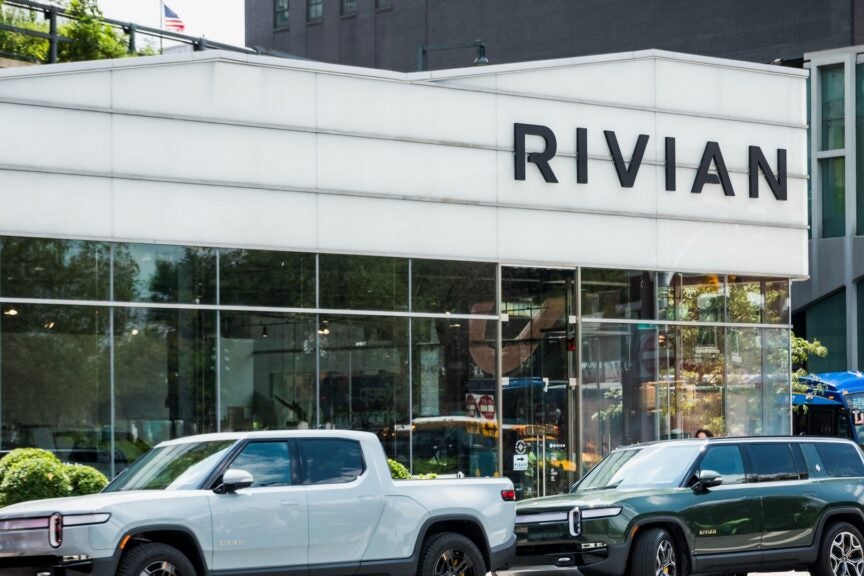
Core Insights - Rivian Automotive Inc.'s upcoming R2 crossover SUV has been spotted testing in Alaska, indicating progress in its development [1][2] Group 1: Vehicle Testing - The R2 SUV was seen at a Supercharger station in Fairbanks, Alaska, suggesting it is undergoing cold-weather testing to assess its performance in sub-zero conditions [2][3] Group 2: Technological Advancements - Rivian's self-driving technology, which includes a LiDAR and camera-based approach, will be featured in the R2 models, potentially enhancing sales [4] - The company plans to introduce an Autonomy+ subscription service, available for a one-time payment of $2,500 or a monthly fee of $49.99, aimed at boosting growth [5] Group 3: Market Performance - Rivian's stock price increased by 7.91% to $14.81 during regular trading and further rose by 1.09% to $14.97 in pre-market trading [6]

Tesla Rival BYD Unveils New Battery Tech Promising 10,000-Cycle Lifespan, Eyes Solid-State Production By 2027 - BYD (OTC:BYDDF)
Benzinga· 2026-02-09 08:51
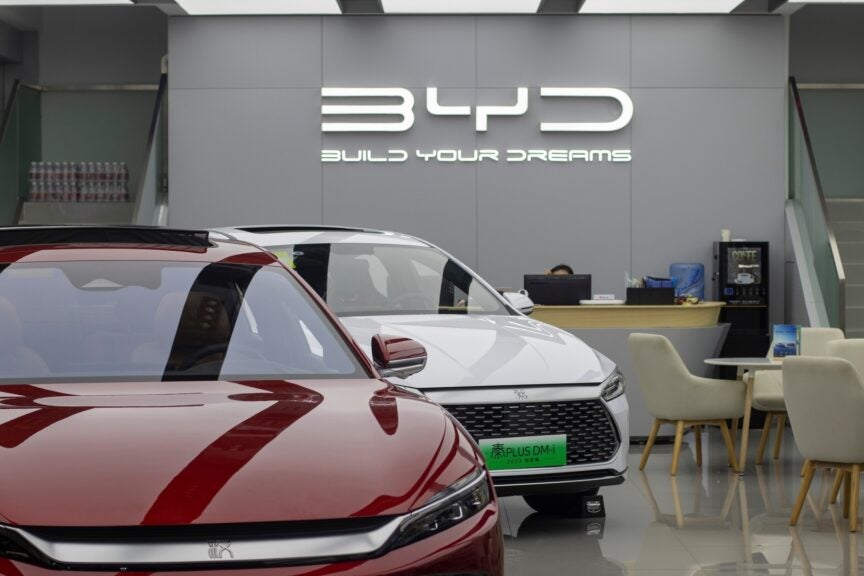
Core Insights - BYD Co. Ltd. has made significant advancements in sodium-ion and solid-state battery technologies, which could enhance the performance and lifespan of electric vehicle batteries [1][4] Group 1: Sodium-Ion Battery Developments - BYD's sodium-ion batteries are reported to be capable of 10,000 charging cycles, a substantial improvement compared to the typical range of 1,500 to 3,000 cycles for current batteries [2] - The company has reached the third generation of its sodium-ion battery research platform, indicating ongoing innovation and development in this area [2] Group 2: Solid-State Battery Progress - BYD's sulfide solid-state battery is projected to enter small-scale production by 2027, promising enhanced lifespan and faster charging times [4] Group 3: Sales Performance and Market Impact - Recently, BYD's shares listed in Hong Kong have seen a decline, attributed to a 30% drop in sales in January, with 210,051 units sold, marking a 50% decrease from December 2025 [5]

Tesla Announces New Semi Truck Trim Levels, Elon Musk Reaffirms Volume Production This Year - Tesla (NASDAQ:TSLA)
Benzinga· 2026-02-09 06:08
Group 1 - Tesla Inc. has announced updates to its Semi truck, with CEO Elon Musk confirming that production will be scaled this year [1][4] - The Semi will be available in two trim levels: Standard and Long Range, with the Standard trim offering a range of 325 miles and energy consumption of 1.7 kWh per mile [2] - The Long Range trim has a range of 500 miles and a curb weight of 23,000 lbs, likely due to a larger battery, and both trims can recover 60% of driving range from a 30-minute charge [3] Group 2 - Tesla has delivered the first unit of the Semi to DHL, which operates the truck in California, traveling 100 miles per day and requiring charging once a week [5] - Tesla's stock price surged 3.50% to $411.11 at market close, with an additional gain of 0.66% to $413.83 during the overnight session [6]
Tesla Says FSD Service Would Be Taken Into Account When Trading In Model S, X, Cyberbeast Trims With Luxe Package - Tesla (NASDAQ:TSLA)
Benzinga· 2026-02-09 04:20
Group 1 - Tesla will consider the Full Self-Driving (FSD) service when estimating trade-in values for Model S and X vehicles, as well as the Cyberbeast trim of the Cybertruck with the Luxe Package being the main criterion for the offer [1] - Updated FSD transfer terms and conditions were released, including an FAQ section addressing various FSD-related questions and its impact on trade-in values [2][3] - FSD will be considered for trade-in values specifically for Model Year 2026 Model X and Model S vehicles with the Luxe package, and any Cyberbeast trim with the Luxe package [3] Group 2 - Tesla announced that Free FSD transfers will end on March 31, and customers can qualify for the scheme by placing their new vehicle order by that date [4] - Tesla's stock price increased by 3.50% to $411.11 at market close on Friday, with an additional gain of 0.66% to $413.83 during the overnight session [5]
Tesla Isn't the Only Robot Game In Town. This Company Aims to Compete.
Barrons· 2026-02-08 17:48
Group 1 - Citi analyst Jeff Chung has assigned a value to XPeng's robot business [1]
Tesla Officially Updates Free FSD Transfer Policy — Here's The Last Date For Placing Orders To Be Eligible - Tesla (NASDAQ:TSLA)
Benzinga· 2026-02-08 12:56
Core Viewpoint - Tesla Inc. has introduced a limited-time offer allowing customers to transfer their Full Self-Driving (FSD) feature to a new Tesla vehicle, available for orders placed by March 31, 2026 [1][2]. Group 1: FSD Transfer Program Details - The FSD transfer program is available for customers who place an order for a new Tesla vehicle by the specified deadline [2]. - Only the new vehicle will have access to the FSD feature after the transfer from an existing vehicle [2]. Group 2: Eligibility Details - Customers must be the legal owner and registrant of the current vehicle with FSD purchased outright to qualify for the transfer [3]. - Both vehicles must be under the same Tesla Account, and all terms and conditions must be agreed upon before delivery [3]. - Vehicles under active lease, business, commercial, or pre-owned orders are not eligible for the transfer program [3]. Group 3: Additional Conditions - The transferring vehicle must not be involved in any pending cancellation or buyback requests or have outstanding liens or balances [4]. Group 4: Recent Updates on FSD - This announcement follows updates regarding Tesla's FSD transfer policies, including the conclusion of the free FSD transfer service at the end of March [5]. - Customers taking delivery between April 24, 2025, and March 31, 2026, may be eligible for free transfers [5].
Elon Musk Admits It Would Take 'Staggeringly Enormous Amount Of Work For Tesla Valuation To Hit $100 Trillion: 'I'm Just Saying…' - Tesla (NASDAQ:TSLA)
Benzinga· 2026-02-08 12:56
Core Viewpoint - Tesla's CEO Elon Musk acknowledges that reaching a $100 trillion valuation is a challenging yet possible goal, requiring significant effort and favorable circumstances [1][2]. Group 1: Current Valuation and Future Goals - Tesla's current market capitalization is $1.5 trillion, indicating a need for a 65-fold increase to reach the $100 trillion target [1]. - Musk's vision for Tesla extends beyond electric vehicles to include robotaxis, humanoid robots, energy storage, and manufacturing [1]. Group 2: Potential Growth Areas - The robotaxi market is projected to be worth $10 trillion by 2030, which could significantly enhance Tesla's valuation [3]. - The humanoid robot market is estimated by Morgan Stanley and Citi to be between $5 trillion and $7 trillion [3]. - Musk aims to produce 100,000 units of the Optimus humanoid robot monthly within five years, potentially generating $30 billion in annual revenue [3]. - Tesla deployed 14.2 GWh of energy storage in the last quarter and 46.7 GWh over the past year, indicating growth in this sector [3]. Group 3: Executive Compensation - In November 2025, Tesla shareholders approved a trillion-dollar pay package for Musk, linking his compensation to the company's advancements in AI and robotics [4]. - Musk has defended his compensation package against criticism, pointing out the contradiction in claims of Tesla's overvaluation while questioning his stock awards [4].

1 Warning Sign for Tesla Stock Investors in 2026
The Motley Fool· 2026-02-08 03:15
Core Viewpoint - Tesla has experienced significant stock performance, with shares increasing by 3,300% over the past decade, but faces major risks due to its high valuation and pressure on core operations [1][4]. Valuation Concerns - Tesla's shares are trading at a price-to-earnings ratio of 375, indicating an inflated valuation that poses downside risk if the company fails to meet expectations [4]. - The market capitalization of Tesla is approximately $1.5 trillion, nearly five times that of the next most valuable carmaker, Toyota [4]. Business Operations - Tesla's automotive revenue decreased by 10% in 2025, and net income fell by 46%, highlighting challenges in the core EV business amid increasing competition [8]. - The company is focusing on future technologies such as robotaxis and robotics, with plans to introduce a mass-market robot, Optimus Gen 3, expected this quarter [6]. Investor Sentiment - Tesla's shareholder base resembles that of venture capitalists, focusing on future potential rather than current fundamentals, which may account for a small portion of the company's valuation [9]. - There is a high expectation for the success of robotaxis and robotics, which could lead to substantial profits if realized [9][10].
Tesla Puts Its Money Where Its Mouth Is in the Biggest Way Possible
The Motley Fool· 2026-02-07 21:30
Core Viewpoint - Tesla is shifting its focus from traditional automotive production to new ventures, specifically humanoid robots and AI, leading to the discontinuation of the Model S and Model X [2][4]. Group 1: Company Strategy - Tesla will end production of the Model S and Model X in Q2, reallocating resources to produce the Optimus robot, as stated by CEO Elon Musk [4]. - The decision reflects Tesla's ambition to transition towards autonomy and advanced technologies beyond electric vehicles [4][10]. Group 2: Market Response - Investors may have anticipated this move, as Tesla had already ceased new orders for the Model S and X in China due to high tariffs and low demand in Europe [6]. - In 2025, combined deliveries of the Model S, Model X, and Cybertruck accounted for only 50,850 units, representing just over 3% of Tesla's total 1.6 million deliveries [8]. Group 3: Financial Overview - Tesla's current market capitalization stands at $1.4 trillion, with a gross margin of 18.03% [9]. - The stock price has seen fluctuations, with a recent change of +3.47%, indicating investor interest amidst strategic shifts [9]. Group 4: Future Outlook - Tesla's future is characterized by uncertainty as it aims to produce a million Optimus robots annually, marking a significant pivot in its business model [10]. - Investors are encouraged to reassess their positions in Tesla, considering the company's evolving identity beyond just an electric vehicle manufacturer [9][10].