Huawei

Search documents
摩根士丹利:亚太数据中心市场洞察- 服务器整体情况
摩根· 2025-06-16 03:16
Investment Rating - The industry investment rating is In-Line [8] Core Insights - Total server shipments grew 22% year-over-year (y/y) in 1Q25, primarily driven by cloud demand for both AI and general servers [1][2] - AI server shipments are expected to continue growing sequentially throughout 2025 [1][15] - High-end server shipments saw significant growth of 491% y/y in 1Q25, indicating strong demand for AI servers [12][13] Summary by Sections Overall Market Performance - Global server shipments totaled 3.9 million units in 1Q25, reflecting a slight decrease of 1% quarter-over-quarter (q/q) but a robust increase of 22% y/y [2] - The US market outperformed with shipments up 43% y/y, while Western Europe saw a decline of 7% y/y [11] Segment Analysis - High-end servers grew 491% y/y, mid-range servers increased 143% y/y, and entry-level servers rose 12% y/y [12] - The aggregate ODM direct shipments reached 1,857k units, marking a 50% y/y increase [4][14] Vendor Performance - ODM direct market share increased to 47.4% in 1Q25, up 10 percentage points from the previous quarter [15] - Major vendors like Dell, HP, and Lenovo experienced declines in market share, with Dell at 9.1% and Lenovo at 4.9% [15] Stock Implications - Preference for ODMs/OEMs over components, with specific recommendations for companies such as Giga-Byte, Hon Hai, and Quanta [7]
Nvidia-mania took over Europe this week. Here's what I learned from Jensen Huang
CNBC· 2025-06-14 06:05
Core Message - Nvidia is positioning itself as a key player in helping Europe build its artificial intelligence infrastructure, emphasizing the importance of AI as a foundational technology for the region's future [2][5]. Group 1: Nvidia's Role in AI Infrastructure - Jensen Huang, CEO of Nvidia, has articulated that the company is more than just a chip manufacturer, framing Nvidia as an infrastructure firm essential for developing AI capabilities in Europe [5]. - Huang highlighted the need for Europe to collaborate and build a joint capacity in AI to compete effectively on a global scale [6]. - A significant partnership was announced between French startup Mistral and Nvidia to create an AI cloud utilizing Nvidia's GPUs [6]. Group 2: Sovereign AI and European Potential - The concept of "sovereign AI" was discussed, focusing on the importance of establishing data centers within national borders to serve local populations [7]. - Huang praised the potential of the U.K., France, and Europe in the AI sector, indicating a positive outlook for the region's capabilities [7]. Group 3: Competitive Landscape with China - Nvidia has faced challenges in selling advanced chips to China due to U.S. export controls, resulting in a $4.5 billion loss on unsold inventory in its last quarterly results [8]. - Huang noted that while Huawei is currently a generation behind Nvidia in AI chip technology, the company is leveraging its resources to catch up [9]. - Concerns were raised about the strategic implications of U.S. companies not engaging with the Chinese market, which could allow Chinese firms to advance in the AI race [11][12]. Group 4: Future Technologies - Huang expressed optimism about the future of robotics and autonomous vehicles, predicting that this decade will be pivotal for these technologies [13][14]. - He also mentioned that quantum computing is reaching an "inflection point," with the potential to solve complex problems beyond the capabilities of classical computers [15].


iPhone Sales Rebound In China, But Apple's Next Move Could Be Risky
Benzinga· 2025-06-13 16:40
Group 1 - Apple Inc's iPhone sales in China topped the charts in May, indicating a rebound in growth in its key markets, China and the U.S. [1] - Global sales for Apple increased by 15% during April and May, marking the highest growth since the pandemic began in 2020 [1]. - Discounts of up to 2,530 yuan ($351) were offered on Apple's latest iPhone 16 models in May through Chinese e-commerce platforms [1]. Group 2 - The rebound in iPhone sales was partly driven by tariff evaders and double-digit growth in Japan, India, and the Middle Eastern markets [2]. - The U.S. and Chinese markets are crucial for the iPhone's future prospects, as highlighted by Ivan Lam of Counterpoint [2]. Group 3 - Counterpoint Research revised its growth expectations for global smartphone shipments in 2025 down to 1.9% from 4.2%, citing uncertainties related to tariffs [3]. - Shipment growth from China is expected to be nearly flat, with Apple and Samsung's shipments anticipated to slow due to increased consumer costs [3]. - IDC also lowered its 2025 global smartphone shipment growth outlook to 0.6% from 2.3% [3]. Group 4 - IDC forecasts a 3% growth in smartphone shipments in China for 2025, driven by government subsidies, while Apple is expected to decline by 1.9% due to competition from Huawei and economic slowdown [4]. - U.S. smartphone shipment growth is projected to slow to 1.9% in 2025, down from 3.3% in 2017, primarily due to tariff-related price increases [4]. - As of the last check, Apple stock was down 0.82% to $197.57 [4].


Altimeter's Brad Gerstner's offers his AI playbook
CNBC Television· 2025-06-12 17:50
Uh, you know, I had Jensen uh Hang on the BG2 podcast uh last year. It's when people were were saying, "Oh, this training is hitting an upper bound and all this AI is overblown and remember uh Nvidia fell and all these AI stocks were falling and and Jensen Hang said on on the podcast, he said, you know, we are now moving into inference time reasoning where the machines begin to recursively think for themselves." And he said at that moment, inference isn't going to 10x. It isn't going to 100x. It isn't going ...

Nvidia CEO: Huawei ‘has got China covered’ if the U.S. doesn’t participate
CNBC Television· 2025-06-12 14:22
Nvidia's Jensen Wong issuing a warning to the US when it comes to imposing these chip restrictions on China. Our Arjent Carpal is in Paris at the Viva Technology Conference where he talked to Nvidia's CEO earlier today. Arjun, good morning. Good morning, Carl.It's been Jensen Mania here in Europe for the past few days. He was in London, now he's in Paris. Uh, and there's been a slew of deals announced around Nvidia and infrastructure deals here in Europe.But I had a chance to catch up catch up with Jensen H ...
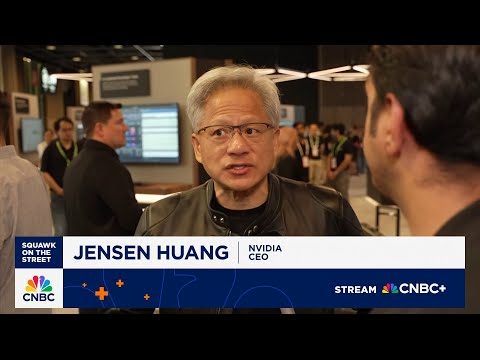
Nvidia's Jensen Huang: Huawei CEO's recent message is 'China's technology is good enough for China'
CNBC Television· 2025-06-12 10:56
in video uh CEO Jensen Wong making some new comments on China's progress in the AI race. CNBC uh caught up with Wong at a tech conference in Paris just a few days after Huawei's CEO was quoted by Chinese state media as brushing off the impact of US restrictions on exports uh to China's chip sector. Here's what Wong had to say.The important thing to remember is that AI tech AI is a parallel problem. If if uh each one of the computers are not as capable, just have more computers. And what he's saying is that ...
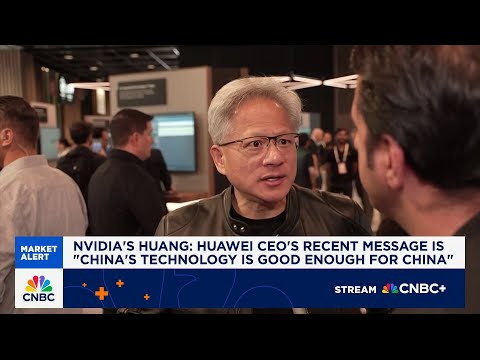
Huawei 'has got China covered' if the U.S. doesn't participate, Nvidia CEO tells CNBC
CNBC· 2025-06-12 08:38
Core Viewpoint - The ongoing U.S. restrictions on AI semiconductor exports to China may benefit Huawei, as the company is positioned to leverage its status in the Chinese market while U.S. firms like Nvidia may miss out on opportunities in China [1]. Group 1: U.S. Restrictions and Huawei's Position - U.S. export curbs are limiting Chinese companies from acquiring advanced semiconductors necessary for AI development, prompting China to support domestic firms like Huawei to establish its own AI chip ecosystem [1]. - Nvidia's CEO Jensen Huang stated that Huawei is prepared to fill the gap left by U.S. companies if they choose not to engage with the Chinese market [1]. Group 2: Huawei's Current Capabilities - Huawei's CEO Ren Zhengfei acknowledged that the company's technology is still a generation behind that of the U.S., indicating that Huawei has not yet achieved the level of advancement often attributed to it [2]. - Ren emphasized the need for Huawei to work harder to meet the standards set by U.S. technology, countering claims of Huawei's superiority [2].
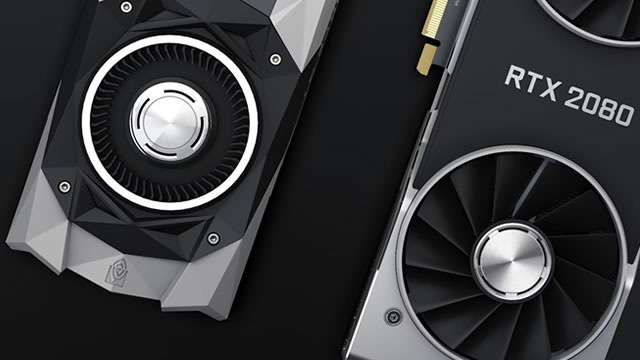
China's racing to build its AI ecosystem as U.S. tech curbs bite. Here's how its supply chain stacks up
CNBC· 2025-06-12 03:55
Core Insights - The U.S. export restrictions on advanced semiconductors are pushing China to develop domestic alternatives, with Huawei being a key player in this effort [1][3][6] AI Chip Design - Nvidia is recognized as the leading AI chip designer, but it does not manufacture the chips itself; it relies on foundries for production [5] - Despite U.S. restrictions, demand for Nvidia chips remains high among Chinese customers, although Nvidia has faced challenges in selling its H20 processor to China [6][7] - Huawei's HiSilicon is making progress in GPU design, with its Ascend 910B and upcoming Ascend 910C chips showing significant advancements, though still behind Nvidia [9][10] AI Chip Fabrication - Nvidia's manufacturing is primarily done by TSMC, which is compliant with U.S. export controls, limiting Huawei's access to advanced chip production [11][12] - SMIC, China's largest foundry, is behind TSMC in technology, officially capable of producing 7-nanometer chips but suspected of working on a 5-nanometer chip for Huawei [13] - Huawei is reportedly working on its own fabrication capabilities, but lacks essential manufacturing equipment [14] Advanced Chip Equipment - Export controls from the Netherlands restrict SMIC's access to advanced lithography machines from ASML, which are crucial for producing advanced GPUs [15][16] - SMIC has attempted to circumvent these restrictions using less advanced lithography systems, but this approach has limitations [17] - Chinese companies like SiCarrier Technologies are exploring alternative lithography technologies, but achieving comparable capabilities may take years [18] AI Memory Components - High Bandwidth Memory (HBM) is essential for AI applications, with South Korean companies like SK Hynix leading the market [19][20] - Chinese firms such as ChangXin Memory Technologies are in the early stages of HBM production but face significant challenges, including export controls [21][22] - Huawei relies on foreign HBM supplies for its Ascend 910C processor, highlighting the ongoing dependence on international suppliers despite domestic advancements [24]
摩根士丹利:Investor Presentation-全球人工智能半导体需求与供应链
摩根· 2025-06-11 02:16
Investment Rating - Industry View: In-Line [7] Core Insights - The semiconductor industry is experiencing unprecedented demand driven by AI advancements and geopolitical tensions, particularly in the context of China's push for AI localization [4][8]. - The report highlights a decoupling between broader semiconductor cycles and AI growth, indicating that while overall semiconductor growth was slow at 10% year-over-year in 2024, AI-related demand continues to surge [10][13]. - Logic semiconductor foundry utilization is reported at 70-80% in the first half of 2025, suggesting that recovery is still ongoing [9]. Demand and Supply Dynamics - Significant demand is anticipated from AI, with NVIDIA experiencing booming demand and its Days of Inventory (DOI) reaching a historical low [15]. - The report forecasts that the top six companies' capital expenditures (capex) will grow by 62% year-over-year to RMB 373 billion [30]. - China's GPU self-sufficiency ratio was 34% in 2024, expected to rise to 82% by 2027, with local GPU revenue projected to reach RMB 287 billion by 2027 [32][35]. Market Trends and Projections - The total addressable market (TAM) for cloud AI semiconductors is projected to grow to USD 235 billion in 2025, with edge AI semiconductors expected to grow at a compound annual growth rate (CAGR) of 22% from 2023 to 2030 [49][60]. - Inference AI semiconductors are forecasted to grow at a CAGR of 55% from 2023 to 2030, outpacing training and general-purpose chips [60]. - The report anticipates robust cloud capex spending of nearly USD 789 billion across 2025-2026, driven by major cloud service providers [49]. Supply Chain and Capacity - TSMC is expected to expand its CoWoS capacity significantly, with projections of producing 5.1 million chips in 2025 [61][70]. - AI computing wafer consumption is estimated to reach up to USD 15 billion in 2025, with NVIDIA accounting for the majority of this consumption [73]. - The report indicates that the semiconductor supply chain is under pressure, with GPU supply and demand needing time to align [70].
One of Jensen Huang's Ambitious Goals Might Make Nvidia Its Own Worst Enemy
The Motley Fool· 2025-06-09 07:51
Core Insights - The evolution of artificial intelligence (AI) is seen as the next major leap for the tech industry, with PwC estimating that AI will contribute $15.7 trillion to the global economy by 2030 [2] - Nvidia has emerged as a significant beneficiary of the AI revolution, with its market cap increasing by over $3 trillion and shares rising more than 870% since the end of 2022 [5][4] - Nvidia's competitive advantage lies in its innovation and leadership in AI-accelerated data centers, particularly with its Hopper and Blackwell GPUs [6][9] Nvidia's Market Position - Nvidia's GPUs are in high demand, allowing the company to charge premium prices, with Hopper chips priced over $40,000 compared to competitors like AMD, which sell their chips for $10,000 to $15,000 [8] - The company's gross margin has significantly increased, reaching as high as 78.4% in the fiscal first quarter a year ago, compared to the low-to-mid 60% range prior to the AI boom [9] Innovation Strategy - CEO Jensen Huang aims to release next-generation AI chips annually, with upcoming products like Blackwell Ultra and Vera Rubin expected to enhance performance and memory capacity [10][11] - While innovation is crucial for success, there are concerns that Nvidia's accelerated innovation timeline may lead to rapid depreciation of its hardware, impacting customer purchasing decisions [15][20] Customer Dynamics - Major customers, referred to as the "Magnificent Seven," are developing their own AI-GPUs, which could lead to delayed upgrade cycles for Nvidia's products as these alternatives are cheaper and more accessible [18][20] - The potential for customers to opt for older Nvidia chips as they depreciate raises questions about the sustainability of Nvidia's pricing power in the face of its own innovation strategy [20][22] Impact on Business Models - Nvidia's aggressive innovation could negatively affect data-center leasing models, as companies may choose to bypass leasing in favor of developing their own solutions [21] - The rapid introduction of new GPUs may lead to a decline in the perceived value of existing Nvidia hardware, impacting both sales and gross margins [20][22]