Bank of America

Search documents
Bank of America's NII Momentum Builds: Can it Maintain the Pace?
ZACKS· 2025-08-13 14:21
Core Insights - Bank of America (BAC) has experienced a significant increase in net interest income (NII) following the Federal Reserve's rate cuts in 2024, driven by fixed-rate asset repricing, higher loan and deposit balances, and declining funding costs [1][4][8] NII Performance - BAC's net interest yield improved slightly to 1.97% in 2024 from 2.08% in 2023, while it was up from 1.96% in 2022 and 1.66% in 2021. The yield remained stable at 1.96% in the first half of 2025 [3] - Management anticipates NII to be between $15.5 billion and $15.7 billion for Q4 2025, with a projected growth of 6-7% for the year [5][8] Market Context - Despite the Fed maintaining interest rates amid inflation and tariff challenges, the likelihood of a 25-basis point cut in the upcoming FOMC meeting has increased due to signs of labor market softness [4] - The central bank's rate cuts are expected to benefit BAC in the near term, although they may slow NII growth [6] Peer Comparison - Citigroup's NII rose 8% year over year to $29.2 million in the first half of 2025, driven by increased deposit and loan balances [7] - JPMorgan's NII increased by 1% to $46.5 billion in the first half of 2025, with management raising its 2025 NII guidance to $95.5 billion, indicating over 3% growth year over year [9][10] Stock Performance and Valuation - BAC shares have increased by 8% year to date, trading at a price-to-tangible book (P/TB) ratio of 1.76, which is below the industry average [8][11][14] - The Zacks Consensus Estimate projects year-over-year earnings growth of 12.2% for 2025 and 16.1% for 2026, with recent estimates for 2025 slightly upward and 2026 slightly downward [15]


X @Bloomberg
Bloomberg· 2025-08-13 06:18
India has gone from fund managers’ top Asian stock market pick to their least preferred in just three months, according to a BofA survey https://t.co/8pzTBXL5XB ...
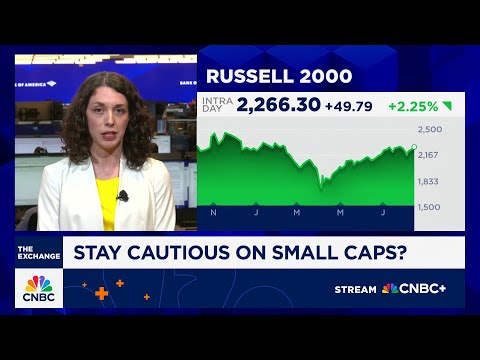
Focus on high quality among mid and small caps, says BofA's Jill Carey Hill
CNBC Television· 2025-08-12 17:48
Market Sentiment & Performance - Bank of America's flow data indicates net selling of small-cap stocks by clients last week, while large and mid-cap stocks saw net buying [1] - 44% of fund managers surveyed believe large-cap stocks will outperform small-cap stocks this year, an increase from the previous reading [1] - The Russell 2000 is up only 1.5% year-to-date, indicating continued underperformance of small caps [1] Concerns & Cautions - B of A remains near-term cautious on the Russell 2000 index and does not expect any Fed rate cuts this year [2][4] - Tariff risk poses a greater threat to small caps due to their thinner margins [3] - Inflation remains sticky, leading to the expectation that the Fed will remain on hold, potentially negatively impacting the Russell 2000, which is sensitive to interest rates [4][5] - Small-cap earnings recovery has been slower than expected compared to large caps, with lofty expectations for the second half of the year [6][7] Opportunities & Recommendations - It is advisable to be selective within small caps, favoring mid-caps due to cleaner balance sheets and lower risk from tariffs and refinancing [8] - Despite risks, small caps offer wider performance spreads and alpha opportunities, with relatively cheap valuations compared to large caps [8] - Focus on higher quality areas within small and mid-caps, prioritizing stocks with positive revisions and stronger margins [9][10]
Here's What Happens When You Get a CD From a Bank You Don't Recognize
The Motley Fool· 2025-08-12 16:04
Core Insights - The Federal Reserve's rapid interest rate hikes have led to a significant increase in Certificate of Deposit (CD) rates, with many top-paying CDs exceeding 5% APY, some even surpassing 5.5% [1] Group 1: CD Market Dynamics - Many high-paying CDs are offered by smaller credit unions rather than well-known national banks, which may cause skepticism among potential depositors [2] - Banks utilize CDs as a strategy to attract depositors, as they earn revenue by lending at higher rates than what they offer to depositors [3] - Lesser-known banks often provide better CD rates to compete for deposits, as they lack the brand recognition of larger institutions [4] Group 2: Comparison of CD Rates - Bank of America offers lower rates on most of its CDs, even in the current high-interest environment, making them less attractive [5] - In contrast, Quontic offers a 3.25% APY on a 1-year CD with a minimum deposit of $500, while Bread Financial also provides competitive rates [6] Group 3: Safety and Trust in CD Issuers - The presence of FDIC insurance is crucial for deposit safety, covering up to $250,000 per depositor, per bank [6] - Signs of a weak bank include branch closures, increasing fees, and loss of depositors, which can indicate potential problems [7] - Many lesser-known CD issuers are likely safe, and thorough research is recommended to find the best rates [8]

These Are the Largest Financial Stocks by Market Cap. Here Are the 3 I'd Buy Today.
The Motley Fool· 2025-08-12 11:23
Core Viewpoint - The financial sector, particularly certain stocks like Berkshire Hathaway, Bank of America, and Wells Fargo, presents attractive investment opportunities despite being overshadowed by technology stocks [1][2][10]. Group 1: Company Valuations - Berkshire Hathaway has reached a market cap of $1 trillion, making it the largest financial company, with its core business in insurance and a significant stock portfolio valued at $300 billion [2][4]. - Bank of America reported a 7% year-over-year earnings growth and a 5% increase in customer deposits, indicating strong performance in a challenging consumer environment [5]. - Wells Fargo, now free from its asset cap, is positioned to benefit from falling interest rates, enhancing its consumer-focused business model [6][10]. Group 2: Market Conditions and Regulatory Environment - Both Bank of America and Wells Fargo could benefit from a potential reduction in corporate tax rates and a generally looser regulatory environment under the Trump administration [7]. - The financial sector is experiencing a shift, with interest rates expected to fall, which could positively impact banks like Bank of America and Wells Fargo [5][6]. Group 3: Comparisons with Other Financial Companies - JPMorgan Chase, while a strong institution, trades at a premium valuation compared to Bank of America and Wells Fargo, which may limit its attractiveness [8]. - Visa and Mastercard, despite being dominant players in the payment processing market, have high P/E ratios of 33 and 39, raising questions about their future growth potential [8].


X @Bloomberg
Bloomberg· 2025-08-11 15:16
Softer US labor data and Fed politics push BofA to forecast lower Treasury yields https://t.co/iwtVKXVmCf ...
X @Bloomberg
Bloomberg· 2025-08-11 08:30
A record share of fund managers see US stocks as too expensive after the sharp rally since April lows, according to a Bank of America survey https://t.co/9JafUs1pU9 ...
Bank of America: A Mispriced Capital Return Engine
Seeking Alpha· 2025-08-11 06:08
Group 1 - Bank of America (NYSE: BAC) is considered a strong buy based on its fundamentals and discounted valuation, presenting an opportunity for patient investors to capitalize on [1] - The company has a recent capital position that supports its investment potential [1] Group 2 - The analysis is informed by a comprehensive and fundamental approach to understanding the macroeconomy and its impact on assets [1]

Gold surges, Stephen Miran tapped by Trump to fill Kugler's spot
Yahoo Finance· 2025-08-08 15:00
Welcome to Yahoo Finance's flagship show, The Morning Brief. I'm Julie Hyman. Let's get to the three things you need to know today.First up, US stock futures pointing to gains at the open. And the NASDAQ composite set to open at a new record high. It's the top performer this week, up nearly 3%.Even with the flurry of tariff headlines over the week, markets took it in stride, as they have been. But Bank of America's Michael Hartnett warning that investors are preparing for a pullback. In a new note, he says ...

Is Bank of America's Slow Start in 2025 an Opportunity for Investors?
ZACKS· 2025-08-08 14:11
Core Insights - Bank of America (BAC) shares have increased by 2.2% in 2025, underperforming compared to Citigroup's 29.9% and JPMorgan's 19.7% gains, indicating relative weakness in the stock performance [1][9]. Financial Performance - In the first half of 2025, Bank of America reported a 5% year-over-year growth in net interest income (NII), driven by strong loan demand, sustained high interest rates, and a solid deposit base. The bank anticipates NII growth of 6-7% for the year [5][4]. - The average global liquidity sources for Bank of America stood at $938 billion as of June 30, 2025, reflecting a robust liquidity profile [11]. Strategic Initiatives - Bank of America is pursuing aggressive branch expansion, planning to open over 150 new financial centers by 2027, with 40 expected to open this year and 70 more in 2026. This strategy aims to enhance customer relationships and penetrate new markets [6][9]. - The bank is also investing heavily in technology initiatives to attract and retain customers, which is expected to boost cross-selling opportunities [10]. Shareholder Returns - The company has authorized a $40 billion share buyback program effective from August 1, 2025, and has raised its dividend by 8% to $0.28 per share, continuing to reward shareholders [12][14]. Investment Banking Performance - Bank of America's investment banking (IB) fees saw a significant decline of 45.7% in 2022 and 2.4% in 2023, but rebounded with a 31.4% increase in 2024. However, in the first half of 2025, IB fees declined by 6% year-over-year due to market headwinds [15][16]. Asset Quality Concerns - The asset quality of Bank of America has been deteriorating, with provisions increasing by 115.4% in 2022, 72.8% in 2023, and 32.5% in 2024. Net charge-offs also rose by 74.9% in 2023 and 58.8% in 2024, indicating ongoing challenges in maintaining asset quality [18][19]. Valuation Metrics - Bank of America is currently trading at a price-to-tangible book (P/TB) ratio of 1.66X, which is below the industry average of 2.87X, suggesting that the stock is undervalued compared to its peers [22][24].