iShares

Search documents
Is JPMorgan Diversified Return U.S. Mid Cap Equity ETF (JPME) a Strong ETF Right Now?
ZACKS· 2025-09-01 11:21
Core Insights - The JPMorgan Diversified Return U.S. Mid Cap Equity ETF (JPME) offers investors exposure to the mid-cap blend category, utilizing a rules-based approach to combine risk-based portfolio construction with multi-factor security selection [1][6]. Fund Overview - JPME was launched on May 11, 2016, and has accumulated over $372.98 million in assets, positioning it as an average-sized ETF in its category [1][5]. - The fund aims to match the performance of the Russell Midcap Diversified Factor Index before fees and expenses [5]. Investment Strategy - JPME employs non-cap weighted strategies, focusing on fundamental characteristics to select stocks with better risk-return performance [3][4]. - The fund's annual operating expenses are 0.24%, which is competitive within its peer group [7]. Sector Exposure - The ETF has a significant allocation in the Industrials sector, comprising approximately 12% of the portfolio, followed by Healthcare and Consumer Staples [8]. - The top 10 holdings account for about 4.96% of total assets, with Tapestry Inc Common (TPR) being the largest individual holding at 0.55% [9]. Performance Metrics - Year-to-date, JPME has increased by approximately 6.41%, and it has risen about 7.16% over the past 12 months as of September 1, 2025 [11]. - The fund has a beta of 0.93 and a standard deviation of 16.09% over the trailing three-year period, indicating effective diversification of company-specific risk [11]. Alternatives - Other ETFs in the mid-cap blend space include the Vanguard Mid-Cap ETF (VO) and the iShares Core S&P Mid-Cap ETF (IJH), which have significantly larger asset bases and lower expense ratios [12][13].



Should ProShares S&P 500 Ex-Technology ETF (SPXT) Be on Your Investing Radar?
ZACKS· 2025-09-01 11:21
Core Insights - The ProShares S&P 500 Ex-Technology ETF (SPXT) is designed to provide broad exposure to the Large Cap Blend segment of the US equity market, launched on September 22, 2015, with assets over $214.90 million [1] - Large cap companies typically have a market capitalization above $10 billion, offering stability and more reliable cash flows compared to mid and small cap companies [2] - The ETF has an annual operating expense ratio of 0.09%, making it one of the least expensive options in its category, with a 12-month trailing dividend yield of 1.24% [3] Sector Exposure and Holdings - The ETF has a significant allocation to the Financials sector, comprising about 20.9% of the portfolio, followed by Consumer Discretionary and Telecom [4] - Amazon.com Inc (AMZN) represents approximately 5.89% of total assets, with the top 10 holdings accounting for about 26.96% of total assets under management [5] Performance Metrics - SPXT aims to match the performance of the S&P 500 Ex-Information Technology & Telecommunication Services Index, excluding companies in the information technology sector [6] - The ETF has gained roughly 8.88% year-to-date and 13.44% over the past year, with a trading range between $81.62 and $99.47 in the last 52 weeks [7] - With a beta of 0.91 and a standard deviation of 14.44% over the trailing three-year period, it is categorized as a medium risk investment [7] Alternatives and Market Position - SPXT holds a Zacks ETF Rank of 2 (Buy), indicating strong expected performance based on various factors [8] - Other comparable ETFs include the iShares Core S&P 500 ETF (IVV) and the Vanguard S&P 500 ETF (VOO), with assets of $660.96 billion and $725.27 billion respectively, both having an expense ratio of 0.03% [9] Industry Trends - Passively managed ETFs are gaining popularity among both institutional and retail investors due to their low cost, transparency, flexibility, and tax efficiency, making them suitable for long-term investment strategies [10]
Active ETFs Gain Momentum as Investors Look Beyond Big Tech
CNBC Television· 2025-08-29 11:16
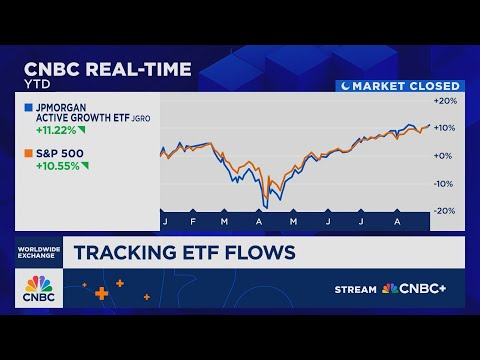
ETF Market Overview - ETF net flows are over $789 billion year to date [1] - Investors are slightly buying the dip on the Triple Q's following Nvidia earnings [2] ETF Inflows - Vanguard Information Technology Index Fund (VGIT) saw the top inflows this week [2] - iShares Russell 2000 ETF (IWM), representing small caps, experienced significant inflows [2] - Investment grade corporate bond ETF (LQD) also saw substantial inflows [2] Active Management & JGRO ETF - JP Morgan suggests active management with the JGRO ETF, emphasizing bottoms-up research and individual stock valuation [3] - JGRO ETF focuses on large-cap growth, considered a suitable strategy in an environment driven by a few key stocks [3] - JGRO ETF is up double digits year to date, performing closely to the S&P 500 [4]
ETFs to Ride the Small-Cap Comeback Wave
ZACKS· 2025-08-27 17:56
Group 1: Market Outlook for Small-Cap Stocks - The likelihood of a Fed interest rate cut is increasing, which positions small-cap stocks for a potential comeback as investors rotate into sectors beyond technology [1][6] - The Russell 2000 Index has surged approximately 3.1% since last Friday and is up nearly 8.9% in August, prompting strategists to revise their outlook on small-cap stocks [2] - Analysts and economists are upgrading their views on small-cap stocks, with some moving from less attractive to neutral [3] Group 2: Performance Expectations - The Russell 2000 is expected to outperform large-cap stocks in the near term, with forecasts indicating that small-cap and low-quality stocks may extend gains due to lower rates relieving balance sheet pressures [4] - Small-cap stocks are believed to be well-positioned for gains, supported by a sector rotation away from large tech companies [5] Group 3: Interest Rate Impact - Expectations for a September interest rate cut have risen to 87.2%, up from 75% prior to Powell's speech, with even higher probabilities for cuts in October (93.8%) and December (98.8%) [6][7] - Small-cap stocks, which are heavily dependent on external borrowings, could significantly benefit from lower interest rates, allowing for increased capital availability and cheaper refinancing of existing debt [8] Group 4: Economic Sentiment - Small-cap companies, being more domestically tied, are poised to outperform as the economy improves, with several financial institutions upgrading their S&P 500 forecasts based on resilient earnings and a supportive macro backdrop [9] - The economy is expected to rebound from the current slowdown, with anticipated rate cuts and other fiscal measures potentially accelerating growth to 3% next year [10] Group 5: Investment Options - Investors can consider various ETFs for increased exposure to small-cap stocks, including iShares Core S&P Small-Cap ETF (IJR), iShares Russell 2000 ETF (IWM), Vanguard Small Cap ETF (VB), Schwab U.S. Small-Cap ETF (SCHA), and SPDR Portfolio S&P 600 Small Cap ETF (SPSM) [11] - IWM is noted for its liquidity, while SPSM has the lowest annual fees at 0.03%, making it suitable for long-term investing; IJR has the largest asset base at $85.35 billion, and VB has outperformed others with gains of 1.85% over the past month and 5.06% over the past year [12]

Time to Jump Into S&P 500 ETFs?
ZACKS· 2025-08-27 17:51
Market Performance - The S&P 500 has gained approximately 9.93% year to date, but this does not fully reflect the broader market's performance in 2025, which has been characterized by volatility [1] - In August, the index advanced by 3.2%, despite notable swings throughout the month [2] Earnings and Economic Outlook - Resilient earnings, a supportive macro backdrop, and signals from Fed Chair Powell regarding potential rate cuts starting in September contribute to an optimistic outlook for the U.S. economy [2] - Jefferies raised its year-end target for the S&P 500 index to 6,600 from 5,600, citing strong second-quarter corporate earnings and projecting a 10% rise in S&P 500 EPS this year [3] - As of last Friday, 80% of the 474 S&P 500 companies that reported second-quarter earnings exceeded analysts' expectations, surpassing the prior four-quarter average of 76.4% and the historical average of 67% [4] Forecast Revisions - UBS Global Wealth Management raised its year-end S&P 500 target to 6,600 from 6,200, marking its second upgrade in two months, driven by confidence in robust corporate earnings and easing trade tensions [5] - Citigroup also increased its year-end S&P 500 target to 6,600 from 6,300, with projections for the index to reach 6,900 by mid-next year [6] - Fundstrat strategist Tom Lee raised his S&P 500 year-end forecast to 6,600, contingent on a dovish Fed and a recovery in the Institute for Supply Management manufacturing index [7] Interest Rate Expectations - Fed Chair Jerome Powell indicated that an interest rate cut could be considered at the next meeting, with markets anticipating an 88.2% likelihood of a rate cut in September, up from 75% prior to Powell's speech [8] Investment Opportunities - Investors are encouraged to explore ETFs tracking the S&P 500 to capitalize on the optimistic outlook for U.S. markets, while maintaining a long-term perspective [9] - Recommended ETFs include Vanguard S&P 500 ETF (VOO), SPDR S&P 500 ETF Trust (SPY), iShares Core S&P 500 ETF (IVV), and SPDR Portfolio S&P 500 ETF (SPLG) [10] - VOO has the largest asset base at $735.54 billion, followed by IVV at $661.68 billion and SPY at $654.64 billion [11] - SPLG is noted as the cheapest option, suitable for long-term investing, while SPY is highlighted for its liquidity, making it ideal for active trading strategies [12] Equal-Weighted ETFs - Equal-weighted funds provide broad market exposure with lower risk, offering sector-level diversification by assigning equal weight to each stock [13] - The S&P 500 Equal Weight Index has gained 7.78% over the past year and 2.28% month to date, outperforming the broader S&P 500 index [14] - Recommended equal-weighted ETFs include Invesco S&P 500 Equal Weight ETF (RSP), ALPS Equal Sector Weight ETF (EQL), and Invesco S&P 100 Equal Weight ETF (EQWL) [14]

Is WisdomTree Japan SmallCap Dividend ETF (DFJ) a Strong ETF Right Now?
ZACKS· 2025-08-26 11:21
Core Insights - The WisdomTree Japan SmallCap Dividend ETF (DFJ) offers investors exposure to small-cap dividend-paying companies in Japan, with a focus on smart beta strategies aimed at outperforming traditional market-cap weighted indexes [1][5][10] Fund Overview - DFJ was launched on June 16, 2006, and has accumulated over $320.9 million in assets, positioning it as an average-sized ETF within the Asia-Pacific (Developed) ETFs category [1][5] - The fund seeks to replicate the performance of the WisdomTree Japan SmallCap Dividend Index, which includes small-cap companies that pay dividends [5] Cost Structure - DFJ has an annual operating expense ratio of 0.58%, which is competitive within its peer group [6] - The fund's 12-month trailing dividend yield stands at 2.26% [6] Holdings and Sector Exposure - The fund's assets are primarily denominated in US Dollars (71.72%), with significant holdings in Japanese Yen and Toyo Tire Co [7] - DFJ's top 10 holdings account for approximately 104.37% of its total assets, indicating a concentrated investment strategy [7] Performance Metrics - DFJ has experienced a year-to-date gain of 25.26% and a 19.63% increase over the past year, with trading prices ranging from $70.93 to $93.98 in the last 52 weeks [8] - The fund has a beta of 0.41 and a standard deviation of 15.67% over the trailing three-year period, categorizing it as a medium-risk investment [9] Competitive Landscape - Alternatives to DFJ include the JPMorgan BetaBuilders Japan ETF (BBJP) and the iShares MSCI Japan ETF (EWJ), which have significantly larger asset bases of $13.96 billion and $15.65 billion, respectively [11] - BBJP has a lower expense ratio of 0.19%, while EWJ charges 0.50%, making them potentially more attractive options for cost-conscious investors [11]
Is Nuveen ESG Mid-Cap Value ETF (NUMV) a Strong ETF Right Now?
ZACKS· 2025-08-26 11:21
Core Insights - The Nuveen ESG Mid-Cap Value ETF (NUMV) offers broad exposure to the mid-cap value segment of the market and debuted on December 13, 2016 [1] - NUMV is managed by Nuveen and aims to match the performance of the TIAA ESG USA Mid-Cap Value Index [5] - The ETF has accumulated over $396.66 million in assets, making it an average-sized fund in its category [5] Fund Characteristics - NUMV has an annual operating expense ratio of 0.31%, which is competitive within its peer group [6] - The fund's 12-month trailing dividend yield is 1.65% [6] - The largest sector allocation is to Industrials at 18.4%, followed by Financials and Real Estate [7] Holdings and Performance - United Rentals Inc. (URI) is the largest individual holding at 2.42% of total assets, with the top 10 holdings comprising 20.07% of total assets [8] - Year-to-date, NUMV has gained approximately 9.53%, and it is up about 8.32% over the last 12 months as of August 26, 2025 [10] - The ETF has a beta of 0.99 and a standard deviation of 17.37% over the trailing three-year period, indicating effective diversification [10] Alternatives - Other ETFs in the mid-cap value space include Vanguard ESG U.S. Stock ETF (ESGV) and iShares ESG Aware MSCI USA ETF (ESGU), which have significantly larger assets of $11.1 billion and $14.22 billion respectively [12] - ESGV has a lower expense ratio of 0.09%, while ESGU has an expense ratio of 0.15% [12]

Should First Trust Mid Cap Value AlphaDEX ETF (FNK) Be on Your Investing Radar?
ZACKS· 2025-08-25 11:21
Core Viewpoint - The First Trust Mid Cap Value AlphaDEX ETF (FNK) is designed to provide broad exposure to the Mid Cap Value segment of the US equity market, with a focus on balancing growth potential and stability [1][2]. Group 1: Fund Overview - Launched on April 19, 2011, FNK has accumulated assets over $204.79 million, categorizing it as one of the smaller ETFs in its segment [1]. - The ETF is passively managed and sponsored by First Trust Advisors [1]. Group 2: Investment Characteristics - Mid cap companies, with market capitalizations between $2 billion and $10 billion, are generally seen as having higher growth prospects compared to large cap companies while being less risky than small cap companies [2]. - Value stocks, which FNK focuses on, typically have lower price-to-earnings and price-to-book ratios, and have historically outperformed growth stocks in long-term performance [3]. Group 3: Costs and Performance - FNK has annual operating expenses of 0.7%, making it one of the more expensive ETFs in its category, with a 12-month trailing dividend yield of 1.62% [4]. - The ETF aims to match the performance of the Nasdaq AlphaDEX Mid Cap Value Index, with a year-to-date return of approximately 5.62% and a one-year return of about 7.56% as of August 25, 2025 [7]. Group 4: Sector Exposure and Holdings - The ETF has a significant allocation to the Consumer Discretionary sector, comprising about 22.1% of the portfolio, followed by Financials and Industrials [5]. - Riot Platforms, Inc. (RIOT) is the largest individual holding at approximately 1.18% of total assets, with the top 10 holdings accounting for about 9.23% of total assets under management [6]. Group 5: Risk and Alternatives - FNK has a beta of 1.08 and a standard deviation of 21.97% over the trailing three-year period, indicating a medium risk profile [8]. - Alternatives to FNK include the iShares Russell Mid-Cap Value ETF (IWS) and the Vanguard Mid-Cap Value ETF (VOE), which have significantly larger asset bases and lower expense ratios [10].

Should JPMorgan Diversified Return U.S. Small Cap Equity ETF (JPSE) Be on Your Investing Radar?
ZACKS· 2025-08-22 11:21
Core Insights - The JPMorgan Diversified Return U.S. Small Cap Equity ETF (JPSE) is designed to provide broad exposure to the Small Cap Blend segment of the U.S. equity market, launched on November 15, 2016, and has assets exceeding $492.87 million [1] Group 1: Small Cap Blend Overview - Small cap companies, with market capitalizations below $2 billion, are considered high-potential stocks but carry higher risks compared to large and mid-cap companies [2] - Blend ETFs typically hold a mix of growth and value stocks, as well as stocks exhibiting both characteristics [2] Group 2: Costs and Performance - The annual operating expenses for JPSE are 0.29%, which is competitive within its peer group, and it has a 12-month trailing dividend yield of 1.6% [3] - JPSE aims to match the performance of the Russell 2000 Diversified Factor Index, utilizing a rules-based approach that incorporates risk-based portfolio construction and multi-factor security selection [6] - The ETF has gained approximately 2.55% year-to-date and is up about 4.6% over the past year, with a trading range between $38.20 and $51.70 in the last 52 weeks [7] Group 3: Sector Exposure and Holdings - The ETF has its largest allocation in the Industrials sector, accounting for about 13% of the portfolio, followed by Information Technology and Real Estate [4] - The top 10 holdings represent about 3.61% of total assets, with Jpmorgan Us Govt Mmkt Fun making up approximately 0.41% of total assets [5] Group 4: Alternatives and Market Position - JPSE carries a Zacks ETF Rank of 3 (Hold), indicating a sufficient option for investors seeking exposure to the Small Cap Blend area [8] - Other alternatives in the space include the Vanguard Small-Cap ETF (VB) and the iShares Core S&P Small-Cap ETF (IJR), with assets of $64.36 billion and $82.23 billion respectively, and lower expense ratios of 0.05% and 0.06% [9] Group 5: Investor Appeal - Passively managed ETFs like JPSE are increasingly favored by retail and institutional investors due to their low costs, transparency, flexibility, and tax efficiency, making them suitable for long-term investment strategies [10]

Should Schwab U.S. Mid-Cap ETF (SCHM) Be on Your Investing Radar?
ZACKS· 2025-08-22 11:21
Core Insights - The Schwab U.S. Mid-Cap ETF (SCHM) is a passively managed fund launched on January 13, 2011, with over $11.83 billion in assets, targeting the Mid Cap Blend segment of the U.S. equity market [1] Group 1: Investment Characteristics - Mid cap companies, with market capitalizations between $2 billion and $10 billion, provide a balance of stability and growth potential, offering less risk and higher growth opportunities compared to small and large companies [2] - The ETF has an annual operating expense of 0.04%, making it one of the least expensive options in its category, with a 12-month trailing dividend yield of 1.4% [3] Group 2: Sector Exposure and Holdings - The ETF has a significant allocation to the Industrials sector, comprising about 21.1% of the portfolio, followed by Financials and Consumer Discretionary [4] - Robinhood Markets Inc Class A (HOOD) represents approximately 1.51% of total assets, with the top 10 holdings accounting for about 6.82% of total assets under management [5] Group 3: Performance Metrics - SCHM aims to match the performance of the Dow Jones U.S. Mid-Cap Total Stock Market Index, which includes mid-cap stocks ranked 501-1000 by market capitalization [6] - The ETF has increased by roughly 4.65% year-to-date and is up about 8.79% over the past year, with a trading range between $22.92 and $30.08 in the last 52 weeks [7] Group 4: Alternatives and Market Position - SCHM holds a Zacks ETF Rank of 3 (Hold), indicating it is a viable option for investors seeking exposure to the Mid Cap Blend market segment [8] - Other comparable ETFs include the Vanguard Mid-Cap ETF (VO) and the iShares Core S&P Mid-Cap ETF (IJH), with assets of $86.07 billion and $97.22 billion respectively, and expense ratios of 0.04% and 0.05% [9] Group 5: Market Trends - There is a growing trend among retail and institutional investors towards passively managed ETFs due to their low costs, transparency, flexibility, and tax efficiency, making them suitable for long-term investment strategies [10]