Reliance Industries

Search documents
Sensex ends lower on foreign fund outflows, selling in blue-chips
Rediff· 2026-01-13 11:51
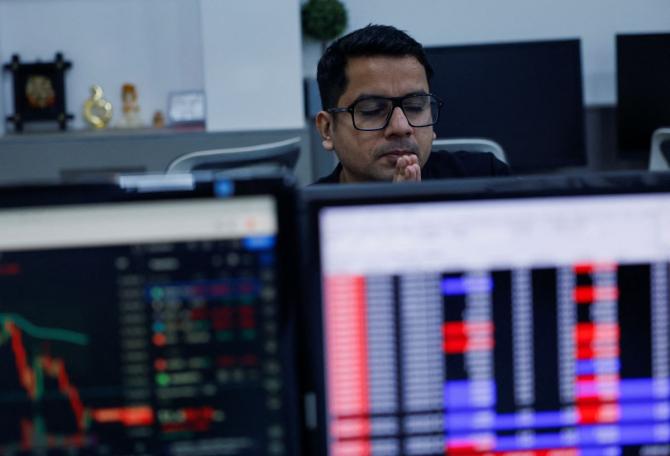
Equity benchmark indices Sensex and Nifty ended lower on Tuesday after a day's breather, tracking unabated foreign fund outflows and selling in blue-chip stocks amid global tariff-related concerns.Photograph: Shailesh Andrade/ReutersMarket sentiment was also sluggish due to a weak start to the earnings season, according to traders.In a volatile trade, the 30-share BSE Sensex dropped 250.48 points, or 0.30 per cent, to settle at 83,627.69.During the day, it declined 615.38 points, or 0.73 per cent, to 83,262 ...

Markets open lower as FII selling drags Nifty below 25,750; Metals shine, IT stocks slump
BusinessLine· 2026-01-13 04:53
Market Overview - Indian equity markets opened on a tepid note, with the Nifty 50 declining by 0.30% to 25,712.90 and the Sensex down 0.32% to 83,608.68 due to profit booking at higher levels [1][2] Sector Performance - Metal stocks led the gainers, while information technology stocks faced selling pressure following mixed quarterly results from major companies [2] - Eternal was the top gainer in the Nifty 50, rising 2.77% to ₹293.15, followed by ONGC at 2.02% to ₹240.47, and Hindalco at 1.20% to ₹931.15 [2] Decliners - Larsen & Toubro led the decliners, falling 2.31% to ₹3,926.00, followed by HCL Technologies down 1.94% to ₹1,635.30, and Reliance Industries slipping 1.44% to ₹1,461.90 [3] Market Sentiment and Technical Analysis - Geopolitical tensions and tariff-related concerns are influencing market sentiment, with a cautious undertone prevailing [2][5] - The Nifty 50 is in a consolidation phase, with immediate resistance at the 50-day EMA around 25,895 and key support levels identified at 25,650 and 25,600 [5] Global Market Influence - Global cues were mixed, with the S&P 500 and Dow reaching record highs, while concerns about the Federal Reserve's investigation were largely dismissed [5] - Commodity markets saw significant action, with gold and silver prices hitting lifetime highs amid geopolitical tensions [5] Trade Agreements and Earnings Focus - The necessity of a US-India trade agreement was highlighted, with expectations for negotiations to resume on January 13 [6] - Market participants are focused on December-quarter earnings, particularly from the IT sector, which could drive stock-specific actions [6]

Will Q3 earnings finally end 6 quarters of pain? 70 stocks to watch out for now
The Economic Times· 2026-01-12 03:35
Core Viewpoint - The Q3FY26 earnings season is expected to show significant profit growth, with brokerages divided on whether this indicates a sustained recovery or a temporary improvement [11] Earnings Projections - Emkay Global projects a 14.5% PAT growth driven by festive season demand and GST rate cuts, with BSE500 expected to grow 14% compared to 8.5% for Nifty [1] - JM Financial forecasts a 9.8% YoY PAT growth for Nifty in Q3, up from 8.4% in Q2, with notable growth in telecom (64%), autos (33%), and industrials (31%) [2] - Motilal Oswal anticipates 20 sectors to achieve double-digit growth, with telecom profits expected to increase 2.6x, cement up 66%, real estate up 64%, and capital goods rising 24% [3] Financial Sector Outlook - Axis Securities expects banks to deliver approximately 12.4% YoY credit growth, with management optimism around growth continuing [6][12] - Motilal Oswal forecasts financials, particularly NBFC-Lending, to grow 26% YoY, while private banks and PSBs are expected to contribute moderately [6][12] - Bernstein maintains an "overweight" stance on financials, telecom, and select consumption sectors, while introducing real estate as an overweight [6] Auto Sector Performance - The auto sector is projected to perform strongly, with Motilal Oswal forecasting a 25% YoY growth, benefiting from GST rate cuts and stable commodity prices [7][12] - Axis Securities highlights the auto sector's healthy earnings trajectory supported by favorable regulatory norms [7] Export-Oriented Sectors - Export-oriented sectors are facing challenges, with Axis Securities noting cautious client spending and pricing pressures as key risks for IT services, pharmaceuticals, and chemicals [8][12] - Nuvama anticipates weak profits in export sectors but strong performance in industrials and domestic autos [8][12] - Emkay warns of ongoing trade-deal uncertainties affecting export-oriented sectors, though recovery is expected in H2CY26 driven by improved retail credit flow [8][12] Stock Recommendations - Axis Securities recommends stocks including IDFC First Bank, Bajaj Auto, and UltraTech Cement [8] - JM Financial lists stocks such as Bharti Airtel, ICICI Bank, and Maruti Suzuki [9] - Motilal Oswal suggests stocks like SBI, Titan, and Infosys [10]


Mcap of 7 of top-10 most valued firms erodes by Rs 3.63 lakh cr; Reliance biggest laggard
The Economic Times· 2026-01-11 10:40
Market Overview - The BSE benchmark declined by 2,185.77 points or 2.54% last week, indicating a negative trend in Indian equity markets due to heightened risk aversion from renewed US tariff threats and rising geopolitical tensions [1][3] Company Valuations - Reliance Industries experienced a significant market valuation drop of Rs 1,58,532.91 crore, bringing its total valuation to Rs 19,96,445.69 crore, making it the most valued firm despite the decline [3] - HDFC Bank's valuation decreased by Rs 96,153.61 crore to Rs 14,44,150.26 crore [3] - Bharti Airtel's market valuation fell by Rs 45,274.72 crore to Rs 11,55,987.81 crore [2][3] - Bajaj Finance's valuation plunged by Rs 18,729.68 crore to Rs 5,97,700.75 crore [2][3] - Larsen & Toubro's market capitalization dropped by Rs 18,728.53 crore to Rs 5,53,912.03 crore, while TCS declined by Rs 15,232.14 crore to Rs 11,60,682.48 crore [3] - Infosys saw a decrease in market capitalization by Rs 10,760.59 crore to Rs 6,70,875 crore [3] Gainers in the Market - ICICI Bank's valuation increased by Rs 34,901.81 crore to Rs 10,03,674.95 crore, marking it as a notable gainer [3] - Hindustan Unilever's market capitalization rose by Rs 6,097.19 crore to Rs 5,57,734.23 crore [3] - State Bank of India's valuation edged higher by Rs 599.99 crore to Rs 9,23,061.76 crore [3] Overall Market Impact - The combined market valuation of seven of the top-10 most valued firms eroded by Rs 3,63,412.18 crore last week, with Reliance Industries being the largest contributor to this decline [3]
Market sell-off: 7 of top-10 firms lose Rs 3.63 lakh crore in a week; Reliance, HDFC Bank biggest drags
The Times Of India· 2026-01-11 09:31
Core Insights - Indian equity markets experienced a significant decline, with the benchmark BSE Sensex falling by 2,185.77 points, or 2.54%, reflecting weak investor sentiment and heightened risk aversion due to renewed US tariff threats and rising geopolitical tensions [4][6] Company Performance - Reliance Industries saw its market capitalisation decrease by Rs 1,58,532.91 crore, bringing its total to Rs 19,96,445.69 crore, making it the largest loser in absolute terms [4][6] - HDFC Bank's valuation dropped by Rs 96,153.61 crore to Rs 14,44,150.26 crore [4][6] - Bharti Airtel's market capitalisation fell by Rs 45,274.72 crore to Rs 11,55,987.81 crore [4][6] - Bajaj Finance lost Rs 18,729.68 crore, closing at Rs 5,97,700.75 crore [4][6] - Larsen & Toubro's market capitalisation decreased by Rs 18,728.53 crore to Rs 5,53,912.03 crore [4][6] - Tata Consultancy Services (TCS) saw a decline of Rs 15,232.14 crore, resulting in a valuation of Rs 11,60,682.48 crore [4][6] - Infosys' market capitalisation edged lower by Rs 10,760.59 crore to Rs 6,70,875 crore [6] Positive Performers - ICICI Bank's valuation increased by Rs 34,901.81 crore to Rs 10,03,674.95 crore [5][6] - Hindustan Unilever added Rs 6,097.19 crore, reaching a market capitalisation of Rs 5,57,734.23 crore [5][6] - State Bank of India's market capitalisation rose by Rs 599.99 crore to Rs 9,23,061.76 crore [5][6] Market Overview - The combined market capitalisation of seven of India's ten most valued companies fell by Rs 3,63,412.18 crore last week [6] - Despite the overall losses, Reliance Industries remained the most valued company in India, followed by HDFC Bank, TCS, Bharti Airtel, ICICI Bank, State Bank of India, Infosys, Bajaj Finance, Hindustan Unilever, and Larsen & Toubro [5][6]
Mcap of 7 of top-10 most valued firms erodes by ₹3.63 lakh cr; Reliance biggest laggard
BusinessLine· 2026-01-11 08:43
Market Valuation Changes - The combined market valuation of seven of the top-10 most valued firms decreased by ₹3,63,412.18 crore last week, with Reliance Industries being the largest contributor to this decline [1] - The BSE benchmark index fell by 2,185.77 points, representing a decline of 2.54 percent [1] Company-Specific Valuation Changes - Reliance Industries' market valuation decreased by ₹1,58,532.91 crore, bringing its total to ₹19,96,445.69 crore [3] - HDFC Bank's valuation fell by ₹96,153.61 crore to ₹14,44,150.26 crore [3] - Bharti Airtel's market valuation dropped by ₹45,274.72 crore to ₹11,55,987.81 crore [3] - Bajaj Finance's valuation declined by ₹18,729.68 crore to ₹5,97,700.75 crore [3] - Larsen & Toubro's market capitalization decreased by ₹18,728.53 crore to ₹5,53,912.03 crore [3] - Tata Consultancy Services (TCS) saw a decline of ₹15,232.14 crore, bringing its valuation to ₹11,60,682.48 crore [3] - Infosys' market capitalization edged lower by ₹10,760.59 crore to ₹6,70,875 crore [4] Gainers in Market Valuation - ICICI Bank's market valuation increased by ₹34,901.81 crore to ₹10,03,674.95 crore [4] - Hindustan Unilever's valuation rose by ₹6,097.19 crore to ₹5,57,734.23 crore [4] - State Bank of India's market capitalization increased by ₹599.99 crore to ₹9,23,061.76 crore [4] Overall Market Sentiment - The Indian equity markets ended the week negatively, influenced by increased risk aversion due to renewed US tariff threats and rising geopolitical tensions [2]
iShares India ETF Is The Easy Way To Invest in India in 2026
Yahoo Finance· 2026-01-10 15:39
Core Viewpoint - India's economy is expected to grow between 6.6% and 7.4% in 2026, making it an attractive alternative to China for investors looking for emerging market exposure [1][3]. Group 1: ETF Overview - The iShares India ETF (INDA) holds 165 companies across various sectors, including major financial institutions and technology firms, with total assets of $9.6 billion and an expense ratio of 0.62% [2][4]. - INDA provides liquid and cost-efficient access to the Indian equity market, which is often difficult for investors to access directly [2]. Group 2: Performance Analysis - Over the past 10 years, INDA has returned 117%, significantly lower than the S&P 500's 241% return during the same period [3][6]. - In the last year, INDA gained only 1.4%, while U.S. markets experienced an 18% increase, indicating underperformance relative to developed markets [3][6]. Group 3: Investment Thesis - The ETF's performance is driven by capital appreciation from underlying Indian stocks, with financials making up 29% and consumer discretionary 12% of its holdings, reflecting a bet on India's growing middle class and credit markets [5]. - The sectors represented in INDA are expected to benefit from rising incomes, urbanization, and the adoption of digital financial services [5]. Group 4: Risks and Trade-offs - Investing in INDA involves trade-offs, including single-country concentration, which lacks diversification across emerging markets. This makes it vulnerable to India-specific challenges [7]. - Recent tariff threats from the U.S. administration highlight the potential economic and political risks for India, which could impact the ETF's performance [7].
Bharti Leads CY25 Market-Cap Surge
Rediff· 2026-01-10 06:34
Group 1: Bharti Group Performance - The Bharti group was the biggest gainer among India's top business conglomerates in calendar year 2025, with a combined market capitalisation increase of 37.3% to Rs 14.7 trillion from Rs 10.7 trillion at the end of December 2024 [3][4] - Bharti Airtel, the flagship company, saw its market capitalisation rise by 40.1% to Rs 12.67 trillion from Rs 9.05 trillion at the end of December 2024 [4] Group 2: Comparison with Other Business Groups - The combined market capitalisation of the country's 10 largest family-owned business groups increased by 10% to Rs 126.4 trillion from Rs 114.9 trillion at the end of CY24 [5] - Vedanta, owned by Anil Agarwal, was the second-biggest gainer with a market capitalisation increase of 36.3% to around Rs 5 trillion from Rs 3.67 trillion [5] - Reliance Industries, led by Mukesh Ambani, ranked third with a market capitalisation increase of 24.7% to Rs 23.4 trillion from Rs 18.73 trillion [7] Group 3: Market Trends and Sector Performance - Traditional industries such as manufacturing, mining, and infrastructure saw gains, with the Bajaj group up 21.1%, Kumar Mangalam Birla up 17%, and Mahindras up 17% [9] - The Tata group, despite retaining the top position, experienced a decline of 10.9% in market capitalisation to around Rs 27.7 trillion [10] - The Adani group lost its third rank to the Bharti group, while the Vedanta group climbed four places to ninth rank from 13th [10]
India's Reliance in talks for US permit to buy Venezuelan oil, sources say
Reuters· 2026-01-09 15:47
Core Viewpoint - Reliance Industries is seeking U.S. approval to resume purchases of Venezuelan crude oil, indicating a strategic move to secure oil supplies amid changing geopolitical dynamics [1] Group 1: Company Actions - Reliance Industries is a private refiner actively pursuing the resumption of Venezuelan crude oil purchases [1] - The company is looking to secure oil supplies, which may reflect its broader strategy to enhance its refining operations and meet domestic demand [1] Group 2: Industry Context - The move by Reliance Industries comes as the global oil market experiences fluctuations, and companies are exploring various sources to ensure stable supply chains [1] - Resuming purchases from Venezuela could signify a shift in the industry's approach to sourcing crude oil, particularly in light of U.S. sanctions and geopolitical considerations [1]

Sensex, Nifty tank nearly 1%
Rediff· 2026-01-09 12:02
Market Performance - Benchmark indices Sensex and Nifty experienced selling pressure for the fifth consecutive session, declining nearly 1 percent due to investor caution over potential US tariff hikes and ongoing geopolitical concerns [1][7] - The BSE Sensex fell by 604.72 points, or 0.72 percent, settling at 83,576.24, while the NSE Nifty dropped 193.55 points, or 0.75 percent, to 25,683.30 [3][4] Foreign and Domestic Investment - Foreign institutional investors sold equities worth Rs 3,367.12 crore, while domestic institutional investors purchased stocks worth Rs 3,701.17 crore on Thursday [6] - The continuous outflow of foreign capital has negatively impacted market sentiment [3] Sector Performance - Among the 30 Sensex firms, NTPC, ICICI Bank, Adani Ports, Bharti Airtel, Sun Pharma, and Bajaj Finance were the biggest laggards, while Asian Paints, HCL Tech, Bharat Electronics, and Reliance Industries showed gains [4] Global Market Context - Asian markets, including South Korea's Kospi, Japan's Nikkei 225, Shanghai's SSE Composite, and Hong Kong's Hang Seng, ended higher, contrasting with the Indian market's performance [7] - European markets were trading positively, while US markets closed mixed [8]