
信息技术行业

Search documents
中科软(603927):中标北京市版权保护中心采购项目,中标金额为403.54万元
Xin Lang Cai Jing· 2026-02-09 15:09
Group 1 - Company Zhongke Soft Technology Co., Ltd. won a procurement project from the Beijing Copyright Protection Center with a bid amount of 4.0354 million yuan [1][2] - In 2024, the company's operating revenue was 6.671 billion yuan, with a revenue growth rate of 2.59% [2] - The net profit attributable to the parent company for 2024 was 355 million yuan, showing a decline of 45.76% [2] - The return on equity (ROE) for the company was 10.92% in 2024 [2] Group 2 - In the first half of 2025, the company's operating revenue was 2.853 billion yuan, with a revenue growth rate of 1.21% [2] - The net profit attributable to the parent company for the first half of 2025 was 107 million yuan, reflecting a decrease of 43.36% [2] - The company operates in the information technology industry, primarily focusing on industry-specific software [2] - The main revenue composition for 2024 included customized software revenue at 72.85%, system integration revenue at 24.99%, software product revenue at 1.93%, and other business revenue at 0.22% [2]

迪普科技(300768):中标中国人寿保险股份有限公司研发中心采购项目,中标金额为219.95万元
Xin Lang Cai Jing· 2026-02-03 12:52
Group 1 - Company Hangzhou Deep Technology Co., Ltd. won a procurement project from China Life Insurance Co., Ltd. with a bid amount of 2.1995 million yuan [1] - In 2024, the company's operating revenue was 1.155 billion yuan, with a growth rate of 11.68%, and a net profit attributable to the parent company of 161 million yuan, reflecting a growth rate of 27.26% [2][3] - For the first half of 2025, the company reported an operating revenue of 551 million yuan, with a growth rate of 9.59%, and a net profit attributable to the parent company of 52 million yuan, showing a growth rate of 0.17% [2][3] Group 2 - The company operates in the information technology industry, primarily focusing on internet services [2][3] - The main product composition for 2024 includes network security products (66.4%), application delivery products (24.9%), service-related businesses (7.89%), and other businesses (0.8%) [2][3]

中科软(603927):中标一汽物流有限公司采购项目,中标金额为152.98万元
Xin Lang Cai Jing· 2026-02-02 07:06
Group 1 - Company Zhongke Ruank (603927.SH) won a procurement project from FAW Logistics Co., Ltd. with a bid amount of 1.5298 million yuan [1] - In 2024, the company's operating revenue was 6.671 billion yuan, with a growth rate of 2.59% [2] - The net profit attributable to the parent company for 2024 was 355 million yuan, showing a decline of 45.76% [2] Group 2 - In the first half of 2025, the company's operating revenue reached 2.853 billion yuan, with a growth rate of 1.21% [2] - The net profit attributable to the parent company for the first half of 2025 was 107 million yuan, reflecting a decrease of 43.36% [2] - The company operates in the information technology industry, with its main product types being industry-specific software [2]
金溢科技(002869):中标山东高速信联科技股份有限公司采购项目,中标金额为3600.00万元
Xin Lang Cai Jing· 2026-01-27 12:24
Group 1 - Shenzhen Jinyi Technology Co., Ltd. won a procurement project from Shandong Expressway Xinyun Technology Co., Ltd. for electronic tags (OBU) and dual-interface CPU cards, with a winning bid amount of 36 million yuan [1][2] - In 2024, Jinyi Technology reported an operating income of 596 million yuan, with a growth rate of 16.39%, and a net profit attributable to the parent company of 79 million yuan, reflecting a growth rate of 59.69% [3] - For the first half of 2025, the company experienced a decline in operating income to 203 million yuan, with a negative growth rate of 11.01%, and a net profit attributable to the parent company of -12 million yuan, indicating a significant decline of 175.92% [3] Group 2 - The company operates in the information technology industry, primarily focusing on electronic components [3] - The main business composition for 2024 includes smart highways at 66.26%, automotive electronics at 28.69%, smart cities at 3.53%, and others at 1.53% [3]

Markets open lower as FII selling drags Nifty below 25,750; Metals shine, IT stocks slump
BusinessLine· 2026-01-13 04:53
Market Overview - Indian equity markets opened on a tepid note, with the Nifty 50 declining by 0.30% to 25,712.90 and the Sensex down 0.32% to 83,608.68 due to profit booking at higher levels [1][2] Sector Performance - Metal stocks led the gainers, while information technology stocks faced selling pressure following mixed quarterly results from major companies [2] - Eternal was the top gainer in the Nifty 50, rising 2.77% to ₹293.15, followed by ONGC at 2.02% to ₹240.47, and Hindalco at 1.20% to ₹931.15 [2] Decliners - Larsen & Toubro led the decliners, falling 2.31% to ₹3,926.00, followed by HCL Technologies down 1.94% to ₹1,635.30, and Reliance Industries slipping 1.44% to ₹1,461.90 [3] Market Sentiment and Technical Analysis - Geopolitical tensions and tariff-related concerns are influencing market sentiment, with a cautious undertone prevailing [2][5] - The Nifty 50 is in a consolidation phase, with immediate resistance at the 50-day EMA around 25,895 and key support levels identified at 25,650 and 25,600 [5] Global Market Influence - Global cues were mixed, with the S&P 500 and Dow reaching record highs, while concerns about the Federal Reserve's investigation were largely dismissed [5] - Commodity markets saw significant action, with gold and silver prices hitting lifetime highs amid geopolitical tensions [5] Trade Agreements and Earnings Focus - The necessity of a US-India trade agreement was highlighted, with expectations for negotiations to resume on January 13 [6] - Market participants are focused on December-quarter earnings, particularly from the IT sector, which could drive stock-specific actions [6]


A股回购规模超1400亿元,真金白银护航市场估值修复|2025中国经济年报
Hua Xia Shi Bao· 2025-12-23 14:15
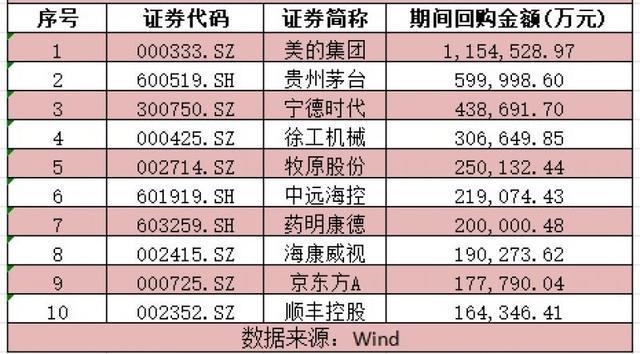
Core Viewpoint - The A-share market has seen a significant wave of stock buybacks in 2025, with nearly 1,500 companies participating, reflecting a robust response to economic recovery and external fluctuations [2][3]. Group 1: Market Overview - As of December 23, the Shanghai Composite Index closed at 3,919.98 points, with a year-to-date increase of 16.95%, peaking above 4,000 points [1]. - The overall market has shown a "shock bottoming and gradual recovery" trend, supported by favorable policies and improved corporate earnings [3]. - The three major indices have all risen this year, with the Shanghai Composite Index, Shenzhen Component Index, and ChiNext Index increasing by 16.95%, 28.37%, and 49.66%, respectively [3]. Group 2: Buyback Activity - Nearly 1,500 companies have initiated stock buybacks this year, with a total repurchase amount exceeding 1,400 billion yuan and over 13 billion shares repurchased [2][3]. - The buyback trend spans various sectors, including consumer, manufacturing, technology, and finance, indicating a comprehensive market support structure [2]. - Companies are increasingly using buybacks to enhance shareholder value and stabilize market expectations [2][3]. Group 3: Leading Companies in Buybacks - The top ten companies by buyback amount include Midea Group (11.55 billion yuan), Kweichow Moutai (5.99 billion yuan), and CATL (4.39 billion yuan) [1][6]. - Notably, Midea Group is the only company with a buyback amount exceeding 10 billion yuan this year [6]. - Companies like JD Display and XCMG Machinery have also made significant contributions to both buyback quantity and amount, showcasing their commitment to shareholder interests [6][7]. Group 4: Industry Participation - The manufacturing, consumer, and information technology sectors have the highest participation rates in buybacks, with leading firms like BOE Technology Group and XCMG Machinery actively repurchasing shares [4][5]. - These companies, backed by stable operating performance and ample cash flow, play a crucial role in stabilizing their stock prices and driving industry valuation recovery [4]. Group 5: Regulatory Support - The ongoing buyback trend is supported by regulatory policies, including the establishment of stock buyback and repurchase loans, which provide low-cost funding for companies [7]. - As of December 23, over 780 companies have disclosed receiving buyback loan support, with total loan amounts reaching over 100 billion yuan [7]. - The combination of these policies encourages companies to shift from passive stabilization to proactive value management [7][8].





【环球财经】土耳其今年前10个月吸引外资同比增长35%
Xin Hua Cai Jing· 2025-12-18 23:11
Group 1 - Turkey attracted foreign direct investment (FDI) of $11.6 billion from January to October this year, representing a year-on-year increase of 35%, indicating growing confidence from international investors in the Turkish economy [1] - The Netherlands was the largest source of foreign investment in Turkey during the first ten months, with an investment of $2.8 billion, followed by Kazakhstan and Luxembourg with $1.1 billion each [1] - In October alone, Turkey attracted approximately $128 million in foreign investment, with EU countries accounting for 82% of this amount, led by France with a 35% share [1] Group 2 - The transportation and warehousing sector received the largest equity investment in October, totaling $199 million, which accounted for 35% of the monthly total; the wholesale and retail sector followed, along with the energy production and distribution sector [1] - From January to October, the wholesale and retail sector attracted the most foreign investment, amounting to $2.8 billion, while the food manufacturing and information technology sectors attracted approximately $1.2 billion each [1] - Despite some foreign capital inflow being affected by asset divestitures and debt repayments in October, equity capital inflows, including foreign real estate investments, continued to support overall data, highlighting Turkey's attractiveness as an emerging market investment destination [2]
降息预期主导市场情绪:海外市场周观察(1124-1130)
Huafu Securities· 2025-12-01 05:11
Group 1 - The core view of the report indicates that the expectation of interest rate cuts by the Federal Reserve is driving market sentiment, leading to a strong performance in U.S. stocks and an increase in gold prices [2][8] - The report highlights that the U.S. retail sales for September increased by 0.2%, which was below the market expectation of 0.4% and the previous value of 0.6% [8] - The report notes that the probability of a 25 basis point rate cut in December has increased, with several Federal Reserve officials expressing support for such a move due to concerns about the labor market [9][10] Group 2 - In terms of asset prices, major global asset classes showed mixed performance, with COMEX silver rising by 12.88% and NYMEX platinum by 10.52%, while the U.S. dollar index fell by 0.71% [28][30] - The report states that the Nasdaq Composite Index had the highest increase among global equity markets, rising by 4.91%, followed by the S&P 500 at 3.73% and the Shenzhen Component Index at 3.56% [33][39] - The materials sector in the U.S. stock market saw the largest gain of 6.43%, while the healthcare sector in Hong Kong also performed well with a 4.94% increase [39] Group 3 - The report indicates that the global commodity market experienced mixed results, with COMEX silver showing the largest gain at 12.88% [46] - The report mentions that the 10-year government bond yields varied globally, with Japan's yield rising to 1.81% and France's yield falling to 3.41% [51][55] - The report highlights that the U.S. labor market remains resilient, with initial jobless claims for the week ending November 22 at 216,000, lower than the expected 225,000 [8][9]
A股,重要调整
Zheng Quan Shi Bao· 2025-11-28 13:17
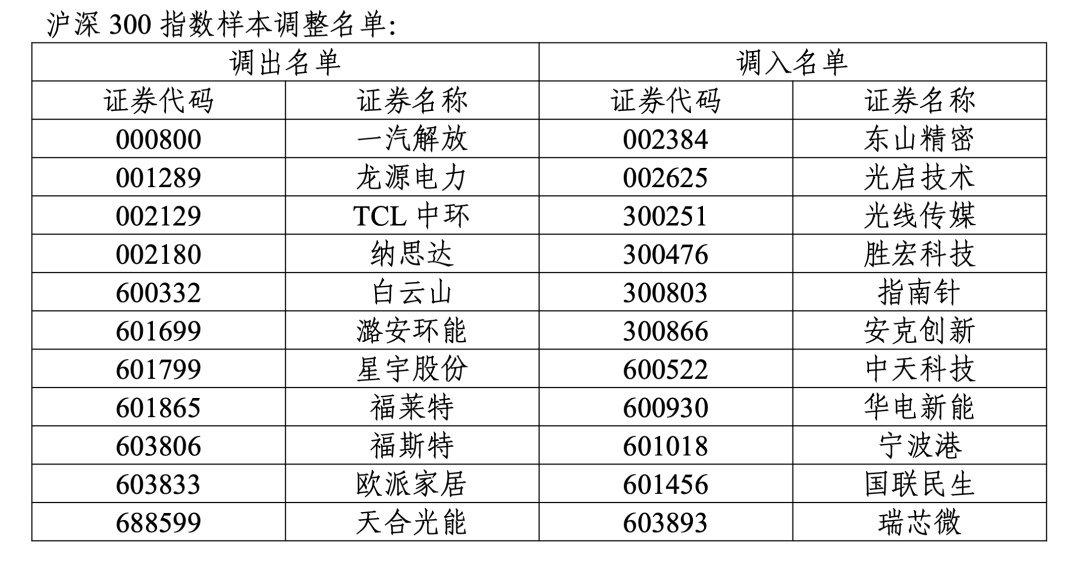
Core Viewpoint - The China Securities Index Co., Ltd. announced the regular adjustment plan for various indices, including the CSI 300, CSI 500, CSI 1000, CSI A50, CSI A100, and CSI A500, which will take effect after the market closes on December 12 [1]. Group 1: CSI 300 Index Adjustments - The CSI 300 index will replace 11 constituent stocks, with new additions including Guolian Minsheng, Guangqi Technology, Ningbo Port, Huadian New Energy, Dongshan Precision, Zhongtian Technology, Zhinancai, and Light Media. Stocks removed from the index include FAW Jiefang, Oppein Home, Fuyao Glass, Longyuan Power, and Trina Solar [2][3]. Group 2: CSI 500 Index Adjustments - The CSI 500 index will replace 50 constituent stocks, with new additions such as Dongfang Yuhong, Heertai, Huahong Semiconductor, Yantian Port, Dazhu CNC, Oppein Home, Zhongce Rubber, and Supor. Stocks removed include China Great Wall, Semir Fashion, Zhongwen Media, and Wangfujing [5]. Group 3: CSI 1000 Index Adjustments - The CSI 1000 index will replace 100 constituent stocks, with new additions including Fenghua Hi-Tech, Shijia Photon, Guoji Precision, Yongding Co., Fuling Pickled Vegetable, Galaxy Magnet, and Hanyu Pharmaceutical [5]. Group 4: Sector Weight Changes - In the CSI 300 index, the number of samples in the information technology and communication services sectors increased by 4 and 2, respectively, with weight increases of 1.46% and 0.75% [5]. - In the CSI 500 index, the industrial sector saw an increase of 11 samples, with a weight increase of 2.48% [5]. - In the CSI 1000 index, the communication services and industrial sectors saw increases of 6 and 2 samples, with weight increases of 0.44% and 0.37% [5]. Group 5: CSI A50 and A100 Index Adjustments - The CSI A50 index will replace 4 constituent stocks, with new additions including Zhongji Xuchuang, Huagong Technology, Guangqi Technology, and Shenghong Technology. Stocks removed include ZTE Corporation, Sanhuan Group, Shanghai Airport, and Hualu Hengsheng [5]. - The CSI A100 index will replace 6 constituent stocks, with new additions including Dongfang Fortune, Guangqi Technology, and Zhongke Shuguang. Stocks removed include Shanghai Airport, Unisplendour, and Citic Securities [5][6]. Group 6: CSI A500 Index Adjustments - The CSI A500 index will replace 20 constituent stocks, with new additions including Zhongtian Technology, Genesis, Borui Pharmaceutical, Guotai Haitong, and Chipone Technology [8].
聚焦科技型企业科创债券:潜力蓝海与信用风险特征深度研究
Lian He Zi Xin· 2025-11-25 11:10
Report Industry Investment Rating No relevant content provided. Core Viewpoints of the Report - The science - innovation bond market in China has witnessed rapid development under policy impetus, with continuous expansion in scale and diverse industry distribution of the science - innovation sector. The future development potential is enormous. The predicted issuance scale of science - innovation bonds for sample companies exceeds 50 billion yuan, and the issuance willingness of technology - based enterprises is expected to increase. However, different science - innovation industries have significant differences in credit risk characteristics, and attention should be paid to science - innovation enterprises with weak growth, average profitability, and heavy debt pressure [2][61]. Summary According to Relevant Catalogs I. Overview of the Science - Innovation Bond Market - **Development Stages**: The science - innovation bond market in China has gone through three stages: the "Double - Innovation Bond" stage (starting in 2015), the "Science - Innovation Corporate Bond and Science - Innovation Note" stage (starting in 2022), and the "Science - and - Technology Innovation Bond" stage (starting in May 2025) [4][5]. - **Issuance Scale**: Since 2021, the issuance scale and number of science - innovation - related bonds have been growing. In 2025 from January to September, the issuance scale reached 1.180853 trillion yuan, with 992 bonds issued, a year - on - year increase of 113.28% and 81.35% respectively. As of the end of September 2025, the market scale of science - innovation bonds reached 2.89 trillion yuan, accounting for 5.59% of the credit - bond stock in terms of scale and 5.42% in terms of number [5]. - **Participation of Entities**: The participation of private and low - credit - rating entities is relatively low. In 2025 from January to September, among the 548 issuers of 992 science - innovation bonds, AAA - rated entities accounted for 67.88%, AA + - rated entities accounted for 22.45%, and AA - rated and below entities accounted for 9.67%. In terms of enterprise nature, local state - owned enterprises accounted for 57.66%, central state - owned enterprises accounted for 23.91%, and private enterprises accounted for 10.58%. The reasons include investor preference, low credit levels of private enterprises, and lack of effective credit enhancement measures [7]. II. Analysis of the Possibility of Technology - Based Enterprises Issuing Science - Innovation Bonds - **Issuance Capacity**: Using the average ratio of the scale of corporate bonds issued in the public market in 2024 to the ending owners' equity of the issuing entities (18.57%) as the upper limit of bond issuance, the predicted issuance scale of science - innovation bonds for 1032 sample companies exceeds 50 billion yuan. However, as of October 21, 2025, the actual issuance scale of bonds by these sample companies was 6.2645 billion yuan, and the scale of science - innovation bonds was only 390 million yuan, far lower than the predicted value, indicating large issuance potential [10][13]. - **Issuance Willingness**: Policy support provides opportunities for technology - based enterprises. Policies have expanded the scope of issuers, optimized the review process, and reduced costs. The improvement of market liquidity, infrastructure, and the long - term capital gap of technology - based enterprises, along with the limitations of traditional financing, are expected to enhance the issuance willingness of technology - based enterprises [17][20][21]. III. Analysis of Credit Risk Characteristics of Technology - Based Enterprises (1) Analysis of Industry Credit Risk Characteristics - **Information Technology Industry**: Sub - sectors face risks such as strong cyclical fluctuations, technological iteration, and geopolitical impacts on the supply chain. Hardware device sub - sectors like consumer electronics, communication equipment, and semiconductors have their own specific risks, and the software service sector has risks related to human capital and project - driven models [23]. - **Biopharmaceutical Industry**: It has "high - uncertainty" credit risks dominated by the R & D cycle. Under the policy of medical insurance cost control, the industry will continue to分化. The core of the credit risk lies in the R & D and clinical risks, patent and market monopoly risks, regulatory and policy risks, and financing and liquidity risks [30]. - **High - end Equipment Manufacturing Industry**: It is capital - and technology - intensive, and the credit risk is "asset + order" dual - driven. The credit risk of enterprises depends on the advancement of equipment, production capacity, and market orders [31]. (2) Analysis of Financial Risk Characteristics - **Information Technology Industry**: The semiconductor sub - sector shows high growth, high profitability, and low debt levels, but there is internal differentiation. The hardware device sub - sector has moderate revenue growth and profitability but relatively high debt levels. The software service sub - sector has slow revenue growth, extremely weak profitability, and serious internal differentiation, and faces greater financial risks [36]. - **Biopharmaceutical Industry**: The overall financial performance is relatively stable, but there is significant internal differentiation. Most enterprises have strong profitability, while some are in the R & D or market - introduction stage and rely on a single product or technology transformation for profit. Enterprises with R & D setbacks and heavy debt burdens face higher re - financing and liquidity risks [49]. - **High - end Industrial Industry**: The overall fundamentals are stable, with moderate revenue growth, differentiated profitability, and weak debt - repayment safety margins. Some enterprises have excessive debt and high supply - chain capital occupation, and face re - financing and liquidity risks [56]. IV. Summary - **Market Development**: The science - innovation bond market has developed rapidly and has great potential. Although the participation of private and low - credit - rating entities needs to be improved, the market is expected to expand further with policy support and infrastructure optimization [61]. - **Credit Risk Differences**: Different science - innovation industries have significant differences in credit risk characteristics. Some enterprises in advanced semiconductor manufacturing, communication equipment related to artificial intelligence and computing power, consumer electronics, biopharmaceuticals, and high - end equipment manufacturing have higher development potential and credit levels [62]. - **Attention to Specific Enterprises**: Attention should be paid to science - innovation enterprises with weak growth, average profitability, and heavy debt pressure, such as those in the software service and biopharmaceutical industries [64].