
贸易协定

Search documents
英国政府警告称,如果美国撕毁贸易协议英国将采取关税报复措施
Shang Wu Bu Wang Zhan· 2026-02-26 11:01
Core Viewpoint - The UK government warns of retaliatory measures if the US violates the previously agreed 10% tariff deal and imposes a new 15% tariff, which could significantly impact UK businesses [1] Group 1: Tariff Implications - The proposed US global uniform tax rate of 15% is expected to be most detrimental to the UK, which previously imposed a 10% tariff on many goods, leading to an average tariff rate increase of 2.1 percentage points [1] - UK businesses express concerns over the new tariff system, with the British Chamber of Commerce president Andy Haldane stating that allied countries with preferential agreements are now at a disadvantage [1] Group 2: Business Impact - The executive chairman of clothing brand Sunspel, Nicholas Brooke, highlights that the changes not only increase costs directly but also create uncertainty in investment confidence in the US due to rapidly changing rules [1] Group 3: Trade Agreements - UK officials assert that the proposed 15% new tariff will not affect the industry trade agreements signed separately with the US, which operate under different legal frameworks [1] - UK officials also indicate that the country is expected to continue benefiting once the US concludes its "Section 301" investigations related to semiconductors and other digital trade areas [1]
有的15% 有的更多?美国贸易代表这话啥意思
Di Yi Cai Jing· 2026-02-26 09:33
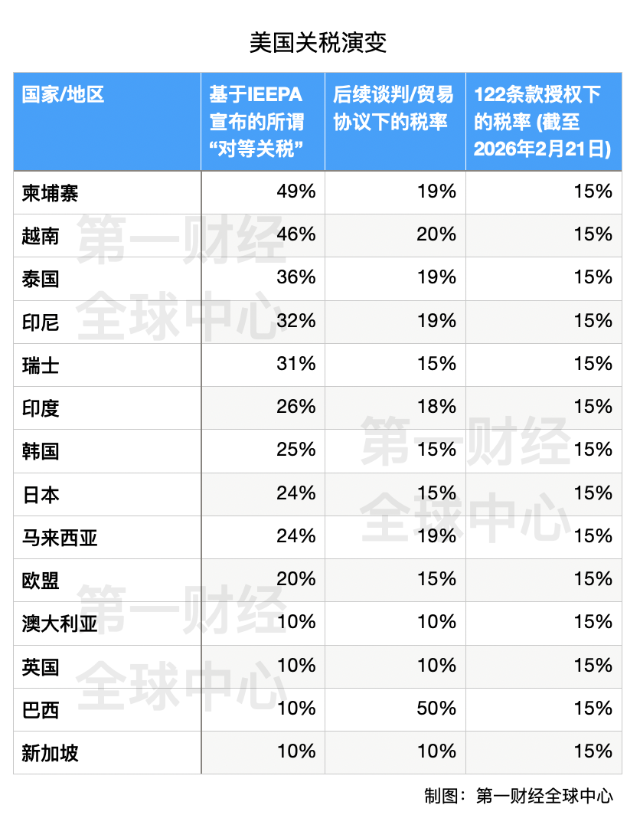
Core Viewpoint - The Trump administration is planning to increase global tariff rates from 10% to 15% or higher for certain countries and regions, causing confusion among trade partners [1][2]. Group 1: Tariff Changes - The U.S. Trade Representative, Robert Lighthizer, indicated that the White House is preparing an announcement to raise temporary tariffs to 15% where appropriate, while considering countries with existing trade agreements [1]. - The current global tariff rate is 10%, but Trump has announced intentions to raise it to 15% [2]. - The Oxford Economics Institute's simulations suggest that even with a 15% global tariff, the macroeconomic impact would be minimal, but industry-level effects would be more significant [2]. Group 2: Impact on Specific Economies - If the global tariff rate is set at 15%, countries like Bangladesh, Pakistan, Indonesia, Vietnam, and Cambodia would face lower tariffs compared to the previous 19%-20% rates [3]. - The EU estimates that the new tariff plan could impose higher tariffs on €4.2 billion (approximately $5 billion) of EU exports to the U.S., exceeding the 15% cap set by existing trade agreements [5]. Group 3: Legal and Regulatory Framework - The Trump administration's tariff measures are now being based on the Trade Act of 1974, specifically Section 122, after the Supreme Court ruled that previous measures lacked clear legal authority [2]. - The Oxford Economics Institute noted that the primary source of future U.S. tariff revenue will likely come from Section 301 tariffs, which allow investigations into foreign trade practices [6]. Group 4: Trade Agreements and Investigations - The U.S. Trade Representative plans to investigate trade practices of countries like Indonesia under Section 301, focusing on their compliance with trade agreements and potential subsidies [7]. - The flexibility in using different legal provisions for tariffs may lead to fluctuations in actual tariff rates in the second half of the year [8].

莫迪白高兴一场!刚谈妥关税优惠,特朗普转头就给印度“补刀”
Sou Hu Cai Jing· 2026-02-25 08:34
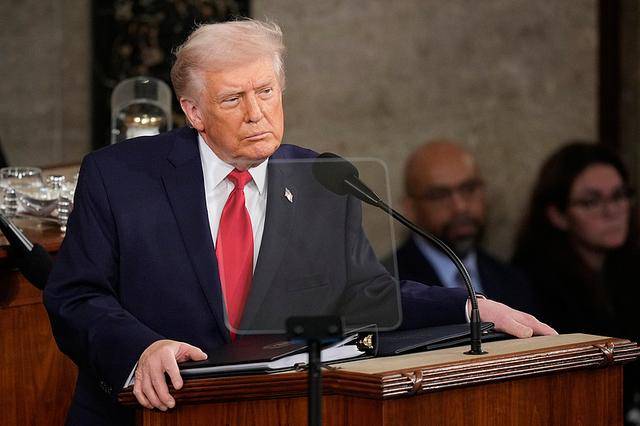
Group 1 - The core point of the news is that President Trump announced an increase in the global import tariff rate from 10% to 15% on goods imported into the U.S. This decision follows a Supreme Court ruling that deemed previous tariff actions unconstitutional [1][2] - The increase to 15% aligns closely with existing tariff levels in trade agreements with other economies, such as the EU, Japan, and South Korea, which have tariffs around 15% [2][3] - The move is seen as a strategy to reduce the incentive for other economies to increase exports to the U.S. under the previously announced 10% tariff policy [2] Group 2 - The increase in tariffs is particularly impactful for the UK, which had previously secured a 10% tariff rate in its trade agreement with the U.S. The new 15% rate will affect approximately 40,000 UK companies exporting to the U.S. [3] - For India, the situation remains uncertain as it had recently negotiated a reduction in tariffs from 50% to 18%. The U.S. government's stance on this agreement is still unclear [5] - The legal framework under which these tariffs are being imposed allows for a maximum duration of 150 days, but there is potential for Congress to authorize extensions or for the administration to repeatedly invoke the same legal provisions [6][7] Group 3 - The legal provisions being utilized, specifically Section 122 of the Trade Act of 1974, have not been used by any previous U.S. president to impose tariffs, indicating a significant shift in trade policy [6] - The Trump administration is also exploring additional legal avenues to impose tariffs, including investigations into "unfair trade practices" under Section 301 and potential tariffs based on national security concerns under Section 232 [7][8] - The upcoming 150 days are critical for the Trump administration to negotiate new trade agreements while maintaining pressure on other countries through these tariffs [7]
格林大华期货早盘提示:棉花-20260225
Ge Lin Qi Huo· 2026-02-25 02:19
Report Summary 1. Report Industry Investment Rating - Not provided in the report 2. Core View - ICE US cotton futures rose driven by tariff benefits, but the uncertainty of trade limited the increase. The main 05 contract settled at 65.56 cents, up 0.6%. Zhengzhou cotton showed a strong and volatile trend due to the expected tight supply in the new year. After the holiday, textile enterprises started work normally, and the spot market for lint cotton was expected to start the post - holiday stocking rhythm. Overall, Zhengzhou cotton broke through the previous high, and it was recommended to maintain a long - position rhythm for the 05 contract [2] 3. Summary by Relevant Catalogs 3.1 Market Conditions Review - Zhengzhou cotton's total trading volume was 617,575, and the open interest was 1,099,390. The settlement prices were 15,090 for May, 15,110 for September, and 15,515 for January. The settlement price of the ICE March contract was 63.56, up 0 points; the May contract was 65.56, up 42 points; the July contract was 67.19, up 37 points, with a trading volume of about 79,000 lots [2] 3.2 Important Information - China's cotton production, consumption, and inventory resource table for this month raised the total demand for this year by 100,000 tons to 8.78 million tons, and the ending inventory decreased to 6.31 million tons. In the new year, the expected output decreased, imports increased, and the total supply decreased; consumption remained stable, and the ending inventory further declined [2] - As of 24:00 on February 9, the national notarized inspection weight of cotton in the 2025 cotton year was 7.4646 million tons. Among them, the inspection weight of Xinjiang cotton was 7.3651 million tons, an increase of 1.0753 million tons year - on - year [2] - On February 9, the US White House issued a bilateral joint statement, stating that the US and Bangladesh officially reached a "Reciprocal Trade Agreement". The US will reduce the reciprocal tariff on Bangladeshi - origin goods from 20% set in 2025 to 19% [2] - In January, Bangladesh's clothing export value decreased by 1.35% year - on - year and increased by 11.77% month - on - month. The total clothing export value for the fiscal year decreased by 2.43% year - on - year [2] - As of the week ending February 5, the net signing of US upland cotton for this year was 52,000 tons, and the shipment was 43,000 tons. Among them, the net signing to China was - 12,000 tons, and the shipment was 2,000 tons [2] 3.3 Market Logic - ICE US cotton futures rose due to tariff benefits, but trade uncertainty limited the increase. Zhengzhou cotton was strong and volatile due to the expected tight supply in the new year. After the holiday, textile enterprises started work normally, and the spot market for lint cotton was expected to start the post - holiday stocking rhythm [2] 3.4 Trading Strategy - Maintain a long - position rhythm for the 05 contract [2]
担忧新关税波及5500亿合作,日本急电美方划红线:贸易协定不能开倒车!
Hua Er Jie Jian Wen· 2026-02-24 09:57
Core Viewpoint - Japan is urging the United States to ensure that new tariffs do not impose stricter trade conditions than those established in last year's agreement, amidst ongoing fluctuations in U.S. tariff policy [1][2]. Group 1: Tariff Policy and Trade Agreement - Japan's Minister of Economy, Trade and Industry, Hiroshi Kajiyama, communicated with U.S. Secretary of Commerce Howard Lutnick, emphasizing that Japan's trade conditions should not worsen compared to last year's agreement [1]. - The U.S. Supreme Court recently ruled that the equal tariffs imposed by the Trump administration were unconstitutional, leading to the announcement of a new 10% tariff effective immediately [1][2]. - Japan is concerned that certain products already subject to specific tariff rates under last year's agreement may face additional burdens due to the new tariffs [1][2]. Group 2: Investment Mechanism and Bilateral Cooperation - Under last year's trade agreement, Japan committed to investing $550 billion in the U.S. through a fund called the "U.S./Japan Investment Tool" in exchange for a reduction in U.S. tariffs on Japanese automobile imports from 27.5% to 15% [2]. - The Japanese government is committed to ongoing communication with the U.S. to ensure that Japan does not find itself in a more disadvantageous position due to the new tariffs [2][3]. - Both countries reaffirmed their commitment to advancing the $550 billion investment mechanism and agreed to expedite the implementation of related projects [3].
铂:受白银走强提振钯:关税扰动再起,震荡偏强
Guo Tai Jun An Qi Huo· 2026-02-24 02:23
Report Overview - The report focuses on the platinum and palladium markets, providing fundamental data, macro and industry news, and trend strength indicators [1][2][4] 1. Investment Rating - No investment rating for the industry is provided in the report 2. Core Viewpoints - Platinum is boosted by the strength of silver, while palladium is affected by tariff disturbances and shows a volatile and slightly upward trend [1][2] 3. Summary by Directory 3.1 Fundamental Data - **Platinum Prices**: The closing price of platinum futures 2606 was 523.80, down 3.87%; the price of the Shanghai Gold Exchange platinum was 525.05, down 2.96%; the New York platinum continuous contract (previous day) was 2171.40, up 4.10%; the London spot platinum (previous day) was 2151.50, up 3.44% [2] - **Palladium Prices**: The closing price of palladium futures 2606 was 416.80, down 3.08%; the price of the RMB spot palladium was 395.00, down 1.50%; the New York palladium continuous contract (previous day) was 1736.10, up 2.36%; the London spot palladium (previous day) was 1765.00, up 5.15% [2] - **Trading Volume and Open Interest**: The trading volume and open interest of platinum and palladium in different markets showed various changes compared to the previous day [2] - **ETF Holdings**: The platinum ETF holdings (ounces) (previous day) were 3267315, down 10735; the palladium ETF holdings (ounces) (previous day) were 1177427, down 1312 [2] - **Inventory**: The inventory of platinum and palladium in different markets remained mostly unchanged compared to the previous day [2] - **Price Spreads**: The price spreads between different platinum and palladium contracts and markets showed different changes compared to the previous day [2] - **Exchange Rates**: The US dollar index was 97.74, down 0.09%; the US dollar to RMB (CNY spot) was 6.91, up 0.01%; the US dollar to offshore RMB (CNH spot) was 6.90, unchanged; the US dollar to RMB (6M forward) was 6.82, unchanged [2] 3.2 Macro and Industry News - Trump will visit China from March 31 to April 2 - The EU Parliament's main party groups decided to suspend the legislation of the US - EU trade agreement due to the lack of clarity in Trump's new tariff policy - US economic data: The annual rate of the US core PCE price index in December was 3%, the highest since February 2025; the US GDP in 2025 increased by 2.2% year - on - year, the lowest level since 2021 - US - Iran relations: US and Iranian negotiators are expected to meet in Geneva on Thursday; Trump tends to launch a preliminary strike against Iran in the next few days and may launch a larger - scale attack in the next few months; some people around Trump suggest not to bomb Iran, while Senator Graham opposes this; the content of the Iran - US negotiations involves nuclear commitments, the US commitment to lift sanctions, and economic cooperation - The Hong Kong Special Administrative Region Government is fully promoting Hong Kong to become an international gold trading center, with the goal of having a gold storage of over 2000 tons in 3 years - The shortage of glass fiber has intensified, and Taiwanese manufacturers will launch a second round of price hikes - The US trade deficit in December widened, and the annual deficit reached 9015 billion US dollars, still one of the largest deficits since records began in 1960 - Trump will extend the sanctions against Russia for one year - Kōmura Sanae was confirmed as the new Prime Minister of Japan [5] 3.3 Trend Strength - The trend strength of platinum is 0, and the trend strength of palladium is 0, indicating a neutral outlook for both [4]
瑞士仍致力于与美国达成具有法律约束力的贸易协定
Xin Lang Cai Jing· 2026-02-23 11:51
Core Viewpoint - The Swiss government plans to negotiate a legally binding trade agreement with the United States to finalize a preliminary agreement reached by the end of 2025, which aims to reduce tariffs on Swiss goods from 39% to 15% [1][3]. Group 1: Trade Agreement Details - The preliminary agreement will lower U.S. tariffs on Swiss goods from 39% to 15% [1][3]. - The Swiss Federal Department of Economic Affairs emphasizes its commitment to fulfilling the agreement with the U.S. government [1][3]. Group 2: Legal Certainty and Stakeholder Involvement - The primary goal of the current negotiations is to achieve a legally binding agreement that provides maximum legal certainty for Swiss businesses [2][4]. - Major stakeholders, including Swiss cantons, have not requested to halt negotiations following the U.S. Supreme Court's ruling that overturned former President Trump's tariff policies [1][3].
一纸裁决引爆连锁反应:欧盟拟冻结对美贸易协定审批
Jin Shi Shu Ju· 2026-02-23 11:43
Core Viewpoint - The European Union is preparing to freeze the approval process for the trade agreement with the United States and is demanding more details from the Trump administration regarding its new tariff plans [1]. Group 1: Trade Agreement Status - The European Parliament's main political groups have decided to suspend the legislative approval of the trade agreement following a ruling by the U.S. Supreme Court that Trump lacks the authority to impose "reciprocal tariffs" globally [1][2]. - The largest political group in the European Parliament, the center-right European People's Party, will collaborate with the Social Democrats and the liberal Renew Europe party to support the suspension of the approval process [2]. - The chair of the Parliament's International Trade Committee, Bernd Lange, plans to hold an emergency meeting to reassess the EU-U.S. trade agreement, emphasizing the need for clarity on new tariffs before proceeding [2]. Group 2: Market Reaction - Following the news of the trade agreement suspension, European stock markets hit daily lows, with the Stoxx Europe 600 index declining by 0.4% [2]. Group 3: Tariff Implications - After the Supreme Court ruling, Trump announced a global tariff increase from 10% to 15%, raising concerns among U.S. trade partners and contributing to economic uncertainty [3]. - The previous agreement reached last summer involved a 15% tariff on most EU goods exported to the U.S., while maintaining a 50% tariff on European steel and aluminum imports to the U.S. [4]. - The approval process for the trade agreement has faced challenges, including the expansion of U.S. metal tariffs to hundreds of additional products, which has angered EU lawmakers [4].
'A deal is a deal' - European officials refuse to accept tariff chaos
Youtube· 2026-02-23 08:07
Trade Relations and Tariffs - The US trade representative confirmed that existing trade agreements with the EU will remain in place despite the Supreme Court ruling, emphasizing that tariffs will continue regardless of the litigation outcome [1][2] - The European Commission has urged the US for clarity on future tariff policies, stating that the EU expects the US to honor its commitments and will not accept any increases in tariffs beyond previously agreed levels [3] - European Parliament lawmakers are considering pausing legislative work until clear commitments from the US are secured, highlighting the need for clarity in trade relationships [4] Industry Reactions - The German industry has expressed a mixed reaction, acknowledging the political checks and balances in the US while also noting that uncertainty could hinder investment and supply chain decisions [6][7] - The automotive and chemical industries in Germany are facing unchanged sectoral tariffs of 15%, which are not affected by the recent court ruling [8] - The French trade minister has suggested that the EU should adopt a united approach against the US's new tariffs, indicating a potential for retaliatory measures [10] Market Impact - Following the Supreme Court ruling, the French stock market index, CAC 40, reached a record high, driven by gains in luxury stocks, which are significantly exposed to exports [11][12] - Key export sectors for France, such as aerospace, currently remain unaffected by tariff changes, maintaining a 0% tariff exemption [12] - The French government is focused on adapting to the ruling's consequences while emphasizing the importance of maintaining fair trade rules and reciprocity [13][14]

关税裁决激起避险潮:贸易协定陷入“一团糟”,黄金一度破5170美元关口
智通财经网· 2026-02-23 02:04
Group 1: Gold Market - The U.S. Supreme Court's limitation on President Trump's tariff powers has created uncertainty in trade agreements, leading to a rise in gold prices, which increased by 1.3% to over $5,170 per ounce [1] - Following the Supreme Court ruling, the dollar weakened, making gold cheaper for many buyers, contributing to its recovery from a recent decline [1] - Gold prices have risen for three consecutive weeks due to ongoing geopolitical tensions and investor caution regarding sovereign debt and currencies [1] Group 2: Oil Market - The prospects of U.S.-Iran nuclear negotiations are impacting the oil market, with Brent crude prices approaching $71 per barrel, despite concerns over potential military actions by the U.S. against Iran [2] - Iranian Foreign Minister Abbas Araghchi indicated a diplomatic solution is possible, with upcoming negotiations in Geneva [2] - Market participants are hedging against potential supply disruptions due to U.S.-Iran tensions, leading to increased trading activity in futures and options markets [2] Group 3: Regional Oil Production - Saudi Arabia, Iraq, and Kuwait transport oil through the Strait of Hormuz, with Iran producing over 3 million barrels of oil daily, accounting for about 3% of global output [3] - Despite concerns over escalating Middle Eastern hostilities, the Brent crude spot price spread has narrowed, indicating a change in market sentiment [3] - Monitoring time spreads and OPEC discipline is crucial, as tightening in the refined oil market could signal real supply issues [3]