
杭州白贝壳实业股份有限公司

Search documents
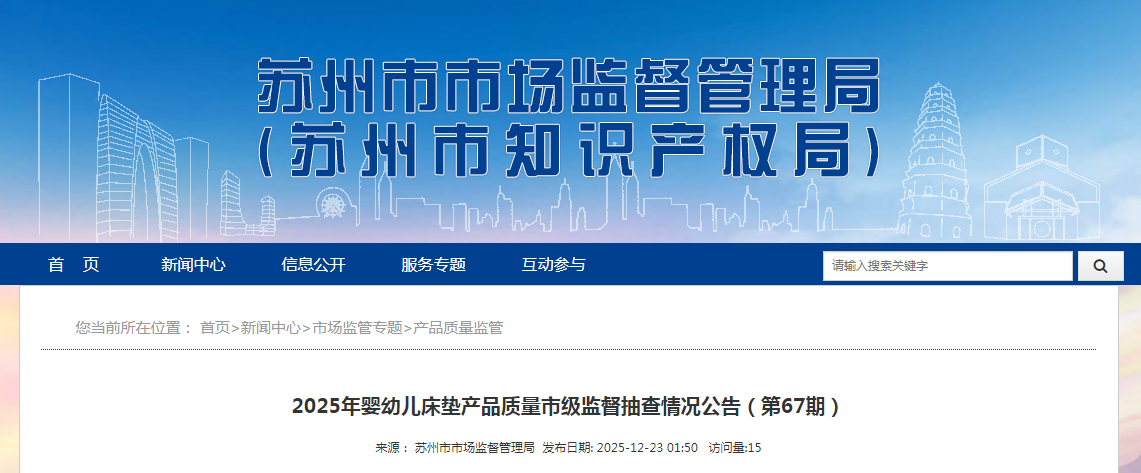
苏州市市场监督管理局发布2025年婴幼儿床垫产品质量市级监督抽查情况公告(第67期)
Zhong Guo Zhi Liang Xin Wen Wang· 2025-12-25 06:57
Group 1 - The core finding of the quality supervision check for infant mattresses in Suzhou is that all 10 batches tested were found to be compliant, resulting in a non-conformity rate of 0% [3][4] - The supervision check was conducted by the Suzhou Market Supervision Administration, which commissioned the Suzhou Product Quality Inspection Institute to carry out the assessment [3] - The check included 9 batches from physical stores and 1 batch from an e-commerce platform, indicating a comprehensive approach to quality assurance across different sales channels [3][4] Group 2 - The report lists various brands and specifications of the tested infant mattresses, including products from companies like 宁波和氏贝婴童用品有限公司 and 好孩子儿童用品有限公司 [4] - The tested products varied in size and type, including options like coconut fiber mattresses and latex mattresses, showcasing a diverse market offering [4] - The testing dates for the products ranged from April 2025 to October 2025, indicating a forward-looking approach in quality assessment [4]

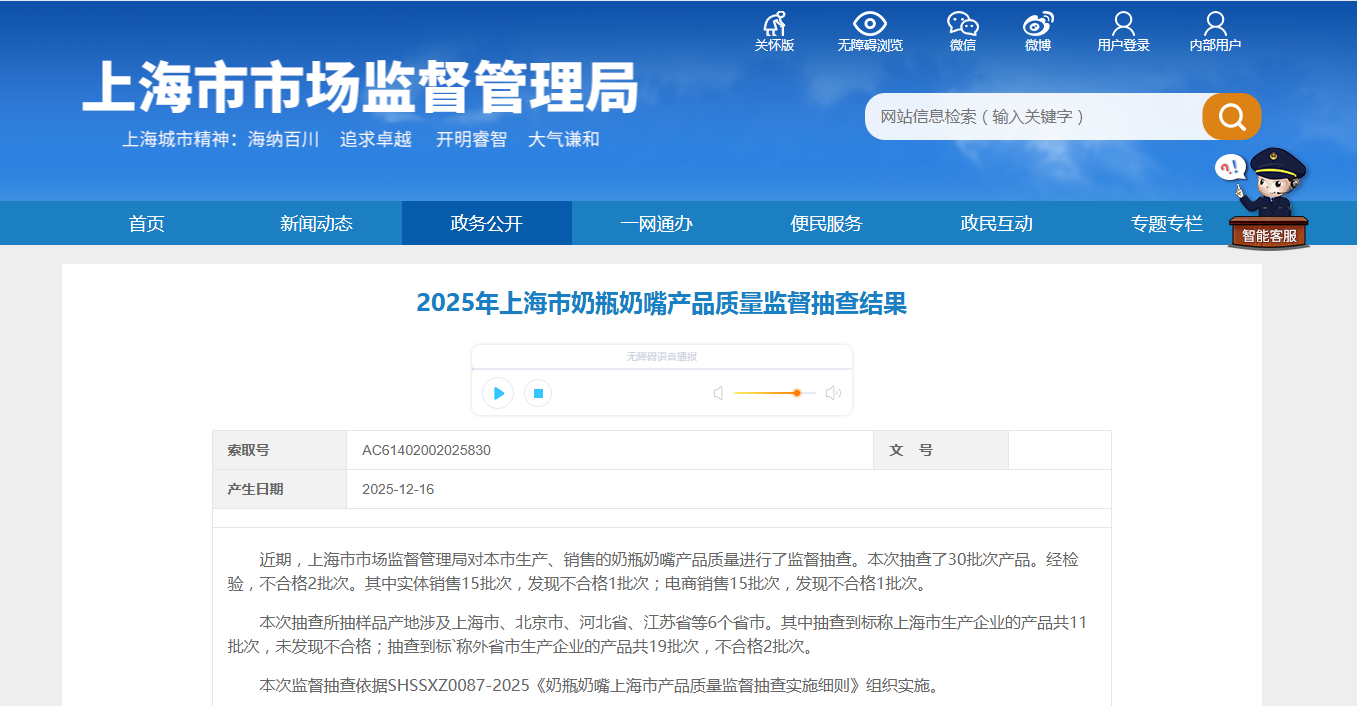
2025年上海市奶瓶奶嘴产品质量监督抽查结果公布
Zhong Guo Zhi Liang Xin Wen Wang· 2025-12-17 07:18
Core Insights - The Shanghai Municipal Market Supervision Administration conducted a quality inspection of baby bottles and nipples, revealing that out of 30 batches tested, 2 were found to be non-compliant with standards [3][4]. Group 1: Inspection Results - The inspection covered products from six provinces and cities, with 11 batches produced in Shanghai passing the quality check, while 19 batches from other regions included 2 non-compliant products [4]. - The non-compliant products were identified in both physical retail (1 out of 15 batches) and e-commerce (1 out of 15 batches) sales [3]. Group 2: Non-compliance Details - The non-compliance issues were related to labeling and small parts, with specific failures including the absence of safety warnings for products containing small detachable components [8][9]. - The standards referenced include GB 38995-2020, which outlines requirements for labeling and safety warnings for baby bottles and nipples [8][9]. Group 3: Consumer Guidance - Consumers are advised to prioritize safety and compatibility when selecting baby bottles and nipples, focusing on materials that are safe for food contact and suitable for the baby's age [11][12]. - It is recommended to check for product qualifications, including manufacturer information and compliance with relevant standards, to avoid purchasing unregulated products [13].
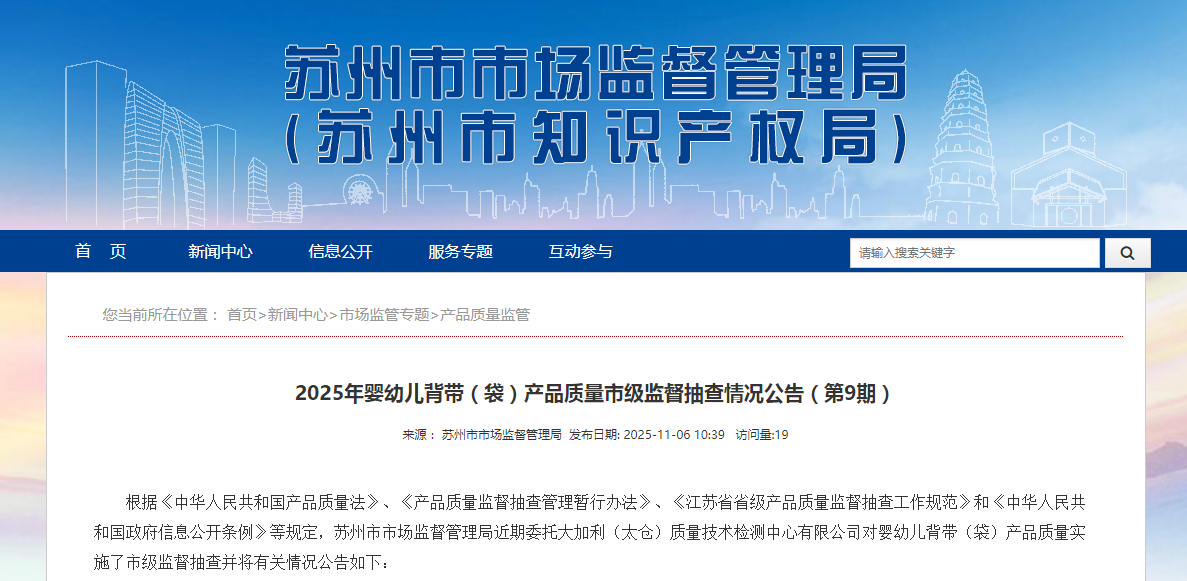
江苏省苏州市市场监管局发布2025年婴幼儿背带(袋)产品质量市级监督抽查情况公告(第9期)
Zhong Guo Zhi Liang Xin Wen Wang· 2025-11-07 08:16
Core Insights - The announcement from Suzhou's market supervision bureau highlights the results of a quality inspection on infant carriers, indicating a significant focus on product safety and compliance with national standards [3][6][7]. Product Overview and Industry Distribution - Infant carriers are essential products for modern parenting, designed with ergonomic features to support the development of infants aged 0-36 months while alleviating the burden on caregivers [3][4]. - The market for infant carriers is diverse, with various designs catering to different carrying positions and stages of infant growth. The industry is expected to see a rapid differentiation among brands, with national and regional brands leading the market [4]. - The infant carrier industry in China has established a comprehensive distribution network centered around the Yangtze River Delta and Pearl River Delta, with Guangdong accounting for 43% of national production capacity [5]. Inspection Basis and Key Projects - The quality inspection was based on several national standards, including GB31701-2015 and GB/T35270-2017, focusing on critical safety parameters such as fiber content, pH value, and the presence of harmful substances [6][7]. Inspection Results - A total of 9 batches were inspected, with 1 batch from manufacturers passing without issues, while 1 out of 6 batches from physical stores and 1 out of 2 batches from e-commerce platforms failed quality tests, resulting in non-compliance rates of 16.7% and 50.0%, respectively [7][9]. - The non-compliance issues primarily involved fiber content and pH value, with potential causes linked to inadequate quality control measures and a lack of awareness regarding product safety among manufacturers [10][11]. Consumer Guidance - Consumers are advised to select appropriate styles based on the infant's age and weight, prioritize safety by choosing reputable brands, and ensure compatibility with the infant's size to avoid discomfort [12][13].
研判2025!中国儿童地垫行业市场政策、产业链、发展现状、竞争格局及发展趋势分析:居民家庭消费占比最大[图]
Chan Ye Xin Xi Wang· 2025-05-28 01:44
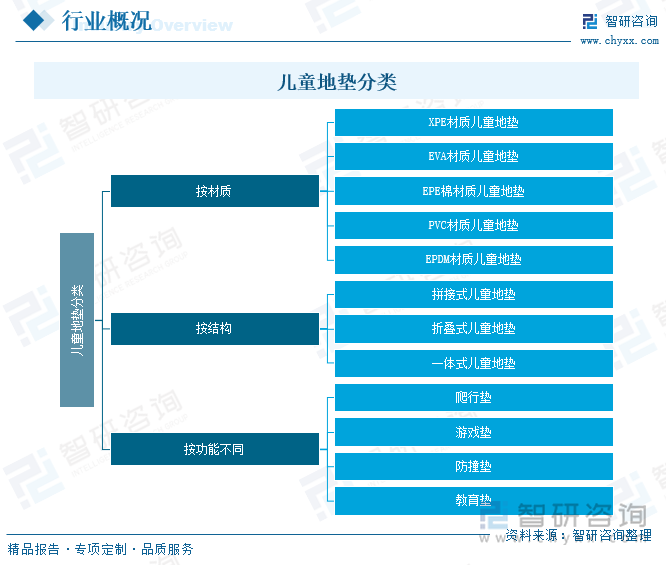
Overview - The demand for children's mats in China is increasing due to rising national income levels and parents' growing emphasis on safety and health in children's activity environments. The market for children's mats is projected to reach a demand of 11,891.3 million square meters and a market size of 2.13 billion yuan by 2024 [1][11]. Market Policies - The Chinese government has implemented various policies to support the development of the children's products market, including children's mats. Key policies include the "14th Five-Year Plan for National Health" and the "Guidelines for Promoting High-Quality Development of Light Industry," which create a favorable environment for the industry [4][6]. Industry Chain - The children's mat industry consists of upstream suppliers of raw materials (EVA, PE, PVC, rubber, etc.), midstream manufacturers, and downstream consumers, including families and educational institutions. The family segment accounts for over 60% of the market [7][9]. Development Status - The market for children's mats is experiencing significant growth, driven by parents' increasing focus on safety and comfort. Educational institutions are also prioritizing high-quality environments for children, leading to a notable rise in demand for safe and aesthetically pleasing mats [1][11]. Competitive Landscape - The children's mat industry in China is characterized by a fragmented market with many small players. Major companies include Zhejiang Runyang New Materials Technology Co., Ltd., Suzhou Hengruida Household Mat Co., Ltd., and Goodbaby International [12][14]. Company Analysis - Zhejiang Runyang New Materials Technology Co., Ltd. focuses on eco-friendly foam materials and has a modern factory covering over 200,000 square meters. The company reported a revenue of 407 million yuan and a gross profit of 84 million yuan in 2024 [14]. - Suzhou Hengruida Household Mat Co., Ltd. is a leading manufacturer of EVA foam mats, equipped with advanced production facilities and certifications, and exports products to various countries [16]. Development Trends - Future demand for children's mats is expected to shift towards high-end functional products with features like antibacterial properties and smart monitoring. It is anticipated that such products will account for nearly 60% of the market within the next five years, with a growing emphasis on environmentally friendly materials [18].


2025年婴儿床品牌推荐:安全焦虑和价格内卷下的品牌突围之道
Tou Bao Yan Jiu Yuan· 2025-05-20 12:15
Investment Rating - The report does not explicitly provide an investment rating for the baby crib industry Core Insights - The baby crib industry is experiencing growth driven by rising consumer awareness of safety and quality, despite a decline in newborn numbers impacting demand [5][8] - The market is expected to recover with a projected increase in newborns due to policy incentives, leading to a gradual market size growth from 5.58 billion to 6.78 billion by 2029 [8] - The industry is shifting towards smart, eco-friendly, and high-quality products to meet evolving consumer demands [5][31] Market Background - The baby crib industry is a significant part of the global baby products market, influenced by consumer upgrades and safety awareness [5] - The market has evolved from traditional wooden cribs to modern smart cribs, with a focus on diverse and high-end designs [5][7] - China is a major production base for baby cribs, benefiting from a complete supply chain and lower production costs [5] Market Status - The market size decreased from 6.41 billion in 2019 to 4.8 billion in 2023 due to declining newborn numbers, but is expected to stabilize and grow in the coming years [8] - The average price range for baby cribs is between 300 to 5000 yuan, with a gross margin of 40%-50% for midstream manufacturers [9] Market Competition - The competition in the baby crib market is fragmented, with leading brands like Goodbaby and Cool Baby holding significant market shares [11][17] - The evaluation of brands is based on innovation, product quality, brand image, and customer service [11][14] - The report highlights ten recommended brands, emphasizing their unique selling propositions and market strategies [18][19][21] Development Trends - The market is expected to expand due to structural growth driven by consumption upgrades and policy support [30] - Technological advancements are leading to the introduction of smart features in baby cribs, enhancing safety and user experience [31] - The integration of online and offline channels is reshaping consumer engagement, with a notable increase in online sales [33]