奶嘴

Search documents
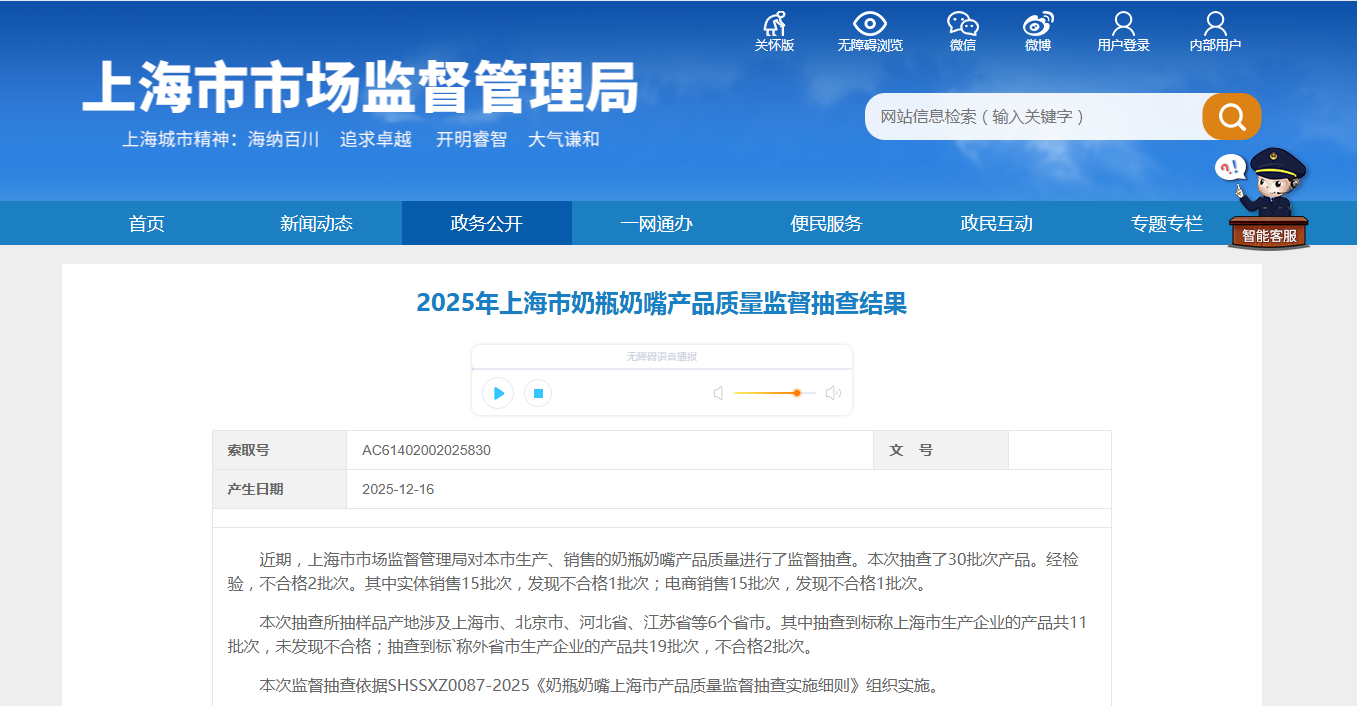
2025年上海市奶瓶奶嘴产品质量监督抽查结果公布
Zhong Guo Zhi Liang Xin Wen Wang· 2025-12-17 07:18
Core Insights - The Shanghai Municipal Market Supervision Administration conducted a quality inspection of baby bottles and nipples, revealing that out of 30 batches tested, 2 were found to be non-compliant with standards [3][4]. Group 1: Inspection Results - The inspection covered products from six provinces and cities, with 11 batches produced in Shanghai passing the quality check, while 19 batches from other regions included 2 non-compliant products [4]. - The non-compliant products were identified in both physical retail (1 out of 15 batches) and e-commerce (1 out of 15 batches) sales [3]. Group 2: Non-compliance Details - The non-compliance issues were related to labeling and small parts, with specific failures including the absence of safety warnings for products containing small detachable components [8][9]. - The standards referenced include GB 38995-2020, which outlines requirements for labeling and safety warnings for baby bottles and nipples [8][9]. Group 3: Consumer Guidance - Consumers are advised to prioritize safety and compatibility when selecting baby bottles and nipples, focusing on materials that are safe for food contact and suitable for the baby's age [11][12]. - It is recommended to check for product qualifications, including manufacturer information and compliance with relevant standards, to avoid purchasing unregulated products [13].

2025年中国消费型育儿产品行业市场深度分析及投资战略咨询报告
Sou Hu Cai Jing· 2025-09-26 08:11
Group 1 - The core viewpoint of the article highlights the significant growth of the consumption-oriented parenting products market in China, driven by the "three-child policy" and consumption upgrades, with the market size expected to reach 87.2 billion yuan in 2024 [1][12] - Consumption-oriented parenting products are characterized by their consumable nature, high-frequency usage, and the need for regular replenishment or updates, distinguishing them from durable parenting products [5][6] - The industry chain of consumption-oriented parenting products includes upstream raw material supply, midstream production and brand operation, and downstream sales and distribution, with each segment closely interconnected [8][9] Group 2 - The competitive landscape of the consumption-oriented parenting products industry is intense, with international brands like Huggies and Pampers historically holding significant market shares, but local brands such as Babycare are rapidly gaining ground due to their cost-effectiveness and understanding of the local market [2] - The market structure for consumption-oriented parenting products in 2024 shows that baby care products dominate with a 76.6% share, followed by bedding products at 12.2% and feeding products at 11.2% [14][15] - The report utilizes various analytical models such as SCP, SWOT, PEST, and regression analysis to comprehensively assess the market environment, industry policies, competitive landscape, technological innovations, and market risks [2]