
Air China

Search documents
Global Markets Digest German Recovery Signs, Mixed China Data, and Shifting US Tech Policy
Stock Market News· 2026-02-13 09:38
Economic Outlook - The German Economy Ministry reports increasing signs of stability in the economic recovery, with indicators suggesting continued improvement at the start of 2026 [2][3] - China's January aggregate financing reached CNY 7.22 trillion, exceeding the estimated CNY 7.085 trillion, while the M2 money supply grew by 9.0% year-over-year, surpassing the expected 8.3% [4] - However, new yuan loans for January were CNY 4.71 trillion, falling short of the CNY 5.00 trillion forecast, indicating potential caution among businesses and consumers [5] Corporate Performance - L'Oréal's CEO stated that 2026 is "off to a strong start" in key markets such as the United States and mainland China [6] - Air China reported a 3% increase in passenger traffic for January, reflecting positive trends in the travel sector [6] - The technology and communication services sectors are leading this earnings season with beat rates of 95% and 100%, while healthcare and consumer discretionary sectors are struggling with negative blended growth [7] Geopolitical Developments - The Trump administration has paused planned bans on certain Chinese technology firms, which may ease immediate pressures on the tech supply chain [8] - In the UK, Labour leader Keir Starmer's team has shifted focus to a 20/80 split between foreign and domestic policy to address economic challenges [9]


中国新兴领域-旅游行业焕发新活力-China's Emerging Frontiers-China's Travel Turning Up the Joy Dial
2026-02-10 03:24
Summary of Key Points from the Conference Call Industry Overview - **Industry**: China's Travel and Tourism - **Focus**: The call discusses the growth potential of the travel and tourism sector in China, emphasizing the recovery and expansion of domestic and inbound tourism as key drivers of economic growth. Core Insights and Arguments 1. **Tourism Revenue Growth**: - China's tourism revenue is projected to reach Rmb12 trillion by 2030, growing at a CAGR of 11% from Rmb7.2 trillion in 2025, with cumulative revenue expected to hit Rmb50 trillion over the next five years [2][15][49]. - Domestic tourism spending is anticipated to account for 18% of per capita consumption by 2030, up from 13% in 2023 [2][16]. 2. **Economic Contribution**: - The tourism sector's contribution to GDP is expected to increase to 6.7% by 2030, compared to 4.8% in 2024, indicating a significant recovery to pre-COVID levels [12][49]. 3. **Demand Drivers**: - Five key growth tailwinds are identified: macroeconomic rebalancing towards service consumption, sustained efforts to attract global tourists, Rmb appreciation supporting outbound travel, policy initiatives targeting youth and elderly demographics, and technological innovations enhancing travel experiences [3][25]. 4. **Tourist Mix Improvement**: - There is an expected improvement in the mix of tourists, with a higher percentage of non-domestic and business travelers, which is likely to enhance monetization for airlines and hotels [4]. 5. **Airlines and Hotels Outlook**: - Airlines are expected to experience stronger pricing power, with load factors at all-time highs, while hotel RevPAR has turned positive after a two-year decline, with earnings projected to rise by 10-25% YoY [11][44][46]. 6. **Inbound and Outbound Travel**: - Inbound tourism is projected to contribute 16% of China's tourism revenue by 2030, up from 12% in 2025, with robust growth in inbound visitation observed [17][99]. - Outbound travel is also crucial, contributing 25-30% of total passenger revenue for airlines, with a significant portion being Chinese outbound travelers [105]. Additional Important Insights 1. **Policy Support**: - The Chinese government has introduced various policies to stimulate travel, including extending public holidays and promoting cultural events, which have led to a surge in travel activity [90][96]. 2. **Demographic Trends**: - The aging population and youth demographics are seen as potential growth drivers for travel demand, with targeted products and services designed to cater to these groups [53][66]. 3. **Technological Innovations**: - The application of digital technologies in tourism is expected to enhance customer experiences and increase spending, with innovations such as AR/VR and IoT-enabled services [40][41]. 4. **Event-Driven Travel**: - The rise of large-scale entertainment events, such as concerts and festivals, has significantly boosted travel demand, with a notable increase in audience participation [22][97]. 5. **Visa Policies**: - New visa-free policies have been introduced to facilitate inbound tourism, contributing to the growth of international visitors [20][21]. 6. **Market Dynamics**: - The supply side for airlines and hotels is tightening, with capacity growth expected to remain low, which could lead to better pricing and profitability in the sector [4][44]. This summary encapsulates the key points discussed in the conference call, highlighting the optimistic outlook for China's travel and tourism industry, driven by various economic, demographic, and policy factors.
中国交通运输 2026 展望:看好航空与油轮,转空集装箱-China Transportation_ 2026 Outlook_ Staying positive on Airlines and Tankers; Turning bearish on Containers
2025-12-19 03:13
Summary of Key Points from the Conference Call Industry Overview - **Industry Focus**: The analysis covers the transportation sector in China, specifically airlines, tankers, and container shipping, with a positive outlook on airlines and tankers while turning bearish on container shipping [1][8][10]. Airlines - **Positive Outlook**: Airlines are expected to benefit from higher international demand and supply constraints, leading to above-cycle Return on Equity (ROE) of 22% in 2027 [1]. - **Earnings Forecast**: The net demand forecast for airlines has been raised to 1.6% and 1.3% for 2026 and 2027, respectively, leading to an earnings upgrade for 2027. However, earnings for 2026 have been cut due to the negative impact from China-Japan flight cancellations [1][10]. - **Key Picks**: Air China-H and CEA-A are highlighted as key investment picks due to their price outperformance [1]. Tanker Shipping - **Optimistic Projections**: The crude tanker sector is expected to see further spot rate hikes amid a continuous upcycle in 2026, driven by faster crude stockpiling in China [2][10]. - **Average TCE Rates**: The average Time Charter Equivalent (TCE) for Very Large Crude Carriers (VLCC) is forecasted to rise to $75, up from $56 in 2025 [1]. - **Supply Dynamics**: Supply growth is expected to be limited to 1% in 2026, with a lower effective supply growth forecast due to the exit of sanctioned capacity and increased storage use [2][10]. Container Shipping - **Bearish Stance**: The outlook for container shipping has turned bearish due to higher-than-expected new ship orders, which have driven the order book to 33% of current capacity. This is expected to lead to a deeper and longer downcycle [3][10]. - **Demand Decline**: There is a shrinking demand on the Transpacific route, exacerbated by declining US imports, which poses further downside risks [3]. Shipbuilding - **Continued Upcycle**: The shipbuilding sector is expected to benefit from limited supply growth, with a slight decline in new ship prices anticipated in the medium term due to a drop in new orders [22][10]. - **Long-term Outlook**: The order book coverage is expected to remain above 2.5x until 2032, indicating sustained demand for shipbuilding despite short-term fluctuations [22][24]. Ports and Exports - **Resilient Exports**: China's resilient export growth is projected at 5-6% per year, benefiting port operators and shipyards [11][10]. - **Port Operators**: Chinese port operators are expected to benefit from this resilient export growth, while shipyards may regain market share due to competitive pricing and cost advantages [11]. Key Investment Recommendations - **Buy Recommendations**: Air China, China Eastern Airlines, COSCO Shipping Energy, and COSCO Ports are recommended for purchase [9][10]. - **Sell Recommendations**: COSCO Shipping Holdings, Eastern Air Logistics, and Shanghai Airport are recommended for sale due to bearish outlooks [9][10]. Additional Insights - **Market Dynamics**: The analysis highlights the impact of supply constraints and lower oil prices on the transportation sector, with airlines and tankers positioned favorably compared to container shipping [8][10]. - **Scenario Analysis**: Potential scenarios regarding the reopening of the Red Sea and its impact on container shipping and tankers are discussed, indicating mixed outcomes for tankers and significant negative impacts for container shipping [12][10]. This comprehensive analysis provides a detailed overview of the current state and future outlook of the transportation sector in China, highlighting key investment opportunities and risks.
Qatar Airways to sell its holdings in Hong Kong's Cathay Pacific for $896 million
Yahoo Finance· 2025-11-06 07:09
Core Viewpoint - Qatar Airways is divesting its 9.57% stake in Cathay Pacific Airways through a share buyback valued at $896 million, marking the end of its eight-year involvement with the airline [1][2]. Group 1: Transaction Details - Qatar Airways will sell all of its holdings in Cathay Pacific, which represents 9.57% of the airline's stock [2]. - The buyback plan is subject to shareholder approval [2]. - Cathay Pacific's shares increased by 4.2% on the Hong Kong Stock Exchange following the announcement [1]. Group 2: Strategic Implications - The sale reflects Cathay Pacific's commitment to portfolio management and long-term growth, as stated by its CEO Badr Mohammed al-Meer [3]. - Analysts suggest that Qatar Airways' decision to divest is influenced by its limited strategic influence due to its minority stake [4]. - The transaction consolidates ownership among Cathay's key shareholders, Swire Pacific and Air China, enhancing their strategic control over the airline [4]. Group 3: Historical Context - Qatar Airways acquired its stake in Cathay Pacific in 2017 for approximately $662 million during a period when Cathay was facing financial difficulties [5]. - Cathay Pacific reported a profit of $1.2 billion in the last fiscal year, indicating a significant turnaround from its previous losses [5].
Several aviation incidents spark investigations
NBC News· 2025-10-21 00:15
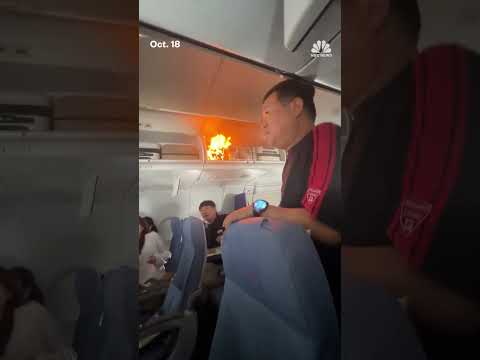
From an onboard fire to a plane crash and shattered cockpit windscreen, a busy Monday for aviation investigators in Hong Kong. An Emirates Air 747 cargo plane arriving from Dubai lost control after landing, crashing through a fence and striking a security vehicle before sliding into the sea. All four air crew members rescued, but two people in the car were killed.Meanwhile, over China, fire and smoke poured from an overhead bin after Air China says a lithium ion battery spontaneously ignited during a flight ...

Lithium battery catches fire during Air China flight
NBC News· 2025-10-18 16:33
An Air China flight made an emergency landing in Shanghai, the airline said, after a lithium battery in a passenger’s carry-on bag spontaneously ignited. No injuries were reported. For more context and news coverage of the most important stories of our day, click here: https://www.nbcnews.com » Subscribe to NBC News: http://nbcnews.to/SubscribeToNBC » Watch more NBC video: http://bit.ly/MoreNBCNews NBC News Digital is a collection of innovative and powerful news brands that deliver compelling, diverse and e ...
中国新兴领域 - 入境旅游增长,谁将受益-China's Emerging Frontiers-Growth in Inbound Tourism Who Stands To Benefit
2025-10-16 01:48
Summary of Key Points from the Conference Call on China's Inbound Tourism Industry Overview - The focus is on China's tourism industry, particularly the growth potential of inbound tourism, which is currently dominated by domestic and outbound demand but is expected to become a significant earnings driver in the next three years [1][4][63]. Core Insights and Arguments - **Inbound Tourism Growth**: Inbound tourism is projected to increase from 11% of China's tourism revenue to 18% within five years, with hotels expected to see the highest revenue exposure, reaching over 20% on average by 2030 [4][77]. - **Service Exports Performance**: China's service exports grew by 14% in the first eight months of 2025, with tourism service exports surging by 56% year-on-year, recovering to 150% of pre-COVID levels [3][39]. - **Infrastructure and Policy Support**: Investments in infrastructure, clean energy, and cultural experiences are enhancing the attractiveness of China as a leisure travel destination. The introduction of the K1 visa aims to attract young talent, further boosting business travel [2][19]. - **Market Dynamics**: The report highlights that low-tier cities are becoming increasingly attractive for inbound tourists, with cities like Hangzhou showing robust growth in inbound tourist numbers [3][4]. Financial Projections - **Revenue Exposure**: Hotels are expected to have the highest revenue exposure to inbound tourism, while OTAs, airlines, and duty-free sectors are projected to see 5-10% revenue exposure in five years [4][78]. - **Earnings Growth**: The report anticipates a 19% compound annual growth rate (CAGR) in inbound tourism spending in USD terms over the next decade, driven by increased visitation and longer stays [39][84]. Key Beneficiaries - **Top Stock Picks**: The report identifies ten stocks that could benefit from the growth in inbound tourism, with Trip.com (TCOM.O) ranked as the most attractive, followed by Air China (0753.HK), Shanghai Airport (600009.SS), and CTG Duty-Free (1880.HK) [5][11][70]. - **Segment Analysis**: OTAs are seen as key enablers for inbound tourism, with Trip.com positioned to benefit significantly due to its international operations [57][90]. Additional Insights - **Healthcare and Shopping**: The inbound healthcare sector is expanding, with significant demand for premium medical services. The retail sector is also experiencing growth, driven by rising consumer demand for premium goods and duty-free shopping [61][60]. - **Government Initiatives**: Recent government measures aim to support service consumption, with inbound travel identified as a key growth driver for the economy [12][25]. - **Challenges and Opportunities**: Despite trade frictions, China's economic ties with emerging markets are strengthening, presenting growth opportunities for inbound travel [25][30]. Conclusion - The outlook for China's inbound tourism is positive, with significant growth expected in the coming years. Key sectors such as hotels, OTAs, and airlines are poised to benefit from this trend, supported by government initiatives and changing consumer preferences.
中国旅游与休闲 - 专家电话会议要-旅游需求健康。在线旅游竞争温和,但酒店每间可售房收入压力可能持续-China Travel & Leisure_ Expert call takeaways_ Healthy travel demand. OTA competition benign, but hotel RevPar pressure may persist
2025-10-16 01:48
Summary of Key Points from the Travel & Leisure Industry Expert Call Industry Overview - The travel industry in China is experiencing healthy demand, particularly during the recent Golden Week holidays, with notable activity in both first-tier and lower-tier cities [1][3] - The hotel industry is seeing positive trends in Average Daily Rate (ADR) and Revenue Per Available Room (RevPar), with increases in the mid to high-single digits during the holidays [1][3] Core Insights - **Travel Demand**: Overall travel demand remains robust, with significant participation from families in lower-tier cities during the Mid-Autumn Festival [3] - **Hotel Performance**: Average occupancy rates for Jinjiang's hotels in tier-3 and below cities reached 91.7%, indicating strong performance in these areas [3] - **Supply Growth**: There is ongoing pressure on hotel RevPar due to continued supply growth, particularly from franchisees in the mid-to-upscale segments [1][9] - **OTA Competition**: The competition among Online Travel Agencies (OTAs) is described as benign, with smaller operators struggling to compete against larger players like TCOM, which holds a ~55% market share in hotel bookings [9] Recommendations - **Preferred Stocks**: The report recommends investments in hotel stocks such as H World and Atour, anticipating better RevPar trends due to reduced competition and slower supply growth [2] - **Macau Market**: Stocks like Sands China and Galaxy are favored due to expected benefits from wealth effects and low base comparisons for Gross Gaming Revenue (GGR) until the end of Q1 2026 [2] - **Air Travel**: Buy ratings are also given to TCOM and Air China, which are expected to benefit from an increase in long-haul outbound travel and rising airfares [2] Additional Insights - **Market Dynamics**: The expert noted a shift in outbound travel preferences from "tick-box travel" to more personalized small-group experiences, typically involving 9-12 people [8] - **Future Outlook**: The expert does not foresee the typical seasonal decline in travel demand post-Labor Day, attributing this to a modest recovery in business travel since September [8] - **OTA Market Share**: Fliggy has seen significant growth in market share, particularly in outbound travel, with a 48% increase in GMV and a 78% increase in domestic hotel room nights year-over-year during the Golden Week [9] Conclusion - The travel and leisure industry in China is poised for continued growth, supported by healthy demand and evolving consumer preferences. Investment opportunities exist in hotel stocks and OTAs, particularly those that can adapt to changing market dynamics and consumer behaviors [1][2][9]
X @Wendy O
Wendy O· 2025-09-04 22:00
Partnerships & Expansion - Webus International ($WETO) partners with Air China to offer services to over 60 million PhoenixMiles members [1] Cryptocurrency & Blockchain Integration - Webus plans to integrate XRP and RLUSD payments into its Wetour platform [1] - The integration aims to enable faster settlements, tokenized rewards, and blockchain-enabled vouchers linked to loyalty benefits [1] - The integration is pending regulatory approval [1] Company Strategy - Webus International recently launched an XRP treasury strategy [1]
中国新兴前沿 -入境旅游:正在展开的故事-China’s Emerging Frontiers-Inbound Travel The Unfolding Story
2025-08-20 04:51
Summary of Key Points from the Conference Call Industry Overview - **Industry**: Inbound Travel in China - **Growth Potential**: Inbound visitation is projected to generate US$2-4 trillion in cumulative revenue over the next decade, despite uncertainties in domestic demand and trade frictions [1][3][4]. Core Insights - **Tourism Service Exports**: China's tourism service exports grew by 67% year-over-year (YoY) in the first half of 2025, significantly outpacing the 14% growth in total service exports and 6% in product exports [2][39]. - **GDP Contribution**: Inbound tourism receipts contributed 0.5% to China's GDP in 2024, up from 0.3% in 2023, but still below the ~1% level seen before COVID-19 [2]. - **Visitor Growth Factors**: Key drivers for increased inbound tourism include longer stays, a higher percentage of foreign visitors compared to those from Hong Kong and Macau, and a potential rise in business travelers [3][4]. Airline Industry Insights - **Airlines' Performance**: In the first half of 2025, international routes accounted for over 60% of the increase in China's air passenger turnover compared to the same period in 2024 [5][31]. - **Pricing Power Challenges**: Domestic demand remains depressed, delaying the expected pricing power inflection for airlines. The current high utilization rates have not translated into higher pricing elasticity [5][32][36]. - **Sustainability Concerns**: The aggressive expansion into international routes by Chinese airlines is viewed as unsustainable without generating profits, necessitating "anti-involution" efforts to avoid deflationary pressures [5][33][34]. Visitor Demographics and Trends - **Visitor Recovery**: Foreign visitation in Beijing has recovered to 90% of pre-COVID levels, with a 120% recovery for foreign tourists overall [12][61]. - **Visa-Free Entries**: Over 70% of foreign visitors entered China visa-free in 2Q25, a significant increase from approximately 50% before the relaxation of visa requirements [57][75]. Economic and Policy Factors - **Shopping as a Growth Driver**: China's potential as a shopping destination is highlighted, driven by global trade barriers and inflation pressures, making Chinese consumer goods more attractive [28][29]. - **Government Initiatives**: The Chinese government has implemented several policies to facilitate inbound travel, including visa relaxations, improved payment systems, and enhanced digital services for tourists [18][29][83]. Revenue Forecast Adjustments - **Revenue Growth Projections**: The base case for 10-year cumulative revenue remains largely unchanged, while the bull case is adjusted down by 6% compared to previous estimates [21][96]. - **CAGR Expectations**: A 19% compound annual growth rate (CAGR) for inbound revenue is deemed achievable, supported by factors such as increased visitor spending and longer stays [24][98]. Conclusion - **Outlook**: The inbound travel sector in China is positioned for significant growth, driven by favorable government policies, increased international connectivity, and evolving consumer preferences. However, challenges remain in the airline industry and overall economic conditions that could impact recovery and growth trajectories.