Chery Group

Search documents
Navigating 50% tariffs: strategic options for Chinese automakers in Mexico
Yahoo Finance· 2026-01-28 13:21
Group 1: Tariff Changes and Impact - Mexico will raise tariffs on Light Vehicles (LVs) from 20% to 50% starting January 2026, affecting countries without a Free Trade Agreement (FTA) [1] - The most significant impact is expected on Chinese and Indian vehicle manufacturers, as sales of Chinese-made vehicles in Mexico have rapidly increased, accounting for 25.4% of total sales in 2025, up 4.6 percentage points from 2023 [2] - The tariff increase poses a challenge for Chinese OEMs, particularly in the Electric Vehicle (EV) segment, where affordability has been their main competitive advantage [3] Group 2: Affected Companies and Strategies - Indian manufacturers, especially Hyundai, Volkswagen, and Suzuki, will also be impacted by the tariff increase, with Suzuki expected to be more resilient due to its export strategy and recent land acquisition in India [4] - Strategies for OEMs to mitigate tariff impacts include inventory planning and cost absorption, with Geely indicating it will not raise prices to remain competitive [5] - Another strategy involves importing from countries with FTAs, such as Brazil, which allows tariff-free LV imports under certain conditions, despite not having a formal FTA with Mexico [7]
全球电池_美国数据中心拉动韩国电池需求,但纯电池企业估值偏高;买入 LG Chem_SDI-Global Batteries_ US data centers drive demand for Korean batteries, but pure play valuations are rich; Buy LG Chem_SDI
2026-01-12 02:27
Summary of Key Points from the Conference Call Industry Overview - The focus is on the **energy storage system (ESS)** battery demand driven by surging US data center and AI power needs, with Korean battery manufacturers positioned to benefit from rising tariffs and localization requirements in the US market [1][2][3] Core Insights 1. **US ESS Battery Demand Projections**: - Demand forecasts for US ESS batteries are variable, with projections ranging from 100 GWh to 180 GWh by 2030. The current estimates lean towards the lower end due to conservative assumptions about peak demand growth and coal plant retirements [46][47] - The expectation is that battery storage will not fully close the surplus created by weak EV demand through 2028, despite some absorption of excess capacity through EV to ESS line conversions [47][67] 2. **Battery Pricing Trends**: - Global battery prices are expected to fall to **US$87/kWh** by 2026, but US prices will likely remain at least **15% higher** than the global average due to labor and logistics costs [2][70][77] - The total cost of ownership (TCO) for US battery electric vehicles (BEVs) is projected to reach parity with internal combustion engine (ICE) vehicles by **2028**, delayed from previous estimates of 2026 [2][25][79] 3. **European Market Dynamics**: - European EV demand is recovering, but Chinese battery imports continue to exert downward pressure on costs, with Chinese exports being approximately **30% cheaper** than Korean production costs [3][85] - The increasing penetration of Chinese OEMs in Europe is contributing to the growth of BEV sales, with market share rising from **0.2%** in January 2024 to **4.2%** in October 2025 [85][89] 4. **Korean Battery Manufacturers' Strategies**: - LG Energy Solution (LGES) is expected to lead in plant utilization by diversifying its product offerings and rapidly recalibrating its assets to meet ESS demand. The company aims to ramp up its LFP battery capacity significantly by the end of 2026 [9][103] - Other Korean manufacturers like Samsung SDI are also expected to benefit from robust growth in ESS shipments, despite facing challenges in the EV battery segment [9][11] Additional Important Insights - **Tariffs and Subsidies**: The AMPC and ITC incentives are crucial for maintaining cost competitiveness for domestic producers as volumes ramp up, potentially allowing the US battery market to move closer to balance by 2027 [47][64] - **Market Surplus**: A surplus of **80 GWh** is anticipated by 2027, but this could be mitigated if high-end battery storage scenarios materialize [67][69] - **Investment Recommendations**: The report suggests a "Buy" rating for LG Chem and Samsung SDI, while maintaining a "Neutral" rating for LGES due to current valuations reflecting base case forecasts [9][11] This summary encapsulates the key points discussed in the conference call, highlighting the dynamics of the battery industry, pricing trends, and strategic moves by major players in the market.
WeRide Records Another Strong Quarter in Q2 2025: Revenue Hits US$17.8 Million, Robotaxi Revenue Increases 836.7% YoY to US$6.4 Million
Prnewswire· 2025-08-01 03:52
Financial Performance - WeRide reported Q2 2025 revenue of US$17.8 million, representing a 60.8% year-on-year increase [8] - Robotaxi revenue surged 836.7% year-on-year to US$6.4 million, contributing 36.1% of total revenue, the highest concentration since 2021 [2][8] - Gross profit increased by 40.6% year-on-year, indicating steady growth [2][8] Commercialization Progress - WeRide's Robotaxi fleet in Abu Dhabi has tripled since December 2024, maintaining the largest fleet outside the US and China [3][9] - The company has achieved over 2,200 days of safe Robotaxi operations, setting an industry safety benchmark [3] - Plans to expand the Robotaxi fleet to hundreds and extend operations into additional areas of Abu Dhabi in 2025 [9] Technology Breakthroughs - WeRide launched the HPC 3.0 high-performance computing platform, developed with Lenovo and powered by NVIDIA's DRIVE AGX Thor chips [15] - The Robotaxi GXR became the world's first mass-produced Level 4 autonomous vehicle built on NVIDIA DRIVE AGX Thor chips [16] - The automotive-grade HPC 3.0 platform reduces the cost of the autonomous driving suite by 50% [16] Management Commentary - The CEO highlighted the rapid growth of the Robotaxi business as a reflection of the company's strategic vision and strong partnerships [15] - The CFO noted that the strong topline performance is driven by the increasing contribution from the Robotaxi business, indicating improved unit economics and commercial viability [15]



WeRide Accelerates Global Growth, Robotaxi Revenue Grew 836.7%
GlobeNewswire News Room· 2025-07-31 08:00
Core Insights - WeRide Inc. reported a significant growth in total revenue, which increased by 60.8% year-over-year to RMB127.2 million (US$17.8 million) for the second quarter of 2025, compared to RMB79.1 million in the same period of 2024 [7] - The company achieved its highest-ever quarterly robotaxi revenue, which surged by 836.7% year-over-year to RMB45.9 million (US$6.4 million), accounting for 36.1% of total revenue in 2Q2025 [3][11] - WeRide launched its High-Performance Computing (HPC) 3.0 platform, powered by NVIDIA DRIVE AGX Thor chips, which reduces autonomous driving suite costs by 50% and is fully automotive-grade [3][6] Financial Performance - Total revenue for 2Q2025 was RMB127.2 million (US$17.8 million), a 60.8% increase from RMB79.1 million in 2Q2024 [7] - Gross profit rose by 40.6% year-over-year to RMB35.7 million (US$5.0 million), with a gross margin of 28.1% [3][9] - The net loss for the quarter was RMB406.4 million (US$56.7 million), slightly improved from a net loss of RMB413.6 million in the same period of 2024 [12][16] Business Developments - WeRide expanded its robotaxi operations, launching Saudi Arabia's first-ever robotaxi pilot in Riyadh and becoming the only technology company with autonomous driving permits in six countries [3][5] - The WeRide-Uber robotaxi fleet in Abu Dhabi has tripled in size since its launch in December 2024, now covering about 50% of the city's core area [3][4] - The company showcased its new generation robotaxi model, CER, during the World Artificial Intelligence Conference in Shanghai, featuring advanced safety systems and a spacious interior [3][5] Strategic Partnerships - WeRide partnered with Chery Group to develop the new generation robotaxi model, CER, which is built on WeRide's universal autonomous driving platform [3][5] - The company aims to grow its robotaxi fleet in Abu Dhabi to hundreds of vehicles, with plans to extend services to additional areas later this year [5][6] - WeRide's collaboration with Uber continues to expand, with plans for commercial robotaxi services in Saudi Arabia by the end of 2025 [5][6]

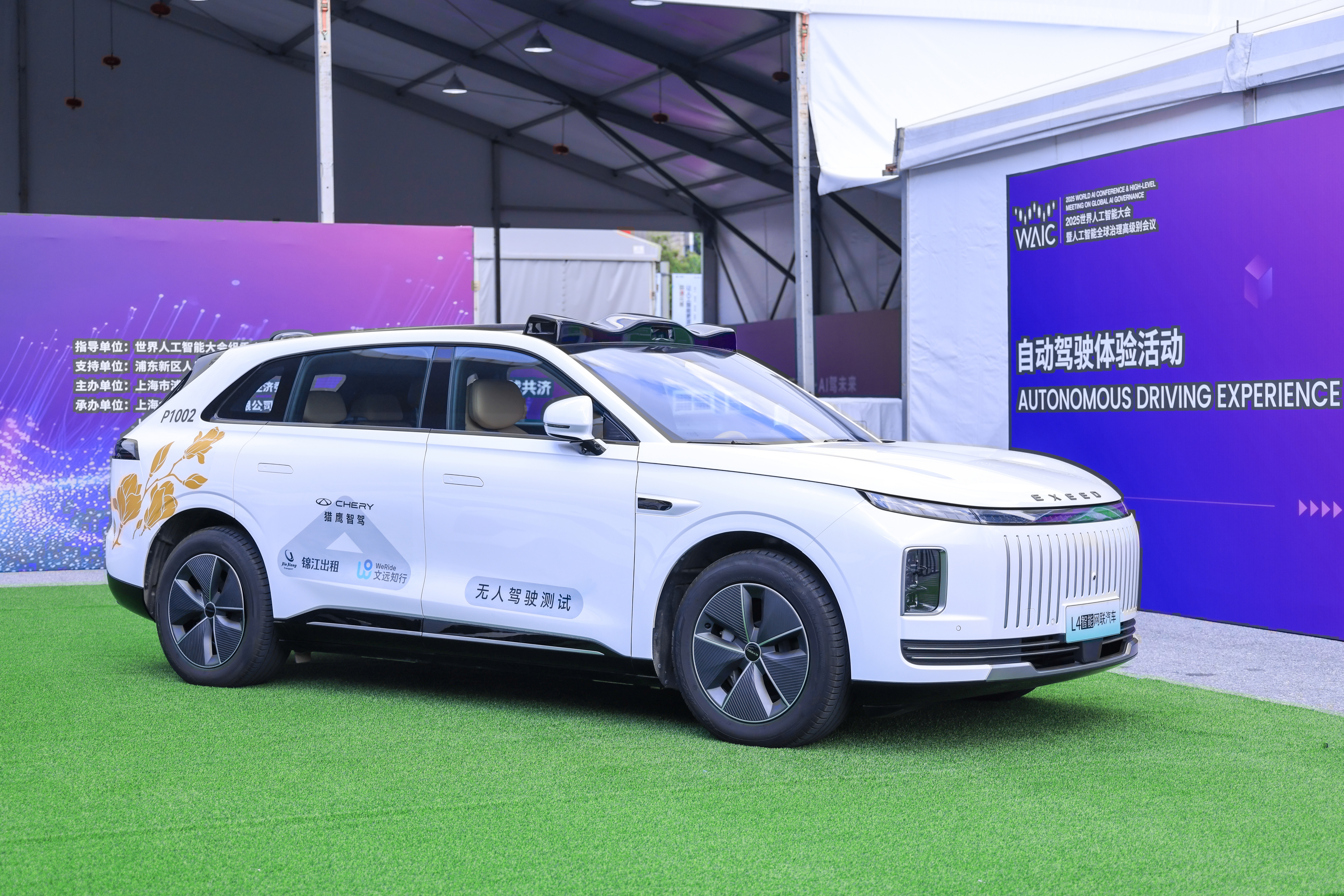
WeRide Wins Permit for Autonomous Robotaxi Service in Shanghai, Partnering with Chery to Revolutionize Urban Mobility
Globenewswire· 2025-07-26 15:42
Core Insights - WeRide has received a permit from the Shanghai municipal government to operate Level 4 autonomous Robotaxi services, marking its entry into the tenth city globally [1][7] - The Robotaxi service was launched in partnership with Chery Group and Jinjiang Taxi during the World Artificial Intelligence Conference 2025, connecting key transport hubs and landmarks in Shanghai [2][4] - The CER, a jointly developed Robotaxi model, was showcased at Auto Shanghai 2025, built on WeRide's autonomous driving platform and Chery's vehicle architecture [5][6] Company Overview - WeRide, founded in 2017, is a leader in Robotaxi research and development, with operations in nine cities across three countries, accumulating over 2,000 days of safe operation [7] - The company is recognized as the first publicly traded Robotaxi company and has received autonomous driving permits in five markets: China, UAE, Singapore, France, and the US [9] - WeRide aims to enhance collaborations with global partners to advance Robotaxi technology and expand commercial deployments [8]