ESRI

Search documents
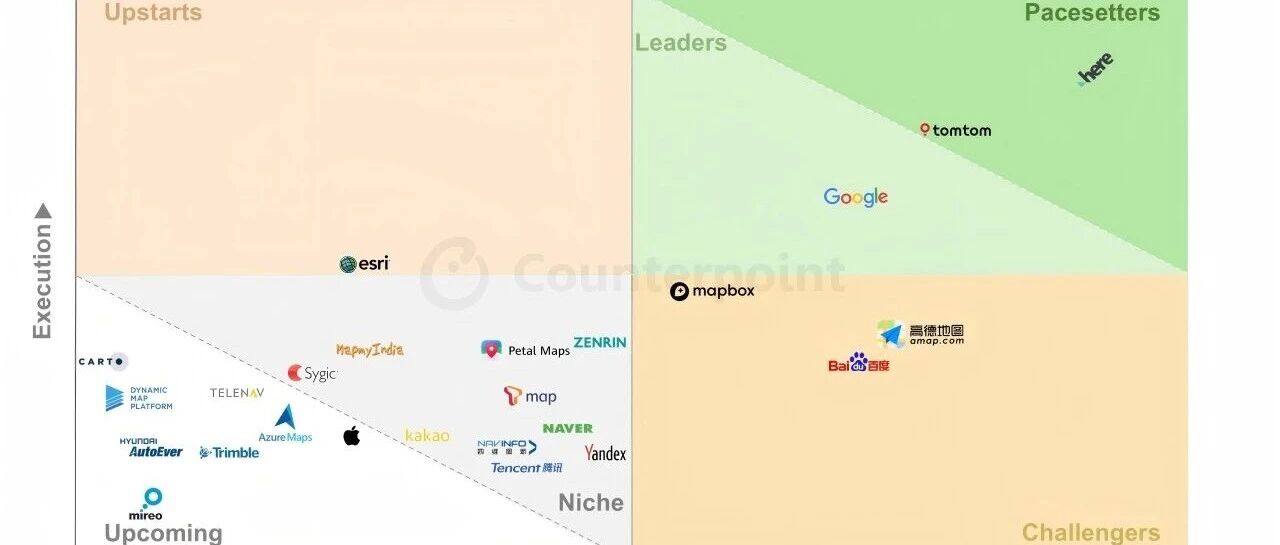
HERE 与 TomTom 在 2026 年定位平台竞争力评估指数中脱颖而出,成为先锋
Counterpoint Research· 2026-01-12 02:45
Core Insights - The article discusses the findings of the "2026 Positioning Platform Competitiveness Assessment Report" by Counterpoint Research, highlighting HERE and TomTom as "Pacesetters" in the positioning platform competitiveness index [4][7] - The report emphasizes the transformation of positioning platforms from traditional mapping solutions to AI-driven data platforms, enhancing user experience through real-time intelligence and personalized services [4][5] Group 1: Positioning Platform Competitiveness - HERE and TomTom are recognized as "Pacesetters" in the positioning platform competitiveness index, while Google is categorized as a "Leader" [4][7] - Baidu, Gaode, and Mapbox are classified as "Challengers" due to their strong platform capabilities but limited market coverage [4][8] - ESRI is noted as an "Upstart" for its execution capabilities, although it still lags behind leading companies in certain dimensions [4] Group 2: HERE's Performance - HERE excels in both platform capability and execution, supported by a comprehensive service product portfolio and a robust partner ecosystem across various verticals like automotive and logistics [5] - The company is leading the transition towards software-defined vehicles (SDVs) and collaborates closely with automakers to guide their transformation [5] - HERE is increasing its R&D investment in product technology and innovation, particularly in AI solutions for the automotive and logistics sectors [5] Group 3: TomTom's Innovations - TomTom has made significant strides with its Orbis map in 3D visualization and traffic analysis, earning its place alongside HERE as a "Pacesetter" [5] - The company is the second global entity, after Google, to launch a Model Context Protocol (MCP) server, facilitating rapid deployment of navigation systems for automakers [5] Group 4: Market Dynamics - The proliferation of location-aware AI features like "search" and "nearby" is leading to hyper-localized and highly personalized user experiences becoming mainstream [7] - Google Maps benefits from its strong core mapping capabilities and vast crowdsourced data from billions of monthly active users, solidifying its "Leader" status [8] - Baidu and Gaode are recognized as regional leaders in China, while Mapbox stands out for its developer-centric approach, offering customizable SDKs for users focused on personalization and visualization [8]



数据可视化工具软件全解析:从入门到专业
Sou Hu Cai Jing· 2025-05-29 17:29
Core Insights - Data visualization has become a core skill for businesses and individuals to interpret information and identify trends in the era of big data. The article reviews over 30 mainstream data visualization tools across seven categories to help match business needs accurately. Group 1: Business Intelligence (BI) Tools - Tableau is a leading BI platform offering a complete solution from data connection to advanced analytics, with a unique VizQL technology that optimizes visualization logic. Walmart saved millions in inventory costs using Tableau [1] - Microsoft Power BI integrates deeply with Office 365, providing advanced features at a subscription price of $9.9 per month. A retail company reduced sales report generation time from 3 days to real-time updates using Power BI [1] - Qlik Sense utilizes in-memory computing to perform data association analysis in 10 seconds, improving fraud detection accuracy by 40% for a bank [1] Group 2: Programming Visualization Libraries - Matplotlib, a standard Python library, supports over 50 basic chart types but requires extensive coding for customization [2] - D3.js allows pixel-level control through data binding with DOM elements, used by GitHub for rendering code submission heatmaps, though it has a steep learning curve [2] - Plotly, based on React, supports complex visualizations like 3D surfaces and is used by a meteorological agency for dynamic typhoon path analysis [2] Group 3: Online Visualization Platforms - Google Data Studio integrates seamlessly with Google services, allowing real-time collaboration for up to 20 users, enhancing reporting efficiency by 70% for a marketing agency [4] - Infogram offers over 200 magazine-quality templates, increasing donation conversion rates by 25% for an NGO [4] - Flourish is used by The New York Times for creating animated election maps, although exporting dynamic charts can be costly [4] Group 4: Open Source Tools - Apache Superset, an open-source solution from Airbnb, supports real-time freight monitoring systems but requires a professional operations team for cluster deployment [6] - Metabase allows business users to generate reports without SQL knowledge, improving response times for an e-commerce customer service team by three times [6] - Redash connects to over 200 data sources and allows for custom plugin development, but requires self-hosting with associated hardware costs [6] Group 5: Specialized Tools - ArcGIS supports geospatial analysis and was used by a city planning bureau to optimize traffic light configurations [8] - Ruanqian BI offers open-source front-end pages for customization and integration into Java applications [8] - RAWGraphs specializes in complex visualizations for multi-variable data, used by a gene research institution to identify potential targets [8] Group 6: Emerging Intelligent Tools - Observe.AI integrates GPT-4 to automatically generate analysis reports from data tables, significantly reducing report preparation time [9] - Airtable combines spreadsheet and database functionalities, helping product teams manage development timelines effectively [9] Group 7: Tool Selection Decision Matrix - The article suggests evaluating tools based on technical capability, interaction needs, data scale, and collaboration requirements, providing examples for different types of organizations [11]

Climate Tech Companies Adopt NVIDIA Earth-2 for High-Resolution, Energy-Efficient, More Accurate Weather Predictions and Disaster Preparedness
Globenewswire· 2025-03-18 19:26
Core Insights - NVIDIA has introduced the Omniverse Blueprint for Earth-2 weather analytics to enhance the accuracy of weather forecasting solutions [1][2] - The climate-related weather events have caused a $2 trillion impact on the global economy over the past decade, highlighting the need for improved risk management and disaster preparedness [2] - The Omniverse Blueprint provides reference workflows, including GPU acceleration libraries and AI frameworks, to facilitate the transition from prototyping to production in weather forecast models [3] Technology and Tools - The blueprint includes NVIDIA NIM microservices such as CorrDiff for downscaling and FourCastNet for predicting global atmospheric dynamics, which are already in use by various weather technology companies and government agencies [4][10] - The Earth-2 platform allows developers to create solutions that provide rapid warnings and updated forecasts, significantly faster than traditional CPU-driven models, with a market size of $20 billion in climate tech [6] - NVIDIA's CorrDiff model is noted for being 500 times faster and 10,000 times more energy-efficient than traditional methods for delivering high-resolution weather predictions [10] Industry Adoption - Companies like G42, JBA Risk Management, and Spire are among the first to adopt the Omniverse Blueprint, developing AI-augmented solutions for advanced weather forecasting and disaster management [5][8] - G42 is integrating the blueprint with its AI-driven forecasting models to enhance the UAE's National Center of Meteorology's capabilities [7] - Spire Global is utilizing AI components from the blueprint to create new products that integrate satellite data for medium-range forecasts, achieving a speed increase of 1,000 times compared to traditional models [8] Collaboration and Ecosystem - The blueprint supports collaboration with industry leaders, including Esri and OroraTech, to enhance geospatial technology and data integration [11] - Tomorrow.io is contributing satellite data to help create an NVIDIA digital twin of Earth for advanced AI model training [12] - The Omniverse platform enables independent software vendors to develop AI-augmented solutions, enhancing the speed and accuracy of weather forecasting [11] Computational Power - The Omniverse Blueprint leverages NVIDIA DGX Cloud for full-stack acceleration in AI-augmented weather forecasting, utilizing advanced supercomputers for climate simulations [14]