
Wartsila

Search documents
Wartsila CEO eyes boost from Trump datacenter push
Reuters· 2026-02-27 09:29
Core Viewpoint - The push for U.S. datacenters to utilize their own power supply is expected to significantly increase demand for Wartsila's environmentally friendly products and lead to a "double-digit" percentage growth in hiring servicing staff over the next two years [1] Company Summary - Wartsila anticipates an 80% increase in delivery capacity for datacentre engines by 2028, driven by U.S. initiatives promoting energy and water-efficient technologies [1] - The company has secured contracts for approximately 1.2 gigawatts of power for datacentres, highlighting the importance of its technology in decision-making processes [1] - Wartsila's engine technology uses "up to 2,000 times less water" than comparable gas turbines and can reduce fuel costs by 20-35%, making it a competitive choice for datacentres [1] Industry Summary - The U.S. market accounts for about half of the world's datacentres, with expected growth as companies seek to enhance computing power, leading to increased competition for skilled workers [1] - The CEO emphasized the need for more vocational training in the U.S. to meet the rising demand for talent in the industry, as there is currently a tight supply of qualified personnel [1]


X @Bloomberg
Bloomberg· 2026-02-17 08:40
Wartsila is seeking a foothold in the AI-fueled US data-center boom https://t.co/V5s4GSbn4a ...
Wartsila orders miss forecast, but upbeat on data centres
Reuters· 2026-02-04 10:11
Group 1 - Finnish engineering group Wartsila missed fourth-quarter orders forecasts [1] - The company faced challenges due to U.S. battery tariffs [1] - Increased competition in the energy storage business impacted performance [1]

全球资本_谁在为数据中心提供动力-Global Capital Goods_ Who powers the data center
2025-12-08 15:36
Summary of Key Points from the Conference Call Industry Overview - The focus is on the **Global Capital Goods** industry, specifically the **data center** sector, which is experiencing significant growth in power demand and generation strategies [2][3][4]. Core Insights and Arguments 1. **Power Generation Bottleneck**: Power availability is a critical bottleneck for data center development, influencing site selection and expansion strategies. Off-grid power generation is becoming increasingly important [2][4]. 2. **Data Center Pipeline Growth**: The US data center pipeline capacity has grown significantly, exceeding **245 GW** with monthly additions of **435 MW**. The top 15 developers account for **59%** of this capacity [3][10][11]. 3. **On-Site Power Generation**: There is a shift towards on-site power generation due to constraints in the US grid infrastructure. Gas accounts for approximately **50%** of planned capacity increases, followed by battery storage, solar, and nuclear [4][51]. 4. **Gas Turbines vs. Gas Engines**: With gas turbine lead times extending to **4-6 years**, gas engines are becoming a viable alternative for data center developers, despite their lower efficiency and higher costs [5][54][76]. 5. **Investment Recommendations**: Analysts recommend buying stocks in **Wartsila** and **Siemens Energy** due to favorable demand and pricing dynamics in the gas turbine market [6][76]. 6. **Long-Term Power Demand**: The demand for power generation is expected to grow significantly between **2026-2030**, driven by the expansion of data center capacity [3][13]. 7. **Regulatory Environment**: Proposed federal regulations may favor data centers with on-site power generation, potentially increasing electricity costs for those relying solely on grid connections [44][45]. Additional Important Insights 1. **Reliability and Redundancy**: Reliability is crucial for data center design, with most larger facilities classified as Tier III or IV, necessitating backup systems for critical infrastructure [22][23]. 2. **Shift in Data Center Locations**: There is a trend of data centers moving from urban to more remote locations, which may increase the demand for off-grid power generation solutions [30][34]. 3. **Intermittent Power Sources**: Renewable energy sources like solar and wind face challenges due to their intermittent nature, which complicates their integration into data center power strategies [40][58]. 4. **Fuel Cells and Alternative Technologies**: While fuel cells offer rapid deployment advantages, their high costs and limited operational history make them a niche solution compared to gas turbines and engines [98]. 5. **Market Dynamics**: The gas turbine market is expected to face supply constraints, leading to increased prices and longer lead times, which may benefit gas engine manufacturers in the short term [72][76]. This summary encapsulates the critical insights and trends discussed in the conference call, highlighting the evolving landscape of power generation for data centers and the implications for investment strategies in the capital goods sector.


全球数据中心设备_深度分析 4.0:热度未减-Global Data Centre Equipment_ Deep dive 4.0. No signs of cooling down
2025-12-08 15:36
Summary of Global Data Centre Equipment Market Conference Call Industry Overview - The report focuses on the **Global Data Centre Equipment** market, providing an updated outlook and analysis of key players across the value chain [2][3]. Market Growth Forecast - The **Data Centre equipment market** (including grey, white, and cooling segments) is projected to grow by **20-25% in 2026**, **15-20% in 2027**, and **10-15% annually from 2028 to 2030**. The estimated growth for 2025 is around **25-30%** [3][39]. - The **Cooling segment** is expected to grow at a **CAGR of approximately 20%** until 2030, with **Liquid Cooling** projected to grow by **45%** [3][39]. Pricing Dynamics - A **20% increase** in market **$/MW** is anticipated due to higher power density rack architectures, primarily driven by cooling and grey space [4][28]. - The **IT equipment $/MW** is expected to rise by **3-4 times**, which explains the rapid capital expenditure (capex) ramp by hyperscalers and reduces price sensitivity towards facility costs [4][28]. AI Adoption and Monetization - There is evidence of rapid adoption of **Generative AI (GenAI)**, with an annual recurring revenue (ARR) of **$17 billion**, representing **6-7%** of the current total SaaS market [5][26]. - Hyperscalers' **Capex/Sales** ratio is projected to more than double compared to 2023, reaching **25-30%**, raising questions about sustainability. However, even with 2026 estimates, capex is expected to represent **75%** of the industry's operating cash flow [5][26]. Key Players and Stock Recommendations - In **Europe**, preferred companies include **Schneider**, **Halma**, **Siemens**, **Prysmian**, and **Wartsila**. - In the **US**, favored companies are **Vertiv**, **Eaton**, **nVent**, **GE Vernova**, and **Comfort Systems**. - In **Asia**, **Delta Electronics** and **Envicool** are highlighted as key players [6][39]. Capacity and Demand Insights - The **Global Data Centre Capacity** is expected to grow significantly, with **24% year-over-year growth** in 2026 and a **21% CAGR from 2025 to 2029** [50][56]. - The **Tech 6** companies (Amazon, Microsoft, Google, Meta, Oracle, and Apple) are projected to account for **10%** of total US electricity demand by 2030, with their incremental demand surpassing the entire US utility-scale solar industry by 2028 [56][58]. Challenges and Risks - Potential risks include project delays, cancellations, and the need for stable grid connections, particularly in Europe where connections are quoted into the 2030s [57][58]. - The industry has faced equipment shortages, particularly in electrical equipment, but this has returned to normal as manufacturers ramped up capacity [57]. Conclusion - The **Global Data Centre Equipment** market is poised for significant growth driven by AI adoption, increased demand for cooling solutions, and substantial capital investments from hyperscalers. However, challenges related to infrastructure and supply chain must be monitored closely to ensure sustainable growth [5][56][57].





Is Vestas Wind Systems (VWDRY) Stock Outpacing Its Industrial Products Peers This Year?
ZACKS· 2025-11-21 15:41
Company Overview - Vestas Wind Systems AS (VWDRY) is currently ranked 2 (Buy) in the Zacks Rank system, indicating a positive outlook based on earnings estimates and revisions [3] - The company has shown a significant year-to-date performance, returning 70%, which is substantially higher than the average return of 2.6% for the Industrial Products sector [4] Industry Context - Vestas Wind Systems AS is part of the Manufacturing - Electronics industry, which includes 15 stocks and is currently ranked 39 in the Zacks Industry Rank [5] - The Industrial Products group, which includes Vestas, is ranked 11 within the Zacks Sector Rank, reflecting the overall strength of the sector [2] Performance Comparison - Another notable performer in the Industrial Products sector is Wartsila (WRTBY), which has returned 90.3% year-to-date and also holds a Zacks Rank of 2 (Buy) [4][5] - The consensus EPS estimate for Wartsila has increased by 4.8% over the past three months, indicating a positive trend similar to that of Vestas [5]
“AI供电交易”热火朝天,设备制造商“鸡犬升天”
Hua Er Jie Jian Wen· 2025-11-06 01:15
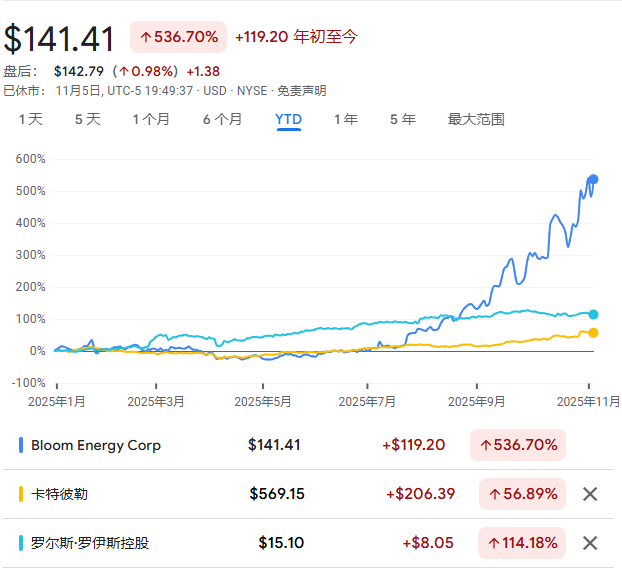
Core Insights - The urgent demand for artificial intelligence power from tech companies is reshaping the power equipment market, with small turbine and fuel cell manufacturers emerging as unexpected winners, significantly outperforming traditional equipment giants [1] Group 1: Market Dynamics - Data centers are facing a severe power shortage, with Morgan Stanley estimating a 45 GW shortfall in the U.S. by 2028, equivalent to the total generation capacity of Illinois [1] - The supply-demand imbalance is driving data centers to adopt off-grid solutions that are more expensive but quicker to deliver, leading to a surge in stock prices for companies like Bloom Energy, which has seen its stock rise over 500% this year [1][3] - Caterpillar and Rolls-Royce have also recorded significant stock price increases due to the rising demand for small turbines and reciprocating engines [1] Group 2: Company Performance - Bloom Energy's solid oxide fuel cells, powered by natural gas, are being heavily procured by data centers, with the company's stock experiencing a sharp increase after announcing agreements with major power companies [3] - Caterpillar reported a 33% year-over-year increase in sales to power generation customers, primarily data centers, and is expanding its supply to various states [4] - Generac, a manufacturer of backup generators, is also witnessing strong demand from large tech companies, although this is somewhat overshadowed by weak residential sales [4] Group 3: Investment Opportunities - There is a noticeable valuation disparity, with turbine and reciprocating engine manufacturers appearing to be more reasonable entry points compared to larger turbine manufacturers like GE Vernova, which has a forward P/E ratio of 47 [5] - The modular nature of small devices provides a competitive edge for data centers requiring near 100% uptime, despite their higher generation costs compared to larger turbines [5] - The upfront costs and maintenance expenses of solid oxide fuel cells are higher, but their fuel efficiency and lower emissions may provide regulatory advantages [5] Group 4: Capacity Expansion and Market Sustainability - Due to supply bottlenecks, data centers are prioritizing speed over cost, with customers willing to pay a premium for power delivery in 2027 or 2028 [6] - Strong demand is prompting manufacturers like Caterpillar to consider capacity expansion, while Bloom Energy plans to double its manufacturing capacity by December 2026 [6] - Large turbine manufacturers are being cautious, having previously suffered from overbuilding during the tech boom in the early 2000s, which may present opportunities for small equipment manufacturers [6]
人工智能数据中心电力需求_推动增长与制约的 6 大要素-GS SUSTAIN_ AI_Data Center Power Demand_ The 6 Ps driving growth and constraints
2025-10-13 15:12
Summary of Key Points from the Conference Call Industry Overview - The focus is on the **data center power demand** driven by AI and non-AI applications, with a projected growth of **175% by 2030** compared to 2023 levels, equivalent to adding a top 10 consuming country [1][6][20]. Core Drivers of Power Demand 1. **Pervasiveness of AI**: The widespread adoption of AI solutions is critical for long-term demand growth and elasticity in response to energy and compute productivity gains [5][20]. 2. **Productivity of Servers**: New-generation AI chips and efficient compute usage are expected to influence aggregate power demand positively [15][20]. 3. **Electricity Prices**: Rising supply costs for both green and non-green power options are not anticipated to constrain demand significantly due to the strong financial positions of hyperscalers [36][39]. 4. **Policy Initiatives**: The sunsetting of the Inflation Reduction Act incentives may impact future sourcing but is not expected to affect near-term power capacity growth [38][39]. 5. **Parts Availability**: Equipment availability will be a key driver for power capacity growth, particularly in renewables and natural gas [12][48]. 6. **People Availability**: The need for skilled labor in infrastructure construction and maintenance poses a risk to meeting power demand growth [58][60]. Investment Opportunities - Attractive investment opportunities are identified across the power supply chain, particularly in utilities and companies involved in data center power demand ecosystems [2][13][14]. Power Demand Growth Projections - The **US power demand growth** is expected to accelerate to **2.6% CAGR through 2030**, with data centers contributing approximately **11%** of total demand by that year, up from **4%** in 2023 [69][70]. - An estimated **82 GW** of new capacity will be required to meet data center demand, with a split of **60%** from natural gas and **40%** from renewables [70][76]. Emissions and Environmental Impact - Data center emissions are projected to double by 2030 compared to 2023 levels, with a significant increase in carbon dioxide emissions expected [55][56]. Labor Market Implications - An estimated **510,000 jobs** will be needed in the US and **250,000 jobs** in Europe to meet the rising power demand by 2030, highlighting a potential labor shortage in skilled positions [58][62]. Conclusion - The data center power demand landscape is evolving rapidly, driven by AI advancements and increasing energy needs. The interplay of technological, economic, and policy factors will shape the future of power sourcing and investment opportunities in this sector.
资本支出追踪-科技和公用事业之外,资本支出削减占主导-Multi-Industry Capex Tracker_ Capex Tracker quick take_ Capex cuts prevail outside of Tech_Utilities
2025-09-30 02:22
Summary of Key Points from the Capex Tracker Industry Overview - The Capex Tracker indicates a trend of capital expenditure (Capex) cuts across various industries, with notable exceptions in Technology and Utilities [3][4]. Core Observations - General Industrial Capex is projected to have a compound annual growth rate (CAGR) of 5.5% for the period 2024-2028, which is a slight decrease of 0.4 percentage points compared to the previous update in July [3][4]. - Positive growth in Capex is observed in the following sectors: - **Datacenters**: 26.5% CAGR, an increase of 3.5 percentage points from July [4]. - **Pulp & Paper**: Improvement noted, but specific growth figures not provided [3]. - **Conventional Power Generation**: Positive outlook with companies like Wartsila and Accelleron showing growth [3]. - **Mining**: Companies such as Epiroc and FLSmidth are expected to benefit [3]. - Conversely, significant declines are noted in: - **Vehicles/Autos**: Negative growth, with a decrease of 1.8 percentage points to 2.0% CAGR [4]. - **Pharma and Biotech**: Both sectors are experiencing negative trends, with Biotech showing a decline of 8.6% [4]. Detailed Capex Growth by Sector - **Datacenters**: - 2025 Capex growth projected at 51.7%, a significant increase of 15.2 percentage points [4]. - **Renewables and T&D**: - 2025 Capex growth at 17.5%, down by 8.0 percentage points [4]. - **Semiconductors**: - 2025 Capex growth at 15.7%, a decrease of 1.2 percentage points [4]. - **Healthcare**: - 2025 Capex growth projected at 0.0%, indicating stagnation [4]. - **Consumer Sector**: - 2025 Capex growth at 0.7%, reflecting a decline of 1.1 percentage points [4]. Additional Insights - The Capex Tracker highlights a robust growth trajectory in Datacenters, Renewables, and Mining, while traditional sectors like Vehicles and Pharma are facing headwinds [4]. - The report emphasizes the importance of monitoring these trends for potential investment opportunities and risks in the respective sectors [3][4]. Conclusion - The Capex Tracker serves as a critical tool for understanding industry trends and making informed investment decisions, particularly in identifying sectors poised for growth versus those facing challenges [3][4].
能源的未来:为人工智能腾飞提供动力已开启-聚焦人工智能非线性进步速度-Future of Energy:Powering AI Liftoff Has Commenced – Focus on the Non-Linear Rate of AI Improvement
2025-09-22 02:02
Summary of Key Points from the Conference Call Industry Overview - The focus is on the energy sector, particularly the power requirements for AI and data centers in North America, with an emphasis on the conversion of Bitcoin mining sites to high-performance computing (HPC) data centers [1][3][29]. Core Insights and Arguments 1. **Surge in Demand for Compute Power**: There is an anticipated surge in demand for compute power, particularly for AI applications, expected to escalate in 2026 due to non-linear improvements in AI capabilities [1][3]. 2. **Power Bottleneck**: A significant power bottleneck is projected between 2025-2028, with a total shortfall of approximately 45 gigawatts (GW) for data centers, necessitating innovative power solutions [9][36]. 3. **Bitcoin Mining Sites as Solutions**: Bitcoin mining sites are seen as a viable solution to the power bottleneck due to their existing infrastructure and lower power costs, with an average cost of $44/MWh compared to $80/MWh in Northern Virginia [29]. 4. **Conversion Potential**: The conversion of Bitcoin mining sites to HPC data centers is highlighted as a high-value opportunity, with potential enterprise value creation ranging from $5-8 per watt, significantly higher than current Bitcoin mining stock valuations [15][16][17]. 5. **Federal Support and Policy Changes**: There is potential for federal support for new nuclear construction and initiatives to reduce U.S. dependency on critical materials from China, which could impact energy infrastructure investments [8][26][28]. Additional Important Insights 1. **Execution Risks**: The transition from Bitcoin mining to data centers involves execution risks, particularly in project construction and regulatory compliance, which could affect timelines and costs [33][34]. 2. **Megatrends in AI**: The rapid increase in computational power for training large language models (LLMs) is expected to double their intelligence, which could significantly impact economic valuations and the demand for energy infrastructure [22][23]. 3. **Market Dynamics**: The analysis suggests that as AI adoption increases, the relative value of energy infrastructure may rise, while the costs of AI-related assets may decrease, leading to a shift in economic paradigms [24][26]. 4. **Investor Considerations**: Investors are encouraged to assess the potential for Bitcoin-to-DC conversions and the associated risks and rewards, particularly in light of the projected power shortfall and the increasing urgency for data center capacity [35][36]. Conclusion The conference call emphasizes the critical intersection of energy infrastructure, AI development, and Bitcoin mining, highlighting significant investment opportunities and risks in the evolving landscape of power demand and technological advancement.