
nVidia

Search documents
PCB的M9材料替换M8材料对设备和钻针影响
傅里叶的猫· 2025-10-23 14:39
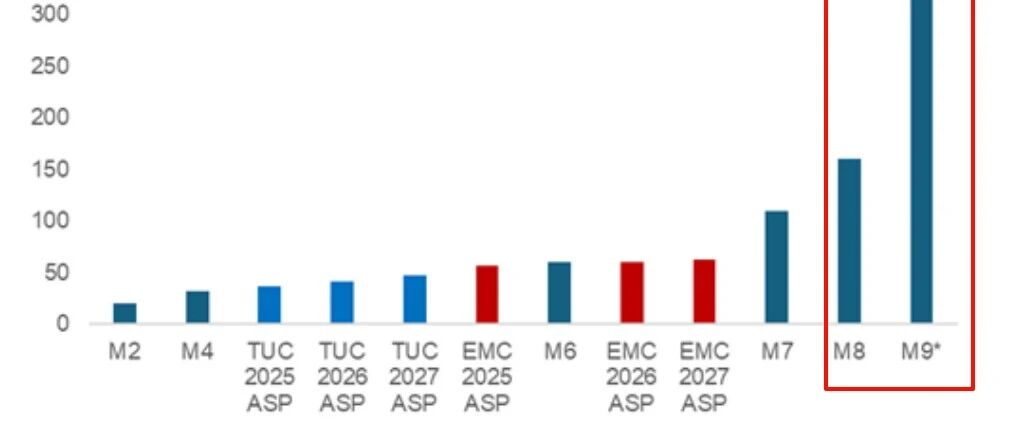
Group 1: PCB Material Solutions - The report from Nomura summarizes various PCB materials used by major companies like nVidia, AWS, Google, and Meta, detailing their respective generations, structures, and suppliers [1] - nVidia's H100 and B200 generations utilize M7 and M8+M4 CCL materials, with suppliers including EMC and Unimicron [1] - AWS's Trainium 2 and Google’s TPU v6p are also highlighted, with specific CCL materials and suppliers listed, indicating a trend towards advanced PCB structures [1] Group 2: Comparison of M8 and M9 - M9 CCL offers significant improvements over M8, including a lower loss factor (Df) of ≤0.0007 compared to M8's 0.001, representing a 30% reduction [7][8] - The dielectric constant (Dk) for M9 is also lower at 2.6-2.8, compared to M8's 2.8-3.1, indicating a 10% decrease [8] - M9 supports higher bandwidth capabilities, enabling 2.4T+ switches and servers, which is a 50% increase in bandwidth compared to M8 [8] Group 3: Impact on Upstream Equipment - The transition to M9 necessitates upgrades in CO2 drilling technology due to the higher melting point of Q-Glass, requiring new equipment development [9] - The wear on drilling needles has increased significantly, with a single needle now only able to drill 100-200 holes for M9, compared to 500 for M8 and 1000 for M7 [9] - The cost of new ultra-fast laser drilling equipment is estimated to exceed 5 million, indicating a substantial investment requirement for manufacturers [9]

野村:Meta 在 ASIC 人工智能服务器的野心 - 2_机遇与挑战_复杂的 ASIC 设计,上下游存在重大产量错配
野村· 2025-06-25 13:03
Investment Rating - The report does not provide a specific investment rating for Meta or the semiconductor industry, indicating that Meta is "Not rated" [1]. Core Insights - Meta is aggressively pursuing its ASIC (Application-Specific Integrated Circuit) roadmap, which is expected to create new business opportunities within the semiconductor supply chain despite a significant volume mismatch between upstream and downstream production [1][2]. - The anticipated production volume for MTIA ASIC-based designs from Broadcom is estimated to be between 300,000 to 400,000 units in 2026, while Meta's expectations range from 1 to 1.5 million units for the same period [2]. - The MTIA T-V1.5 chip, set for mass production in the second half of 2026, is projected to be a major volume driver, potentially accounting for 70-80% of total MTIA ASIC shipments [2][4]. - The semiconductor supply chain must focus on increasing MTIA ASIC volume shipments starting in 2026, with a particular emphasis on the capabilities of leading foundries like TSMC to meet the expected demand [3]. Summary by Sections ASIC Production and Specifications - Meta's MTIA ASIC production forecast includes several models, with the MTIA T-V1.5 expected to be a significant contributor to volume, and the MTIA T-V2 anticipated to adopt SolC design in 2027 [3][4]. - The MTIA T-V1.5 chip is larger than previously expected, which may present technological challenges during initial ramp-up stages [2]. Market Dynamics - The report highlights the increasing aggressiveness of cloud service providers (CSPs) in deploying their own AI ASIC solutions, with Meta being a key player in this trend [1]. - The report suggests that the semiconductor industry is evolving towards larger chip sizes, necessitating more advanced packaging technologies [3]. Future Outlook - If Meta can successfully ramp up production, it is expected to become a significant adopter of SolC technology alongside competitors like AMD and Apple [3]. - The report indicates that the semiconductor supply chain will need to adapt to the growing demand for AI chips, particularly in light of Meta's ambitious production goals [3].
