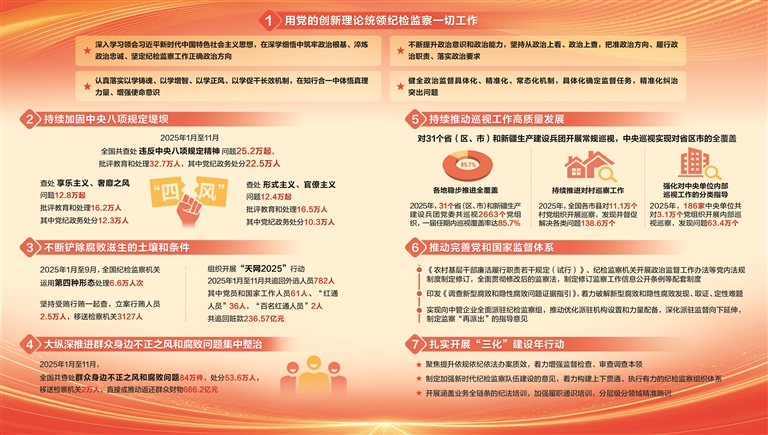
整治群众身边不正之风和腐败问题

Search documents
为人民而战 让群众有感
Ren Min Ri Bao· 2026-02-13 00:28
Core Viewpoint - The article emphasizes the importance of addressing corruption and misconduct in proximity to the public, highlighting the need for continuous efforts by various levels of government to ensure that citizens feel the positive changes in their daily lives [1][2]. Group 1: Implementation and Coordination - In 2025, the central disciplinary inspection and supervision agencies directly handled 8,116 cases of misconduct and corruption affecting the public, guiding provincial-level agencies in managing 3,808 cases, demonstrating a strong commitment to tackling grassroots "micro-corruption" [3]. - A total of 967,000 cases of misconduct and corruption were addressed nationwide, resulting in the punishment of 627,000 individuals and the referral of 22,000 cases to the judiciary, with 77.63 billion yuan returned to the public [3]. Group 2: Focus on Specific Issues - The central disciplinary inspection and supervision agencies focused on specific issues such as school meal management, rural collective asset management, and the supervision of rural revitalization funds, leading to the resolution of 61,000 cases related to school meal corruption and the punishment of 35,000 individuals [5]. - The agencies also worked on 16 major livelihood projects, including resolving historical property registration issues affecting over 5.5 million properties and addressing rural water supply problems [5]. Group 3: Systematic Improvements - The article discusses the establishment of improved internal control mechanisms and procurement processes in response to corruption cases, emphasizing a combination of punishment, treatment, and prevention to enhance governance [7]. - In 2025, 32 national welfare policy documents were introduced to strengthen long-term management and oversight, ensuring that the benefits of reforms are equitably distributed among the populace [7][8].
仲音:惩治微腐败,让新风正气更充盈
Ren Min Ri Bao· 2026-02-13 00:28
Group 1 - The article emphasizes the importance of addressing local issues and corruption to enhance public trust and satisfaction, highlighting the need for a systematic approach to governance [1][2][3] - The implementation of various reforms, such as the "one-stop service" and "online appointment" systems, has improved administrative efficiency and transparency, making it easier for citizens to access services [1][3] - The focus on specific areas like school meal quality and agricultural subsidies demonstrates a commitment to addressing pressing public concerns and ensuring that benefits reach the intended recipients [2][3] Group 2 - The article discusses the successful resolution of long-standing property registration issues in Guangdong, with a target to resolve 42,200 cases by November 2025, showcasing effective governance and service delivery [3] - The establishment of data-driven monitoring systems aims to prevent corruption and ensure that public funds are used appropriately, reflecting a proactive stance against financial misconduct [2][3] - The narrative underscores the significance of maintaining a clean governance environment to foster public confidence and support for government initiatives, which is crucial for the advancement of modernization efforts [4]
惩治微腐败,让新风正气更充盈
Ren Min Ri Bao· 2026-02-12 23:38
Core Points - The article emphasizes the importance of addressing grassroots issues and corruption to enhance public trust and improve governance [1][2][3] - It highlights successful initiatives in various regions that have led to tangible improvements in public services and accountability [1][2][3] Group 1: Governance and Public Services - The article discusses the positive changes in local governance, where online appointment systems and streamlined processes have improved service delivery, making it comparable to first and second-tier cities [1] - It mentions the central government's focus on tackling corruption and improving public services, particularly in education and social welfare, to ensure that benefits reach the intended recipients [1][2] - The implementation of data-driven monitoring systems has helped identify and rectify issues in subsidy distribution, ensuring that funds are used effectively for the benefit of the community [2] Group 2: Community Impact and Public Sentiment - The article illustrates individual stories, such as a resident receiving a long-awaited property certificate, showcasing the direct impact of improved governance on citizens' lives [3] - It emphasizes the need for continuous efforts to address longstanding issues and enhance transparency in government operations, which fosters public confidence [3] - The narrative reinforces the idea that combating corruption and improving service delivery are essential for maintaining public support and trust in government [2][3]
2025群众身边不正之风和腐败问题集中整治成效综述
Xin Hua Wang· 2026-02-11 23:05
Core Viewpoint - The article emphasizes the importance of addressing corruption and misconduct at the grassroots level, highlighting the efforts made by the Central Commission for Discipline Inspection and local supervisory bodies to enhance integrity and accountability within the community [1][6]. Group 1: Anti-Corruption Efforts - In 2025, a total of 96.7 million cases of misconduct were investigated, resulting in the punishment of 627,000 individuals and the transfer of 22,000 cases to the judiciary [2]. - The focus on "micro-corruption" at the grassroots level has led to significant actions, including the investigation of 8,116 cases directly overseen by the Central Commission for Discipline Inspection [2]. - The campaign against corruption has also included measures to ensure food safety in schools, with a 100% coverage rate of dietary supervision committees [2]. Group 2: Addressing Public Concerns - The article highlights the proactive measures taken to address public grievances, such as the refund of 220 million yuan in pre-paid medical fees in Yantai [4]. - Since 2025, the Central Commission for Discipline Inspection has initiated six national rectification projects, addressing over 20 areas of public concern, including basic living standards and social assistance [4]. - The inclusion of 14,000 new individuals into social assistance programs demonstrates a commitment to safeguarding the livelihoods of vulnerable populations [4]. Group 3: Systematic Reforms - The article discusses the establishment of a parent supervision system in schools to enhance the oversight of campus dining services, improving transparency and accountability [7]. - In Fujian, a comprehensive platform for law enforcement and supervision has been developed, leading to a noticeable decrease in administrative penalties [7]. - The ongoing reforms aim to create a sustainable mechanism for protecting public interests and preventing corruption from taking root [8]. Group 4: Long-term Commitment - The article underscores that the fight against corruption is both a short-term and long-term battle, requiring sustained efforts to build public trust [9]. - The leadership of the Communist Party of China is committed to continuous improvement in governance, ensuring that the public feels the impact of anti-corruption measures in their daily lives [9].
让群众切实感受到正风肃纪反腐就在身边——2025年群众身边不正之风和腐败问题集中整治成效综述
Xin Hua She· 2026-02-11 13:59
Core Viewpoint - The article emphasizes the importance of addressing corruption and misconduct at the grassroots level, highlighting the efforts of the Central Commission for Discipline Inspection and local supervisory bodies to enhance integrity and accountability in governance, ultimately benefiting the public [1][8]. Group 1: Anti-Corruption Measures - In 2025, a total of 96.7 million cases of misconduct were investigated, resulting in the punishment of 627,000 individuals and the referral of 22,000 cases to the judiciary, showcasing a strong commitment to tackling "micro-corruption" at the grassroots level [2][3]. - The focus on food safety in schools led to the establishment of a comprehensive oversight system, achieving a 100% coverage rate of dietary supervision committees [2]. - The agricultural sector saw the identification of collective assets totaling 10.18 trillion yuan, with over 2,200 cases of fraudulent claims rectified [2]. Group 2: Public Welfare Initiatives - The city of Yantai initiated a refund program for outpatient prepayment fees, successfully returning 220 million yuan to the public through various communication channels [4]. - The government addressed social assistance gaps, incorporating an additional 14,000 individuals into the minimum living standard program [4]. - Collaborative efforts among multiple departments resolved over 5.5 million historical housing issues, significantly improving citizens' access to property rights [5]. Group 3: Systematic Reforms - The establishment of a parent supervision system in school meal management in Sichuan has enhanced oversight effectiveness [7]. - The implementation of the "Min Law Enforcement" platform in Fujian has led to a noticeable decrease in administrative penalties and enforcement cases [7]. - Continuous efforts to integrate supervision, case handling, and governance reforms aim to eliminate the conditions that foster corruption [7].
守好人民群众“救命钱”,今年山东将组织开展医疗保障基金专项审计
Qi Lu Wan Bao· 2026-02-10 09:05
Core Viewpoint - The Shandong Provincial Audit Office is focusing on enhancing audit efforts in key areas related to public welfare, rural development, and combating corruption in 2026, aiming to protect public interests and improve the quality of life for citizens [3][4]. Group 1: Public Welfare - The Shandong audit authorities will conduct a special audit on medical insurance funds, focusing on fund management, implementation of healthcare reform policies, and insurance coverage for key populations [3]. - The audit aims to identify issues and risks in fund operations and policy execution, providing actionable recommendations to ensure the safe and stable operation of medical insurance funds [3]. Group 2: Rural Development - A special audit will be organized for rural revitalization projects, concentrating on the implementation of planning, policy measures, project operations, and performance of fund usage [3]. - The audit seeks to uncover systemic issues, institutional barriers, and management loopholes that hinder rural development and governance, ensuring effective financial management [3]. Group 3: Anti-Corruption Efforts - The Shandong audit authorities will implement measures to address corruption and misconduct at the grassroots level, focusing on issues such as embezzlement, misappropriation, and fraudulent claims [4]. - The goal is to resolve prominent issues raised by the public, enhancing their sense of gain, happiness, and security [4].

省委常委会召开会议传达学习中央有关会议精神 部署社会政法和信访等工作
Shan Xi Ri Bao· 2026-02-01 01:13
Group 1 - The meeting emphasized the need to uphold and strengthen the Party's comprehensive leadership, ensuring that various provincial bodies implement the spirit of the 20th National Congress and subsequent plenary sessions, while focusing on clear goals and tasks to better serve the public and enterprises [1][2] - There is a strong focus on enhancing grassroots governance and improving service management for various social groups, aiming to elevate the quality of community service and governance systems [1] - The meeting highlighted the importance of the absolute leadership of the Party over political and legal work, promoting a higher level of safety and rule of law in Shaanxi, while addressing conflict resolution and risk management [2] Group 2 - The meeting called for the effective use of the petition joint meeting mechanism to ensure the implementation of the Petition Work Regulations, aiming for legal governance in petition work and addressing root causes of petition issues [2] - There is a commitment to persistently tackle corruption and misconduct in communities, focusing on key areas and enhancing the effectiveness of case handling and systemic governance [2] - The meeting reviewed several work lists for 2026, including those aimed at promoting high-quality projects, improving the business environment, and enhancing the capabilities of officials [2]
学纪知纪明纪守纪丨用心用情为群众办实事解难题
Zhong Yang Ji Wei Guo Jia Jian Wei Wang Zhan· 2026-01-28 00:20
Group 1 - The article emphasizes the importance of safeguarding the interests of the people, particularly during the year-end and New Year period, highlighting the need for accountability and effective action to address public concerns [2][3][4] - It discusses the role of the Communist Party's internal regulations in ensuring that the interests of the people are prioritized, focusing on service, accountability, and discipline [4][5][6] - The article outlines specific measures to prevent corruption and misconduct at the grassroots level, emphasizing the need for strict adherence to regulations and the importance of public feedback [9][10][11] Group 2 - The article highlights the necessity of integrating supervision into various aspects of public service to effectively address the urgent needs of the people, ensuring that their concerns are met [16][17][18] - It stresses the importance of a systematic approach to governance, focusing on enhancing the efficiency of public services and preventing the abuse of power [7][8][9] - The article calls for a proactive stance from supervisory bodies to ensure that public welfare policies are implemented effectively, particularly in critical areas such as social security and agricultural support [20][19]

落实五次全会精神见行动 | 深化整治群众身边不正之风和腐败问题
Zhong Yang Ji Wei Guo Jia Jian Wei Wang Zhan· 2026-01-23 00:46
Core Viewpoint - The central theme of the articles is the emphasis on strengthening anti-corruption efforts and addressing issues of misconduct and corruption that affect the public, as outlined in the important speech by General Secretary Xi Jinping at the Fifth Plenary Session of the Central Commission for Discipline Inspection [2] Group 1: Strategic Deployment - The Central Commission for Discipline Inspection emphasizes the need to focus on the people's interests and to combat corruption and misconduct that directly affect the public [2] - The meetings held in various regions, including Shanghai, Henan, and Ningxia, highlight the commitment to implement the directives from the Central Commission and to ensure that anti-corruption measures yield tangible benefits for the populace [3][4][6] Group 2: Focus Areas for Action - The Shanghai meeting stresses maintaining a high-pressure stance against corruption, particularly in areas with concentrated power and resources, and aims to enhance the effectiveness of anti-corruption measures [3] - The Henan meeting outlines a focus on protecting the people's interests, addressing issues related to employment, social security, housing, healthcare, and rural revitalization, while also improving the governance of the business environment [4][5] - The Ningxia meeting emphasizes the need for a comprehensive approach to tackle corruption, including the management of rural collective assets and healthcare funds, and the establishment of effective mechanisms for public engagement and feedback [6]
特别报道|2025:纪检监察工作高质量发展取得新进展新成效
Zhong Yang Ji Wei Guo Jia Jian Wei Wang Zhan· 2026-01-11 01:58
Core Viewpoint - The article emphasizes the importance of political supervision in ensuring the implementation of the Party's political line and maintaining a high-pressure stance against corruption and misconduct within the Party and government institutions [3][20]. Group 1: Political Supervision - Political supervision is crucial for maintaining the centralized leadership of the Party and ensuring that major decisions and directives from the Party are implemented effectively [3][4]. - The focus of political supervision should be on specific tasks and responsibilities, ensuring that the directives from the Party are translated into actionable plans [4][6]. - Various regions, such as Beijing and Zhejiang, have implemented targeted political supervision measures to ensure compliance with Party directives and enhance governance [5][6]. Group 2: Anti-Corruption Efforts - The article highlights the ongoing efforts to combat corruption, particularly in local governance, by addressing both minor and major corruption issues [20][28]. - There is a strong emphasis on the need for collaboration among different departments to effectively tackle corruption and misconduct [24][29]. - The article notes that significant progress has been made in addressing corruption linked to public services, with various regions reporting successful interventions [32][33]. Group 3: Integration of Supervision Mechanisms - The integration of various supervisory mechanisms is essential for enhancing the effectiveness of anti-corruption efforts, with a focus on collaboration between different supervisory bodies [39][40]. - The establishment of clear communication and coordination among supervisory entities is emphasized to ensure a unified approach to governance and oversight [41][42]. - The article discusses the importance of grassroots supervision in extending the reach of anti-corruption measures and ensuring accountability at all levels of government [43][44]. Group 4: Continuous Improvement and Education - Continuous education and training for supervisory personnel are highlighted as vital for maintaining high standards of governance and accountability [45][46]. - The article stresses the need for ongoing learning and adaptation of supervisory practices to meet the evolving challenges in governance and corruption prevention [47].