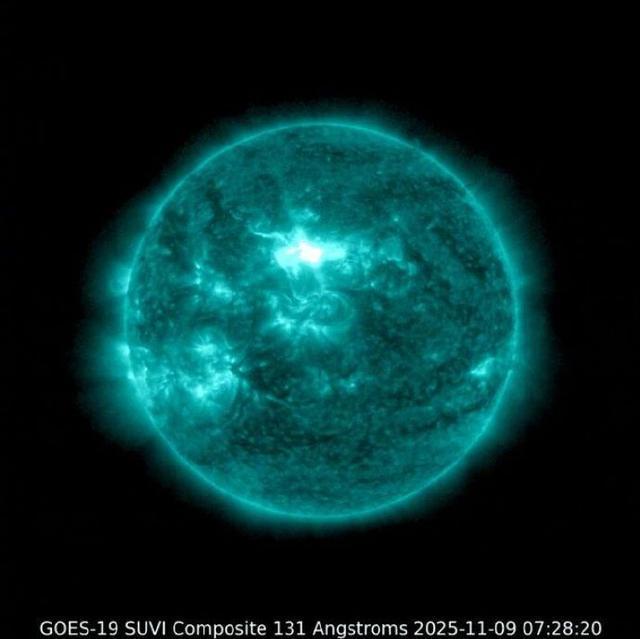
日冕物质抛射

Search documents
太阳爆发X8.1级耀斑
Xin Lang Cai Jing· 2026-02-02 12:50
Group 1 - The National Oceanic and Atmospheric Administration's Space Weather Prediction Center reported a significant solar flare of X8.1 intensity from sunspot region 4366, with expectations of more active solar phenomena in the coming days [1] - The simulation of coronal mass ejections indicates that most of the ejected material will pass by Earth from the northern and eastern sides around February 5 [1] - Such high-level solar flares typically exhibit rapid intensification and weakening, lasting from minutes to hours, potentially causing widespread signal degradation or interruptions in high-frequency communication on the sunlit side of Earth [1] Group 2 - Solar flares are among the most intense phenomena on the Sun, characterized by sudden brightening in localized areas of the solar atmosphere, often accompanied by enhanced electromagnetic radiation and particle emissions [2] - Solar flares are classified into five levels (A, B, C, M, X) based on energy, with each level further divided into ten grades [2] - Strong solar flare events can lead to solar radiation storms and coronal mass ejections, which may trigger geomagnetic storms affecting satellites, space stations, and ground-based power and communication systems [2]
今年首个X级耀斑爆发 地磁暴对人体健康影响微乎其微
Ke Ji Ri Bao· 2026-01-22 03:04
Core Viewpoint - The recent X1.9-class solar flare marks the first significant solar event of 2026, leading to intense geomagnetic storms that have resulted in stunning auroras across multiple regions in China [1] Group 1: Causes of the Geomagnetic Storm - The geomagnetic storm's intensity is attributed to a coronal mass ejection (CME), which can eject billions of tons of solar material at speeds exceeding 1200 kilometers per second, significantly impacting Earth's magnetic field [2] - This event is noted as the strongest solar proton event since March 24, 1991, and the third strongest on record, indicating a high level of solar activity [2] Group 2: Forecasting and Warnings - Current capabilities allow for geomagnetic storm warnings, which differ fundamentally from traditional weather forecasts, focusing on monitoring solar activity and predicting the arrival of solar "shock waves" [3] - The prediction process involves tracking solar events, estimating the speed and direction of CMEs, and measuring solar wind characteristics using satellites positioned at the L1 point between the Earth and the Sun [3][4] - Despite advancements, the accuracy of geomagnetic storm predictions remains limited, with potential timing errors of ±12 hours due to gaps in observational data [4] Group 3: Impact on Human Health and Technology - Experts agree that geomagnetic storms have negligible effects on human health, with no significant physical sensations or health risks associated with these events [5][6] - While geomagnetic storms do not pose health threats, they can affect satellite operations and navigation systems, necessitating monitoring and potential adjustments to satellite orbits [6] - The impact on wildlife, particularly migratory animals that rely on geomagnetic navigation, is significant, suggesting caution during geomagnetic storm events [6]
地磁暴对人体健康影响微乎其微
Xin Lang Cai Jing· 2026-01-22 02:45
Core Viewpoint - The article discusses the recent X1.9-class solar flare and its resulting geomagnetic storm, marking the first significant solar activity of 2026, with implications for space weather forecasting and its effects on Earth [1][2]. Group 1: Solar Activity and Geomagnetic Storms - The X1.9-class solar flare occurred on January 19, 2026, leading to a significant geomagnetic storm that began on January 20, resulting in 15 hours of severe geomagnetic activity [1]. - The geomagnetic storm was triggered by a coronal mass ejection (CME), which can eject billions of tons of solar material at speeds exceeding 1,200 kilometers per second, causing significant disturbances in Earth's magnetic field [2][3]. Group 2: Forecasting and Monitoring - Current capabilities allow for geomagnetic storm warnings, which involve monitoring solar activity through satellites and predicting the arrival and impact of solar events on Earth [2][3]. - The forecasting process includes tracking solar flares, estimating the speed and direction of CMEs, and measuring solar wind characteristics to predict storm intensity and duration [3]. Group 3: Impact on Human Life and Technology - Experts indicate that geomagnetic storms have negligible effects on human health, as they are imperceptible and do not pose a direct threat [4]. - However, geomagnetic storms can affect satellite operations and aviation, necessitating monitoring and potential adjustments to satellite orbits [4].
地磁暴对人体健康有影响吗?
Huan Qiu Wang Zi Xun· 2026-01-22 01:08
Core Viewpoint - The article discusses the recent X1.9-class solar flare and its resulting geomagnetic storms, highlighting the intensity and implications of these solar activities on Earth and human life [1]. Group 1: Causes of Geomagnetic Storms - The recent geomagnetic storm was triggered by a coronal mass ejection (CME), which can eject billions of tons of solar material at speeds of hundreds to over a thousand kilometers per second [2]. - This particular event is noted as the strongest solar proton event since March 24, 1991, and the third strongest on record [2]. - The CME was directed towards Earth and occurred near the solar surface, contributing to the high intensity of the geomagnetic storm [2]. Group 2: Forecasting and Warnings - Current capabilities allow for geomagnetic storm warnings, which differ fundamentally from traditional weather forecasts [3]. - The forecasting process involves monitoring solar activity, predicting the arrival of solar "shock waves," and estimating the storm's intensity and duration [3]. - There is a noted error margin of approximately ±12 hours in predicting the timing of geomagnetic storms due to a lack of observational data during the CME's journey to Earth [4]. Group 3: Impact on Human Health and Technology - Experts agree that geomagnetic storms have minimal impact on human health, as they are not perceivable and do not pose a direct threat [5][6]. - While there are no health risks, geomagnetic storms can affect aircraft and satellite operations, necessitating monitoring and potential adjustments to satellite orbits [6]. - The storms may significantly impact animals that rely on geomagnetic navigation, such as homing pigeons, suggesting caution during such events [6].
南非观测到极强地磁暴
Xin Hua She· 2026-01-20 14:04
Core Viewpoint - A geomagnetic storm triggered by a solar storm reached G5 (extreme) level in South Africa on January 20, 2023, impacting satellite performance and wireless communication [1] Group 1: Solar Activity - A prolonged X1.9 solar flare on January 18 initiated a coronal mass ejection, leading to charged particles reaching Earth and causing a geomagnetic storm [1] - The geomagnetic storm escalated to G4 (severe) level on the evening of January 19 before reaching G5 (extreme) level early on January 20 [1] Group 2: Geomagnetic Storm Metrics - The Kp index, which measures the intensity of geomagnetic storms, peaked at 9 during the G5 storm, indicating a high level of disturbance in Earth's magnetic field [1] - On January 20 at 6:21 AM, the Earth experienced a Kp value of 6, with solar wind speeds reaching 900 kilometers per second, while the geomagnetic storm intensity in Hermanus was recorded at Kp value 7 [1] Group 3: Effects and Observations - Geomagnetic storms can cause significant disturbances in the Earth's magnetosphere, ionosphere, and upper atmosphere, potentially affecting satellite operations and wireless communications [1] - Residents in parts of South Africa's Western Cape shared photos of auroras on social media, which are more vibrant during stronger geomagnetic storms [1]
2025年,十大太空发现 | 红杉爱科学
红杉汇· 2025-12-26 00:06
Group 1 - The article highlights ten significant space discoveries in 2025, including gravitational wave echoes from deep space and extreme high-energy particles traversing the Milky Way [3] - The discoveries address long-standing scientific questions and challenge existing assumptions about the fundamental laws of the universe [3] - Key findings include clues to life's building blocks in asteroid samples, the detection of interstellar comets, and the first observation of coronal mass ejections beyond the Sun [3][5][10] Group 2 - The asteroid Bennu, approximately 525 meters in diameter and 320 million kilometers from Earth, yielded samples containing various salts, ribose, glucose, and organic materials, suggesting that the building blocks of life may originate from space [5] - The comet 3I/ATLAS, entering the solar system at a speed of about 152,000 miles per hour, is the third confirmed interstellar object, with ongoing observations to determine its size and physical properties [7] - The first direct observation of coronal mass ejections from an M dwarf star was achieved, marking a significant milestone in understanding solar phenomena [10] Group 3 - A report identified five known microquasars in the Milky Way as sources of high-energy cosmic rays, confirming the existence of natural "particle engines" [13] - An extreme black hole merger event was reported, creating a new black hole with a mass of approximately 225 solar masses, challenging existing theories about black hole mass ranges [16] - The LIGO observatory captured the clearest gravitational wave signal to date, validating Stephen Hawking's area theorem with a confidence level of 99.999% [19] Group 4 - The KM3NeT detector in the Mediterranean reported the detection of a neutrino with an energy of 220 PeV, setting a new record for neutrino energy [22] - Astronomers measured the distribution of ordinary baryonic matter in the universe, revealing that over three-quarters of it is hidden in diffuse gas between galaxies, addressing the "missing baryon problem" [25] - Recent findings suggest that dark energy, previously thought to be constant, may be weakening, which could necessitate significant revisions to the cosmological standard model [26][27] Group 5 - New-generation telescopes, including the Euclid space telescope and Vera C. Rubin Observatory, have released unprecedented cosmic data, paving the way for a new era of understanding in areas such as asteroid and galaxy evolution, dark matter, and dark energy [30]

为什么北京也能看到极光?专家解答
Huan Qiu Wang Zi Xun· 2025-11-15 10:02
Core Viewpoint - A rare aurora phenomenon has been observed in several northern regions of China, including Beijing and Inner Mongolia, attributed to recent coronal mass ejections causing geomagnetic storms [1] Group 1: Aurora Phenomenon - The aurora has been reported in northern areas such as Heilongjiang, Inner Mongolia, and Xinjiang, with opportunities to witness it continuing until November 15 [1] - Experts explain that the visibility of auroras in Beijing is due to its relatively northern location and lower light pollution [1] Group 2: Solar Activity - The current solar activity cycle is expected to peak in 2024 and 2025, increasing the likelihood of auroras during this period [1] - The geomagnetic storms resulting from coronal mass ejections are the primary cause of the auroras being visible in regions not typically known for such phenomena [1]
中国气象局:太阳活动区14274爆发X4.0级耀斑
Yang Shi Xin Wen· 2025-11-15 03:48
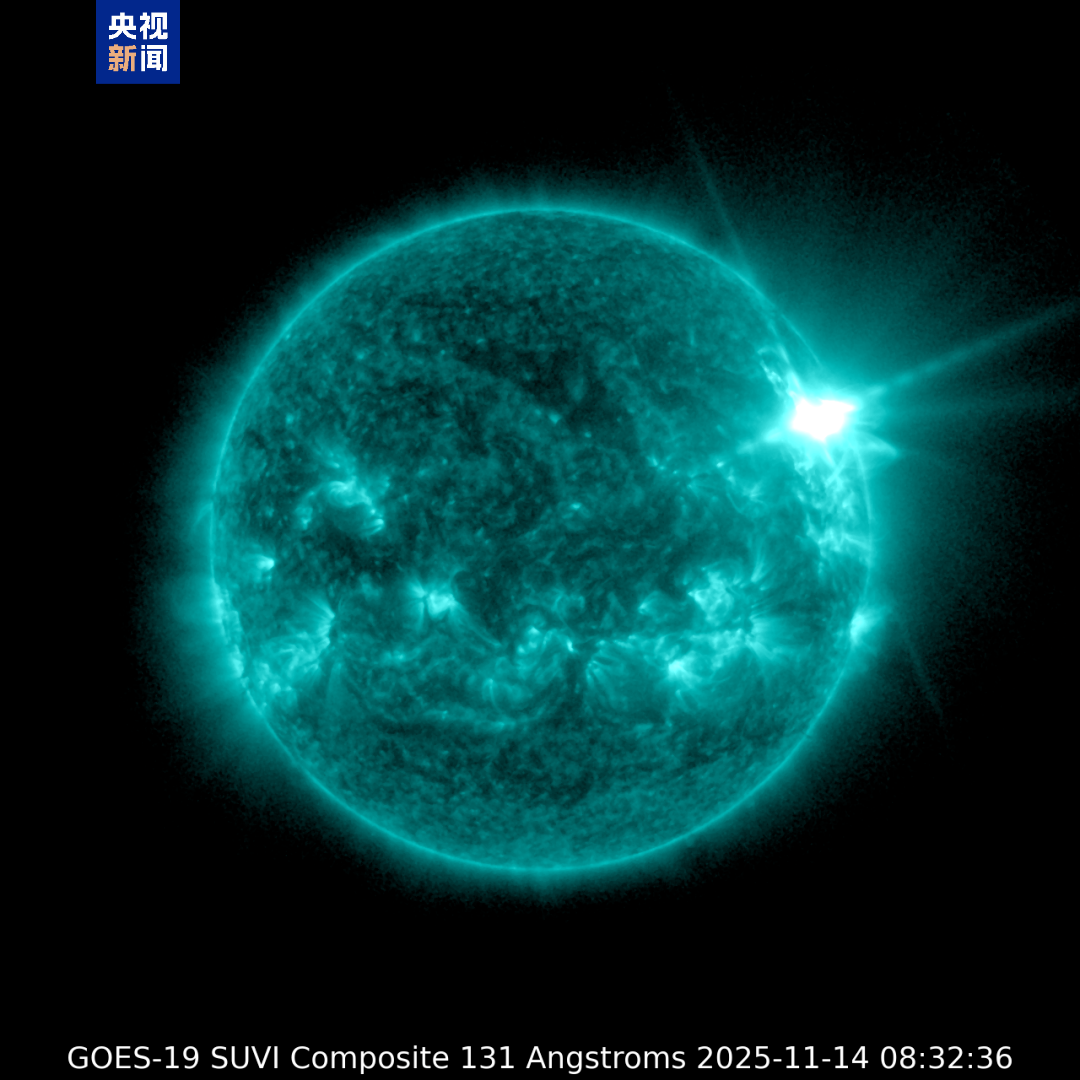
Core Points - The solar activity region 14274 erupted an X4.0 class flare on November 14, marking the fifth X-class flare during its current rotation cycle [1] - The timing of the flare coincided with daytime in most parts of China, potentially affecting shortwave radio communications due to changes in the ionosphere [3] - A coronal mass ejection occurred, but its trajectory is relatively away from Earth, minimizing direct impact [3] Summary by Sections - **Solar Activity**: The X4.0 class flare is significant as it is the fifth occurrence in the current solar rotation cycle [1] - **Impact on Communications**: The flare's occurrence during daytime may lead to disruptions in shortwave radio communications due to ionospheric changes [3] - **Future Predictions**: There is an expectation of minor geomagnetic storms in the coming days, with a low likelihood of M-class or higher flares. The solar activity level is predicted to be low, with geomagnetic activity remaining mostly calm to mildly disturbed [5]
强烈地磁暴来袭,我国北方多地有望邂逅极光
Ke Ji Ri Bao· 2025-11-14 06:35
Core Points - A significant geomagnetic storm began on November 12, 2023, with the real-time geomagnetic activity index reaching a maximum level of 9, indicating intense space weather activity [1] - The storm is attributed to recent strong solar activities, including multiple high-intensity solar flares classified as X1.8 and X1.1 on November 5, followed by M7.4 and M8.6 flares [1] - The geomagnetic storm is expected to allow for aurora observations in northern regions of China, particularly for observers north of the 40-degree latitude line [2] Group 1 - The geomagnetic storm is a result of a large, complex active region on the sun's surface that has produced multiple medium to high-intensity flares and significant coronal mass ejections [1] - High-energy particles from the storm collide with atmospheric molecules, creating auroras, with colors depending on the altitude and type of gas involved [2] - The auroras are considered a "byproduct" of geomagnetic storms, with the potential for observation extending to lower latitudes during periods of intense solar activity [2] Group 2 - While geomagnetic storms may affect shortwave communication and satellite navigation systems, their impact on human health is negligible [3] - The ongoing solar activity suggests that there may be further opportunities for aurora observations in various locations, providing more chances for astronomy enthusiasts [3]
近期可能出现极光,各位极光爱好者,做好准备了吗
Huan Qiu Wang Zi Xun· 2025-11-11 07:16
Group 1 - The recent solar activity, particularly from active region 12474, has resulted in multiple X-class flares, with a notable X1.2 flare occurring on November 10 [1][4] - Following the X-ray flux decrease from this flare, a significant amount of solar magnetic energy is being released through Coronal Mass Ejections (CMEs), which can impact Earth depending on their intensity and relative position [4][6] - The National Space Weather Monitoring and Warning Center has forecasted that multiple CMEs will likely lead to moderate to strong geomagnetic storms on November 11-12, with a possibility of minor storms on November 13 [6]