
AI Buildout

Search documents
UTG: The Right Way To Play The AI Buildout Card For Retirees
Seeking Alpha· 2026-03-06 14:15
Core Insights - The article highlights the extensive experience of Roberts Berzins in financial management, particularly in shaping financial strategies for top-tier corporates and executing large-scale financings [1] - It emphasizes Berzins' contributions to institutionalizing the REIT framework in Latvia, aimed at enhancing the liquidity of pan-Baltic capital markets [1] - The article also notes Berzins' involvement in developing national SOE financing guidelines and frameworks to channel private capital into affordable housing [1] Group 1 - Roberts Berzins has over a decade of experience in financial management [1] - He has played a significant role in institutionalizing the REIT framework in Latvia [1] - Berzins is a CFA Charterholder and holds an ESG investing certificate [1] Group 2 - He has contributed to the development of national SOE financing guidelines [1] - Berzins is actively involved in initiatives to support the development of pan-Baltic capital markets [1] - His background includes an internship at the Chicago Board of Trade [1]


Dividend Investing Hasn’t Been This Exciting In Some Time: 3 Stocks to Buy Immediately
Yahoo Finance· 2026-03-02 15:12
Core Viewpoint - There are significant opportunities in dividend stocks that can provide strong total returns over the long term, despite existing market risks [1] Group 1: Investment Opportunities - Three highlighted stocks offer healthy dividend yields, solid balance sheets, and impressive cash flow generation capabilities [3] - Enbridge (ENB) has a dividend yield in the mid-5% range and has maintained uninterrupted dividends for over 70 years, with 31 consecutive years of increases [4] - Fortis (FTS) is a utility company benefiting from structural tailwinds and is expected to deliver 6-7% annual dividend increases over the next five years [10] Group 2: Company Profiles - Enbridge's cash flow is stable due to long-term volume contracts, making it a defensive dividend stock in the energy sector [5] - Enbridge's payout ratio exceeds 100%, but management is focused on debt reduction and improving operating efficiency [6] - Fortis serves millions of customers across Eastern Canada, the U.S., and the Caribbean, positioning it well for future energy demand [8][9]


Clearway Energy Has Accelerating Growth From AI Buildout
Seeking Alpha· 2026-02-06 22:10
Core Viewpoint - Clearway Energy (CWEN) has made significant changes that support its ambitious growth guidance, projecting a Cash Available For Distribution (CAFD) of $2.90-$3.10 by 2030, indicating a compound annual growth rate (CAGR) of 7%-8% through 2030 [2][4]. Company Guidance - CWEN's long-term guidance includes a target CAFD of $2.90-$3.10 by 2030, reflecting a growth rate of 7%-8% CAGR [2]. - The growth rate is considered unusual for a yield-co, which typically focuses on steady cash flows to pay dividends, limiting retained cash for further investments [3][4]. Market Environment - The demand for energy has surged, driven by the rise of AI and the need for increased power capacity, while regulatory frameworks have not kept pace with this demand [5][6]. - CWEN is well-positioned to capitalize on this demand due to its developer mindset and a parent company pipeline of over 11 GW, which will be dropped down into CWEN at strong CAFD yields [6]. Project Pipeline - CWEN has a robust pipeline of projects, with several repowering initiatives already in progress, targeting CAFD yields of about 10.5% [12][14]. - The company has 863 MW of repowering projects locked in with power purchase agreements (PPAs), which are expected to yield double-digit returns [17]. Pricing Trends - Power purchase agreement (PPA) pricing has nearly doubled, which positively impacts CWEN's yield and organic growth potential [8][19]. - Historical PPA prices have seen a significant decline, but recent trends indicate a recovery, with prices expected to stabilize around $70/MWh for solar and wind by 2025-2026 [31][32]. Organic Growth Potential - The upward trend in PPA prices enhances CWEN's organic growth prospects, allowing for better contract renewals and reducing the risk of revenue declines from expiring contracts [34][36]. - CWEN aims to maintain a growth rate of CAFD per share at 5% or more beyond 2030, supported by favorable market conditions [37]. Share Structure and Valuation - CWEN has a dual share structure, with CWEN.A trading at a discount compared to CWEN, presenting an arbitrage opportunity for investors [38][39]. - The current valuation suggests that a 16X CAFD multiple is reasonable, given the company's growth ambitions and market conditions [37].


ORCL Class Action Alert: Robbins LLP Reminds Investors of the Lawsuit on Behalf of Oracle Corporation Bondholders
Globenewswire· 2026-02-06 00:25
Core Viewpoint - A class action has been filed against Oracle Corporation for allegedly misleading investors regarding its AI infrastructure funding needs and the associated debt requirements [1][2]. Group 1: Allegations and Financial Details - Oracle announced a $300 billion, five-year cloud computing contract with OpenAI on September 10, 2025, to supply computing power [2]. - Following this announcement, Oracle issued $18 billion in Senior Notes on September 25, 2025, to fund its AI infrastructure expansion [2]. - The complaint claims that Oracle did not disclose the need for additional significant debt to support the Oracle-OpenAI agreement [2]. - Reports emerged on November 13, 2025, indicating that Oracle was seeking to raise an additional $38 billion in debt, which would include $23 billion and $15 billion term loans from various banks [3]. - The proceeds from this additional debt would fund two data centers in Wisconsin and Texas, necessary for the Oracle-OpenAI agreement [3]. Group 2: Market Reaction - Following the news of the additional debt requirement, Oracle's Senior Notes began trading with yields and spreads similar to lower-rated issuers, indicating increased perceived credit risk among investors [3].


ClearBridge Global Infrastructure Income Strategy Q4 2025 Commentary
Seeking Alpha· 2026-01-15 14:00
Core Insights - Listed infrastructure underperformed global equities in Q4, despite two cuts in short-term rates in the U.S., due to higher long-term bond yields and a prevailing higher-for-longer sentiment [3] - European utilities outperformed U.S. utilities, aided by improving regulations, while renewables benefited from their increasing relevance in AI and policy derisking [3] Sector Performance - Underperforming sectors included natural gas utilities, energy infrastructure pipelines, communication towers, and North American rails, primarily due to higher production levels and adverse weather forecasts for natural gas [4] - Electric utilities, particularly in Western Europe, were the top contributors, with SSE and Iberdrola leading the performance [5][6][7] Company Highlights - SSE, the largest renewable energy generator in the U.K., saw its share price rise as funding risks diminished and macroeconomic concerns eased [6] - Iberdrola, a multinational integrated electric utility, raised guidance during its third-quarter results, reflecting strong operational performance [7] - OGE Energy and Redeia were the largest detractors, with OGE facing delays in a data center deal and Redeia impacted by negative sentiment from a regulatory review [8][9] Outlook - The outlook for listed infrastructure remains positive, with expectations of continued performance driven by inflection in electricity demand and solid earnings growth, supported by lower nominal bond yields [10] - Electric utilities are benefiting from several tailwinds, including the energy transition, climate change adaptation, and growing electricity demand from AI data centers and industrial sectors [11] Portfolio Highlights - The strategy saw positive contributions from eight out of ten sectors, with electric and water utilities being the top contributors, while energy infrastructure and communications were detractors [13] - The strategy outperformed relative to the FTSE Global Core Infrastructure 50/50, driven by stock selection in electric, water, and gas utility sectors, along with a renewables overweight [14] - Top contributors to absolute returns included SSE, Iberdrola, Enel, NextEra Energy, and Clearway Energy, while detractors included OGE Energy, Redeia, WEC Energy, Enbridge, and Crown Castle [15] Investment Activity - New positions were initiated in U.S. electric utilities Portland General Electric and Edison International, as well as French utility Engie and Brazilian utility Axia Energia, while positions in CPFL Energia, Crown Castle, and WEC Energy were exited [16]


Microsoft announces glut of new data centers but says it won't let your electricity bill go up
TechCrunch· 2026-01-13 20:15
Core Viewpoint - The tech industry, including major players like Microsoft, is committed to expanding AI infrastructure despite public backlash against data centers, with Microsoft adopting a "community-first" approach to address local concerns [1][2]. Group 1: Microsoft's Commitment to Community - Microsoft has pledged to be a "good neighbor" by ensuring that local electricity costs are not adversely affected by its data centers, promising to work with utility companies to cover its share of the burden on the local grid [3][4]. - The company has also committed to creating jobs in the communities where it operates and minimizing water usage, addressing environmental concerns associated with data centers [4]. Group 2: Public Backlash and Political Context - Data center construction has faced significant opposition, with 142 activist groups across 24 states organizing against such developments, indicating a growing political flashpoint [5]. - Microsoft has already experienced the impact of this backlash, having abandoned plans for a new data center in Caledonia, Wisconsin, due to negative community feedback, and facing protests in Michigan [6]. Group 3: Broader Implications and Responses - The backlash against data centers has reached the White House, with President Trump emphasizing the need for Microsoft to implement changes to prevent rising electricity bills for Americans [10]. - The effectiveness of Microsoft's new commitments to jobs, environmental stewardship, and electricity cost management in changing public opinion remains uncertain [10].


The Perks of Looking Beyond Traditional Infrastructure Assets
Etftrends· 2025-12-26 13:39
Core Insights - The BNY Mellon Global Infrastructure Income ETF (BKGI) expands the definition of infrastructure investing beyond traditional assets like bridges and roads to include non-traditional assets such as real estate, healthcare, and communication services [2][3][4] Group 1: Investment Strategy - BKGI's investment strategy includes a broader definition of infrastructure, allowing for investments in sectors that generate cash flow and have regulatory predictability [3][4] - The fund's approach enables access to attractive secular themes, including AI development and real estate trends, while still investing in traditional infrastructure companies [4] Group 2: Global Diversification - BKGI invests in a diverse range of companies globally, reflecting a popular investment theme for 2025 and continuing into 2026 [5] Group 3: Performance Metrics - As of October 31, 2025, BKGI has an annualized dividend yield of 5.09% and a year-to-date NAV increase of 35.98% as of December 8, 2025 [6] - Due to its strong 3-year performance, Morningstar upgraded BKGI's rating to 5 stars [6]

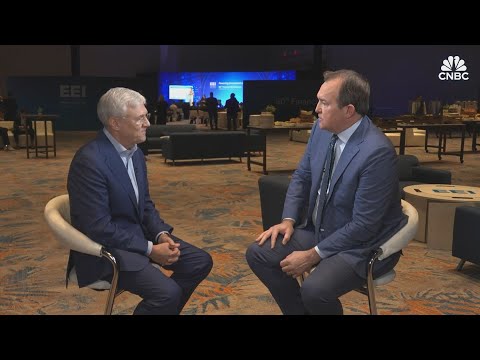
Edison Electric Institute CEO Drew Maloney on investing in the power grid
CNBC Television· 2025-11-10 20:56
Grid Investment and Infrastructure - The electrical grid is the most critical engine in America, with companies investing over $1 trillion (万亿) in the next 5 years to ensure reliable and affordable power for the growing economy [2][3] - Permitting costs can account for 20% of electricity bills, highlighting the need for permitting reform to reduce costs and expedite power delivery [7] - Data centers want to be connected to the grid for reliability and a diverse energy mix, potentially lowering costs and stabilizing the grid [12][13][14] Energy Sources and Technologies - There are currently zero nuclear power plants under construction in the United States, with optimism surrounding small modular reactors, though none are currently operating [5] - The industry needs as much power and as many electrons on the grid as possible, emphasizing the need to accelerate power generation [6] - While government incentives exist for nuclear power development in national labs, proving the technology and building large-scale nuclear plants is crucial [9][10] Regulatory and Policy Issues - Permitting reform is needed, as building a power plant or transmission line in the US can take over a decade, compared to less than three years in China [6] - Bureaucratic red tape, including NEPA, water permits, and litigation, adds time and costs to infrastructure projects, which is unacceptable for customers [7][8] - Congress is called upon to pass permitting reform to accelerate power delivery and lower costs [6]
Forget the Fed: Here's the Real Market Driver
Investor Place· 2025-10-31 23:35
Core Insights - The Federal Reserve's recent interest rate cut occurred while the S&P was at all-time highs, historically leading to an average return of 20% over the next year [1][2] - The current market dynamics suggest that the Fed's interest rate policy may be less relevant due to the ongoing AI buildout, which is driving significant capital expenditures [2][3] AI Buildout and Investment Opportunities - The AI buildout is characterized by investments in data centers, power infrastructure, high-performance chips, and advanced cooling systems, indicating a capex supercycle [3][4] - Companies involved in building the infrastructure for AI, such as those providing power equipment and data center solutions, are expected to benefit significantly from this trend [6][19] - The demand for energy is projected to increase dramatically as AI technologies, particularly generative AI, require substantial electricity to operate [8][18] Energy Demand and Corporate Strategy - The shift towards AI is prompting companies to reconsider their workforce strategies, with many opting to maintain or reduce staff while relying on AI to enhance productivity [15][17] - The U.S. data center electricity demand is expected to double by 2030, with the AI boom potentially consuming as much power as an entire industrialized nation [18][20] - Major tech firms are securing long-term energy contracts and investing in renewable energy sources to meet their growing power needs [19][20] Recent Earnings Reports - Amazon reported strong earnings, beating revenue and earnings expectations, and raised its capital expenditure forecast to $125 billion, driven by a 20% increase in Amazon Web Services [25] - Apple also exceeded earnings expectations but faced slight pressure due to lower-than-expected iPhone sales in China, although management remains optimistic about future revenue growth [26] - The overall performance of major tech companies indicates continued enthusiasm for AI investments, with strong earnings supporting market confidence [27]



PG&E CEO Poppe on Earnings, Rates and AI Buildout
Yahoo Finance· 2025-10-23 22:27
Core Insights - PG&E CEO Patti Poppe discussed the company's third-quarter earnings and its strategic initiatives in AI and wildfire preparedness [1] Financial Performance - The company reported its third-quarter earnings, highlighting key financial metrics and performance indicators [1] AI Initiatives - PG&E is actively involved in the AI buildout, indicating a commitment to leveraging technology for operational improvements [1] Wildfire Preparedness - The company is making preparations for potential wildfires, emphasizing its focus on safety and risk management [1]
