Quantitative Investment

Search documents
Fast Money Funds Ditch US Stocks For Safe Havens as Jitters Rise
Yahoo Finance· 2026-02-27 10:30
Cboe, Bloomberg The latest bout of volatility lashing US stocks has driven some quantitative investment managers completely out of equities and into less risky assets. The shift reflects a broader repositioning among systematic investors who rely on quantitative signals rather than fundamental analysis. These funds use data and model-driven allocation to mechanically increase exposure during sustained uptrends and cutting risk when volatility rises or trends weaken. Most Read from Bloomberg The S&P 50 ...
How This Foreign Equities ETF Uses Quantitative Data to Set Itself Apart
Etftrends· 2026-02-26 13:46
Core Insights - The Fidelity Enhanced International ETF (FENI) has shown strong performance in foreign equities, returning 37.25% over the past year as of December 31, 2025, amidst a successful year for foreign equities [1] - FENI employs a quantitative data-driven investment approach, focusing on identifying businesses with durable competitive advantages at reasonable prices [1] - The ETF charges a fee of 28 basis points and is set to celebrate its three-year milestone in 2026, which is significant for brokerage consideration [1] Investment Strategy - FENI's investment strategy is grounded in systematic equity analysis, utilizing computer-aided models to objectively rank individual securities [1] - The fund primarily invests in stocks from the MSCI EAFE index, excluding the U.S. and Canada, and emphasizes metrics such as growth, profitability, and historical valuation [1] - The managers believe that financial markets are not fully efficient due to behavioral tendencies of investors, and thus apply a systematic process to mitigate emotional biases [1] Future Outlook - FENI's quantitative approach positions it well for continued outperformance in foreign equities as market conditions evolve in 2026 [1] - The fund's long-standing track record since its conversion from a mutual fund in 2007 supports its credibility and investment process [1]


《2025基金行业发展现状与投资趋势研究报告》正式发布
Zheng Quan Ri Bao Wang· 2026-02-11 12:13
Core Insights - The report titled "2025 Fund Industry Development Status and Investment Trends Research Report" was jointly released by Tsinghua University's Wudaokou School of Finance and several research centers to analyze global fund industry dynamics and assess the financial service efficiency of China's fund industry [1] Group 1: Global Fund Industry Development Analysis - The first part of the report provides a global perspective, systematically reviewing the development status, business characteristics, and future trends of major fund markets including the US, Europe, Singapore, and Japan [1] - It includes an in-depth analysis of public and private funds as well as investor behavior in mainland China and Hong Kong, aiming to offer a comprehensive and objective cross-market comparison and trend judgment [1] Group 2: Global Investment Market Special Analysis - The second part focuses on current frontier issues in the financial market, particularly discussing the synergy between ETF strategies and market ecology, as well as the integration of quantitative investment innovations with AI technology [1] - This section aims to reveal the profound impact of new technologies and asset classes on the global investment landscape, providing forward-looking perspectives and decision-making references for industry participants [1]
智驭未来:人工智能驱动资产管理新范式 | 清华五道口香港论坛
清华金融评论· 2026-02-03 08:43
Core Viewpoint - The forum highlighted the transformative impact of artificial intelligence (AI) on the asset management industry, while also addressing the challenges that lie ahead in its implementation and integration [3][5][17]. Group 1: Key Insights from Keynote Speakers - Liang Dingbang emphasized that different asset management firms are leveraging AI in varied ways, with large firms using proprietary AI platforms for risk analysis, while smaller funds utilize third-party tools to enhance investment insights [3]. - Yang Qiang discussed the evolution of AI towards multi-modal integration and intelligent systems, stressing the need for decentralized models to address challenges in various sectors, including finance [5]. - Wu Chao pointed out the symbiotic relationship between quantitative trading and AI, highlighting the shift from linear models to end-to-end AI models that enhance data processing capabilities [7][8]. Group 2: Roundtable Discussions - Zhang Wei noted that the asset management industry is transitioning from experience-based decision-making to data-driven approaches, driven by advancements in AI technology [10]. - Gao Bin argued that AI cannot fully replace human judgment in investment activities due to the inherent complexities and unpredictability of the market [12]. - Zhong Hong highlighted the importance of human-machine collaboration in the future of asset management, where AI's computational efficiency complements human insight and judgment [17]. - Xia Chun pointed out that even as AI becomes more integrated into investment processes, human oversight will remain crucial for accountability and regulatory compliance [19].

年仅40岁,百亿量化私募创始合伙人逝世
21世纪经济报道· 2026-02-02 11:42
Core Viewpoint - The announcement of the passing of Shen Xianbing, the founding partner of Qilin Investment, highlights the impact of leadership changes in the private equity sector, particularly in quantitative investment firms [1][2]. Group 1: Company Overview - Qilin Investment was founded in 2015 by Shen Xianbing, Wang Hongyong, and Dong Cheng, focusing on quantitative investment and becoming a representative of the University of Science and Technology of China (USTC) system in the private equity sector [2]. - As of October 2025, Qilin Investment manages an asset scale of 150 billion RMB, positioning it as one of the leading quantitative private equity firms in China [2]. Group 2: Leadership and Background - Shen Xianbing, who passed away at the age of 40, graduated from USTC with a degree in physics and had prior experience at companies such as Anhui Keda Xunfei Information Technology Co., Ltd., Shanghai Yiju Information Technology Co., Ltd., and Shanghai Dingjian Communication Technology Co., Ltd. [2]. - Wang Hongyong, the other co-founder, also holds a bachelor's degree in physics from USTC, indicating a strong academic background in the founding team [2].

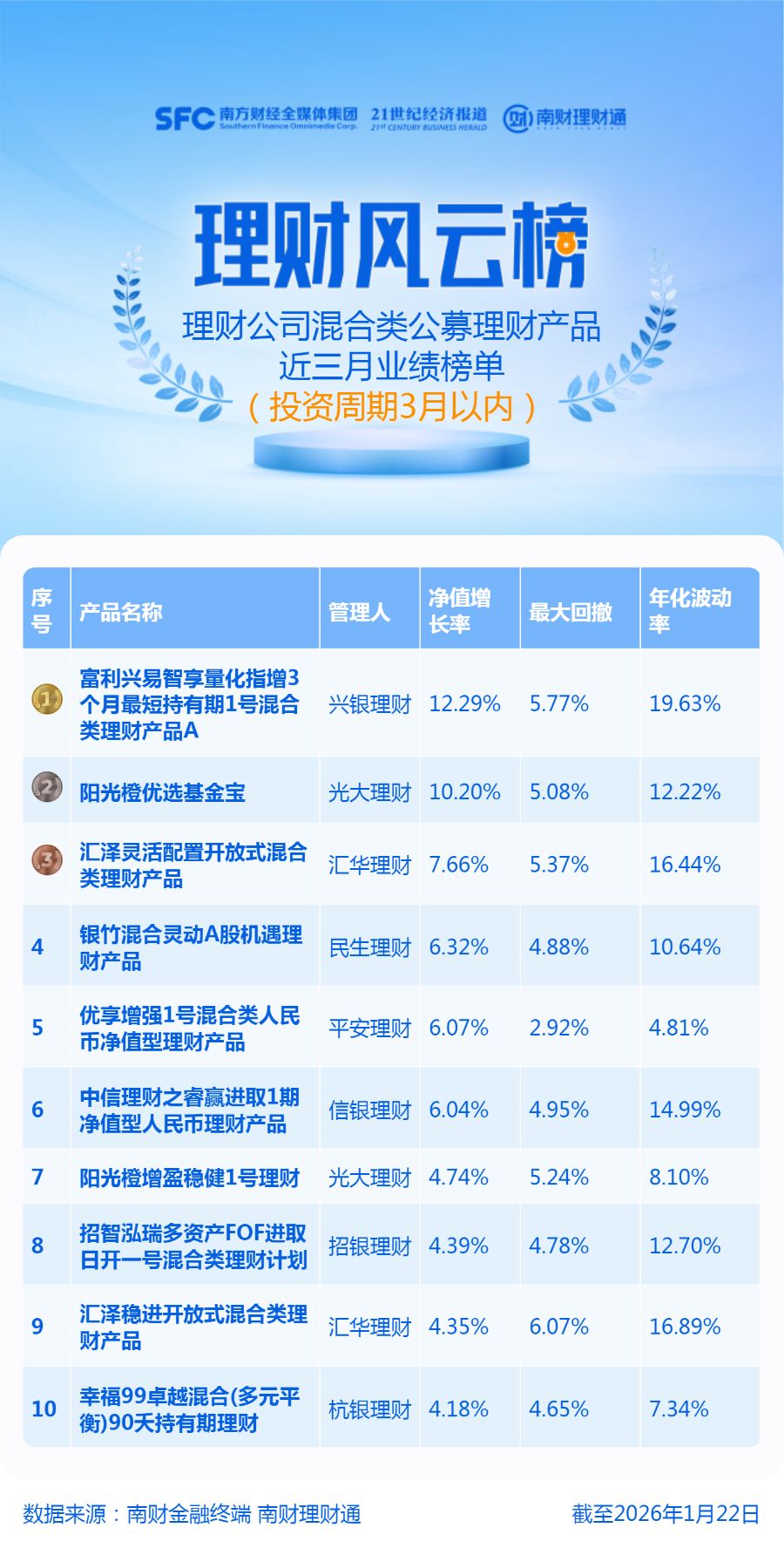
A股行业与板块显著分化,量化指增混合类产品再夺榜首!
2 1 Shi Ji Jing Ji Bao Dao· 2026-01-30 09:44
Market Performance - In Q4 2025, the A-share market's technology sector experienced a phase adjustment, with funds shifting from previously hot areas like computing power and AI applications to dividend-stable, cash-rich assets [5] - The dividend sector showed overall stable performance, with high dividend and stable earnings sub-sectors performing prominently, while some consumer and media dividend stocks faced pressure [5] Mixed Public Fund Performance - As of January 22, 2026, there are 329 mixed public funds with an investment period of less than 3 months, with over 60% of these funds showing a net value growth rate of less than 1% in the last three months [6] - Nearly 30% of the funds had a net value growth rate between 1% and 4% [6] - Notably, Everbright Wealth and Huihua Wealth each had two products listed in the performance rankings, while other firms like Xingyin Wealth, Minsheng Wealth, Ping An Wealth, Xinyin Wealth, Zhao Yin Wealth, and Hangyin Wealth each had one product listed [6] Product Analysis - Xingyin Wealth's "Fuli Xingyi Intelligent Quantitative Index Growth 3-Month Minimum Holding Period No. 1 Mixed Wealth Management Product A" topped the list with a net value growth rate of 12.29% over the last three months [7] - This product focuses on equity asset allocation, with 54.19% of its holdings in equity assets as of the end of Q4 2025, and minor allocations to public funds and financial derivatives at 4.43% and 1.60%, respectively [7] - As a mid-to-high risk level product, it emphasizes risk control through multi-factor diversification and balanced industry allocation, adapting to the market's shift from aggressive growth to dividend and value sectors [7]
Mackenzie Investments Partners with SEI to Expand U.S. Institutional Presence
Prnewswire· 2026-01-27 13:00
Core Viewpoint - Mackenzie Investments and SEI have launched four new Collective Investment Trusts (CITs) to provide U.S. institutional investors with access to Mackenzie's Global Quantitative Equity strategies, combining advanced data science with human insight to generate alpha while managing risk [1][2][3]. Group 1: New Investment Offerings - The newly launched CITs include the following strategies: Mackenzie Quantitative International Large Cap CIT, Mackenzie Quantitative International Small Cap CIT, Mackenzie Quantitative US Small Cap CIT, and Mackenzie Quantitative Emerging Markets All Cap CIT [7]. - These CITs are designed to streamline access for defined contribution and defined benefit plans to Mackenzie's holistic quantitative investment approach [2]. Group 2: Partnership and Operational Excellence - SEI Trust Company will serve as the trustee for the new CITs, enhancing operational scale and fiduciary capabilities to meet the needs of U.S. institutional investors [3][4]. - The partnership aims to empower institutional investors, allocators, consultants, and recordkeepers with efficient investment options, reflecting a commitment to operational excellence and fiduciary service [4]. Group 3: Company Backgrounds - Mackenzie Investments, a Canadian investment management firm, manages approximately $244 billion (CAD) in assets as of December 31, 2025, and is part of IGM Financial Inc., which has total assets under management and advisement of approximately $310 billion (CAD) [5]. - SEI, a global provider of financial technology and asset management services, manages, advises, or administers approximately $1.8 trillion in assets as of September 30, 2025 [6].


Mackenzie Investments Partners with SEI to Expand U.S. Institutional Presence - SEI Investments (NASDAQ:SEIC)
Benzinga· 2026-01-27 13:00
Core Viewpoint - Mackenzie Investments and SEI Trust Company have launched four new Collective Investment Trusts (CITs) to provide U.S. institutional investors with access to Mackenzie's Global Quantitative Equity strategies, combining advanced data science with human insight to generate alpha while managing risk [1][2]. Group 1: Company Overview - Mackenzie Investments is a Canadian investment management firm with approximately $244 billion (CAD) in assets under management as of December 31, 2025, and aims to deliver strong investment performance and innovative portfolio solutions [4]. - SEI is a global provider of financial technology, operations, and asset management services, managing, advising, or administering approximately $1.8 trillion in assets as of September 30, 2025 [5]. Group 2: Collective Investment Trusts Details - The newly launched CITs include the Mackenzie Quantitative International Large Cap CIT, Mackenzie Quantitative International Small Cap CIT, Mackenzie Quantitative US Small Cap CIT, and Mackenzie Quantitative Emerging Markets All Cap CIT [6]. - The CITs are designed to offer defined contribution and defined benefit plans streamlined access to Mackenzie's investment strategies, reinforcing the commitment to U.S. institutional investors [2][3]. Group 3: Trustee and Operational Excellence - SEI Trust Company will serve as the trustee for the CITs, leveraging its 30 years of expertise in the CIT space to provide trustee, accounting, valuation, administrative, and fiduciary services [3]. - The partnership between Mackenzie and SEI aims to enhance operational excellence and fiduciary service, empowering institutional investors with efficient investment options [3].

2025量化私募交出高分卷,头部机构领跑业绩赛道
Xin Hua Cai Jing· 2026-01-22 14:44
Core Insights - The quantitative private equity industry is expected to achieve nearly 100% positive returns by 2025, with significant performance disparities favoring larger firms [1][2] - The average return for quantitative private equity stock strategies in 2025 is projected to exceed 36%, with 98% of firms reporting positive returns [1] - The industry is experiencing a "Matthew Effect," where resources and returns are increasingly concentrated among leading firms [1] Performance by Scale - Firms with over 10 billion yuan in assets show the strongest performance, with 40 firms achieving an average return of 42.87% and 100% positive returns [1][2] - The 50-100 billion yuan tier has 23 firms with an average return of 35.51% and a 95.65% positive return rate [2] - The 20-50 billion yuan tier has 28 firms achieving 100% positive returns with an average return of 40.73% [2] - Smaller firms (0-5 billion yuan and 5-10 billion yuan) lag behind, with average returns of 34.57% and 32.87%, respectively [2] Factors Influencing Performance - Leading firms benefit from strong capital and research capabilities, allowing them to invest in factor exploration, model iteration, and technology upgrades [3] - Mid-sized firms are in a "golden development phase," balancing strategy capacity and return elasticity effectively [3] - Smaller firms face challenges in scaling and upgrading strategies, leading to performance volatility [3] Long-term Focus and Investor Guidance - The industry is increasingly focused on long-term shareholder interests, with many firms increasing dividend payouts [4] - Investment managers recommend that investors consider research capabilities, strategy stability, and scale adaptability when selecting quantitative private equity products [3]
准百亿私募年度业绩榜揭晓!盛麒、云起、喜世润领衔!量魁、会世、念空等上榜!
私募排排网· 2026-01-21 10:00
Core Insights - The article discusses the emergence of "quasi-billion" private equity firms in China, defined as those managing between 5 billion to 10 billion yuan, highlighting their potential to transition into top-tier institutions in the future [3] Group 1: Overview of Quasi-Billion Private Equity Firms - As of December 2025, there are 122 quasi-billion private equity firms in China, up from 110 in Q3 2025 [3] - Among these firms, 66 are subjective, 35 are quantitative, and 18 employ a combination of both investment strategies [3] - The distribution of core strategies shows that 69 firms focus on stock strategies, 10 on bond strategies, 19 on multi-asset strategies, and 10 on futures and derivatives strategies [3] - The majority of these firms are located in Shanghai (54), followed by Beijing (29) and Shenzhen (16) [3] Group 2: Performance of Quasi-Billion Private Equity Firms - In 2025, the average return for 376 products under quasi-billion private equity firms was 29.44%, with 92.02% of products yielding positive returns [5] - The top ten performing quasi-billion private equity firms in 2025 include 盛麒资产, 云起量化, 喜世润投资, and others [5] Group 3: Top Performing Products - The average return for subjective long-only products was 36.28%, with 喜世润投资's product leading the performance [8] - For quantitative long-only products, the average return was 48.95%, significantly outperforming subjective strategies [11] - The top three products in the quantitative long-only category were from 量魁私募, 上海合骥私募, and 安子基金 [11] Group 4: CTA Strategies - The average return for CTA strategy products was 16.65%, with 会世私募, 宏锡基金, and 洛书投资 leading the performance [14] - The only subjective CTA product listed was 嘉鸿基金's product, which also performed well [16] Group 5: Market Neutral Strategies - The average return for market-neutral products was 8.23%, with 量魁私募 and 念空私募 among the top performers [17] Group 6: Multi-Asset Strategies - The average return for multi-asset strategy products was 17.58%, with 喜世润投资 and 洛书投资 leading the performance [21]