
Energy Storage

Search documents
Solar(CSIQ) - 2025 Q3 - Earnings Call Transcript
2025-11-13 14:00
Financial Data and Key Metrics Changes - In Q3 2025, total revenue reached $1.5 billion, landing at the high end of expectations, with a gross margin of 17.2%, exceeding guidance due to strong contributions from energy storage shipments [5][22] - Net income attributable to shareholders was $9 million, resulting in a net loss of $0.07 per diluted share, impacted by preferred shareholder effects [6][22] - Operating expenses normalized to $222 million, reflecting lower shipping costs and ongoing internal cost reductions [22] Business Line Data and Key Metrics Changes - Solar module shipments totaled 5.1 gigawatts, in line with expectations, while energy storage shipments reached a record 2.7 gigawatt-hours [5][11] - CSI Solar reported revenue of $1.4 billion, with a gross margin decrease of 730 basis points to 15%, driven by margin changes in both solar and storage businesses [11] - Recurrent Energy generated $102 million in revenue with a gross margin of 46.1%, primarily from profitable project sales [16] Market Data and Key Metrics Changes - The contracted backlog for energy storage solutions increased to $3.1 billion, supported by new projects in North America and Europe [12] - The company is expanding into new markets like Germany and Australia for residential energy storage, which is on track to become profitable in 2025 [9][14] Company Strategy and Development Direction - The company is focusing on U.S. manufacturing investments, with plans for solar cell production in Indiana and lithium battery production in Kentucky [8] - The strategy includes increasing project ownership sales in 2026 to enhance cash recycling and reduce leverage [26] - The company aims to differentiate itself through a resilient combination of strategy and execution amid a complex macro environment [6][7] Management's Comments on Operating Environment and Future Outlook - Management noted that the solar industry is at an inflection point, with market conditions stabilizing after a downturn [6] - The rise of AI-driven data centers is creating unprecedented global electricity demand, which the company aims to address with solar plus storage solutions [8][9] - Management expressed confidence in meeting OBBBA requirements and maintaining financial discipline while pursuing growth [34][50] Other Important Information - The company plans to maintain disciplined volume management, projecting module shipments of 4.6-4.8 gigawatts for Q4 2025 [25] - Total debt increased to $6.4 billion, primarily due to new borrowings tied to project development assets [24] Q&A Session Summary Question: Can you talk about the strategy of timing and leverage for project sales? - Management indicated they have enough operational projects to sell without needing to sell early, focusing on maximizing value post-COD [30] Question: Can you discuss the maturity of supplier relationships for U.S. manufacturing? - Management stated that there are many suppliers outside China, and they are confident in meeting OBBBA requirements for domestic content [32][34] Question: How do you bridge the gross margin gap with your A-share subsidiary? - Management clarified that the gross margin for project sales was significantly higher, supporting overall margins despite lower manufacturing margins [38][46] Question: What is the expected growth rate for U.S. installations in 2026? - Management expects stable demand for solar installations, while energy storage is anticipated to grow, particularly driven by data center-related demand [70][72] Question: How much of the 14-17 gigawatt-hours of shipment is expected to be in the U.S.? - Management indicated that around two-thirds of the shipments will be outside the U.S., reflecting a diversified portfolio [78]

Energy Vault(NRGV) - 2025 Q3 - Earnings Call Transcript
2025-11-10 22:30
Financial Data and Key Metrics Changes - Q3 2025 revenue reached $33.3 million, a 27-fold increase year-over-year compared to $1.2 million in Q3 2024, driven by strong execution on projects in Australia and initial contributions from the Asset Vault assets [17] - GAAP gross profit for Q3 2025 was $9 million, improving nearly 18 times from the prior year, resulting in a gross margin of 27% for the quarter and 32.6% year-to-date [17] - Adjusted EBITDA loss narrowed to $6 million in Q3 2025 from a loss of $14.7 million in the prior year, reflecting higher revenue and gross profit [18] Business Line Data and Key Metrics Changes - The company has built, commissioned, and is now operating two initial projects in Texas and California, contributing to the revenue for the first time in Q3 [4] - The contract backlog remains near $1 billion, more than doubling this year and about four times what it was from the same time last year [12] - The company expects to deliver approximately $150 million in revenue in Q4 2025, driven by ongoing projects in Australia and the U.S. [12] Market Data and Key Metrics Changes - The total developed pipeline for advanced projects is around $2.1 billion, or roughly 8.7 gigawatt-hours [20] - The company anticipates receiving $40 million in investment tax credit proceeds in Q4 2025, contributing to an expected cash balance of $75 million to $100 million by year-end [18][21] Company Strategy and Development Direction - The launch of the Asset Vault platform marks a significant strategic move, focusing on developing, owning, and operating energy storage assets [4][22] - The company aims to accelerate deployment of 1.5 gigawatts in attractive priority markets, with a clear monetization strategy supported by long-term offtake agreements [22][23] - Energy Vault is positioned to generate predictable, recurring, and high-margin cash flows through the vertically integrated ecosystem created by the Asset Vault [22] Management's Comments on Operating Environment and Future Outlook - Management acknowledges the volatile operating environment, including tariff impacts and macroeconomic uncertainties, but remains confident in maintaining guidance due to ongoing project deliveries [35] - The company is experiencing a target-rich environment for asset acquisition, indicating strong opportunities despite market challenges [35] - Management emphasizes the importance of agility and operational expertise in navigating market fluctuations and maintaining a diverse project portfolio [36] Other Important Information - Energy Vault has improved its ESG scores, placing in the top 98% of all companies reviewed by S&P Global, and maintaining its leadership in the energy storage segment [15] - The company has completed a $300 million preferred equity agreement to fund the Asset Vault, which is expected to significantly enhance cash flow and project financing capabilities [18][22] Q&A Session Summary Question: R&D expense decline and future capitalization - Management noted that the decline in R&D expenses reflects cost-tightening measures and a shift in focus towards activities related to Asset Vault [30][31] Question: Customer acquisition pace amid macro uncertainty - Management indicated that while there have been delays due to market volatility, they are holding their guidance and seeing a rich environment for asset opportunities [34][35] Question: Backlog inclusion of recently announced projects - The current backlog does not include the recently announced projects in Albania, but these will be added to both the backlog and Asset Vault once finalized [40][45] Question: Increase in development pipeline - The increase in the development pipeline reflects stage four or five opportunities that have been shortlisted or awarded, with specific projects not disclosed [46]

Alliant Energy(LNT) - 2025 Q3 - Earnings Call Presentation
2025-11-07 15:00
Financial Performance & Growth - Alliant Energy achieved a total shareholder return of approximately 10% with a 10-year compound annual EPS growth of 6.5%[6] - The company is initiating 2026 EPS guidance, projecting a 6.6% increase over the 2025 EPS guidance midpoint[6] - The long-term annual EPS growth target is set at 5-7%+, with projections at or above the high end for 2027-2029[6] - Updated 2025 ongoing EPS guidance is between $3.17 and $3.23[9] - 2026 EPS guidance is projected to be between $3.36 and $3.46[10] - The 2026 dividend target is $2.14 per share, representing a 5.4% increase over the 2025 target[11, 13] Load Growth & Capital Expenditure - Data center demand is expected to drive a 50% increase in projected demand by 2030, compared to 2024 levels[6, 20] - The company has a $13.4 billion 4-year capital expenditure plan, which is a 17% increase over the prior plan[6] - Approximately 3 GW of peak obligation to serve is included in the capital expenditure plan[18] Investments & Funding - The company plans to invest $4.7 billion in natural gas generation, $4.4 billion in energy storage and renewables, and $4.3 billion in electric & gas distribution, technology & other from 2026-2029[25, 26] - The capital expenditure program will be funded through cash from operations (34%), tax credit monetization (12%), new debt (36%), and equity (18%)[28] Regulatory & Customer Focus - Wisconsin electric revenue requirement increase of $79 million in 2026 and $73 million in 2027[44] - Wisconsin gas revenue requirement increase of $7 million in 2026 and $5 million in 2027[44]

中国工业科技-2025 年第三季度业绩整体符合预期,个股涨跌分化;人工智能、储能需求与海外扩张为核心亮点
2025-11-07 01:28
Summary of Conference Call Notes Industry Overview - The conference call discusses the performance of the China Industrial Tech sector, focusing on various companies within the industry, particularly in the areas of AI, energy storage systems (ESS), and consumer electronics. Key Highlights 1. **3Q25 Results**: - The sector average revenue and operating profit increased by 18% and 17% year-over-year respectively, with results mostly in-line with expectations [1][2] - Notable performance drivers included: - Capacity buildout by major domestic PCB customers for AI applications, particularly Hans Laser [1] - Capital expenditures in batteries and consumer electronics [1] - Strong demand in AIDC power and ESS, along with export demand [1] - Liquid cooling technology advancements [1] - Market share gains in the industrial automation segment [1] - Effective cost control leading to margin improvements [1] - Expansion into new technology markets such as infrared [1] 2. **Challenges Faced**: - Smaller players struggled with scaling and profitability [1] - Prolonged capital expenditure weakness in process automation sectors like steel and chemicals [1] - Delays in defense orders impacting AVIC Jonhon [1] - Margin deterioration due to high exposure to precious metals [1] 3. **Margin Trends**: - Smaller companies like HCFA are more vulnerable in a deflationary environment with ASP pressure [2] - AVIC Jonhon faced margin deterioration due to precious metal price hikes [2] - Larger players like Sanhua achieved margin beats through stringent cost control [2] - Kstar's ESS segment gross profit margin improved by over 3 percentage points due to a favorable product mix [2] Actionable Investment Ideas 1. **Buy Recommendations**: - Hans Laser: Strong demand in PCB and consumer electronics [3] - Kstar: Beneficiary of AIDC power and overseas ESS growth [3] - Inovance: Resilient performance in industrial automation [3] - Nari Tech and Centre Testing: Defensive plays with stable margins [3] 2. **Sell Recommendations**: - Raycus: Limited military end-market sales [3] - Baosight: Continued weakness in domestic steel industry capex [3] - Sanhua-A: Potential profit-taking pressure due to optimistic market expectations [3] Sector Focus Areas 1. **AI Demand**: - Hans Laser is experiencing strong growth in PCB equipment sales driven by capex expansion from key customers like Victory Giant [6] - Kstar anticipates higher sales growth in data center products due to increasing orders from domestic and overseas customers [6] 2. **Energy Storage**: - Sungrow expects 40%-50% global ESS installation growth in 2026, driven by renewable energy needs and market-driven policies in China [7] - Kstar aims to double its ESS sales growth in 2025, supported by positive demand outlook [7] 3. **Consumer Electronics**: - OPT anticipates stronger demand due to shifts in product form factors, particularly with Apple's upcoming products [8] - Han's Laser is benefiting from solid demand for iPhone 17 and next-generation smartphone equipment [8] 4. **Overseas Expansion**: - Hongfa has a dominant market share in HVDC relays and is expanding capacity in Germany and Indonesia to meet EV demand [10] - Inovance is also expanding overseas to support sales growth in EV powertrain products [10] Additional Insights - The conference call highlighted the importance of product mix and cost control in maintaining margins amid challenging market conditions [2][3] - The outlook for the sector remains positive, particularly in AI and energy storage, despite some challenges faced by smaller players and specific sectors [6][7][8]





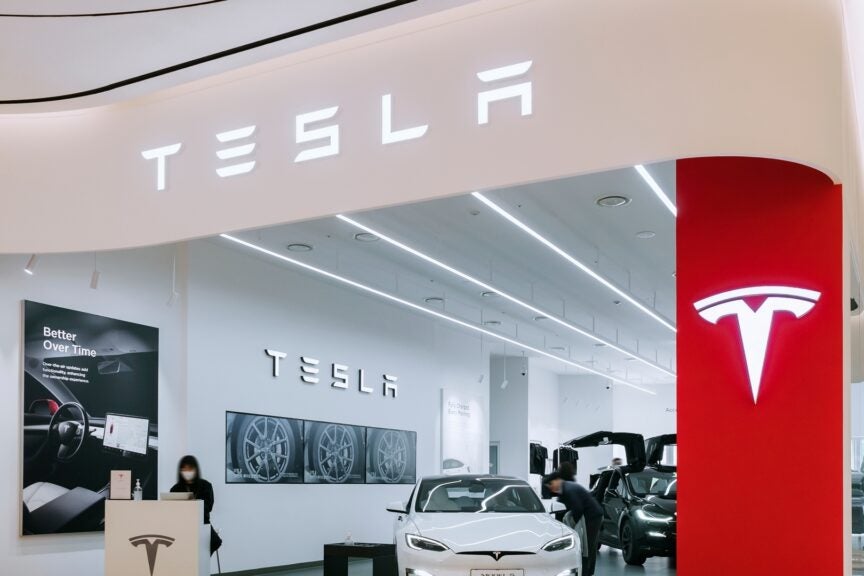
Tesla Is Set to Buy $2 Billion in Energy Storage Systems Batteries. What Does That Actually Mean for TSLA Stock?
Yahoo Finance· 2025-11-06 18:44
Core Insights - Tesla has reached a significant supply agreement with Samsung SDI, valued at over 3 trillion won (approximately $2.1 billion), for battery cells over a three-year period, marking the largest battery order for Samsung SDI [1][6][14] - The agreement is primarily aimed at supporting Tesla's Energy Storage System (ESS) business, specifically for products like Megapack and Powerwall, rather than its electric vehicle segment [7][8][14] - Tesla's energy storage division has shown impressive growth, contributing about 12% of total revenue in Q3, with a record revenue of $3.4 billion, reflecting a 44% year-over-year increase [12][14] Company Developments - Tesla's market cap stands at $1.48 trillion, and the company is focused on accelerating the transition to sustainable energy through electric vehicles, solar energy systems, and energy storage products [3] - The company is diversifying its battery supply chain, having previously relied on CATL and BYD, to mitigate tariff-related costs, which amounted to approximately $400 million in Q3 [11][14] - The deal with Samsung SDI follows another agreement with LG Energy Solution for lithium-iron-phosphate (LFP) batteries, indicating Tesla's strategy to secure multiple suppliers for its energy storage needs [11][14] Market Context - Tesla shares have gained 10% year-to-date, despite facing pressure from broader market concerns, including a rejection of a proposed compensation package for CEO Elon Musk by Norway's sovereign wealth fund [2][4] - Analysts remain divided on Tesla's stock, with a consensus rating of "Hold," reflecting mixed sentiments about the company's future performance [13] - The growing demand for ESS in North America, driven by AI investments, has prompted Tesla to secure this supply agreement, positioning the company to capture a larger share of the expanding energy storage market [8][14]

Elon Musk-Led Tesla Pens $2 Billion Energy Storage Deal With Samsung After 44% Growth In Q3: Report - NVIDIA (NASDAQ:NVDA), Tesla (NASDAQ:TSLA)
Benzinga· 2025-11-03 11:51
Group 1 - Tesla Inc. has agreed to a $2 billion deal with Samsung SDI to supply energy storage system batteries over the next three years [2][3] - Tesla's Energy Storage business has experienced a 44% growth, generating $3.4 billion in revenue, which accounts for 12% of the company's total revenue [3] - Tesla previously signed a $4.3 billion deal with LG Energy Storage Solutions for LFP batteries for its energy storage systems [4] Group 2 - Redwood Materials, a battery recycling and energy storage startup founded by Tesla co-founder JB Straubel, secured over $350 million in Series E funding, with backing from Nvidia's NVentures [5] - Tesla scores well on Momentum and Quality metrics, with satisfactory Growth but poor Value, and has a favorable price trend in the short, medium, and long term [6]

TETRA Technologies(TTI) - 2025 Q3 - Earnings Call Presentation
2025-10-29 14:30
Company Overview - TETRA's market capitalization is $105 billion as of October 24, 2025[14] - The company's net debt is $114 million as of September 30, 2025[14] - The enterprise value is $117 billion as of October 24, 2025[14] - Q3 2025 TTM revenue is $619 million, with an adjusted EBITDA margin of 187%[15,21] Financial Performance and Targets - 2024 revenue was $599 million, with adjusted EBITDA of $994 million[20] - 2025 revenue guidance is $620-630 million, with adjusted EBITDA of $107-112 million[20] - The company targets 2030 revenue of $125 billion, representing a 15% CAGR, and adjusted EBITDA of $325 million, with a 26% adjusted EBITDA margin[146] Business Segments and Growth - Completion Fluids & Products revenue is $362 million TTM, with an adjusted EBITDA margin of 331%[15,41] - Water & Flowback Services revenue is $257 million TTM, with an adjusted EBITDA margin of 121%[15] - The company is transitioning to three future segments: Energy Services, Specialty Chemicals & Minerals, and Water Treatment & Desalination[27] Critical Minerals and Bromine Project - TETRA has over 40000 acres of mineral-rich Smackover brine leases[115] - The Arkansas Bromine Project has a projected incremental revenue of $230 million and incremental EBITDA of $105 million at full production[124] - The Arkansas Bromine Project has a project capex of $270 million, an NPV10 of $710 million, and an IRR of 62%[124]

Tesla's New Competitor Is a Huge Problem
Yahoo Finance· 2025-10-29 13:32
Core Insights - The electric vehicle (EV) market in China is becoming increasingly competitive, with Xiaomi emerging as a significant challenger to Tesla, leveraging its established ecosystem and aggressive pricing strategy [6][7][18]. Group 1: Xiaomi's Position and Strategy - Xiaomi has a strong foothold in the human-vehicle-home ecosystem, with 731 million monthly active users, which may lead to increased trust in its vehicles [2]. - The YU7 model launched by Xiaomi has achieved nearly 240,000 firm orders within 18 hours, priced at 253,500 yuan ($35,364), which is lower than Tesla's Model Y [4][5]. - Xiaomi's SU7 sedan outperformed Tesla's Model 3 in sales in December 2024, indicating strong demand for its vehicles [5]. Group 2: Tesla's Market Challenges - Tesla's global market share has decreased to 7.5% in the first half of 2025, down 4.2 percentage points year over year, while BYD leads with a 19.9% share [7]. - Tesla's share in the Chinese EV market has dropped from 16% in 2020 to 4.4% in August 2025, highlighting the intense competition from local players [14]. - Despite delivering 497,099 vehicles in Q3 2025, Tesla's production decreased by 5%, raising concerns about future sales normalization [11][12]. Group 3: Financial Performance - Xiaomi reported a 30.5% year-over-year revenue increase to 116 billion yuan ($16.11 billion) in Q2 2025, with net profit surging by 75% to 10.8 billion yuan ($1.5 billion) [9]. - The company is investing heavily in R&D, with spending up 41% year over year to 7.8 billion yuan, indicating strong financial flexibility [10]. - Tesla's revenue increased by 12% year over year to $28.09 billion in Q3 2025, but its operating margin fell by 501 basis points to 5.8% due to price cuts [13]. Group 4: Future Outlook - Xiaomi's focus on pricing, perceived performance, and ecosystem benefits may allow it to continue gaining market share in China, while Tesla faces cost pressures and competition [18][19]. - Tesla is expanding its energy storage and AI-powered autonomy initiatives, but these may not translate into immediate high-growth and high-margin businesses [19].
Eos Energy Enterprises Announces Date for Third Quarter 2025 Financial Results and Conference Call
Globenewswire· 2025-10-27 21:28
Core Viewpoint - Eos Energy Enterprises, Inc. is set to release its third quarter 2025 financial results on November 5, 2025, with a conference call scheduled for November 6, 2025, to discuss the results and engage with shareholders [1][2]. Company Information - Eos Energy Enterprises, Inc. specializes in zinc-based battery energy storage systems (BESS) and is a leader in this field, with products manufactured in the United States [1][6]. - The company aims to enhance American energy independence through innovative energy storage solutions, particularly its Znyth™ aqueous zinc battery, which addresses the limitations of traditional lithium-ion technology [6]. Shareholder Engagement - Eos has partnered with Say Technologies to facilitate a platform for retail and institutional shareholders to submit and vote on questions prior to the earnings call, promoting active engagement with management [2]. - The question submission period will open on October 28, 2025, and close on November 4, 2025, allowing shareholders to participate in the discussion [3]. Conference Call Details - The live webcast of the earnings call will be accessible on the company's Investor Relations page, and participants are encouraged to join 15 minutes early to avoid delays [4]. - A replay of the conference call will be available for twelve months following the live presentation, starting from approximately 11:30 a.m. ET on November 6, 2025 [5].


中国光伏与储能 - 储能专家电话会议要点_储能专家电话会议要点- China solar & energy storage - ESS expert call takeaways_ ESS expert call takeaways
2025-10-27 00:31
Summary of Key Takeaways from the Expert Call on Solar Energy Storage Systems (ESS) Industry Overview - **Industry**: Solar Energy Storage Systems (ESS) - **Date of Call**: 22 October 2025 Key Markets and Insights United States - **Demand Outlook**: Unclear for 2026-27 due to policy uncertainties - **Installation Forecast**: Expected ESS installation of 45-60 GWh in 2026E, compared to approximately 50 GWh in 2025E [1] - **Average Selling Price (ASP)**: Likely to remain strong in 2026E due to better economics and project returns [1] - **Data Center Demand**: Estimated annual demand of around 10 GWh based on a 10 GW data center buildout, with a storage-to-generation ratio of 20-40% and four-hour storage duration [1] Europe - **Demand Growth**: Strong growth expected into 2026-27E - **Installation Forecast for 2025E**: Approximately 30 GWh, with breakdowns of ~10 GWh from residential, ~5 GWh from commercial and industrial (C&I), and ~15 GWh from utility sectors [2] - **CAGR Projections**: Positive outlook for C&I and utility-scale ESS installations, with likely CAGRs of 30-40% and over 40%, respectively, driven by robust demand and supportive policies [2] China - **Supply Shortage**: Structural supply shortage of ESS battery cells expected to continue into 2026E - **Causes of Shortage**: Driven by robust downstream demand and limited capacity for mainstream products as manufacturers shift to next-generation products [3] - **Policy Support**: Anticipated sustainable policy support for ESS installation, with ASP less likely to fall subsequently [3] Middle East - **Demand Status**: Robust demand despite delayed installations - **Installation Forecast**: Expected ESS installation of ~20 GWh, behind the scheduled 30 GWh due to project delays [4] - **Future Projections**: Confidence in demand with expected installations of 30-35 GWh in 2026E and a CAGR of over 30% thereafter [4] - **Tender Activity**: Anticipation of 70 GWh project tenders in 2H25 to support installations in 2026-27E [4] Additional Insights - The expert highlighted the importance of policy frameworks in shaping the demand outlook across different regions, emphasizing the need for clarity in US policies to foster growth in the ESS market [1][2][3][4] - The shift towards next-generation battery technologies in China indicates a long-term strategic move by manufacturers, which may impact short-term supply dynamics [3] This summary encapsulates the critical insights from the expert call regarding the solar energy storage systems industry, focusing on demand forecasts, market dynamics, and regional variations.