Geopolitical Risks

Search documents
Alibaba Q1 Earnings Preview: Can Core Commerce And AI Innovation Outshine Geopolitical Risks?
Seeking Alpha· 2025-08-20 13:30
Group 1 - The ongoing U.S.-China geopolitical tension, particularly regarding tariff negotiations and regulatory issues over advanced semiconductor technology, is negatively impacting the broader Chinese tech sector [1] - Despite the challenging operating environment, Alibaba's stock performance is being closely monitored [1]



Natural Gas and Oil Forecast: OPEC+ Supply and Geopolitical Risks Fuel Market Volatility
FX Empire· 2025-08-19 08:01
Core Viewpoint - The content emphasizes the importance of conducting personal due diligence and consulting competent advisors before making any financial decisions, particularly in the context of investments and trading [1]. Group 1 - The website provides general news, personal analysis, and third-party content intended for educational and research purposes [1]. - It explicitly states that the information does not constitute any recommendation or advice for investment actions [1]. - Users are advised to perform their own research and consider their financial situation before making decisions [1]. Group 2 - The website includes information about complex financial instruments such as cryptocurrencies and contracts for difference (CFDs), which carry a high risk of losing money [1]. - It encourages users to understand how these instruments work and the associated risks before investing [1].

What to do with Intel, if Berkshire is selling Apple, should you?
Yahoo Finance· 2025-08-15 18:30
Market Trends & Geopolitical Impact - Markets are anticipating a potential September rate cut from the Federal Reserve, despite mixed economic data [2] - The meeting between President Trump and President Putin is a focal point, with potential to introduce market volatility, particularly in oil markets [3][6][11] - Geopolitical risks, exemplified by the Israel-Iran escalation, can unexpectedly impact markets, causing fluctuations in oil prices and equity values [20] Earnings Season & Retail Sector - The earnings season has been largely positive, with 81% of S&P 500 companies reporting positive EPS and revenue surprises [13] - Upcoming earnings reports from major retailers like Walmart, Target, and Home Depot will be crucial in assessing the strength of the consumer and the likelihood of future rate cuts [13][37] - Strong consumer spending is currently supporting the economy, but this is contingent on the stability of the labor market and the absence of significant layoffs [38] Company Specific News & Analysis - Berkshire Hathaway purchased 5 million shares of UNH, leading to a 9% increase in its stock price, despite a nearly 50% decline since the start of the year [8] - DA Davidson upgraded Salesforce to neutral, citing potential activist investor activity from Starboard, which increased its stake by 47% [42][43] - The Trump administration is reportedly in talks to take a stake in Intel, raising questions about the company's future direction and competitiveness against rivals like Nvidia and AMD [44][45] Investment Strategies & Perspectives - Analysts have raised their forecasts for the S&P 500, citing strong earnings expectations for 2025 and beyond, suggesting the current rally has potential to continue [22] - The report suggests investors should not blindly follow Warren Buffett's investment decisions, as individual circumstances and investment horizons differ [58][60][66] - Tariffs may impact corporate bottom lines, but the extent to which consumers, domestic companies, or foreign companies bear the cost remains unclear [62][63][65]


Natural Gas and Oil Forecast: Rate Cut Bets Fuel Energy Bulls Despite Geopolitical Risks
FX Empire· 2025-08-15 07:40
Core Viewpoint - The content emphasizes the importance of conducting personal due diligence and consulting competent advisors before making any financial decisions, particularly in the context of investments and trading [1]. Group 1 - The website provides general news, personal analysis, and third-party content intended for educational and research purposes [1]. - It explicitly states that the information does not constitute any recommendation or advice for investment actions [1]. - Users are advised to perform their own research and consider their financial situation before making decisions [1]. Group 2 - The website includes information about complex financial instruments such as cryptocurrencies and contracts for difference (CFDs), which carry a high risk of losing money [1]. - It encourages users to understand how these instruments work and the associated risks before investing [1].

Central banks are increasingly buying gold from local mines as prices surge
CNBC· 2025-07-15 23:31
Core Viewpoint - Gold prices have recently declined from a near four-week high due to a modest rise in the dollar, but uncertainty regarding the U.S.-China trade agreement has limited the decline. Central banks are increasingly sourcing gold from domestic mines to bolster their reserves [1][8]. Central Bank Strategies - Central banks are turning to local gold mines to secure gold, which supports local industries and avoids impacting foreign exchange reserves. Countries like the Philippines and Ecuador have been doing this for years, and more central banks are considering direct local purchases [2][4]. - According to a World Gold Council survey, 19 out of 36 central banks are currently buying gold directly from domestic artisanal and small-scale miners, with four more considering it. This marks an increase from the previous year [3]. Economic Benefits - Purchasing gold directly from local mines is often cheaper than buying on the international market, as central banks can acquire gold at a slight discount. For instance, Ghana's Gold Board has agreements to buy 20% of gold output from local mining companies [5][8]. - Buying domestic gold allows central banks to grow their reserves using local currency, thus not sacrificing other reserve assets like the U.S. dollar [12]. Geopolitical Context - The rising global debt levels and geopolitical risks are prompting central banks to strengthen their reserve buffers. Approximately 95% of central banks surveyed expect their peers to increase gold reserves in the coming year [13]. Support for Local Industry - Central banks are incentivized to support local mining operations, which generate jobs and bolster local economies. However, purchasing gold from local mines can come with risks related to labor practices and environmental concerns [15][16]. - Central banks have the potential to improve the supply chain for artisanal and small-scale miners, providing a legal and fair outlet for their gold, which can enhance traceability and accountability [17][18].

IBKR Stock Gains on Higher June DARTs: Should You Buy, Hold, or Sell?
ZACKS· 2025-07-03 15:05
Core Insights - Interactive Brokers Group, Inc. (IBKR) reported a significant year-over-year increase in client Daily Average Revenue Trades (DARTs) for June 2025, leading to a 3.4% rise in its share price [1][10] - Total client DARTs reached 3,448,000 in June 2025, marking a 39.7% increase from June 2024, driven by higher net new accounts and options trading, despite a decline in futures trading [1][10] Group 1: Market Conditions and Client Activity - The company has benefited from increased market volatility and client activity due to tariff concerns and geopolitical risks, which are expected to continue driving new account openings and trading volume [2] - The momentum in client activity is anticipated to persist as investors assess the impact of tariffs on various sectors, suggesting a continued rise in total client DARTs for IBKR [2] Group 2: Global Expansion and Product Diversification - IBKR has enhanced its global presence through product diversification, including extending trading hours for Forecast Contracts and launching these contracts in Canada [3] - The company expanded its offering of Stocks and Shares Investment Savings Accounts in the U.K. by adding mutual funds, providing investors with a broader range of tax-efficient investment products [4] - Recent launches, such as Plan d'Epargne en Actions accounts for French clients and the IBKR GlobalTrader mobile application, have further diversified its offerings [5] Group 3: Technological Advancements - IBKR's technological superiority allows it to process trades across more than 150 exchanges globally, enhancing its operational efficiency [7] - The company has introduced several innovations, including Overnight Trading for U.S. stocks and ETFs, commission-free trading through IBKR Lite, and cryptocurrency trading with lower commissions [6] - The development of proprietary software to automate broker-dealer functions has contributed to a steady rise in revenues, with a compound annual growth rate (CAGR) of 21.8% over the past five years [8] Group 4: Financial Performance and Valuation - Net revenues are projected to improve further, supported by strong DART numbers and increased market participation [9] - IBKR shares are currently trading at a price-to-tangible book (P/TB) ratio of 1.46X, significantly lower than the industry average of 2.87X, indicating a potential buying opportunity [13][14] - Year-to-date, IBKR shares have risen 31.8%, outperforming peers such as Schwab and Tradeweb [15] Group 5: Earnings Estimates and Future Outlook - The Zacks Consensus Estimate for 2025 and 2026 earnings remains stable at $1.76 and $1.89, respectively, indicating expected growth [19] - The company is well-positioned for growth in a volatile operating environment, with strong technological capabilities and diversified product offerings supporting long-term growth [21]


ECB's Guindos on Inflation, Euro Rate, Fiscal Policy
Bloomberg Television· 2025-07-01 07:37
Economic Outlook & Uncertainty - Trade negotiations are a relevant factor influencing the European economy, with predictions varying based on different outcomes [1] - High levels of uncertainty persist due to geopolitical risks and the unknown final outcome of trade negotiations [4][5] - The Euro area's growth rate is expected to be below 1% in 2025 and slightly above that in 2026, with risks tilted to the downside [9] - Investment is flat, and consumption is not recovering, indicating a weak economic situation [9][10] Monetary Policy - The ECB has reduced interest rates eight times, from 4% to 2%, and is in a good place to deal with the future [3] - Further interest rate cuts are unlikely to significantly improve the economy, and the focus should be on certainty in trade and fiscal policies [10][11] - The evolution of inflation is expected to be positive, with the possibility of undershooting the target being limited [6][7] - The ECB does not target any concrete level for the exchange rate but monitors its level and evolution, considering its impact on inflation [16] Inflation & Exchange Rate - The ECB is confident that inflation will reach 2%, with favorable factors including the exchange rate and the evolution of energy prices [17][18][19] - An exchange rate of 1.17 or even 1.20 is considered acceptable, but overshooting beyond that would be more complicated [14] Fiscal Policy & Market Risks - Increased defensive spending is supported, but fiscal sustainability is needed, as markets may not continue to overlook fiscal policy [21][22] - Concerns exist about a market event linked to perceived unsustainable fiscal policy, which could lead to higher yields and impact valuations [23][24]

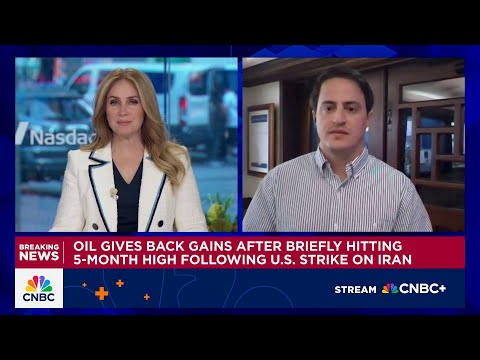
Oil should be $5 to $10 a barrel higher even without geopolitical risks: Bison Interests' Josh Young
CNBC Television· 2025-06-23 11:02
Market Overview - WTI crude oil price approached $79 per barrel, and Brent crude even exceeded $80 per barrel overnight [1] - Over the past month, WTI crude oil prices have increased by 20%, reflecting a significant premium [2] - Industry analysis suggests oil prices could be $5 to $10 per barrel higher, even without geopolitical risks, based on current fundamentals [3] Supply and Demand Dynamics - US oil supply is beginning to decline, evidenced by a surprise 11 to 12 million barrel decrease in weekly oil inventories reported by the EIA [4] - Lower oil prices have led to a reduction in supply, which is expected to eventually drive prices higher due to high shale decline rates [6][7] - Reduced shipping activity through the Strait of Hormuz, even without a complete closure, could significantly limit supply and increase prices [8] Geopolitical Risks - Despite the unlikelihood of Iran directly closing the Strait of Hormuz, the potential for economic warfare through terror proxies remains a concern [9][11] - Attacks on ships by groups like the Houthis have previously led to substantial declines in shipping activity, suggesting a similar scenario could impact traffic through the Strait of Hormuz [12] - The Iranian regime, facing internal pressure and reduced conventional warfare capabilities, may resort to economic warfare, potentially impacting oil supply [10][11]
Bloomberg: The China Show 6/23/2025
Bloomberg Television· 2025-06-23 05:59
Geopolitical Risks & Middle East Tensions - The world awaits Iran's response to US strikes [1] - China condemns Trump's attack on Iran nuclear sites [1] - Shipping is on high alert in the Middle East [1] - Gulf States urge restraint after US strikes [1] - IMF Managing Director Kristalina Georgieva discusses geopolitical risks [1] - Trump reports 'monumental damage' done to all nuclear sites in Iran [1] Market Outlook & Analysis - BCA Research's Matt Gertken provides insights on Middle East tensions [1] - Reed Capital Partners' Gerald Gan shares the markets outlook [1] - Commonwealth Bank of Australia's Vivek Dhar discusses commodity markets [1] Shipping Industry - Pacific Basin's Martin Fruergaard shares the shipping industry outlook [1]
Chevron Shuts Down Leviathan Gas Field Amid Rising Tensions
ZACKS· 2025-06-16 13:06
Core Insights - Chevron Corporation has confirmed the complete shutdown of the Leviathan gas field due to an emergency directive from Israel's Energy Ministry, driven by national security concerns amid escalating tensions with Iran [1][8][11] - The shutdown has halted natural gas exports to Egypt, significantly impacting regional energy markets and supply chains [1][4][6] Group 1: Impact on Israel's Energy Landscape - The Leviathan gas field is Israel's largest energy asset, with an estimated 22.9 trillion cubic feet of recoverable natural gas, and had been exporting a record 981 million cubic feet per day to Egypt in 2024, an 18% increase from 2023 [2][8] - The cessation of Leviathan's operations disrupts a critical energy supply chain connecting the Mediterranean to North Africa and Europe, despite other fields like Tamar and Karish continuing to operate [3][8] - Expansion plans to increase Leviathan's output from 12 billion cubic meters (bcm) to 21 bcm annually have been suspended due to geopolitical risks [9][10] Group 2: Regional and Global Energy Implications - Egypt, heavily reliant on Israeli gas imports, faces immediate energy strain and potential LNG shortfalls, which could lead to emergency procurement and higher global gas prices [4][5][6] - Europe's natural gas prices spiked by up to 6.6% following the announcement of the shutdown, highlighting the continent's vulnerability to supply disruptions from the Eastern Mediterranean [6][14] - The interconnected gas pipeline infrastructure linking Israel, Egypt, and Jordan is at risk, potentially triggering broader energy crises in the region [7][14] Group 3: Geopolitical Context and Future Outlook - The shutdown reflects rising regional conflict, particularly following military actions by Israel against Iran, prompting preemptive measures to secure energy infrastructure [11][12] - The duration of the shutdown will be critical; a prolonged disruption could deepen market imbalances and increase competition for LNG globally [15][16] - Resuming operations at Leviathan will require improved security conditions and regulatory reassurances from Israeli authorities, emphasizing the direct impact of geopolitical risks on the gas market [16]