Unemployment Rate

Search documents
It's a 'strange' economy right now, says UBS' Evan Brown
CNBC Television· 2025-10-28 22:29
Market Overview - The current economy is described as strange, characterized by strong GDP and a soft labor market [1] - History suggests that when the Fed is easing and the economy and earnings are strong, equity returns tend to be favorable, indicating a potentially good environment for stocks [2] Labor Market Analysis - The speed of unemployment rate increase, rather than a specific level, is a key concern for the markets [3] - The overall unemployment level is at 43%, and current state-level data on initial jobless claims does not appear concerning [4] Investment Strategy - The advice is to lean into sectors that are currently performing well [6] - Financials are considered overweight, with expectations of future gains [7] - Despite the momentum in tech, the firm is looking for other ways to play the AI theme, specifically in China [7] AI and Productivity - Since the launch of Chat GPT in October 2022, the stock market is up 70% while job openings are down 30% [10] - There is a potential disconnect between the market's expectation of productivity gains from AI and the current job opening situation [11] - Increased use of AI tools may lead to meaningful public policy conversations about income redistribution [13] China's AI Approach - China offers a cheaper and less crowded way to invest in the AI theme [8] - China's AI approach focuses on efficiency and immediate applications, contrasting with the US focus on building the greatest model possible [9]

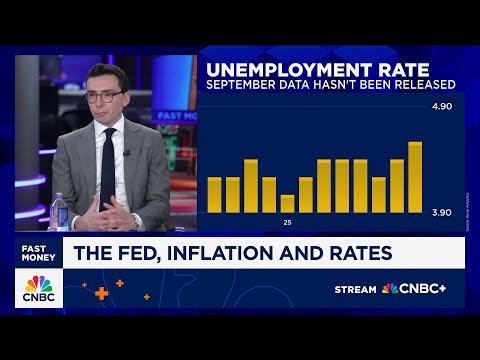
What to expect from Wednesday's Fed meeting on rate cuts as layoffs at major companies continue
CNBC Television· 2025-10-28 21:54
Market Expectations & Fed Policy - The market anticipates the Fed will cut rates, pricing in a near certainty for a quarter-point cut, despite limited official jobs data due to a government shutdown [1] - Some anticipate a potential for 50 basis points (0.5%) of cuts tomorrow, although this is not a widely held view [3][4] - The market is betting that job cuts will prompt Fed cuts through the end of the year, with major indices setting intraday records [2] Employment Market & Layoffs - Amazon is officially cutting 14,000 jobs, and UPS has slashed payrolls by 48,000 this year, joining other companies like Target, Meta, and Starbucks [1] - The unemployment rate is expected to increase measurably over the next couple of quarters [3] - Corporate job cuts are a concern, particularly regarding their impact on consumer spending [7] Economic Indicators & Data - The absence of a month's worth of economic data due to the shutdown makes it difficult to assess the current economic situation [5] - Regional Fed surveys offer some insight into the economy [6] - Traditional measures of the relationship between the unemployment rate and the rate of change in the unemployment rate may not be reliable in the context of AI [6] Company Specific Analysis - UPS layoffs are attributed to a reversal of the pull-forward in goods demand experienced during the pandemic [8] - Amazon's layoffs are seen as a way to maintain capital discipline and continue investing in areas with the highest potential ROI, such as Nvidia and capex spend [9] - Companies may be cutting jobs to make gains in productivity [10]



Fed Confronts Dual Mandate Test | Presented by CME Group
Bloomberg Television· 2025-10-28 18:47
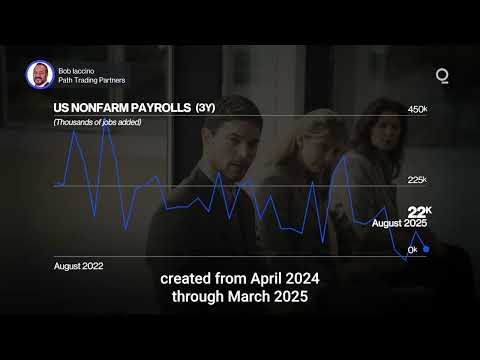
[Music] With headline inflation ticking up to 3% year-over-year in September, its highest level since January, and the unemployment rate sitting at 4.3%, the Federal Reserve faces a classic dual mandate dilemma. Persistent price pressures clash with a slightly softer labor market where job gains have slowed and revised data reveal 911,000 fewer positions created from April 2024 through March 2025 than previously thought. Yet the Fed will likely prioritize jobs.Despite stubborn inflation, officials have sign ...
Fed Getting Closer to Neutral Rate, Says Goldman's Kaplan
Bloomberg Television· 2025-10-28 16:42
Let's talk about the data if we can. You're in a position now where you've got a ton of data yourself. What's it like at the Federal Reserve.Just this idea of flying blind without having that official data. What does that mean. On the margin, they can still use private sources and they can talk to businesses.The sense is that hiring is sluggish. I think you hear that from business. You also hear from business.We're not we may be belt tightening, but we're not firing significantly either. And so the reason t ...
Fed Expected to Deliver Second Straight Rate Cut
Bloomberg Television· 2025-10-27 16:29
Looking ahead to the week ahead. Lots of tech earnings come Wednesday and Thursday. Big meeting between the US and Chinese leader coming up on Thursday, too.Sandwiched in between somewhere, a Federal Reserve decision that we're all taking for granted make the case just an assumption. They cut interest rates again and it's easy sailing, except you and I both know it's different that committee. Mike, how difficult will it be for the Chairman Powell, to communicate anything beyond the October decision.Oh, it's ...

X @Bloomberg
Bloomberg· 2025-10-23 11:40
Chile’s unemployment rate has hovered between 8% and 9% for two-and-a-half years, never getting back to the pre-pandemic levels https://t.co/hZb5mijMu7 ...
中国9 月工业生产超预期,投资不及预期;2025 - 26 年 GDP 预期调整至 4.9%-China_ September industrial production beat while investment missed; 2025_26 GDP forecasts adjusted to 4.9
2025-10-21 01:52
Summary of Key Points from the Conference Call Industry Overview - The report focuses on the Chinese economy, particularly the industrial production, fixed asset investment, and retail sales sectors, as well as GDP growth forecasts for 2025 and 2026. Core Insights and Arguments 1. **GDP Growth**: China's Q3 GDP growth moderated to 4.8% year-on-year (yoy) from 5.2% in Q2, slightly above market consensus of 4.7% but in line with forecasts. Sequentially, GDP growth showed a slight acceleration to 1.1% quarter-over-quarter (qoq) non-annualized in Q3 from 1.0% in Q2 [1][10][20]. 2. **Industrial Production**: Industrial production (IP) growth rose significantly to 6.5% yoy in September, exceeding expectations, driven by stronger exports and increased auto output. Sequentially, IP gained 1.4% month-over-month (mom) non-annualized in September [3][13][20]. 3. **Fixed Asset Investment (FAI)**: FAI growth remained depressed at -0.5% year-to-date (ytd) yoy in September, with a notable single-month decline of -6.7% yoy. This was attributed to ongoing "anti-involution" policies and a prolonged downturn in the property sector [8][14][20]. 4. **Retail Sales**: Retail sales growth slowed to 3.0% yoy in September from 3.4% in August, impacted by weaker offline sales and the fading effectiveness of the consumer goods trade-in program. Online sales showed slight improvement [9][15][20]. 5. **Services Sector**: The Services Industry Output Index remained stable at 5.6% yoy in September, indicating resilience in the services sector despite challenges in retail sales [16][20]. 6. **Property Market**: The property market continued to show weakness, with significant year-on-year declines in new home starts (-14.4%) and property sales (-10.5% in volume) [11][18][20]. 7. **Unemployment Rates**: The nationwide unemployment rate decreased slightly to 5.2% in September from 5.3% in August, although youth unemployment remains a concern at 18.9% for the 16-24 age group [19][20]. Adjustments to Economic Forecasts - Full-year real GDP growth forecasts for 2025 and 2026 have been raised to 4.9% and 4.3%, respectively, reflecting adjustments based on Q3 GDP outcomes and historical data revisions. The growth target of "around 5%" for the year remains on track despite US-China tensions [1][20][37]. Additional Important Insights - The effectiveness of existing easing measures is diminishing, necessitating targeted easing to ensure stable growth and employment in the coming quarters [20]. - The majority of recent easing measures' growth impulses are expected to materialize in late 2025 or early 2026 [20]. This summary encapsulates the key points from the conference call, providing a comprehensive overview of the current state of the Chinese economy and its outlook.
Workers with a Four-Year Degree Earn $81,000 at the Median—70% More Than Workers with a High School Diploma Alone, Georgetown University Report Says
Globenewswire· 2025-10-16 08:01
Core Insights - The choice of bachelor's degree major significantly influences graduates' earnings potential and employment prospects, with prime-age workers (ages 25–54) earning 70% more than high school graduates and facing lower unemployment rates [1][2] Earnings and Employment Outcomes - The report categorizes 152 majors and provides insights into median earnings, graduate degree earnings premium, and unemployment rates for prime-age workers and recent graduates [2][3] - Median earnings for prime-age workers vary by major, ranging from $58,000 in education and public service to $98,000 in STEM fields [1][3] Major Trends - Over the past 15 years, there has been a significant increase in students majoring in higher-paying fields, particularly in computers, statistics, and mathematics, with degree production in these areas more than doubling since 2009 [4] - Despite the increase in graduates in STEM fields, the unemployment rate for recent graduates in computers, statistics, and mathematics is currently 6.8%, the highest within STEM [5] Graduate Degree Considerations - Workers with a graduate degree earn 29% more than those with only a bachelor's degree, but the earnings premium varies across majors [5] - Some professions require a graduate degree for career advancement, highlighting the importance of considering long-term career goals when selecting a major [5] Representation and Economic Implications - There are imbalances in representation among racial/ethnic groups in lucrative fields, with certain demographics overrepresented in STEM [6][7] - Addressing these imbalances is crucial for the nation's economic health, as better alignment between degree production and labor market needs is necessary to avoid skills shortages [7]

White House Starts Firing Workers During Shutdown
Bloomberg Television· 2025-10-10 17:53
Layoffs and Workforce Impact - Thousands of federal workers are expected to be laid off, with the reductions in force having begun [1][2] - Approximately 750,000 federal workers are expected to be furloughed, raising concerns about permanent firings [5] - Only about 20% of the federal workforce is located in Washington DC, indicating a nationwide impact [4] Economic Impact of Shutdown - If the shutdown extends into a third week, the unemployment rate could increase to 47%, as furloughed workers are counted as temporarily unemployed [5] - Many federal workers have missed their first paycheck, and members of the military might miss their paycheck on October 15th [7] Political Standoff - Both sides believe they have the upper hand, creating a unique logjam [6] - Republicans and the White House are firm on not negotiating until the government reopens [8]