Stock valuation

Search documents
Why Ubiquiti Stock Just Crashed
Yahoo Finance· 2025-11-07 16:23
Core Insights - Ubiquiti's stock experienced a significant decline of 16.8% despite reporting better-than-expected earnings for fiscal Q1 2026, with a profit of $3.43 per share compared to analysts' expectations of $2.92 per share [1][3] Financial Performance - Revenue for the quarter ending September 30 surged by 33% year-over-year to $733.8 million, with North America showing the strongest growth at 41% [3] - Gross profit margin increased by nearly 4 percentage points to 46%, while operating margin stood at 35.6%, contributing to a net profit increase of nearly 62% [3] - However, there was a sequential decline in sales quarter-over-quarter, which may have contributed to investor concerns [3] Valuation Concerns - Ubiquiti is currently valued at $38 billion, trading at 48 times trailing earnings and over 64 times trailing free cash flow [5] - Analysts predict a significant slowdown in earnings growth next year, forecasting a drop to as low as 26%, which raises concerns about the high valuation multiples relative to future growth [5] Analyst Sentiment - Despite the earnings beat, analysts express skepticism about the stock's future performance, suggesting it may be a sell due to the high valuation and anticipated growth slowdown [6][8]

Chipotle Stock Slumps 25% in a Month: Has the Free-Fall Ended?
ZACKS· 2025-11-07 14:40
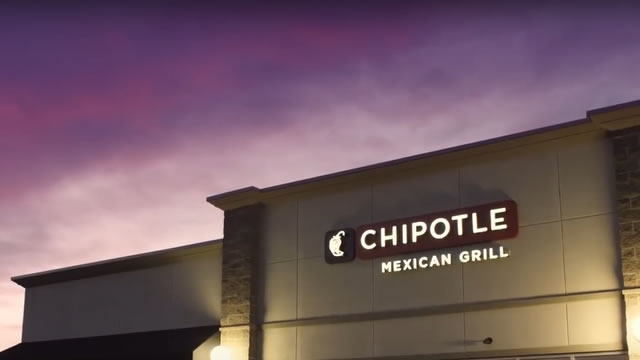
Core Insights - Chipotle Mexican Grill, Inc. (CMG) stock has decreased approximately 25% over the past month due to signs of slowing traffic, particularly among younger and lower-income consumers [1][8] - In the same period, the industry has seen a decline of 0.3%, while the S&P 500 has gained 1.3% [1] - Other industry players like Darden Restaurants, Inc. (DRI) and CAVA Group, Inc. (CAVA) have also experienced declines of 5.5% and 26.2%, respectively [1] Sales Performance - The company reported only a 0.3% increase in comparable sales for Q3 2025, indicating a decline in transactions as household budgets tightened [5] - Management noted that the 25-35 age group, a significant part of Chipotle's customer base, is facing pressure, leading to decreased dining-out frequency [5][9] Market Position and Strategy - Despite current challenges, Chipotle's core fundamentals and long-term growth story remain intact, with healthy new-unit economics and strong brand relevance [6] - The company is not pursuing aggressive menu price increases in the near term, which has affected market sentiment [5][6] Consumer Behavior and Competitive Landscape - Weaker traffic trends are attributed to macro-driven consumer pressures rather than a loss of brand relevance, with lower-income households opting for food-at-home options [9] - The industry is experiencing an intensifying value-focused promotional environment, but Chipotle prefers to maintain product quality over deep discounting [10] Operational Improvements - Chipotle is addressing operational inconsistencies, particularly in digital order accuracy, through system-wide retraining and adjustments to bonus incentives [12] - The rollout of high-efficiency equipment is showing improvements in speed and consistency in early test markets [12] Menu Innovation and Customer Engagement - The company plans to accelerate limited-time offerings in 2026, focusing on new proteins and sauces to drive repeat visits [13] - Enhancements to the rewards program and gamified promotions aim to deepen loyalty among younger customers [14] Earnings Estimates - Estimates for CMG's 2025 earnings have been revised down from $1.19 to $1.17, with expected year-over-year growth of 4.5% [15] - Comparatively, earnings for Darden Restaurants, Restaurant Brands, and CAVA are projected to increase by 11.1%, 9.9%, and 26.2%, respectively [15] Valuation - Chipotle's stock continues to trade at a premium, with a forward 12-month price-to-earnings ratio of 24.69, higher than the industry's 23.15 and the S&P 500's 23.47 [16] Conclusion - The recent stock pullback reflects significant pressure on Chipotle's core customer base and a challenging consumer environment [18] - While management is implementing strategies to improve operations and customer engagement, these initiatives will take time to yield results [19]


Fluor Corporation (NYSE: FLR) Faces Legal Challenges Ahead of Earnings Release
Financial Modeling Prep· 2025-11-07 01:00
Core Viewpoint - Fluor Corporation (NYSE:FLR) is facing multiple securities fraud class action lawsuits that may affect investor sentiment, despite its potentially undervalued stock metrics as it prepares to release quarterly earnings on November 7, 2025 [1][6]. Financial Performance Expectations - The company anticipates an earnings per share (EPS) of $0.44 and revenue of approximately $4.2 billion for the upcoming quarterly earnings [1][6]. Legal Challenges - The lawsuits, initiated by firms such as Glancy Prongay & Murray LLP, Schall Law Firm, and Gross Law Firm, allege that FLR failed to disclose critical information regarding escalating project costs due to subcontractor design errors, price increases, and scheduling delays [2]. - These legal actions cover investors who purchased FLR securities between February 18, 2025, and July 31, 2025, with a lead plaintiff deadline set for November 14, 2025 [2]. Valuation Metrics - FLR's price-to-earnings (P/E) ratio is approximately 1.84, indicating a low valuation relative to its earnings [3]. - The price-to-sales ratio of 0.45 and enterprise value to sales ratio of 0.38 suggest that FLR's stock is trading at less than half of its annual sales per share, appealing to value investors [3]. Financial Health Indicators - The company has a debt-to-equity ratio of 0.18, indicating a low level of debt compared to its equity [4]. - A current ratio of 1.62 suggests that FLR has sufficient liquidity to cover its short-term liabilities [4]. - However, the enterprise value to operating cash flow ratio of 17.67 reflects a higher valuation in relation to its cash flow from operations, which investors should consider [4]. Future Considerations - As FLR approaches its earnings release, the outcome of the lawsuits and the company's ability to manage project costs amid economic uncertainty will be crucial for its financial performance and stock valuation [5].

Why APP Could Outperform Shopify Stock
Forbes· 2025-11-06 17:45
Group 1 - Shopify has been a favorite in the e-commerce market, but AppLovin may offer better growth potential at a lower valuation [2][3] - AppLovin shows greater revenue and operating income growth compared to Shopify, despite having a lower Price to Operating Income ratio [3] - The current discrepancy between AppLovin's valuation and performance suggests it may be a more attractive investment option than Shopify [3] Group 2 - A year-over-year analysis of key metrics may indicate whether Shopify's stock is overvalued compared to its competitors [6] - Persistent underperformance in Shopify's revenue and operating income growth could confirm that its stock is overpriced relative to peers [7] - The analysis of additional metrics is essential for a comprehensive investment assessment, which informs portfolio strategies [8]



Daily Spotlight: Stocks Not Cheap, Not Overvalued
Yahoo Finance· 2025-11-05 12:09
Sign in to access your portfolio Sign in ...
Why Did BlackSky Stock Drop Today?
Yahoo Finance· 2025-11-04 15:50
Core Viewpoint - BlackSky Technology has announced a significant defense contract worth over $30 million, yet the stock price has declined by 2.6%, raising questions about the market's reaction to the news [1][3]. Group 1: Contract Details - BlackSky has secured a multi-year contract exceeding $30 million to integrate Gen-3 high-cadence tactical ISR services for a strategic international defense customer [3]. - The duration of the contract is unspecified, making it challenging for investors to assess its impact on annual revenue [3]. - The term "expanded solution" suggests that this may be an extension of an existing contract rather than a new customer acquisition [4]. Group 2: Financial Performance and Valuation - BlackSky's current market valuation is approximately $710 million, with a price-to-sales ratio of 6.8, which is higher than the historical average of 4x for unprofitable space stocks [6]. - The company reported a loss of $86 million per year, and analysts predict it may not achieve profitability until 2027 [6]. - The high valuation relative to its financial performance raises concerns about the attractiveness of investing in BlackSky at this time [5][6]. Group 3: Investment Considerations - Despite the contract announcement, the lack of clarity regarding the customer and contract duration may lead to skepticism among investors [8]. - The stock is considered overpriced for an unprofitable space company, which may deter potential investors [8]. - Other investment opportunities are suggested to be more favorable compared to BlackSky Technology [9].

Roblox Stock To Crash To $70?
Forbes· 2025-11-04 14:45
Core Insights - Roblox (RBLX) stock has seen a significant decline of 22.3% in less than a month, dropping from $138.56 on October 15, 2025, to $107.66 currently, following Q3 earnings that revealed strong revenue and user growth but a large net loss compared to the previous year [1] - Management has projected a slight margin decline in 2026 due to increased spending on infrastructure, developer exchange rates, and safety measures [1] - The stock's current valuation is considered very high, indicating potential for further downside, with a price target of $73 being plausible based on historical performance [3] Financial Performance - Q3 earnings showed significant revenue and user growth, but the company reported a large net loss compared to last year [1] - Historically, RBLX has yielded a median return of 4.9% over one year and a peak return of 41% following sharp dips of over 30% within 30 days [4][6] - The median duration to peak return after a dip event is 77.5 days, with a median maximum drawdown of 23% within one year following a dip [6] Investment Considerations - The stock has experienced four events since January 1, 2010, where the dip threshold of -30% within 30 days was met, indicating a pattern of recovery potential [6] - Purchasing during a dip should be carefully scrutinized, considering revenue growth, profitability, cash flow, and balance sheet strength to minimize risks [7] - The Trefis High Quality Portfolio, which includes RBLX, has a history of exceeding benchmark indices, yielding superior returns with lower risk [7]


Stock market today: S&P 500, Nasdaq futures tumble ahead of earnings rush as valuation worries creep in
Yahoo Finance· 2025-11-03 23:49
Market Overview - US stock futures experienced a sharp pullback, with S&P 500 futures down 1.3% and Nasdaq 100 futures down 1.6% as doubts about the AI-driven rally emerged [1] - Wall Street is seeing deepening losses, with skepticism about stock valuations despite strong earnings reports [2] Earnings Reports - Palantir's shares dropped over 5% despite beating third-quarter earnings expectations, as analysts suggested the company's valuation is overinflated [2][10] - The upcoming earnings season is expected to feature over 100 reports, with notable companies like AMD, Uber, Spotify, and SuperMicro reporting on Tuesday [3] Valuation Concerns - Wall Street CEOs have warned of a potential equity market drop of more than 10% in the next 12 to 24 months, indicating that such a correction could be beneficial [5] - Corporate earnings are strong, but concerns about valuations persist, with investment manager Capital Group's CEO stating that most view stocks as between fair and fully valued [6][7] Specific Company Movements - Denny's stock surged nearly 50% in premarket trading after announcing an agreement to be taken private by a group of investors [4]

The Dividend Blueprint: How to Build Steady Income That Grows Every Year
Yahoo Finance· 2025-11-01 13:00
Group 1 - Warren Buffett's investment strategy emphasizes finding good companies, buying them at attractive prices, and holding them long-term, which aligns with the principles of dividend investing [2][3] - A reliable dividend history is crucial for identifying attractive stocks, as highlighted by Benjamin Graham, Buffett's mentor [3] - Companies that have increased their dividends for at least 10 consecutive years are recommended as candidates for dividend investors, indicating strong business management [4] Group 2 - Dividend Kings, which have increased dividends annually for at least 50 years, represent the highest honor for dividend stocks, requiring a robust business model [5] - Dividend investors should adopt a mindset similar to Buffett's by focusing on reliable dividend stocks and seeking attractively priced businesses [7] - Valuation can be simplified by using dividend yield as a gauge, with a focus on stocks that have historically high dividend yields, while also considering traditional metrics like price-to-sales and price-to-earnings ratios [8]
3 Stocks With Scary Valuations That I'd Avoid Right Now
Yahoo Finance· 2025-11-01 11:45
Core Insights - Valuations are critical in investment decisions, as purchasing stocks at inflated prices can significantly limit future returns [2][3] - Palantir Technologies is highlighted as a stock with an excessively high valuation, trading at a price-to-earnings (P/E) multiple exceeding 600, which is not justified by its financial performance [4][5] - Concerns are growing regarding the sustainability of AI-related spending, which could negatively impact Palantir's stock given its high valuation [6] Company Overview - Palantir Technologies has a market capitalization of $450 billion and provides an AI platform aimed at enhancing decision-making for both government and commercial clients [4] - The company has experienced strong growth, approximately 50%, but faces potential risks if AI spending slows down [6] Valuation Concerns - The current P/E multiple of Palantir is over 600, and even the forward P/E is projected to be above 200 based on analyst expectations [5] - A recent MIT study indicates that 95% of businesses are not seeing significant returns from their AI investments, raising concerns about future growth for companies like Palantir [6] Market Sentiment - The excitement surrounding certain stocks has led to valuations that are considered absurdly high, with some stocks rising over 300% in the past year [7]