
Tariffs

Search documents
Tariff Uncertainty Reigns Amid Supreme Court Skepticism
Bloomberg Television· 2025-11-06 07:00
The US Supreme Court is signaling skepticism of President Trump's global tariffs, with key justices suggesting he had overstepped his authority. The vehicle is imposition of taxes on on Americans. And that is always been the core power of Congress.So to have the President's foreign affairs power trump that basic power for Congress seems to me to kind of at least neutralize between the two powers, the executive power and the legislative power. Bloomberg Managing Editor Jill Disis now joins us now from Hong K ...


Why tax the children? Toy manufacturer CEO pushes back on Trump tariffs
Youtube· 2025-11-06 06:30
Core Argument - The Supreme Court is hearing arguments regarding the legality of tariffs imposed by the president under the International Emergency Economic Powers Act, with small businesses like Learning Resources challenging these tariffs as unlawful [1][3]. Industry Impact - MGA Entertainment, a major player in the toy industry, is closely monitoring the Supreme Court proceedings, expressing concerns about the negative impact of tariffs on toy prices and sales [2][3]. - Tariffs have led to significant price increases for popular toys, with examples showing price hikes from $5.99 to $7.99 and from $14.99 to $17.99, affecting middle and lower-income consumers [4][5]. Financial Burden - A small toy maker in Illinois reported spending approximately $2.3 million in tariffs for 2024, with estimates rising to $100 million for the entire year due to the tariffs [5]. - The same company indicated that they have already paid around $11 to 12 million in tariffs this year, with sales down by 25 to 30%, which is expected to lead to layoffs across the industry [7]. Manufacturing Concerns - Plans for expanding toy manufacturing in Ohio have been put on hold due to the tariffs, despite the company's long history of domestic production [11][12]. - The CEO of MGA Entertainment criticized the tariffs, stating that no new toy manufacturing has been established in the U.S. since the tariffs were enacted, contradicting the intended goal of boosting domestic production [14]. Consumer Impact - A study indicated that tariffs could increase holiday spending by $132 per American shopper, further straining consumer budgets during the holiday season [15].

The Last Word with Lawrence O'Donnell - Nov. 5 | Audio Only
MSNBC· 2025-11-06 05:49
The last word with Lawrence O'Donnell starts right now. Hey, Lawrence. >> Hey, Jen.Uh, you know, I think many of us were expecting some sort of um interpretation necessary about last night's results. I mean, you know, yet during say yesterday afternoon, like you know, maybe it' be a win here, a loss there, and it'd be a mixed bag of of data to try to figure out uh what was the real outcome, but boy, you just couldn't have had a clearer result last night. You're you're so right and I know you were talking ab ...
FAA to Cut Air Traffic 10% By Friday If No Shutdown Deal | Balance of Power 11/05/2025
Bloomberg Television· 2025-11-06 01:24
>> THIS IS "BALANCE OF POWER," LIVE FROM WASHINGTON, D.C. JOE: FROM BLOOMBERG'S WORLD HEADQUARTERS IN NEW YORK TO OUR TV AND RADIO AUDIENCES GLOBALLY, WELCOME TO "BALANCE OF POWER. " I AM JOE MATHIEU. THE PRESIDENT'S TARIFF AUTHORIZATION HANGS IN THE BALANCE. >> IS IT YOUR CONTENTION THAT EVERY COUNTRY NEEDED TO BE TARIFFED BECAUSE OF THREATS TO THE BASE? SPAIN, FRANCE? JOE: SKEPTICISM FROM THE HIGHEST COURT IN THE LAND AS JUSTICES HEAR ARGUMENTS. WHAT THE JUSTICES SAID THAT MADE BETTING MARKETS LEAN TOWARD ...
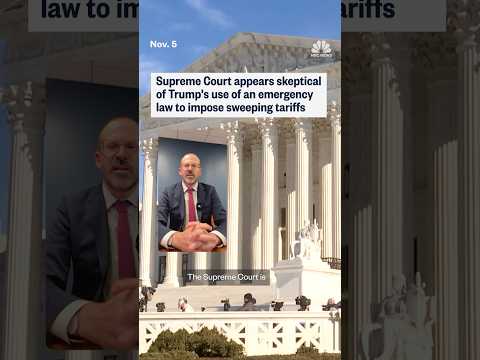
Supreme Court appears skeptical of Trump's use of an emergency law to impose sweeping tariffs
NBC News· 2025-11-06 00:23
The Supreme Court is deciding one of the biggest issues on President Trump's policy agenda, his tariffs. The court is deciding whether President Trump had the authority to issue sweeping tariffs under an emergency law called AIPA, which stands for the International Emergency Economic Powers Act. Based on the oral arguments, the justice did seem skeptical that President Trump has the power to do this.And while we don't know what the ruling is going to be yet, it looks like it's going to be an uphill battle f ...
Amazon, Target and Walmart Raised Prices in Response to Tariffs
PYMNTS.com· 2025-11-05 23:36
Price Increases - Amazon has raised prices by 12.8% this year, while Target and Walmart have increased prices by 5.5% and 5.3% respectively [2] - The price increases for all three retailers are attributed to the impact of new U.S. tariffs, with Amazon's increases occurring before the tariffs were imposed, possibly due to price normalization after holiday discounts [3] Marketplace Dynamics - Amazon earns a higher percentage of its revenue from third-party sales compared to Target and Walmart, making its marketplace sellers, often small businesses, more vulnerable to tariff-related cost increases [4] - Third-party sellers lack the scale, inventory flexibility, and private-label leverage that larger retailers like Walmart and Target possess to offset costs [4] Broader Industry Trends - A report indicated that 90% of goods firms and over 70% of services firms among mid-market companies have raised prices in response to tariffs and macroeconomic pressures [5] - Some companies are absorbing most of the tariff costs due to concerns about losing market share to competitors who do not raise prices, as well as the temporary nature of the tariffs [6] - Goldman Sachs economists estimated that consumers will ultimately bear more than 50% of the total cost of U.S. tariffs, with consumers having shouldered about 22% of the cost as of mid-year [7]


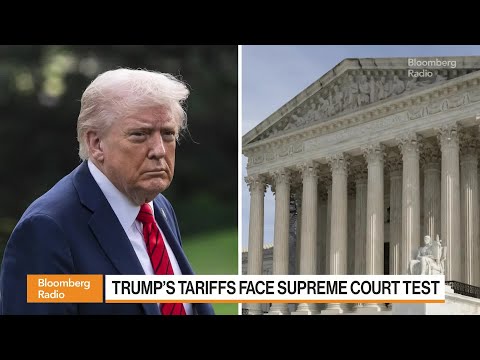
Trump Tariffs Face Huge Test in US Supreme Court
Bloomberg Television· 2025-11-05 22:56
Case Overview - The Supreme Court is hearing a major case concerning President Trump's authority to impose tariffs under the International Emergency Economic Powers Act (IEEPA) [1] - The central question is whether the President can use IEEPA to impose tariffs, given that the act doesn't explicitly mention tariffs or duties [1][2] - Lower courts, including the International Court of Trade, have ruled against the President's use of IEEPA for tariffs [3] Legal Arguments - The President argues that the fentanyl crisis and trade deficit constitute "unusual and extraordinary circumstances," justifying the use of emergency powers [2] - Opponents argue that imposing tariffs is a power that belongs to Congress, not the President [2] - Amicus briefs overwhelmingly oppose the tariffs, with 40 briefs against and 10 in favor, including submissions from the Chamber of Commerce, small businesses, and law professors [4] Key Players - The plaintiffs are small businesses, including a wine exporter and a toy goods company [5] - Neal Katyal, a former acting solicitor general with an hourly rate of $3,000, is arguing for the plaintiffs [5] - The solicitor general is arguing on the other side, representing the government [6] Potential Outcomes and Implications - A ruling against the President would limit the use of IEEPA for imposing tariffs [10] - Even if the President loses the case, the administration may seek other ways to implement tariffs [11] - Bloomberg Economics estimates the U S is collecting $556 million daily in IEEPA tariffs, projecting over $140 billion by the end of 2025, raising questions about potential reimbursements [13]
Supreme Court appears skeptical of Trump's tariffs argument
NBC News· 2025-11-05 22:31
Legal & Policy Analysis - The Supreme Court is reviewing the president's use of the International Emergency Economic Powers Act (IEEPA) to impose tariffs, with justices questioning whether the president is infringing on Congress's authority [1][2][9] - Some justices expressed skepticism about the administration's broad view of executive authority in foreign affairs and the delegation of power from Congress to the president [2][3][4] - The focus of the legal argument is whether IEEPA, which grants the president power to regulate imports, also includes the power to impose tariffs [9] - There is a debate on whether the tariffs are regulatory or revenue-raising, with the government arguing they are primarily regulatory, despite raising revenue [10][11] Economic Impact & Trade Strategy - The Trump administration views tariffs as a cornerstone of its economic policy, and is likely to pursue alternative measures if the current tariffs are struck down by the Supreme Court [14] - Alternative measures to tariffs would likely involve investigations by the Commerce Department or the International Trade Commission, requiring more time than the current approach [15] - The full impact of the hundreds of billions of dollars of tariffs collected is still being assessed, with uncertainty about whether it can be done without harming the economy [17] - Companies should prepare for some form of tariffs, whether these or others, as the administration is expected to continue using them [18] Market Outlook & Timeline - The Supreme Court's decision is expected relatively quickly, potentially before the end of the year or early next year, due to the expedited basis of the case [19]
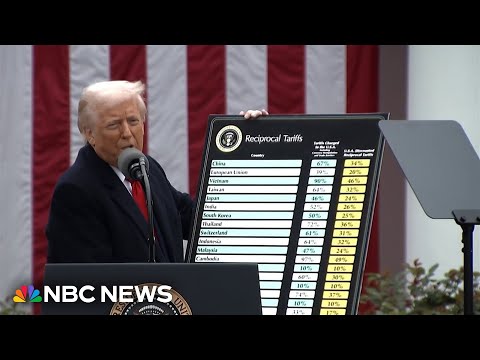
Arm, Qualcomm, and Robinhood earnings beat expectations, Trump's tariffs face challenges from SCOTUS
Youtube· 2025-11-05 22:24
Market Overview - The market is experiencing a rebound with the Dow up more than 300 points, S&P 500 up about 0.7%, and NASDAQ rallying about 1% [2][50] - Trade-sensitive stocks, including automakers and apparel retailers, are seeing gains following Supreme Court hearings regarding President Trump's tariff policies [2][10] Supreme Court Hearing on Tariffs - The Supreme Court justices, including Chief Justice John Roberts, expressed skepticism towards the Trump administration's legal arguments for tariffs, suggesting they may be viewed as taxes on Americans [6][7][10] - The questioning from both liberal and conservative justices indicates a potential challenge to the legality of Trump's blanket tariffs, which could impact market expectations [5][10][13] Labor Market and Federal Reserve Policy - ADP reported a surprising addition of 42,000 jobs in October, reversing a decline from September, which may influence Federal Reserve policy discussions [14] - Fed Governor Steven Myron indicated that the labor market poses a greater risk than inflation, suggesting a more cautious approach to monetary policy [15][16] AI and Technology Sector Insights - Concerns are emerging regarding AI valuations, with analysts cautious about the sustainability of current business models and potential market corrections [20][21][22] - Companies are underweight in AI-related stocks, favoring investments in European markets due to attractive valuations [23][24] Scott's Miracle Grow Performance - Scott's Miracle Grow reported a decrease in net sales but improved gross margins and market share, indicating a recovery phase [28][30] - The lawn and garden sector is described as recession-resistant, with strong consumer demand and growth in DIY projects [33][34] Qualcomm's Financial Results - Qualcomm's Q4 results showed earnings per share of $3, beating expectations, with revenue at $11.27 billion, also above estimates [54][57] - The company is diversifying into automotive and IoT markets, with a focus on AI chip development to enhance growth potential [59][66] Robinhood's Earnings Report - Robinhood's Q3 earnings showed a beat on both top and bottom lines, with significant net deposit growth, although initial stock reactions were negative due to high expectations [83][88] - The company is exploring opportunities in prediction markets, which could diversify revenue streams and enhance long-term growth potential [90][92] ARM Holdings Performance - ARM reported earnings per share of 39 cents, beating estimates, with revenue of $1.14 billion, also exceeding expectations [70][72] - The company is well-positioned in the chip industry, with strong demand for its designs across various markets, including data centers and IoT [79][80]




X @Bloomberg
Bloomberg· 2025-11-05 22:20
Stocks in some of America’s top retail brands, from department stores to toymakers and apparel companies, rallied as a skeptical US Supreme Court raised hopes the sweeping tariffs could be lifted https://t.co/AhfDCRZsDI ...