Artificial General Intelligence

Search documents
X @Cathie Wood
Cathie Wood· 2025-07-12 16:10
RT Tim Sweeney (@TimSweeneyEpic)Grok 4 feels like Artificial General Intelligence to me. It is clearly not just constructing statistically likely connections, but is drawing fairly deep insights on problems it hasn’t seen before, in ways I haven’t seen elsewhere. Here’s an example: https://t.co/n00hEEZfMJ ...
X @Elon Musk
Elon Musk· 2025-07-10 20:45
AI能力评估 - Grok 4 在材料科学领域展现出深度洞察力,即使面对未知的、不在书籍或互联网上的问题[1] - Grok 4 被认为不仅仅是构建统计上的可能性连接,而是能够对之前未见过的问题进行深入分析[1] 行业影响 - Tim Sweeney 认为 Grok 4 接近于通用人工智能 (Artificial General Intelligence)[1]
AI's reasoning blind spot
CNBC Television· 2025-06-26 16:26
AI Model Performance & Limitations - AI reasoning models, despite mimicking human reasoning, may break down when pushed beyond narrow tasks, posing a fundamental limitation [3][4] - The current reasoning models cannot generalize, requiring specific specialized models, which falls short of achieving Artificial General Intelligence (AGI) [11] - Progress in AI model pre-training has stalled, raising concerns about the return on investment (ROI) [6][9] Market & Investment Risks - Wall Street is betting that smarter reasoning models will drive demand for compute and infrastructure, benefiting companies like Nvidia [5] - If AI models cannot scale or generalize, investments in AI may not lead to productivity and could become sunk costs [6] - The market may pause investments until a clear return on investment is demonstrated for AI models [10] Company Impact - The limitations of AI reasoning models could impact the entire AI trade, including Nvidia, AMD, and cloud players [8] - Breakthroughs in reasoning could redefine the Microsoft-OpenAI relationship and who controls the future of AI [7] - Reasoning is fueling Zuckerberg's recruiting drive and Jensen Huang's trillion-dollar bull case for physical AI [7]


Meta Reportedly Hires Away 3 Researchers From OpenAI
PYMNTS.com· 2025-06-26 16:02
Core Insights - Meta has successfully recruited three researchers from OpenAI's Zurich office to enhance its artificial intelligence (AI) initiatives [2] - CEO Mark Zuckerberg is actively seeking to strengthen Meta's AI capabilities, reportedly offering up to $100 million to attract top talent [3] - The competition for AI expertise is intensifying, with major companies like OpenAI, Google DeepMind, Microsoft, and Anthropic also vying for skilled professionals [6] Recruitment Strategy - The newly hired researchers are part of Meta's broader strategy to bolster its artificial general intelligence (AGI) efforts [2][3] - Zuckerberg has attempted to recruit other high-profile figures from OpenAI, including co-founders Ilya Sutskever and John Schulman, but they have declined [4] - Meta's recruitment drive is complemented by significant investments, including a recent $14 billion investment in AI startup Scale [3] AI Development Focus - Meta aims to expand the capabilities of its Llama AI model and integrate advanced AI features across its platforms [7] - The company's AI-driven functionalities currently enhance user experiences on platforms like Instagram and WhatsApp [7] - Meta is exploring the use of AI agents to improve customer service and commerce within its ecosystem [7]


Report: Meta Aims to Hire AI Investors Nat Friedman and Daniel Gross
PYMNTS.com· 2025-06-19 01:09
Group 1 - Meta is in discussions to hire AI investors Nat Friedman and Daniel Gross and may partially acquire their venture capital fund, NFDG [1][2] - The goal is for Friedman and Gross to lead Meta's AI initiatives, with NFDG having invested in AI startups like Perplexity, The Bot Company, and Safe Superintelligence [2][3] - If the acquisition occurs, Meta would hold minority stakes in the startups but would not gain access to their information [2] Group 2 - Gross, a co-founder of Safe Superintelligence, would leave that position if he joins Meta, while Friedman is already advising Meta on AI [3] - Recently, Scale AI announced a significant investment from Meta, with its founder Alexandr Wang set to join Meta for AI efforts [4] - Meta is actively recruiting top engineers for its artificial general intelligence (AGI) team, aiming to hire around 50 people, including a chief scientist [4][5] Group 3 - CEO Mark Zuckerberg is personally involved in recruiting AI researchers and engineers, indicating a strong focus on AI as a priority for Meta [5] - Reports suggest that Meta is offering substantial signing bonuses to attract talent from competitors like OpenAI [5] - In May, Meta reorganized its generative AI team to accelerate product rollouts and enhance its competitive position in the AI industry [6]
Altman Says Meta Offering $100 Million to Recruit OpenAI Staff
PYMNTS.com· 2025-06-18 12:41
Group 1: Meta's Recruitment Efforts - Meta is reportedly offering signing bonuses of up to $100 million to attract talent from competitors, as stated by OpenAI CEO Sam Altman [2][3] - Altman mentioned that Meta views OpenAI as its biggest competitor and has been aggressive in its recruitment strategy [2] - Meta CEO Mark Zuckerberg is personally involved in interviewing candidates for a new team focused on developing artificial general intelligence [4] Group 2: Investment and Talent Acquisition - Meta has announced a $15 billion investment in data-labeling startup Scale AI, with expectations that Scale AI's co-founder and employees will join Meta [4] - Some AI experts, such as Jack Rae from Google DeepMind, have accepted offers to join Meta, indicating some success in their recruitment efforts [4] Group 3: Challenges Faced by Meta - Meta has encountered setbacks in its AI initiatives, including allegations of inflating performance metrics for its Llama large language model [5] - The company has faced criticism for not providing a comprehensive technical report to accompany its AI model [5]

Gateway to AGI
Matthew Berman· 2025-06-17 14:07
Alpha Evolve AI that can discover new knowledge. It really feels like we're at this inflection point of the intelligence explosion. Are we at that inflection point given it seems like this is self-improving artificial intelligence.You're spot on to the potential for something like Alpha Evolve. It's amazing. We launch in this lowkey way.Yeah, it's one of the most groundbreaking work we are doing. The fact that you know you can have these agents which can go improve code, make discoveries. What an extraordin ...

X @Investopedia
Investopedia· 2025-06-10 17:00
Meta Platforms CEO Mark Zuckerberg reportedly is building a team of 50 AI experts aimed at beating the company's tech rivals in achieving artificial general intelligence. https://t.co/SZRAXIDCxD ...
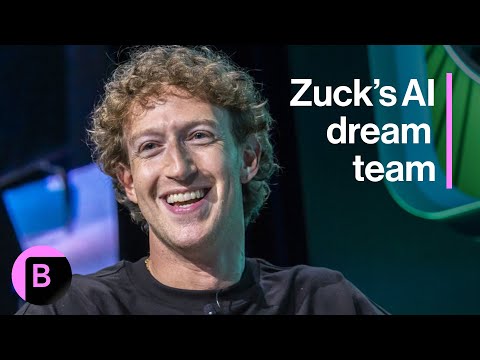
Zuckerberg's Bet: Building a Superteam at Meta to Solve AI Shortfalls
Bloomberg Television· 2025-06-10 09:13
We have Mark Zuckerberg assembling a team of experts to achieve artificial general intelligence. So it seems we still need the humans and their brain trust to develop this stuff. Yeah, absolutely.And this kind of connects quite well with the scale AI investment that we talked about relates to meta yesterday and scale AI is all about using humans to train um the the artificial intelligence. So, you know, I think this is a clear yesterday and today very clear statement of intent from Meta that they want to be ...