
Federal Reserve rate cuts

Search documents
Stock Index Futures Muted After Record Rally, U.S. Confidence Data on Tap
Yahoo Finance· 2025-09-12 10:13
Economic Indicators - The U.S. consumer prices rose by +0.4% month-over-month in August, exceeding expectations of +0.3% [1] - Year-over-year headline inflation increased to +2.9% in August from +2.7% in July, aligning with forecasts [1] - Core CPI, excluding food and fuel, rose by +0.3% month-over-month and +3.1% year-over-year in August, meeting expectations [1] - Initial jobless claims unexpectedly rose by +27,000 to 263,000, marking a 3-3/4-year high, compared to the expected 235,000 [1] Stock Market Performance - Wall Street's main equity benchmarks closed higher, with the S&P 500, Dow, and Nasdaq 100 reaching new record highs [2] - Warner Bros. Discovery (WBD) surged over +28% following reports of a cash bid from Paramount Skydance [2] - Centene (CNC) rose about +9% after reaffirming its full-year adjusted EPS guidance [2] - Micron Technology (MU) climbed over +7% after Citi raised its price target from $150 to $175 [2] - Netflix (NFLX) fell more than -3% after the announcement of the Chief Product Officer's departure [2] Market Sentiment and Future Expectations - Investors are awaiting the University of Michigan's preliminary reading on U.S. consumer sentiment, with expectations for a figure of 58.2 [5] - U.S. rate futures indicate a 100% probability of a 25 basis point rate cut and a 7.5% chance of a 50 basis point cut at the next monetary policy meeting [4] International Market Developments - The Euro Stoxx 50 Index decreased by -0.24% amid cautious sentiment, while healthcare stocks led declines [6] - The U.K. economy stagnated in July, with GDP unchanged month-over-month and a +1.4% year-over-year increase [7] - Germany's CPI rose by +0.1% month-over-month and +2.2% year-over-year, in line with expectations [7] - France's CPI rose by +0.4% month-over-month and +0.9% year-over-year, also meeting forecasts [8] Corporate News - Baidu surged over +8% and Alibaba climbed more than +5% in Hong Kong after reports of using internally-designed chips for AI models [9] - General Motors (GM) advanced more than +1% in pre-market trading after Barclays upgraded the stock to Overweight with a price target of $73 [12] - RH (RH) plunged over -10% in pre-market trading after reporting downbeat Q2 results and cutting its full-year revenue growth guidance [12]
US Treasury curve to steepen on Fed easing bets, fiscal strain: Reuters poll
Yahoo Finance· 2025-09-10 11:51
Core Viewpoint - The U.S. Treasury yield curve is expected to steepen in the coming months due to anticipated Federal Reserve rate cuts, which will lower short-term yields while longer-dated yields remain elevated [1][2]. Treasury Yield Trends - Recent data indicates a decline in Treasury yields, with the benchmark 10-year yield reaching a five-month low, influenced by a weaker labor market and a significant downward revision of job creation estimates [2][4]. - The current 10-year yield is at 4.08%, projected to rise to 4.20% in three months and 4.25% in a year, which is lower than previous forecasts [4]. Rate Cut Expectations - Interest rate futures are now pricing in three 25 basis point cuts from the Federal Reserve this year, an increase from earlier expectations of two cuts [3]. - Analysts predict that the 2-year Treasury yield, currently at 3.55%, will remain stable for six months before declining to 3.40% in a year, leading to a widening spread between 2- and 10-year yields [6]. Market Sentiment - A majority of analysts (85%) anticipate that the U.S. yield curve will steepen by year-end, reflecting a consensus on the direction of interest rates [6]. - The steepening of the yield curve is attributed to a rising term premium, driven by fiscal deficits, tariff uncertainties, and concerns regarding the Federal Reserve's independence [7].
Barclays, Deutsche Bank raise S&P 500 forecasts as bull run continues
Yahoo Finance· 2025-09-10 08:56
Core Viewpoint - Barclays and Deutsche Bank have raised their year-end targets for the S&P 500, driven by stronger corporate earnings, resilient U.S. economic growth, and optimism surrounding artificial intelligence [1][2]. Group 1: Target Adjustments - Deutsche Bank increased its S&P 500 target to 7,000 from 6,550, while Barclays raised its forecast to 6,450 from 6,050 [1]. - Barclays also lifted its 2026 target for the S&P 500 to 7,000 from 6,700 [4]. Group 2: Market Performance - The S&P 500 has risen 11.2% so far this year and touched a record high of 6,555.97 earlier [1]. - The index has rallied more than 30% from its April lows, supported by resilient earnings and investor enthusiasm around the AI boom [3]. Group 3: Economic Indicators - U.S. job growth weakened sharply in August, with the unemployment rate rising to a near four-year high of 4.3% [3]. - Signs of a cooling labor market and tame inflation have increased expectations for U.S. Federal Reserve rate cuts this year and next [4]. Group 4: Analyst Insights - Analysts expect equity valuations to remain elevated due to higher payout ratios and perceptions of higher trend earnings growth [2]. - Barclays anticipates three rate cuts before year-end, which may help offset labor market weaknesses [4].


Global Markets Rise, Tracking Record Highs for U.S. Indexes
Yahoo Finance· 2025-09-10 08:23
Group 1 - Global stock markets rose after U.S. indexes closed at record highs, driven by optimism regarding Federal Reserve rate cuts [1] - U.S. futures for the S&P 500 and Nasdaq increased by 0.3%, while Dow Jones futures declined by 0.1% following the record close [4] - European indexes opened higher, with defense stocks gaining due to geopolitical tensions, particularly after the Russian drone incursion into Poland [5] Group 2 - Novo Nordisk's shares fell by 1.0% after the company downgraded its guidance for the second time in six weeks and announced a workforce reduction of approximately 11% to save $1.3 billion annually [6] - Oracle's shares surged by 29% in premarket trading after securing four multibillion-dollar contracts with three different customers in the quarter ending August 31 [7]
Gold Sets New Record High. Rate Expectations Are Helping.
Barrons· 2025-09-09 10:43
Core Insights - Gold prices have reached a new record high, with futures rising 0.4% to $3,692 and peaking at $3,698 during early trading, marking a 40% increase in 2025 [1] - Market expectations for Federal Reserve rate cuts are driving investor confidence, with a 67% probability of three rate cuts by the end of the year, up from 65% the previous day and 40% a week ago [2] Market Performance - The stock market indices, including the Dow, S&P 500, and Nasdaq, have all achieved record highs [1] - The rise in gold prices is indicative of broader market trends influenced by monetary policy expectations [1][2] Investor Sentiment - Increased bets on Federal Reserve rate cuts are contributing to the bullish sentiment in the gold market [1][2] - The significant climb in gold prices reflects a shift in investor strategy towards safe-haven assets amid changing economic conditions [1]
What investors should expect from stocks after the Fed’s September meeting
Yahoo Finance· 2025-09-08 23:05
Group 1 - The stock market's reaction to Federal Reserve rate cuts is not consistently positive, with historical data showing that in 40% of cases, the market was lower a month later, 37% lower after six months, and 27% lower after 12 months [1][2][3] - The market tends to rally when rate cuts occur in a strong economy, while it declines in a weak economy, indicating that the context of the rate cut is crucial [2][3] - Following a weak August jobs report, which increased the likelihood of a rate cut, the S&P 500 futures initially rose but then reversed, suggesting concerns about a potential recession [3][4] Group 2 - The correlation between daily changes in the S&P 500 and the probability of a Fed rate cut supports the notion of a market downturn post-rate cut [4][5] - Contrary to common belief, the S&P 500 performed better on days when the projected fed-funds rate was higher than the previous day, indicating an inverse relationship [5]
美联储监测-我们现在预测美联储将于 9 月开始降息-Federal Reserve MonitorWe now forecast Fed rate cuts beginning in September
2025-08-26 01:19
Summary of Key Points from the Conference Call Industry Overview - The discussion revolves around the Federal Reserve's monetary policy and its implications for the North American economy, particularly focusing on interest rate adjustments and labor market conditions. Core Insights and Arguments 1. **Forecast for Rate Cuts**: The Federal Reserve is expected to initiate rate cuts starting in September, with a projected 25 basis point (bp) cut as the baseline [1][4][12] 2. **Shift in Fed's Focus**: Chair Powell has expressed increased concern over labor market risks, marking a shift from previous emphasis on low unemployment and persistent inflation [1][4][10] 3. **Rate Cut Projections**: The expectation is for two rate cuts in 2025, with a 25bp cut in September and another in December, followed by quarterly cuts in 2026, targeting a terminal range of 2.75-3.0% [4][17] 4. **Economic Growth and Inflation**: Real GDP growth averaged 1.3% in the first half of the year, with inflation expected to remain above the Fed's 2.0% target due to tariff-related price increases [7][8] 5. **Labor Market Dynamics**: The unemployment rate has remained stable at 4.2%, despite a slowdown in labor demand, indicating a complex balance in the labor market [7][11] 6. **Risks to Employment**: There is a growing concern about downside risks to employment, which could lead to higher layoffs and rising unemployment if materialized [11][12] 7. **Inflation Dynamics**: The Fed is cautious about the potential for tariffs to create lasting inflationary pressures, although current conditions do not suggest a tight labor market [11][12] 8. **Dissenting Opinions**: There may be dissent among Fed members regarding rate cuts, with some members likely to oppose the cuts based on the balance of risks [16] Other Important Considerations 1. **Data Dependency**: The Fed's decision-making will heavily depend on upcoming employment and inflation data, particularly the August employment report [15][19] 2. **Potential for Multiple Cuts**: The updated forecast suggests the possibility of several rate cuts followed by a pause, depending on economic conditions [17][19] 3. **Uncertainty in Economic Outlook**: The evolving economic landscape introduces uncertainty, with the potential for more aggressive cuts if a recession occurs [18][19] 4. **Market Reactions**: The Fed's communication strategy indicates that any adjustments in policy will likely involve more than a single rate cut, signaling a cautious approach [14] This summary encapsulates the key points discussed in the conference call regarding the Federal Reserve's monetary policy outlook and its implications for the economy.
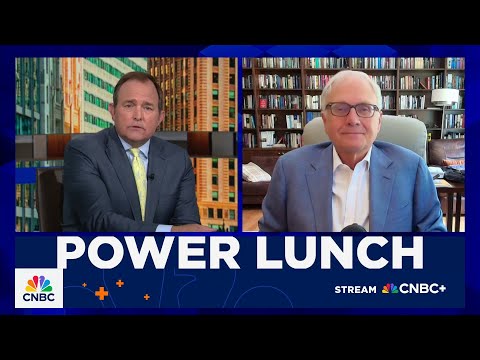
Markets are holding onto the idea the economy's actually resilient, says Ed Yardeni
CNBC Television· 2025-08-14 18:51
And where are stocks heading from here. Well, we welcome Ed Yardi to Power Lunch. He is founder and head of Ardeni Research.Ed, great to have you on. >> Thank you very much. >> All right.Why do you think the market is not reacting a little more negatively to the hot inflation read and a lowered expectation of more Fed rate cuts in the future. Well, I think the uh market hasn't given up on the idea that the economy is actually resilient, that it doesn't necessarily need lower interest rates and that if we ge ...

X @Bloomberg
Bloomberg· 2025-08-04 04:08
Market Trends - Emerging-market currencies experienced a rally following weaker-than-expected US jobs data [1] - Traders are pricing in Federal Reserve rate cuts, leading to a weaker dollar [1]
美联储观察 - 9 月降息路径-Federal Reserve Monitor-Paths to September rate cuts
2025-07-29 02:31
Summary of Key Points from the Conference Call Industry or Company Involved - The conference call primarily discusses the **U.S. economy** and the **Federal Reserve's monetary policy** outlook, particularly regarding potential interest rate cuts in 2025 and 2026. Core Insights and Arguments 1. **No Rate Cuts Expected in 2025**: The baseline outlook remains for no rate cuts in 2025, with potential cuts only in 2026 as the economy slows and tariff-induced inflation is deemed transitory [8][6][5] 2. **Inflation Forecast**: The forecast anticipates a 3-month annualized rate of PCE inflation at 4.3% in September-October, with year-on-year rates of headline and core PCE inflation at 3.0% and 3.2% by year-end [6][8] 3. **Labor Market Dynamics**: The unemployment rate is projected to remain below 4.5% until Q1 2026, influenced by tighter immigration controls, which may keep labor supply constrained [7][8] 4. **Paths to Rate Cuts**: Five scenarios are outlined that could lead to rate cuts as early as September, including significant declines in payrolls, higher-than-expected breakevens, weak services inflation, and a lack of pass-through to goods prices [23][24][19] 5. **Economic Scenarios**: The report assigns a 40% probability to a baseline scenario of slow growth and firming inflation, with 20% probabilities for upside scenarios and 40% for a mild recession induced by protectionism [12][11] 6. **Impact of Tariffs**: The effective tariff rate is expected to rise, impacting consumer prices and inflation, with a noted shift in the Fed's assessment of risks associated with tariffs over time [60][62] 7. **Consumer and Business Confidence**: Confidence is expected to rebound in 2026, although it remains low due to ongoing uncertainty and sluggish growth [49][48] Other Important but Potentially Overlooked Content 1. **Labor Market Signals**: Current labor market data does not indicate an acceleration in layoffs, but there is concern that the labor market can appear healthy until a downturn occurs [24][31] 2. **Immigration Policy Effects**: Recent immigration policy changes are projected to significantly reduce net immigration, which could further constrain labor force growth and impact breakeven hiring rates [42][41] 3. **Potential for Revisions**: There is a possibility of downward revisions to payroll data, which could signal a more severe labor market downturn than currently reported [30][29] 4. **Consumer Spending Trends**: Consumer spending is expected to slow, particularly in goods, due to tariffs and immigration policies, but a tighter labor market may support spending in 2026 [12][8] 5. **Credit Conditions**: Credit conditions are anticipated to tighten further as the economy contracts, with a gradual loosening expected in 2026 [8][7] This summary encapsulates the key points discussed in the conference call, focusing on the economic outlook, Federal Reserve policy, and the implications of labor market and inflation dynamics.