Supply Chain

Search documents
X @Bloomberg
Bloomberg· 2025-08-20 01:27
Rare Earth Supply Chain - A rebel army in Myanmar has become a major player in the global supply of rare earths [1] - The rebel army's growing influence has implications for neighboring China [1]
X @Bloomberg
Bloomberg· 2025-08-19 21:54
On today’s Big Take Asia podcast, how a rebel army in Myanmar became a major player in the global supply for rare earths — and what its growing influence means for neighboring China. https://t.co/37RBnI7RFP ...
X @外汇交易员
外汇交易员· 2025-08-19 07:41
Geopolitical & Trade Relations - Reports indicate China has lifted restrictions on rare earth exports to India [1][2] - Discussions regarding rare earth export restrictions were held between Indian and Chinese officials, with agreements to continue dialogue on critical mineral supply and broader economic and trade issues [1][2] Supply Chain Stability - China expresses willingness to strengthen dialogue and cooperation with relevant countries and regions to jointly maintain the stability of global supply chains [1]
X @Bloomberg
Bloomberg· 2025-08-19 06:25
Production Strategy - Apple is expanding iPhone production in India [1] - The company aims to reduce its dependence on China for iPhone models destined for the US market [1]

X @The Economist
The Economist· 2025-08-18 19:20
Industry Trend - Western countries are seeking to reduce reliance on China's rare-earth supplies [1] - Recycling is presented as a viable alternative to replicating China's rare-earth supply chain [1]
Peter Navarro on Trump's new pharma executive order: Investors can make billions of dollars here
CNBC Television· 2025-08-14 15:44
Government Initiatives & Policy - Aims to establish a strategic active pharmaceutical ingredient (API) reserve to bolster domestic manufacturing [2] - Calls for creating a list of drugs critical to America's health and security interests [1] - Health and Human Services (HHS), the Veterans Affairs (VA), and the Department of Defense (DoD) to issue long-term contracts to buy needed medicines, stabilizing demand [3][9] - Considers pharmaceutical tariffs under Section 232 due to national security concerns [6][8] Supply Chain & Manufacturing - Focuses on fast-tracking advanced continuous manufacturing to reduce costs and waste in pharmaceutical production [4][5] - Aims to reduce reliance on China and India, which currently supply 60% of US API and medicines [5] - Seeks to move from extreme vulnerability to "America first" in pharmaceutical manufacturing [10] Investment Opportunities - Presents significant investment opportunities for those who can identify potential winners in the pharmaceutical sector [7] - Executive order is a follow-up to previous efforts to bring pharma manufacturing back to the US [6] Risks & Challenges - Acknowledges the need for careful administration to transition to pharmaceutical independence [10] - Highlights the vulnerability of relying on foreign sources for essential medicines, citing China's past threats [8]

全球宏观下一步:细节为何重要 _ What's Next in Global Macro_ Why the Details Matter
2025-08-14 02:44
Summary of Key Points from the Conference Call Industry Overview - The discussion primarily revolves around the **U.S. economy**, focusing on the implications of **tariffs** and **inflation** on market dynamics and Federal Reserve policy decisions. Core Insights and Arguments 1. **Market Reactions to FOMC Meeting**: The market's pricing for the September FOMC meeting fluctuated significantly, with initial expectations for a rate cut shifting after Chair Powell's comments, indicating ongoing uncertainty in economic conditions [2][5]. 2. **Nonfarm Payrolls Impact**: The July nonfarm payrolls report showed a downward revision of 258k for May and June, the largest revision outside of the Covid period, altering the market's narrative regarding the U.S. economy [2][5]. 3. **Inflation Trends**: The June CPI indicated the onset of tariff-driven inflation, with effective tariff rates rising from 8.7% in May to 8.9% in June, while announced rates exceed 15%. This discrepancy is attributed to supply chain dynamics and timing of tariff applications [3][4]. 4. **Inventory Management Effects**: Companies, particularly in the auto sector, are delaying price increases until new inventory arrives, which may further postpone inflation pass-through to consumers [4]. 5. **Fed's Balancing Act**: The Federal Reserve's decision in September will need to balance inflation pressures against employment data, with tariff uncertainties continuing to complicate the economic outlook [5][7]. 6. **Upcoming Economic Data**: The importance of forthcoming CPI and jobs data is emphasized, as they will be critical in shaping the Fed's decisions regarding interest rates [2][7]. Additional Important Insights 1. **Sector-Specific Inflation**: The analysis indicates that about 80% of the surge in "front loading" inventory in Q1 was concentrated in just seven product categories, suggesting that inflationary pressures may not be as widespread as initially thought [4]. 2. **Consumer Sentiment**: The University of Michigan's survey showed long-run inflation expectations declining to 3.4% in July, with consumer sentiment rebounding but still below last year's levels [22]. 3. **Global Economic Indicators**: Other global economic indicators, such as China's broad credit growth and Japan's GDP forecasts, are also mentioned, reflecting a broader context of economic performance [9][19][20]. This summary encapsulates the critical points discussed in the conference call, highlighting the interplay between tariffs, inflation, and Federal Reserve policy in the current economic landscape.
Altana CEO: Electronics and automobiles are exposed from tariffs due to ties with China
CNBC Television· 2025-08-13 18:24
Tariff Impact & Inflation - Traditional tariff understanding involves border application, but new trade policies apply tariffs based on goods within goods or raw materials, complicating cost assessment [1][2] - The accumulation of tariff impacts across the global value chain of production leads to earning and inflation shocks [3] - Companies are adjusting pricing decisions based on when and how they understand their costs related to tariffs [3] Supply Chain Dynamics - Cost pressure from suppliers is increasing, leading to appeals for price increases [4] - Customers are using data to negotiate and understand appropriate pricing in response to tariff increases [4] - Tariff impacts are working their way through the supply chain to the end customer and ultimately affecting earnings [4]
Can the U.S. break China's rare earth dominance?
CNBC Television· 2025-08-12 16:30
Industry Overview - Rare earth elements, comprising 17 elements with unique magnetic properties, are vital for modern technology [1] - Rare earth magnets are essential for electric vehicles, wind turbines, defense equipment, data centers, and high-tech consumer electronics [2] - The US, once a leader in rare earth production, has become largely dependent on China for its supply [2] Geopolitical Implications - Escalating trade tensions between the US and China, particularly after China's export controls on rare earths, have spurred the US to develop a domestic supply chain [3] - The US views the competition with China in rare earths as an "existential competition" [3] US Strategy - The US is seeking to wean itself off of Chinese rare earths by exploring domestic mining and processing options [3][4]

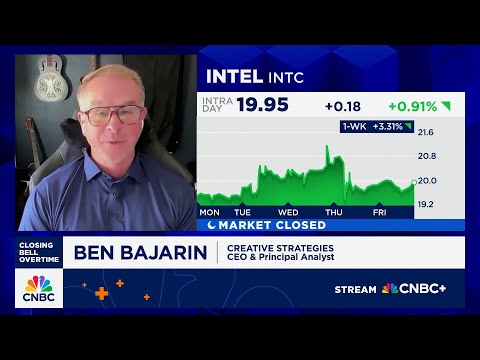
Creative Strategies' Ben Bajarin breaks down Big Tech under Trump
CNBC Television· 2025-08-08 20:51
Apple's Investment and Supply Chain - Apple 宣布将额外投资 1000 亿美元($100 billion)于美国公司和供应商 [1] - Apple 与 Corning 达成 25 亿美元($2.5 billion)的合作协议,用于生产 iPhone 和 Apple Watch 的全部保护玻璃,Corning 将在肯塔基州增加 50% 的制造和工程人员 [9] - Apple 几年前就已投资 5 亿美元($0.5 billion)与 MP Materials 建立合作关系 [10] - Apple 致力于加强其在美国的组件生态系统,并增加对现有美国供应商的投资 [6][7][9] - Apple 可能会开始投资土地或建筑物,用于数据中心和小型服务器容量,以支持其混合 AI 方法 [8] - Apple 可能会增加对台积电(TSMC)非领先芯片的采购,用于 Mac、iPhone 和 AirPods 等产品,以实现更广泛的生态系统受益 [12] Intel's Situation - 特朗普总统呼吁 Intel CEO 李彬下台,声称他与中国过去的商业关系存在利益冲突 [1] - Intel 回应称,公司、董事会和 CEO 坚定致力于推进美国的国家和经济安全利益 [2] - 本届政府与 Intel 的互动较少,尤其是在新 CEO 李彬上任后 [3] - 特朗普可能希望通过批评来促成与 Intel 的会面,以达成双赢协议,强调 Intel 在美国增加制造业投资 [4]