Inflation

Search documents
Lululemon's CEO search, Broadcom earnings, what AI could mean for the Fed and inflation
Youtube· 2025-12-12 15:50
分组1 - Stock futures show a mixed picture, with NASDAQ under pressure due to an AI-led downturn in tech stocks, while Dow futures are higher after record closes for both the Dow and S&P 500 [2][6] - All 11 S&P 500 sectors are in the green year-to-date, indicating a broadening stock rally beyond tech, which has been the primary market driver this year [3][8] - Broadcom reported better-than-expected earnings and revenue but saw its shares decline due to a sales outlook that did not meet high investor expectations, despite a backlog of $73 billion in AI product orders [4][14] 分组2 - Lululemon's CEO Calvin McDonald will depart in January, with analysts reacting positively to the news as the stock had declined over 50% this year [5][30] - Despite the CEO change, Lululemon's latest earnings results beat analyst expectations, and the company raised its full-year outlook [5][36] - The company has struggled with product innovation and competition, leading to a series of CEO changes over the years, indicating ongoing challenges in maintaining market position [30][32] 分组3 - Cannabis stocks surged following reports of President Trump's plans to ease federal restrictions on marijuana, which could significantly impact the industry by lowering taxes and increasing financing accessibility [40][41] - Fairmy shares fell over 40% after a tenant terminated a construction funding agreement, although the company remains optimistic about meeting its power delivery schedule [42][43] - RH shares rose after reporting stronger revenue growth than competitors, despite challenges in the housing market [44]



Fed's Hammack would prefer tighter policy given too high inflation
Yahoo Finance· 2025-12-12 15:27
Core Viewpoint - Federal Reserve Bank of Cleveland President Beth Hammack prefers a tighter monetary policy to address high inflation levels [1][2][4] Group 1: Monetary Policy Stance - Hammack believes the current interest rate policy is around a neutral level and advocates for a slightly more restrictive stance to exert pressure on inflation [2][4] - She indicated that if she had a vote at the recent Federal Open Market Committee meeting, she would have opposed the decision to cut the interest rate target range by 0.25 percentage points to between 3.5% and 3.75% [3][4] - Hammack expressed skepticism about rate cuts given the persistent high inflation levels and highlighted the challenges of setting monetary policy in the current environment [4][6] Group 2: Inflation Concerns - Hammack noted that price pressures are a constant concern among her business contacts and that these pressures stem from factors beyond just tariff impacts [5][6] - She stated that if inflation remains elevated for an extended period, it may necessitate a reevaluation of the current policy stance, particularly if the labor market remains strong [6] Group 3: Future Leadership and Focus - Hammack will be a voting member of the FOMC next year and believes that the next central bank leader will continue to prioritize the goal of maintaining price stability [7][8] - She expressed confidence that the new chair will focus on achieving a 2% inflation objective [8]
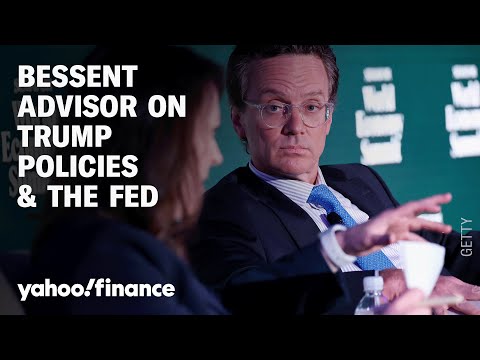
Advisor to Treasury Secretary Bessent talks growing the economy & why the Fed should cut rates
Yahoo Finance· 2025-12-12 15:00
And for more on that, I want to welcome into the program Joe Leavia, counselor to Treasury Secretary Bessett. Joe, thanks so much for joining me. Always great to see you.>> Thank you. Thank you. >> The Fed yesterday increased their outlook for the economy next year.They now see GDP growth of 2.3%. Fed Chair Powell said that he thinks that any price increases from tariffs could peak in the first quarter. where they see inflation falling to 2.5% next year, but the unemployment rate is expected to hold at 4.4% ...
Advisor to Treasury Secretary Bessent talks growing the economy & why the Fed should cut rates
Youtube· 2025-12-12 15:00
Economic Outlook - The Federal Reserve has increased its GDP growth forecast for next year to 2.3% and expects inflation to fall to 2.5% while maintaining an unemployment rate of 4.4% [2][4] - The Atlanta Fed reports a growth rate of 3% for the current quarter, following a 3.8% growth in the second quarter [2][3] - The economy is performing better when excluding federal spending, with growth estimated at 4.5% in the second quarter [3] Productivity and Tax Policies - Current productivity trends and tax policies, referred to as "Trumpomics," are expected to drive faster economic growth than the Fed's forecast [4][5] - The administration anticipates tax refunds of $1,000 to $2,000 per household next year, which could stimulate demand [6] Interest Rates and Financial Markets - The Fed has cut rates three times since September, but the current yield on the 10-year Treasury is around 4.1%, indicating a restrictive policy environment [9][10] - The Treasury is implementing policies to restore fiscal sanity and reduce budget deficits, which is expected to lead to lower interest rates and mortgage rates [12][15] Financial Stability Oversight - Proposed changes to the Financial Stability Oversight Council aim to reduce regulatory burdens on the banking system, facilitating credit flow to small businesses [16][17] - The goal is to enhance economic growth and improve wage rates by ensuring that credit is accessible to the backbone of the economy, small businesses [17][18]

‘Inflation remains too high.' Two Fed dissenters who rejected latest interest-rate cut explain why.
MarketWatch· 2025-12-12 14:50
Core Viewpoint - The Federal Reserve could have postponed its decisions regarding interest rates until more comprehensive economic reports on inflation and employment were available, according to Austan Goolsbee, President of the Chicago Federal Reserve Bank [1] Group 1 - The Chicago Federal Reserve Bank President suggests that the Fed's timing on interest rate decisions may not have been optimal [1]

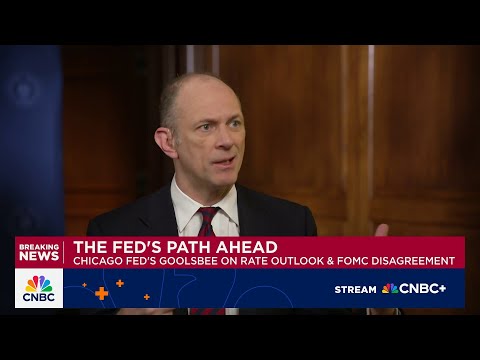
Chicago Fed's Goolsbee: Uncomfortable with front-loading rate cuts assuming inflation is transitory
Youtube· 2025-12-12 14:27
Core Viewpoint - The discussion centers around the Federal Reserve's approach to interest rates, inflation, and the labor market, highlighting a divergence in opinions among Fed officials regarding the timing and necessity of rate cuts. Group 1: Federal Reserve's Interest Rate Decisions - The Kansas City Fed president expressed dissent against a rate cut, citing concerns over high inflation and an imbalanced labor market [1][3][4] - There is a belief that while inflation may eventually decrease, it is premature to assume that current inflation trends are transitory, advocating for a cautious approach to rate cuts [4][11][12] - The Fed president anticipates that rates could be lower by the end of 2024, but emphasizes the need for more data before making significant changes [10][32] Group 2: Labor Market Analysis - Current job market data indicates stability in unemployment and layoff rates, suggesting that a rapid deterioration in the labor market is unlikely [5][9][34] - The hiring rate is low, but the layoff rate is also low, indicating a unique situation of low hiring and low layoffs, which may reflect uncertainty rather than a slowdown [6][9] - Concerns were raised about the accuracy of monthly payroll data due to factors like immigration and retirements, complicating the understanding of the labor market's health [6][7][8] Group 3: Inflation Concerns - Inflation has remained above the target for over four years, with recent data showing disturbing trends in services inflation, which is typically more persistent [11][18][31] - The Fed president is cautious about assuming that inflation will decrease solely due to external factors like tariffs, stressing the need for observable data to support such claims [12][14][32] - Market-based measures of inflation expectations appear more stable than consumer survey measures, providing some comfort regarding future inflation trends [31][32]

Chicago Fed's Goolsbee: Uncomfortable with front-loading rate cuts assuming inflation is transitory
CNBC Television· 2025-12-12 14:27
Monetary Policy & Inflation - A Kansas City Fed president dissented due to inflation being too high and a largely imbalanced labor market [2] - The speaker has been saying for months that rates will be able to be a fair bit lower than they are today for 2026, but is uncomfortable front loading too many rate cuts and assuming that what we've seen in inflation be transitory [4] - The speaker wants evidence that tariffs coming off next year will cause inflation to fall, as the theory sounds like the argument of 2021's "transitory" inflation [13] - The speaker is one of the most optimistic people for one year from now about how far rates can go down, more than the median in 2026 [15] - The speaker wants to get evidence that inflation is going to be temporary, because there were some disturbing readings on services before the lights went out [17] - The speaker says that inflation has been above the target for four and a half years, and it's rising [20] Labor Market - Most measures of the job market have been pretty stable, and the chance that things in the job market would fall apart rapidly in the within 1 to 2 months before we would revisit this again, feel relatively low [5] - The unemployment rate is ticking up from 4% at the beginning of the year to 4040 basis points [10] - If the unemployment rate is for four and a half or under and stays there stably as long as it's coupled with some of these other rates, the vacancy rate, the hiring rate, the layoff rate, if those show stability [35] Fed Operations - The decision to come back into the market and purchase $40 billion of bills is a technical adjustment, not QE, intended to allow rate control, not to influence monetary policy [27] - The balance sheet is growing, but in an ample reserves regime, it's supposed to be a share of something, a share of bank deposits, a share of GDP [29]
Understanding U.S. Inflation: Key Drivers & Impacts
Etftrends· 2025-12-12 14:26
Core Insights - U.S. inflation is influenced by demand-pull, cost-push, and structural factors, with CPI peaking at 9% in June 2022 and currently moderating to around 3% [1][5] Group 1: Demand-Pull Inflation - Demand-pull inflation arises when demand for goods and services exceeds supply, often driven by fiscal stimulus and loose monetary policy, notably the $5 trillion injected into the economy through the CARES Act and American Rescue Plan [1][5] - The U.S. Federal Reserve's actions, including cutting interest rates and purchasing bonds, significantly increased the money supply, with M2 rising nearly $5 trillion above previous business cycle trends by spring 2022 [1][5] - Excess savings peaked at $2.3 trillion, contributing to higher consumption and inflation [1] Group 2: Cost-Push Inflation - Cost-push inflation is driven by rising input costs, particularly energy prices, with crude oil prices increasing from $40 per barrel in 2020 to $120 in 2022 due to OPEC+ cuts and the Russia-Ukraine war [2] - A 10% increase in oil prices can add 0.2–0.4% to annual inflation, as energy prices affect approximately 70% of goods [2] Group 3: Housing Market Impact - Housing accounts for 35% of CPI and is a significant inflation driver, with shelter costs lagging market rents by 12–18 months [3] - Home prices surged by 44% from January 2020 to June 2022 due to post-pandemic migration and low inventory, exacerbating the housing shortage [3] Group 4: Food and Other Sectors - Food, comprising 14% of CPI, is influenced by energy and commodity prices, with wheat and corn prices spiking 30-50% in 2022 [4] - Ongoing food inflation is attributed to various dynamics, including energy costs [4] Group 5: Global Factors and Policy Responses - Global supply-chain bottlenecks contributed 1% to inflation in 2021, while the Fed's interest rate hikes from 2022 to 2023 aimed to curb demand but risked recession [5] - The fiscal drag from expiring stimulus and higher rates has helped maintain lower annual inflation rates compared to 2022 peaks [5] Group 6: Future Outlook - Sustaining a 2% inflation rate requires balanced growth, energy stability, and housing reforms [6] - Monitoring leading indicators like ISM prices paid and Zillow's rent indexes can aid in forecasting inflation trajectories [6]

Hoping for lower mortgage rates? Don't hold your breath
Yahoo Finance· 2025-12-12 14:12
Core Viewpoint - The Federal Reserve's recent interest rate cut does not directly lead to a decrease in mortgage rates, which are more closely aligned with the long-term 10-year Treasury yield rather than the federal funds rate [1]. Group 1: Federal Reserve Actions - The Federal Reserve's third consecutive rate cut in 2025 has lowered the target range for the federal funds rate to 3.5%-3.75%, primarily due to a weakening jobs market [2]. - The Fed has indicated that further rate cuts are on hold, projecting only one quarter-percentage-point cut in 2026 as it aims to control inflation and maximize employment [2]. Group 2: Mortgage Rate Trends - Following the Fed's rate cut, the national average for a 30-year fixed mortgage rate decreased to 6.3% on Wednesday, down from 6.35% on Tuesday, and further fell to 6.26% on Thursday [3]. - Despite the Fed's rate cuts, current mortgage rates have increased from 6.13% in late October [3]. Group 3: Economic Context - The Trump administration's trade war and tariffs are expected to slow economic growth and maintain elevated inflation levels, with tariffs resulting in an average tax increase of $1,100 per household in 2025 and $1,400 in 2026 [5]. - Experts caution that lowering the federal funds rate could lead to negative economic consequences, such as higher unemployment and job losses, which may deter consumers from committing to large financial decisions like mortgages [6]. Group 4: Factors Influencing Mortgage Rates - Mortgage rates are influenced by various economic factors, including the jobs market, inflation, geopolitical events, lender capacity, and borrower demand, rather than solely by the Fed's control over short-term interest rates [7].
Fed's Goolsbee explains vote against rate cut, says central bank should have waited
CNBC· 2025-12-12 13:27
Austan Goolsbee, President and CEO of the Federal Reserve Bank of Chicago, speaks to the Economic Club of New York in New York City, U.S., April 10, 2025.Chicago Federal Reserve President Austan Goolsbee on Friday explained why he voted against this week's interest rate cut, saying policymakers should have waited until they had more information before easing further."While I voted to lower rates at the September and October meetings, I believe we should have waited to get more data, especially about inflati ...