多功能化

Search documents
2025年中国消泡剂行业发展历程、产业链、产需情况、市场规模及未来趋势研判:消泡剂行业规模持续增长,环保型消泡剂将成为未来主流产品[图]
Chan Ye Xin Xi Wang· 2025-06-19 01:38
Industry Overview - The defoamer industry is experiencing rapid growth due to economic development and industrial upgrades, becoming an essential component in various sectors such as oil and gas extraction, automotive manufacturing, environmental engineering, and new synthetic materials [1][14] - The market size of China's defoamer industry is projected to grow from 4.75 billion yuan in 2018 to 5.87 billion yuan by 2024, with a compound annual growth rate (CAGR) of 3.59% [1][14] - The demand for defoamers in traditional industries like coatings, papermaking, and construction materials remains stable amid ongoing urbanization and infrastructure improvements [1][14] Defoamer Characteristics - Defoamers are substances that reduce surface tension in liquids to prevent or eliminate foam, impacting product quality and production processes [3][5] - Key properties of defoamers include strong defoaming ability, low dosage requirements, chemical stability, and safety [5][11] Industry Development History - The defoamer industry has evolved through four generations, starting with mineral oil and fatty acid-based products, followed by polyether defoamers, and currently dominated by silicone-based defoamers [6] Industry Chain - The defoamer industry chain consists of upstream raw materials (active ingredients, emulsifiers, carriers), midstream production, and downstream applications across various sectors including food, papermaking, water treatment, and more [9] Market Demand and Production - By 2024, China's defoamer production is expected to reach approximately 961,800 tons, with a demand of about 927,000 tons [13] - The increasing scale of industrial production and technological advancements are driving the demand for defoamers [13] Key Companies - Notable companies in the defoamer industry include Jiangsu Sixin Technology, Shenzhen Dayang New Materials, and Guangdong Tianfeng Defoamer, among others [2][19] - Jiangsu Sixin Technology, established in 1992, is a leading domestic defoamer manufacturer with a wide range of products across various industries [20] - Jiangsu Saiou Xinyue Defoamer Co., Ltd. focuses on high-performance defoamers and has a comprehensive application system covering multiple sectors [22] Industry Trends - The defoamer industry is moving towards green and multifunctional products, with an emphasis on biodegradable materials and integrated functionalities [25][26] - Innovations such as high-temperature resistant defoamers and smart defoaming systems are being developed to meet specific industrial needs [27][28]

全球与中国发泡微球市场现状及未来发展趋势
QYResearch· 2025-06-12 10:16
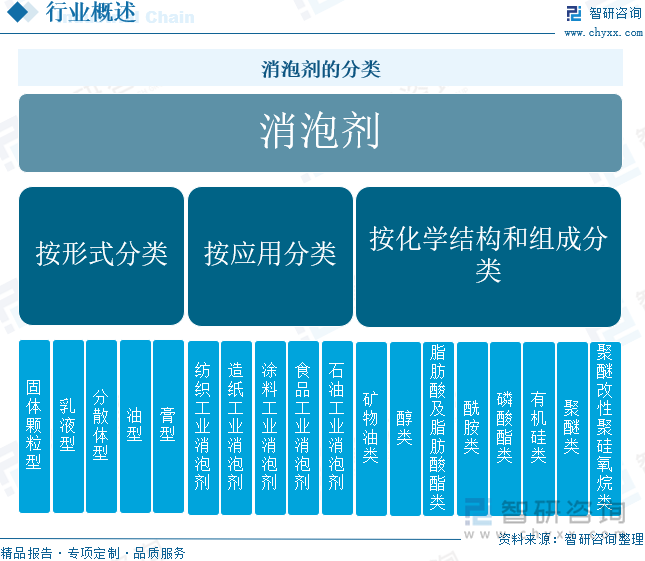
Core Viewpoint - The article discusses the rapid development and market dynamics of the expandable microsphere industry, highlighting its applications, growth trends, and regional market shares. Industry Current Status Analysis - The expandable microsphere industry has formed a complete system from raw material supply to microsphere preparation and application development, with significant disparities in development levels across different segments [3]. - Developed regions like North America and Europe dominate the market due to technological advantages, focusing on high-end applications, while the Asia-Pacific region, particularly China, is emerging as the fastest-growing market driven by demand in construction materials and consumer goods [3]. Development Trends - The market is shifting towards high-performance and multifunctional products, with a focus on directed expansion and integrated functionalities such as thermal insulation, flame retardancy, shock absorption, and flexibility [4]. - There is a movement towards green and sustainable manufacturing, promoting low VOC content, non-toxic, and recyclable microspheres for use in green building materials and eco-friendly coatings [5]. Global Market Scale Analysis - In 2024, the global expandable microsphere market is projected to reach USD 430 million, with an expected growth to USD 637 million by 2031, reflecting a compound annual growth rate (CAGR) of 5.84% from 2025 to 2031 [8]. - The market is fragmented, with major companies like Nouryon, Sekisui Chemical, and Kureha accounting for 66.23% of the global revenue in 2024 [10]. - The largest market share in 2024 is held by North America at 29.44%, followed by Europe at 26.18%, and China at 18.39% [10]. - Expandable microspheres are categorized by particle size, with those ≤ 25 μm representing the largest consumption market, accounting for 76.55% of sales revenue in 2024 [10]. - The transportation sector is the largest application market, capturing 35.90% of the sales market share in 2024 [11]. New Demand Drivers - The increasing focus on energy consumption control and green building standards globally is driving demand for expandable microspheres in insulation mortar, thermal coatings, and other building materials [11]. - The automotive industry's push for lightweight materials, especially in the context of electrification and low-carbon transitions, is leading to a surge in demand for lightweight, high-performance materials [11]. - The electronics sector is emerging as a new frontier for expandable microspheres, with applications in thermal insulation layers and electronic encapsulation materials [11].
全球与中国发泡微球市场现状及未来发展趋势
QYResearch· 2025-06-12 10:16
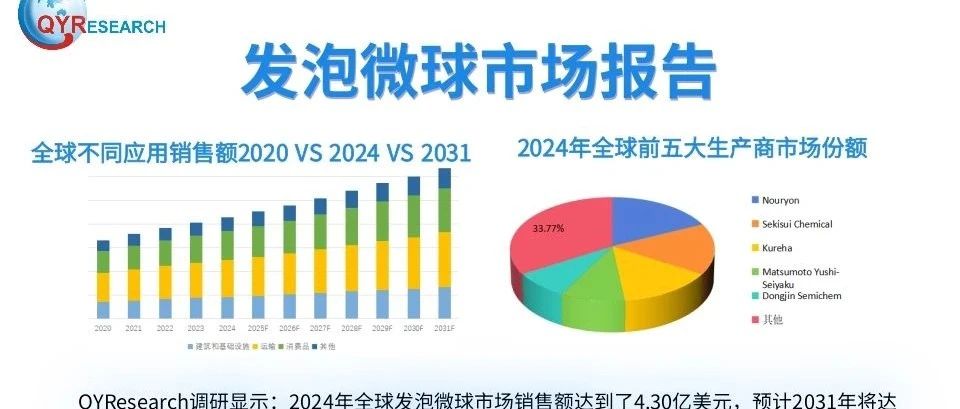
Core Viewpoint - The article discusses the rapid development and market dynamics of the foamed microsphere industry, highlighting its applications, regional market distribution, and future trends in performance and sustainability [3][4][5]. Group 1: Current Status of the Foamed Microsphere Industry - Foamed microspheres are a unique polymer functional material that has seen rapid global growth, with a complete industry chain from raw material supply to application development [3]. - Developed regions like North America and Europe dominate the market due to technological advantages, while the Asia-Pacific region, particularly China, is emerging as the fastest-growing market driven by demand in construction and consumer goods [4]. Group 2: Development Trends - The market is shifting towards high-performance and multifunctional foamed microspheres, with a focus on directed expansion and integrated functionalities such as thermal insulation, flame retardancy, and shock absorption [5]. - There is a movement towards green and sustainable manufacturing, promoting low VOC content and recyclable microspheres for use in green building materials and eco-friendly coatings [6]. Group 3: Global Market Scale Analysis - The global foamed microsphere market is fragmented, with major companies like Nouryon, Sekisui Chemical, and Kureha accounting for 66.23% of the market share by 2024 [9]. - North America holds the largest sales share at 29.44% in 2024, followed by Europe at 26.18% and China at 18.39% [10]. - The largest consumer market segment is for microspheres with a particle size of less than or equal to 25 μm, which is expected to account for 76.55% of sales revenue in 2024 [11]. Group 4: Industry Opportunities and Driving Factors - The demand for green building materials and energy-efficient construction is increasing, with foamed microspheres being widely used in insulation mortar, thermal coatings, and prefabricated building systems [13]. - The automotive industry's push for lightweight materials, especially in the context of electrification and low-carbon transitions, is driving demand for foamed microspheres in various applications [13]. - The electronics sector presents new opportunities for foamed microspheres in thermal insulation layers and electronic encapsulation materials [13].
2025年全球与中国轻商型制冷设备市场现状及未来发展趋势
QYResearch· 2025-05-13 09:05
Core Viewpoint - The light commercial refrigeration equipment industry is experiencing significant growth driven by urbanization and increasing consumer demands for food safety and freshness [2][12]. Group 1: Current Industry Status - Market demand for light commercial refrigeration equipment is continuously increasing due to urbanization and heightened consumer expectations for food safety and freshness [2]. - The market competition is intensifying with both international giants like Haier and Carrier Commercial Refrigeration and numerous small to medium enterprises competing through price, product innovation, and service differentiation [3]. - There is a trend towards product differentiation and customization to meet specific client needs, such as tailored refrigeration solutions based on actual site and storage requirements [4]. Group 2: Development Trends - The industry is moving towards energy efficiency and environmental sustainability in response to global concerns about carbon emissions and energy consumption [5]. - The application of Internet of Things (IoT) technology is enhancing operational efficiency through remote monitoring, fault diagnosis, and energy management [6]. - Modular design is becoming prevalent, making equipment easier to install, maintain, and upgrade, thereby reducing user costs [7]. - Equipment is increasingly multifunctional, combining refrigeration and display capabilities, as well as ice-making and cooling functions to meet diverse scenario requirements [8]. Group 3: Market Size Analysis - The global market for light commercial refrigeration equipment is projected to reach $21.03 billion in sales by 2024, with an expected growth to $25.72 billion by 2031, reflecting a compound annual growth rate (CAGR) of 3.12% from 2025 to 2031 [12]. - The consumption market is primarily concentrated in China, Europe, and North America, with China holding the largest market share at 30.23% in 2024, followed by Europe at 20.51% and North America at 16.51% [13]. - Commercial refrigerators are a significant product type, accounting for 63.18% of sales in 2024, with supermarkets and convenience stores representing 50.05% of application sales [14]. - Major global manufacturers include Haier, Carrier Commercial Refrigeration, Epta SpA, Panasonic, and Zhejiang Xinxing, with the top five companies holding a market share of 32.85% in 2024 [17]. Group 4: Industry Opportunities - The rise of new business formats, such as chain milk tea shops and coffee shops, is increasing the demand for small ice machines and refrigeration cabinets [18]. - The rapid development of the restaurant industry, characterized by chain and brand trends, is driving the need for standardized and efficient refrigeration equipment [19]. - The integration of IoT and artificial intelligence technologies is expected to further enhance the intelligence level of equipment, enabling remote monitoring and energy management [20]. - Emerging markets in Southeast Asia and Africa are anticipated to become significant growth drivers, necessitating increased market expansion efforts by companies [21].
研判2025!中国高分子发泡材料行业发展历程、产业链、发展现状、竞争格局和发展趋势分析:环保政策趋严,高分子发泡材料积极推动绿色转型[图]
Chan Ye Xin Xi Wang· 2025-05-11 00:08
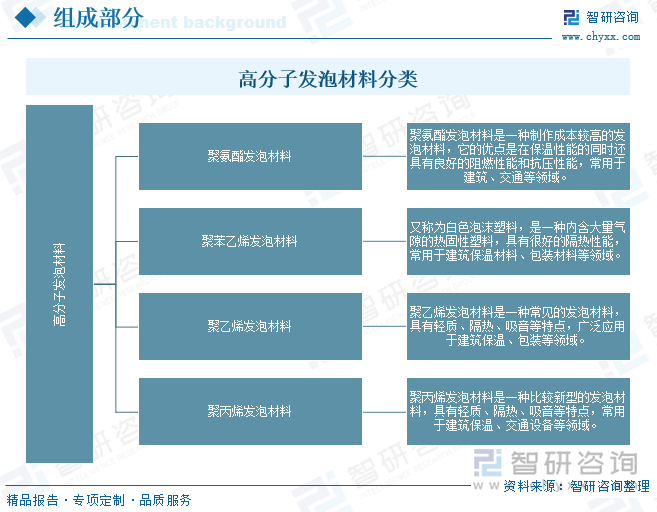
Core Viewpoint - The demand for polymer foam materials is increasing due to rising living standards and the need for comfort, safety, and environmental protection. The market size of China's polymer foam materials industry is projected to grow from 1.2 trillion yuan in 2019 to 2.3 trillion yuan in 2024, with a compound annual growth rate of 13.9% [1][14]. Industry Overview - Polymer foam materials are characterized by a porous structure, low density, and excellent thermal insulation, sound absorption, and fire resistance properties. They can be categorized into various types, including polyurethane, polystyrene, polyethylene, and polypropylene foams [3][5]. - The industry has evolved through four stages: initiation (1980-1992), development (1993-2005), rapid development (2006-2015), and transformation (2015-present) [5]. Industry Chain - The upstream of the polymer foam materials industry includes raw materials such as plastics, rubber, catalysts, and foaming agents, primarily sourced from the petrochemical industry. The midstream involves the production of polymer foam materials, while the downstream encompasses applications in construction, packaging, consumer electronics, and transportation [8]. Market Demand and Applications - Polymer foam materials are widely used in construction for insulation, soundproofing, and fire protection, in the automotive industry to reduce weight and enhance safety, and in packaging to protect products and reduce costs. The packaging market in China is expected to reach approximately 1.2 trillion yuan in 2024, reflecting a year-on-year increase of 3.99% [12][14]. Competitive Landscape - The industry is becoming increasingly competitive, with numerous companies entering the market. Key players include Changzhou Tiangsheng New Materials Group Co., Ltd., Hubei Xiangyuan New Materials Technology Co., Ltd., and others. Companies must enhance their technology, product quality, and cost efficiency to remain competitive [18][20]. Development Trends 1. **Environmental Focus**: The industry is moving towards environmentally friendly practices, including the reduction or elimination of harmful substances in production processes [24]. 2. **Multifunctionality**: Future developments will focus on enhancing the functionalities of polymer foam materials, such as adding flame retardant, anti-static, and antibacterial properties [25]. 3. **Intelligent Manufacturing**: The industry is transitioning towards smart and automated manufacturing processes, integrating information technology with production techniques to drive sustainable development [27].