
寒潮天气

Search documents
受寒潮天气影响,京珠北高速部分路段实施临时交通管制
Xin Lang Cai Jing· 2026-01-20 15:49
Group 1 - The cold wave weather has caused the minimum temperature in high-altitude areas of the Jingzhu North Expressway to drop to -2°C, leading to icy road conditions on the Yunyan section [1] - To ensure road safety, temporary traffic control measures were implemented starting January 20 at 19:00, including exit diversion and entrance closures for certain sections of the Jingzhu North Expressway [2] - Road maintenance teams have repeatedly spread de-icing agents on the affected sections to mitigate icy conditions [4] Group 2 - Drivers are advised to closely monitor weather and official road conditions, avoid controlled sections, and be cautious during nighttime when temperatures are prone to cause ice formation [5] - Recommendations for safe driving include reducing speed, maintaining distance, and using tail lights, especially on icy roads, while electric vehicle users should check battery range in advance [5] - In case of traffic congestion, drivers are urged to follow guidance and remember the protocol of "pulling over, evacuating, and calling for help" in case of accidents or breakdowns [5]


月内三创新高!全国冬季用电负荷首破14亿千瓦
Ren Min Ri Bao· 2026-01-20 11:39
Core Viewpoint - The national electricity load in China has reached a record high of 1.417 billion kilowatts during winter, driven by a significant cold wave affecting the country [1] Group 1: Electricity Load Records - The national maximum electricity load surpassed 1.4 billion kilowatts for the first time in winter, reaching 1.417 billion kilowatts [1] - This marks the third time this year that the electricity load has set a new winter record, with previous highs of 1.351 billion kilowatts on January 4 and 1.379 billion kilowatts on January 19 [1] - A rapid increase of 150 million kilowatts in electricity load was observed over three days, equivalent to Japan's maximum annual electricity load [1] Group 2: Regional Load Increases - The electricity load in the North China, Northwest, Northeast regions, and 12 provincial grids including Xinjiang and Tibet has set historical highs 75 times since the beginning of winter [1] - Daily electricity consumption has remained high, with a record of over 30 billion kilowatt-hours for the first time in winter on January 5 [1] - Daily electricity consumption exceeded 30 billion kilowatt-hours on January 5-7 and again on January 19 [1]
江苏降雪 部分航班受延续或取消
Zhong Guo Xin Wen Wang· 2026-01-20 03:00
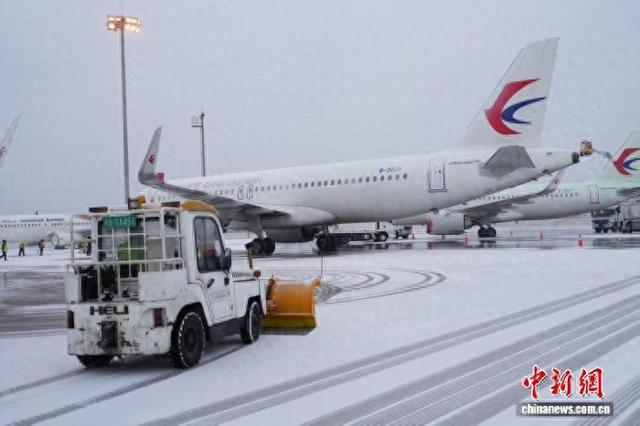
Group 1 - Heavy snowfall occurred in Jiangsu from January 19 to 20, leading to flight cancellations at Nanjing Lukou International Airport, including flights to and from cities like Zunyi, Changsha, Harbin, Chongqing, Zhuhai, and Nanning [1] - China Eastern Airlines Jiangsu Company reported minor flight delays on the morning of January 20, with staff using de-icing vehicles and manual snow removal methods to ensure safety [2][4] - A cold wave blue alert and yellow alerts for freezing and strong winds were issued by the Central Meteorological Observatory, indicating a widespread cold wave with low temperatures and snow from January 18 to 23 in Jiangsu [4]

大寒迎雪至 长江中下游多地开启“速冻”模式
Zhong Guo Xin Wen Wang· 2026-01-20 03:00
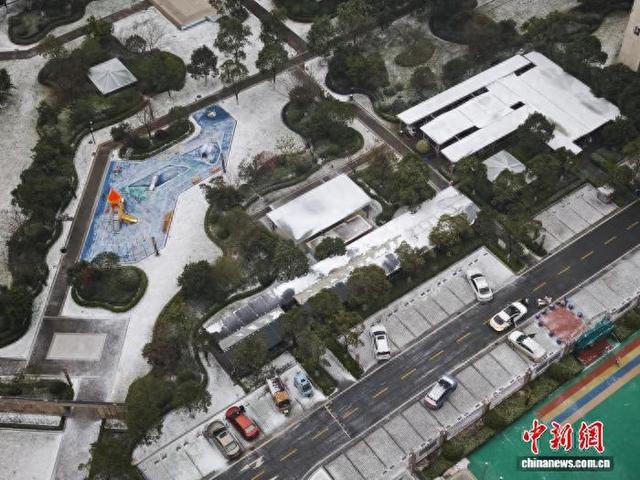
Core Viewpoint - A significant cold wave is affecting the lower reaches of the Yangtze River, leading to a sharp drop in temperatures and adverse weather conditions, including snow and strong winds, impacting various sectors such as transportation, agriculture, and tourism [2][3]. Group 1: Weather Conditions - The cold air mass has caused temperatures in Jiangxi, Hunan, and Hubei provinces to drop dramatically, with average temperature declines of 12°C to 14°C expected from January 19 to 22 [3]. - Specific regions, such as northern Jiangxi, may experience minimum temperatures dropping to between -3°C and -1°C, while areas along the river and high-altitude regions are forecasted to receive heavy snowfall [3]. Group 2: Emergency Responses - The Jiangxi Provincial Meteorological Bureau has initiated a Level 4 emergency response to address the cold wave conditions [3]. - Hunan's meteorological authority has issued a yellow warning for low-temperature rain and snow, activating a Level 3 emergency response [3]. - Hubei has issued multiple warnings, including an orange-level warning for low-temperature rain and snow, a yellow-level warning for blizzards, and a blue-level warning for cold wave winds [3].
贵阳已开启降温,今晚东北部局地有冻雨
Xin Lang Cai Jing· 2026-01-19 12:01
Group 1 - The core viewpoint of the articles highlights the impact of a strong cold air mass on Guiyang, leading to significant temperature drops and the potential for freezing rain in certain areas [1][3][4] - The temperature in the northeastern part of Kaiyang County has already dropped to between 6 to 8 degrees Celsius, with a notable decrease from a high of 16.5 degrees Celsius to 8.3 degrees Celsius within four hours [1] - The weather forecast indicates that from the night of January 19 to the day of January 20, there will be overcast skies with light rain and freezing rain in higher terrain, with temperatures in the main urban area expected to range from 2 to 13 degrees Celsius [3] Group 2 - The forecast for January 20 to January 21 predicts continued overcast skies with freezing rain and road icing, with temperatures in the main urban area expected to be between -1 to 2 degrees Celsius [4] - From January 21 to January 22, the freezing rain is expected to transition to overcast skies, with temperatures dropping further to between -2 to 3 degrees Celsius in the main urban area [4] - The weather is expected to improve slightly from January 22 to January 23, with daytime temperatures rising to between -2 to 9 degrees Celsius, although frost is still anticipated in higher terrain at night [4]

小雪、中雪、雨夹雪、冻雨!甘肃未来几天天气→
Xin Lang Cai Jing· 2026-01-18 11:14
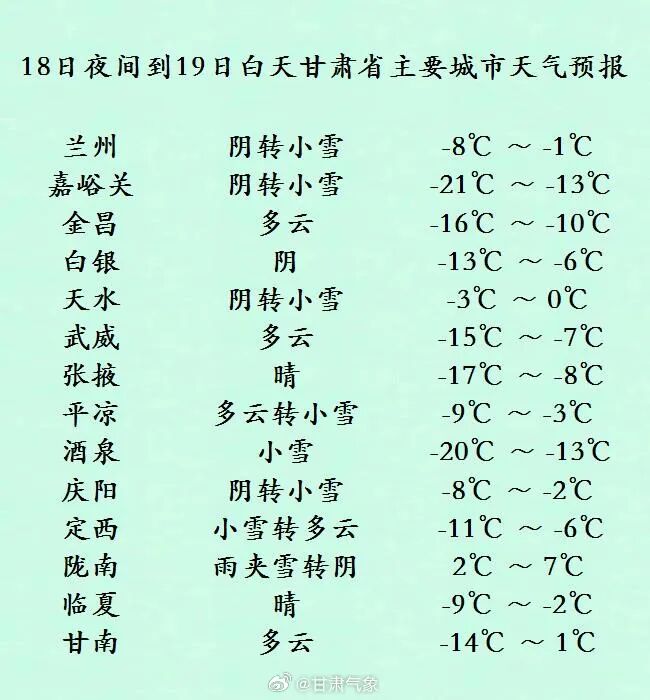
Group 1 - The weather forecast indicates small snow or sleet in cities such as Dingxi, Longnan, Tianshui, Pingliang, and Qingyang from January 18 to January 19, with some areas experiencing moderate snow and freezing rain [1] - A significant temperature drop of 6-8°C is expected in the southeastern regions of Longzhong and Longdong from January 18 to January 20, with local areas potentially seeing a drop of over 10°C, indicating a cold wave [1] - From January 20 to January 21, Longnan, Tianshui, Pingliang, and Qingyang will experience cloudy weather, while the rest of the province will be mostly sunny with some clouds [1] Group 2 - The temperature forecast for various cities includes: Lanzhou (-8°C to -1°C), Jiayuguan (-21°C to -13°C), Jinchang (-16°C to -10°C), and Tianshui (-3°C to 0°C) [2] - Other cities such as Wuwei, Zhangye, and Pingliang are expected to have varying weather conditions, with temperatures ranging from -17°C to -3°C [2] - Longnan is forecasted to have rain mixed with snow, with temperatures between 2°C and 7°C [2]
受降雪、道路结冰等影响 多省区干线部分路段封闭管控
Xin Lang Cai Jing· 2026-01-18 10:12
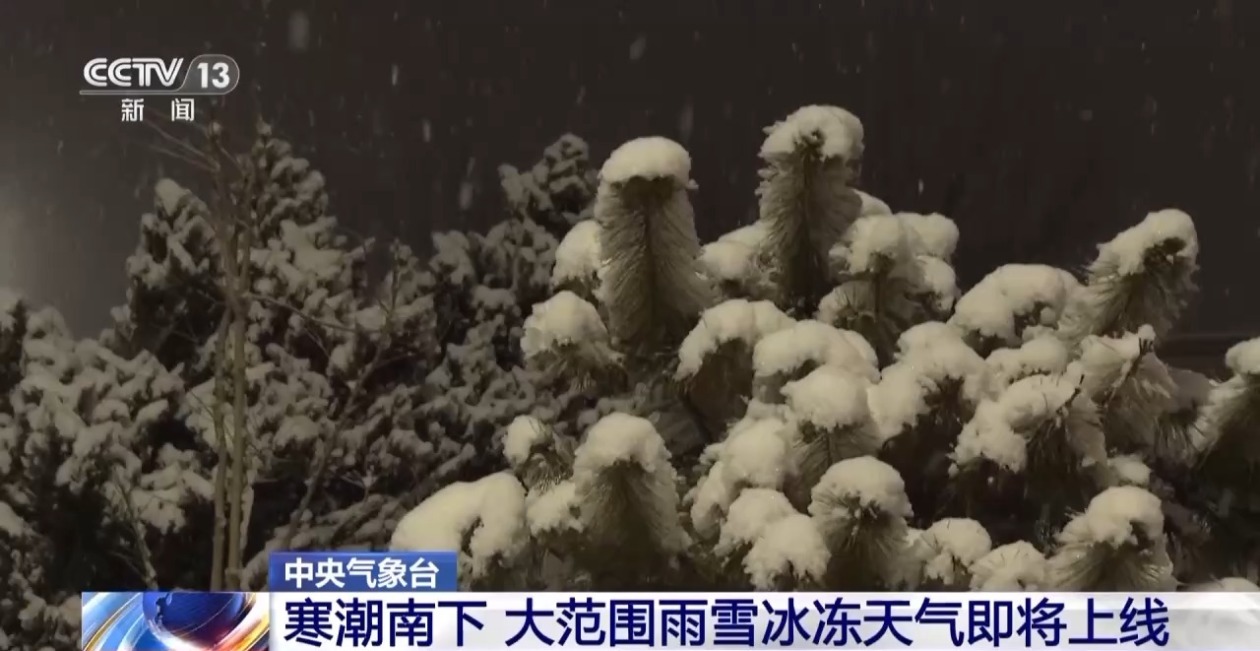
Core Viewpoint - A significant cold wave is affecting various regions in China, leading to widespread rain and snow, with the most severe weather expected in the coming days [1][3][14] Weather Impact - The cold wave has resulted in snow and sleet across regions such as Xinjiang, Inner Mongolia, Beijing, and Hebei, with some areas experiencing heavy snowfall [1][3] - The Central Meteorological Observatory predicts continued snow and sleet in multiple provinces, including significant snowfall in southern Shaanxi, southern Henan, and parts of Hubei [1][3][14] Transportation Disruptions - Due to the adverse weather conditions, several provinces have implemented road closures, with 40 road sections in Shandong, Shanxi, Inner Mongolia, and Xinjiang under control measures as of noon [5][6] - The closures affect 28 highways and one national and provincial road, with additional closures in Henan due to fog [6] Emergency Preparedness - In response to the snowfall, Beijing has mobilized over 4,000 emergency personnel and 2,600 snow removal machines, implementing specific measures for public transport and road safety [10] - Local authorities in Hunan are preparing for significant cold and snow, enhancing monitoring and preemptive measures to ensure road safety [12][14]
今年首场寒潮上线!深圳最冷时刻在......
Xin Lang Cai Jing· 2026-01-18 03:00
Core Viewpoint - A significant cold wave is expected to impact various regions in China, including Guangdong, bringing a notable drop in temperatures and adverse weather conditions [2][4]. Group 1: Cold Wave Characteristics - The current cold wave is characterized as a "penetrating" cold front, leading to prolonged low temperatures rather than a quick drop [4]. - The cold wave will result in the most extensive rain and snow impacts this winter across central and eastern regions, affecting travel due to complex precipitation types [6]. - The cold wave will bring the largest area of freezing rain this winter, particularly affecting provinces like Hubei, Hunan, and Chongqing, posing risks of power outages and hazardous road conditions [7]. Group 2: Impact on Guangdong - The cold front will reach Guangdong between January 20 and 23, resulting in significant temperature drops and strong winds [8][9]. - Average temperature drops in Guangdong will range from 7-10°C in the northern regions to 3-5°C in the southern coastal areas, with the lowest temperatures expected around January 22 [11]. - Wind gusts in northern Guangdong will reach 5-7 levels, with coastal areas experiencing gusts of 6-8 levels, further lowering the perceived temperature [11]. Group 3: Weather Forecast for Shenzhen - From January 18 to 20, Shenzhen will experience mainly dry and sunny weather with a temperature range of 17-26°C [14]. - Following the arrival of the cold air on January 21, temperatures in Shenzhen will significantly decrease, with minimum temperatures dropping to around 8°C [14]. - After January 24, temperatures are expected to rise again [14].
明起雨雪天气进入鼎盛时段 出行需做好防寒防滑
Yang Shi Xin Wen· 2026-01-18 01:12
Group 1 - A significant cold wave is impacting China, with rain and snow spreading southward, expected to peak from January 19 [1][3] - The temperature is dropping sharply across many regions, with some areas experiencing a temperature drop of 10°C to 16°C [2][4] - The cold wave is expected to last for an extended period, with many areas in the Yangtze River basin experiencing record low temperatures [2][9] Group 2 - Heavy snowfall is anticipated in regions such as Henan and Shandong, with some areas experiencing blizzards [3][6] - The weather will include a mix of rain, snow, and freezing rain, particularly in the central and southern parts of China [3][4] - Public advisories are issued for potential traffic disruptions due to snow and ice accumulation [9]
本轮寒潮为何这么冷
Bei Jing Ri Bao Ke Hu Duan· 2026-01-18 00:10
【#本轮寒潮为何这么冷#】#四九开启速冻模式#据央视新闻,昨天是"四九"的第一天,从昨天起,今年 以来降温最强、雨雪强度最强的一轮寒潮天气过程已经开始。这轮寒潮有哪些特点?将一直持续到什么 时候?中国气象局气象分析师胡啸分析,这轮寒潮天气的特点很鲜明,首先就是体感变化巨大。刚刚过 去的"三九",全国平均气温偏高,偏暖的程度是同期历史的第三暖,其中河南是历史最暖的"三 九"。"三九"异常暖,"四九"寒冬至。寒潮到来,降温空间很大。从今天(18 日)开始到21日,中东部 都会有明显降温,气温会普降6~12℃,不少地区降温幅度甚至会突破15℃,大家体感好似速冻。第二个 特点是降雪强。寒潮移动相对比较慢,在渗透南下的过程当中有水汽配合。昨天(17 日)华北地区陆 续降雪,今天(18 日)河南山东降雪增强,19日降雪范围最广也会最强。陕西南部、山西南部、河 南、湖北北部、安徽、江苏的北部等地会有大雪甚至暴雪天气。第三个特点是冻雨范围广。这是今冬首 轮大范围的冻雨天气。寒潮渗透南下,在近地面形成冷垫。大气的中层暖湿气流发展,所以整层大气特 别容易形成上冷中间暖近地面也冷的格局,有利于冻雨的形成。19日到21日,在湖北的西 ...