新能源外送

Search documents
新华全媒+ | 2260公里跨越5省份 0.007秒“疆电”点亮山城
Xin Hua She· 2025-06-10 08:26
Core Points - The "Xinjiang Power to Chongqing" project is China's first ultra-high voltage direct current transmission line connecting the northwest and southwest regions, enabling efficient electricity transfer over a distance of 2260 kilometers [1][3] - The project has a total investment of approximately 28.6 billion yuan and is expected to deliver over 36 billion kilowatt-hours of electricity annually, with more than half coming from renewable sources [1][3] - The project is part of a broader strategy to enhance energy resource allocation in China, particularly addressing the energy supply and carbon reduction pressures faced by eastern and central provinces [3][4] Investment and Economic Impact - The project is expected to significantly lower electricity costs for data centers in Chongqing, which have a growing demand for green electricity [2] - The renewable energy capacity associated with the project includes 10.2 million kilowatts from wind, solar, and thermal sources, accounting for over 70% of the total installed capacity [1][3] - The project will help reduce coal consumption by approximately 6 million tons and decrease carbon dioxide emissions by about 16 million tons annually [1] Technological Advancements - The core equipment at the converter stations has been domestically produced, enhancing the stability and efficiency of renewable energy transmission [2] - The converter stations utilize advanced technology, including second-generation synchronous condensers, which have world-leading performance in key parameters [2] - The project includes customized designs for transmission towers to withstand high wind speeds, ensuring structural integrity and reliability [3] Renewable Energy Potential - Xinjiang has significant renewable energy resources, with a technical potential of 780 million kilowatts for wind energy and 1.6 trillion kilowatt-hours for solar energy [3] - The project exemplifies the potential for Xinjiang to become a national energy resource hub, addressing the mismatch between energy production and consumption in different regions [3][4] - The time difference between Xinjiang and central/eastern regions allows for effective utilization of solar energy, supporting national energy supply during peak demand periods [4]
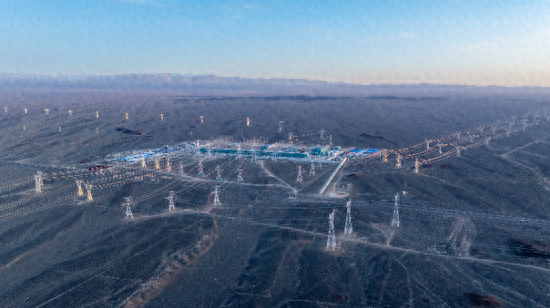
“疆电入渝”特高压巴里坤换流站启动带电调试
Zhong Guo Xin Wen Wang· 2025-04-28 09:04
Core Points - The Hami-Chongqing ±800 kV UHVDC project has successfully passed equipment acceptance at the Baliqun converter station, marking the transition from construction to operational phase with the initiation of 750 kV AC system commissioning [1][4] - The Baliqun converter station plays a crucial role in energy collection and distribution, directly impacting the efficiency of the entire DC transmission system [4][7] - The commissioning process will take place from April 26 to May 10, involving over 180 testing projects to ensure the system's reliability and safety [4][6] Group 1 - The "Xinjiang Power to Chongqing" project has a total installed capacity of 14.2 million kW, with renewable energy sources such as wind, solar, and thermal accounting for 10.2 million kW, representing 71% of the total capacity [7] - The project aims to establish Xinjiang as the largest renewable energy export base in China, facilitating the transmission of over 33 million kW of electricity through a "three direct and three alternating" transmission corridor [11] - Once completed, the project is expected to deliver 36 billion kWh of electricity annually from Northwest to Southwest China, enhancing the power supply capability of Chongqing and supporting its economic development [11] Group 2 - The Hami-Chongqing ±800 kV UHVDC project spans 2,290 kilometers, passing through five provinces and municipalities, with ongoing construction of several key substations and lines [9] - The project is part of the first batch of large-scale wind and solar power bases in China, contributing to a diversified power supply system in Chongqing [11] - The technical support for the commissioning is provided by 28 technical experts from the State Grid Xinjiang Electric Power Company, focusing on system testing and data analysis [4][6]