暗能量

Search documents
“宇宙之眼”将开启暗物质与银河系探秘之旅
Ke Ji Ri Bao· 2025-06-19 02:18
Core Insights - The Vera C. Rubin Observatory, named after the American astronomer, is set to unveil more cosmic mysteries with its operations beginning by the end of this year [1][2] - The observatory, with a budget of $810 million, will utilize the world's largest digital camera to conduct groundbreaking missions in astronomy [2][3] Group 1: Observatory Features - The observatory features an 8.4-meter diameter telescope that can create panoramic images of the southern sky every three days [3] - It is equipped with the largest "Legacy Survey of Space and Time" (LSST) digital camera, boasting a resolution of 3.2 billion pixels, designed for wide-field, rapid, and deep imaging [3][5] - The LSST camera will generate approximately 20 terabytes of data each night, which is 350 times the daily data output of the James Webb Space Telescope [3] Group 2: Scientific Missions - The observatory aims to map the universe, track dark matter, discover millions of new solar system bodies, and provide early warnings for near-Earth objects [2][6] - It will explore the mysteries of dark matter and dark energy, potentially revealing the structure of the universe and the nature of these elusive components [6][8] - The observatory will also enhance understanding of the solar system and the Milky Way by identifying near-Earth asteroids and reconstructing the galaxy's evolutionary history [7][8] Group 3: Data Accessibility and Collaboration - All observational data, including calibration images and real-time alerts, will be made freely available to the global scientific community, promoting collaboration between professional and amateur astronomers [7][8] - The observatory's advanced software processing system will utilize statistical analysis and machine learning to identify anomalies in astronomical data, generating over 8 million alerts each night [5][6]


从“一锅基本粒子粥”到星辰大海
Ren Min Ri Bao· 2025-06-12 22:10
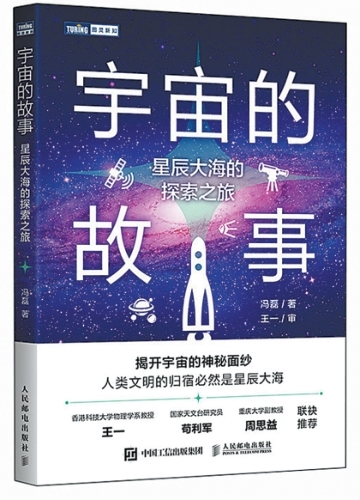
Core Viewpoint - The book "The Story of the Universe: An Exploration Journey through Stars and Seas" by Feng Lei presents the latest advancements in cosmology, emphasizing the evolution of human understanding of the universe from vague speculation to precise measurement and verification [2][3][4]. Group 1: Historical Context - In the early 20th century, physicist Kelvin claimed that physics was complete, but challenges like the Michelson-Morley experiment and the ultraviolet catastrophe of black body radiation led to revolutions in physics, namely relativity and quantum mechanics [2]. - In the early 21st century, scientists identified new challenges in physics, categorized as "two dark, one black, and three origins," which include dark matter, dark energy, black holes, and the origins of the universe, celestial bodies, and life [2]. Group 2: Cosmological Concepts - The book discusses how measurements of cosmic expansion led to the Big Bang cosmology model, predicting that the universe originated from a monumental explosion 13.8 billion years ago, evolving from a primordial state of basic particles to stars and galaxies [3][4]. - The narrative emphasizes the philosophical implications of cosmology, linking the vastness of the universe to the fundamental particles that constitute it, thus presenting cosmology as a unified field of study [3]. Group 3: Modern Cosmology - Modern cosmology has transitioned from philosophical speculation to an independent scientific discipline, with the Big Bang model providing numerous testable predictions that have been increasingly confirmed by precise experimental measurements [4][5]. - The book aims to make complex astrophysical processes and new cosmological knowledge accessible through descriptive language, avoiding mathematical formulas to engage a broader audience [5].