
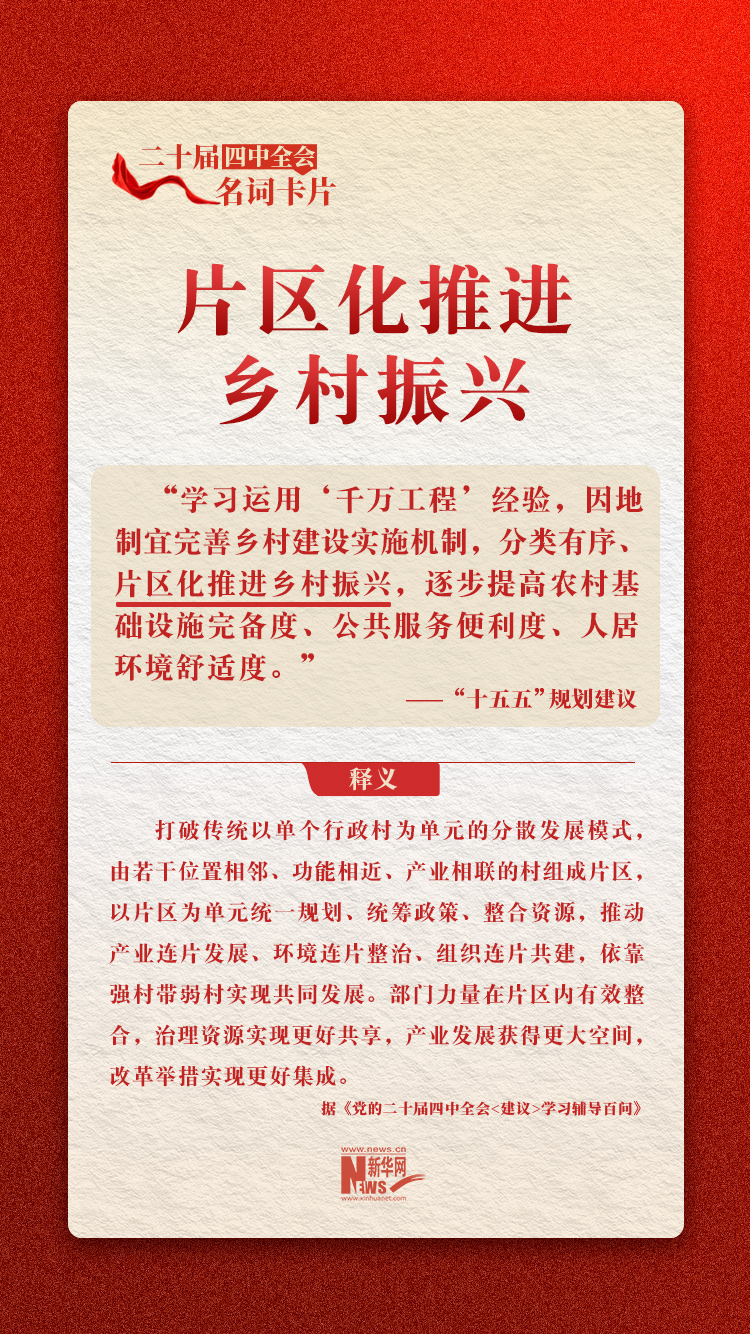
片区化推进乡村振兴

Search documents
二十届四中全会名词卡片:片区化推进乡村振兴
Xin Hua Wang· 2025-11-23 13:54
Group 1 - The core idea of the article emphasizes the need for a systematic and categorized approach to rural revitalization, moving away from the traditional model of isolated village development to a more integrated, area-based strategy [2][3][6]. - The "14th Five-Year Plan" suggests leveraging the "Ten Million Project" experience to enhance rural infrastructure, public services, and living environments through orderly and categorized advancement [2][6]. - The article outlines a classification system for villages, focusing on different development strategies based on their characteristics, such as enhancing industrial development in clustered villages and promoting urban-rural integration in suburban villages [6][7]. Group 2 - The area-based approach to rural revitalization involves grouping adjacent villages with similar functions and industries to promote coordinated planning, resource integration, and collective development [3][7]. - It is crucial to respect farmers' opinions and ensure their rights are protected while implementing area-based strategies, avoiding a one-size-fits-all approach [7]. - The article stresses the importance of practical effectiveness and the role of market mechanisms in the area-based advancement of rural revitalization, advocating for a gradual and thoughtful implementation process [7].

乡村振兴不能单村独斗
Jing Ji Ri Bao· 2025-11-11 02:30
Core Viewpoint - The article emphasizes the importance of regional collaboration in rural industrial development, advocating for a shift from isolated village growth to integrated partnerships among neighboring villages to address issues like resource dispersion and unbalanced development [1][2]. Group 1: Regional Development Strategy - The concept of "regionalization" in rural revitalization is highlighted as a new exploration, aiming to overcome the limitations of single-village development by integrating resources and promoting collective growth among neighboring villages [1][2]. - The "14th Five-Year Plan" introduces the idea of categorized and orderly regional promotion of rural revitalization, marking a significant policy shift [1]. Group 2: Industry Foundation and Collaboration - Establishing a solid industrial foundation is crucial for the success of regionalization, with the development of specialized industrial clusters serving as a natural support for this approach [2]. - Successful examples include villages forming standardized agricultural bases and enhancing surrounding services, such as hospitality and dining, to create a win-win situation [2]. Group 3: Systematic and Inclusive Approach - The article stresses the need for innovative mechanisms and systematic thinking in planning and executing regional development, ensuring that infrastructure and public services are shared and integrated [2][3]. - It is essential to respect farmers' opinions and protect their rights while determining the boundaries of regions, avoiding arbitrary metrics and ensuring that the process is grounded in practical needs [3]. Group 4: Balanced Resource Allocation - The article warns against the pitfalls of hasty implementation and emphasizes the importance of equitable resource distribution among all villages to prevent over-concentration and ensure fair development [3]. - The regionalization approach is seen as a means to break the isolation of individual villages, fostering a dynamic county-level economic system through resource sharing and complementary advantages [3].
中经评论:乡村振兴不能单村独斗
Jing Ji Ri Bao· 2025-11-11 00:10
Core Viewpoint - The concept of "regionalized promotion of rural revitalization" is gaining traction as a new exploration in many areas, as highlighted in the "Suggestions on Formulating the 15th Five-Year Plan for National Economic and Social Development" by the Central Committee of the Communist Party of China, marking its first appearance in such an important document [1] Group 1: Regionalized Promotion - Regionalized promotion addresses the issue of resource dispersion in individual villages while overcoming the challenges of implementing precise policies at the county or township level [1] - The approach encourages the integration of resources and collaborative development among neighboring villages to tackle imbalances in development and extend industrial chains [1] - The core of regionalized promotion is based on functional complementarity and industrial collaboration, aiming for regional coordinated development [1] Group 2: Industrial Foundation - Establishing a solid industrial foundation is crucial for regionalized promotion, with characteristic industrial clusters serving as natural support [2] - Some regions focus on 1-2 dominant industries, building standardized agricultural bases and coordinating facilities for processing, logistics, and tourism services [2] - Successful examples include villages that attract tourism but rely on surrounding areas for additional services, demonstrating the benefits of resource integration [2] Group 3: Systematic Innovation - Regionalized promotion emphasizes innovation in institutional mechanisms, requiring systematic thinking and coordinated planning across rural development, construction, and governance [2] - Infrastructure sharing and integrated public services are essential, with examples of collaborative efforts in education, healthcare, and elder care to avoid redundancy [2] - The "pre-operation + strong village company" model is highlighted for managing project construction and asset management effectively [2] Group 4: Practical Effectiveness - The implementation of regionalized promotion should focus on practical effectiveness rather than arbitrary segmentation, respecting farmers' opinions and protecting their rights [3] - The approach should align with natural geographical trends and economic developments, determining the scale and coverage of regions scientifically [3] - There is no fixed model for regionalized promotion; it should be adaptable to local needs, avoiding a one-size-fits-all approach [3] Group 5: County-Level Development - From the perspective of rural revitalization and county development, regionalized promotion helps break the isolation of individual villages, fostering resource sharing and complementary advantages [3] - This strategy aims to create a dynamic county economic system through collaborative development [3]